The two types people cross-shop when they have ruled out fan heaters — and they are almost perfect opposites.
By Scooter M. · Published September 13, 2026 · Last reviewed September 13, 2026
How this page is funded: we earn a commission if you buy through the links here, at no extra cost to you. Picks are chosen before links are attached, which is why every roundup names something to skip. Full disclosure.
An infrared heater warms objects and people directly and is effective within seconds, but only in its line of sight. An oil-filled radiator warms the whole room slowly and evenly and keeps radiating after it cuts off. At the same wattage they cost exactly the same to run.
The short version
Infrared quartz
Oil-filled radiator
How the heat reaches you
Radiation — direct to objects and people
Convection from a warm steel body
Time to feel it
Seconds
Twenty to thirty minutes
Heats the air?
Barely, and deliberately so
Yes — that is the mechanism
Works behind furniture / round corners
No
Yes
Noise
Most have a fan
None — no moving parts at all
Residual heat after cut-off
Essentially none
Ten to twenty minutes, tapering
Best in
Drafty, tall, leaky or briefly-occupied rooms
Sealed, small-to-average rooms you sit in for hours
Cost per hour at 1,500 W
27.5¢
27.5¢ — identical
Output at 1,500 W
5,118 BTU/h
5,118 BTU/h — identical
Both at 1,500 W. Every cost and coverage figure here is computed from wattage, not quoted from a maker.
They cost the same. This is not a tie-break.
Both categories are marketed on efficiency and neither deserves it. Every electric resistance heater converts essentially 100% of the electricity it draws into heat in your room, so at 1,500 W both of these cost 27.5 cents an hour at the U.S. average residential rate and both produce 5,118 BTU/h. There is no version of this comparison where one of them is cheaper per hour than the other.
Wattage
Per hour
1 h
4 h
8 h
750 W
13.8¢
$0.14
$0.55
$1.10
1,500 W
27.5¢
$0.28
$1.10
$2.20
Computed at 18.34¢/kWh — the U.S. residential average for June 2026 (EIA, Electric Power Monthly, Table 5.6.A, released August 26, 2026). Your rate is on your own bill; substitute it and the arithmetic still holds. Figures assume full output for the whole period.
Where a real difference in your bill can appear is in hours run, and the two types get there by opposite routes. Infrared can make you comfortable in a cold garage in five minutes, so you run it briefly. An oil-filled radiator with a good thermostat holds a bedroom steady without swinging, so it cycles off more of the time. Both are usage effects, both are conditional on the room, and neither is a property of the device. The full argument is on the cheapest space heater to run.
This is the most recent month EIA has published. Residential rates move seasonally and vary enormously by state — from roughly a dime per kilowatt-hour in parts of the South to more than 40¢ in Hawaii — so treat it as a national reference point, not as your rate.
The real difference: what happens when you move
This is the distinction that decides the purchase, and it is not usually how the comparison is framed.
Infrared heats you. Stand in front of it and you are warm almost immediately, because the radiation is landing on you rather than on the air. Walk four feet to the left, or turn your back, or put a chair between yourself and the heater, and the warmth stops — completely and instantly. The air in the room has barely changed temperature, so there is nothing to fall back on.
An oil-filled radiator heats the room. It takes half an hour to do anything you can feel, and during that half hour you will wonder whether it is working. After that, the whole room is warm, including behind the sofa and the far side of the bed, and it stays that way for a while after the element cuts out.
Noise, which is not the tie people expect
Oil-filled radiators are silent. Not quiet — silent. There is no fan, no pump and no moving part of any kind; the only sound one can make is the occasional tick of expanding metal.
Infrared is often assumed to be silent too, because radiant heat itself makes no noise. In practice most portable infrared cabinets include a fan to move the radiant heat off the quartz tubes and into the room, and that fan is audible. The Dr Infrared DR-968 is one of the very few units in this entire category that publishes a decibel figure at all — 39 dB — which is quiet for a fan-driven heater but is not nothing. If silence is an absolute requirement, oil-filled wins by default and it is not close.
Where each one is genuinely the right answer
Choose infrared for
A garage or workshop. Uninsulated, leaky, and you are trying to warm a person at a bench rather than the building. See best space heaters for a garage.
A room with high ceilings, where convected warm air rises out of the occupied zone and never comes back.
Somewhere you occupy briefly — a home gym, a hobby room, a cold entryway.
A nursery or a room with a sleeping child, where a warm surface is preferable to an exposed hot element behind a grille.
A home office you sit in all day, where the slow start is irrelevant because you are there for eight hours.
Any room where people sit in several different places, because radiant shadowing makes that scenario miserable.
Sizing applies equally to both
Neither type escapes the arithmetic. At 10 watts per square foot with average insulation and an 8-foot ceiling, 1,500 W covers 150 sq ft, whichever technology delivers it.
Room size
Watts needed
BTU/h
Plug-in heaters
100 sq ft
1,000 W
3,412
1
150 sq ft
1,500 W
5,118
1
200 sq ft
2,000 W
6,824
2 (different circuits)
300 sq ft
3,000 W
10,236
2 (different circuits)
Computed as square feet x 10 W x insulation factor x (ceiling / 8 ft), for an average heated room — 10 W/sq ft, 8 ft ceiling. Heater count assumes the 1,500 W plug-in ceiling.
The caveat is the one from the infrared section above: in the leaky, tall spaces where you would choose infrared, the table is answering “can this raise the air temperature of the whole room” and the answer is usually no. That is not an argument against buying it. It is an argument for being clear that you are buying personal warmth rather than a warm building.
One of each
The two units below are the clearest examples of each type in our registry — one that publishes an unusual amount of hard data for an infrared cabinet, and one that is the type's silence argument made physical.
Quick picks
Ranked for fit, not for hype. Coverage and current draw are computed from each unit’s published wattage. Tap a row for the full write-up, or go straight to the listing.
#
Product
Best for
Covers
Draw
Price
1
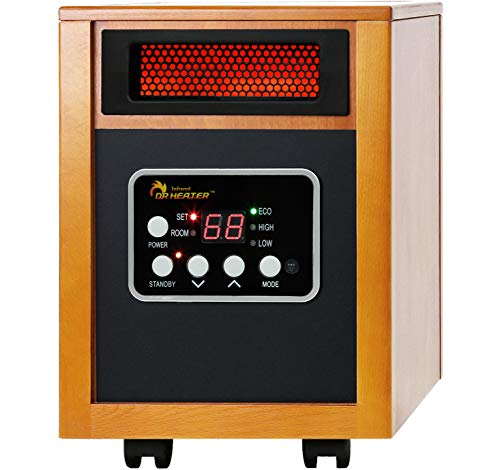
Dr Infrared DR-968The one listing in this category that publishes its amp draw and its noise level, which is exactly the arithmetic everyone else leaves you to do — 12.5 A and 39 dB, both stated.
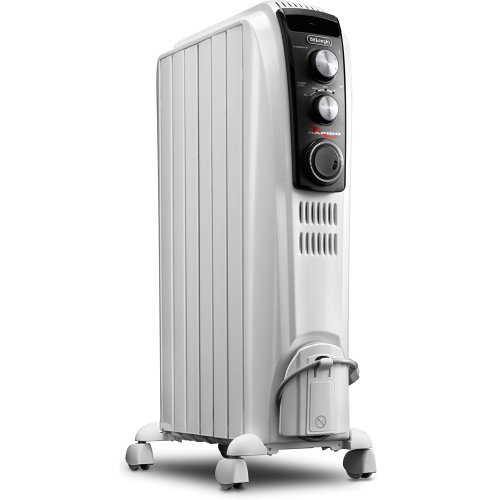
De'Longhi TRD40615TNo fan, so no noise and no moving dust — and the sealed oil keeps radiating after the element cuts out, which is why an oil-filled unit feels steadier than a ceramic one at the same wattage.
The one listing in this category that publishes its amp draw and its noise level, which is exactly the arithmetic everyone else leaves you to do — 12.5 A and 39 dB, both stated.
Rated power
1,500 W
Covers (computed)
150 sq ft
Draw (computed)
12.5 A at 120 V
Cost per hour
27.5¢
Coverage at 10 W/sq ft, average insulation, 8 ft ceiling = 5,118 BTU/h. Cost at 18.34¢/kWh; an eight-hour night at full output is $2.20. Exceeds the 12 A continuous limit of a 15 A circuit — check what else shares the breaker.
What works
Publishes 12.5 A, which is the number that decides whether it fits your circuit
Publishes 39 dB, which is the number that decides whether it fits your bedroom
A wooden-cabinet infrared unit runs cooler on the outside than a bare panel
What does not
19 lb with wheels: this is furniture, not a portable you carry between rooms
12.5 A against a 15 A circuit's 12 A continuous limit — it does not legally fit, see the circuit-load guide
Dated cabinet styling that will not disappear into a modern room
Published specification
Rated power
1,500 W at 120 V
Current draw
12.5 A (published)
Noise
39 dB (published)
Element
Infrared quartz tube plus PTC
Thermostat
Electronic, 50–85°F
Other
12-hour auto-off timer, IR remote, caster wheels, 19 lb
Heat type
Infrared quartz
Maker’s coverage claim
None published — the coverage figure above is ours
Safety listing
No listing mark published in the listing text; check the cabinet's rating plate for the UL or ETL mark.
Who it is for
A reader who wants to compute the load rather than trust a claim: the published amp draw and decibel figure make it the easiest unit on this site to check.
What it is not for
A 15 A circuit shared with anything else, and not a small room where a 19 lb cabinet on wheels is in the way.
No fan, so no noise and no moving dust — and the sealed oil keeps radiating after the element cuts out, which is why an oil-filled unit feels steadier than a ceramic one at the same wattage.
Rated power
1,500 W
Covers (computed)
150 sq ft
Draw (computed)
12.5 A at 120 V
Cost per hour
27.5¢
Coverage at 10 W/sq ft, average insulation, 8 ft ceiling = 5,118 BTU/h. Cost at 18.34¢/kWh; an eight-hour night at full output is $2.20. Exceeds the 12 A continuous limit of a 15 A circuit — check what else shares the breaker.
What works
Genuinely silent: there is no fan to hear at 3 a.m.
The oil holds heat, so the room temperature swings less between thermostat cycles
Nothing blows air, so nothing stirs up dust in a bedroom
What does not
Slow. It takes 20–30 minutes to feel like it is doing anything
Heavy — the wheels are not a courtesy, they are a requirement
The surface gets genuinely hot; this is a radiator, not a cool-touch case
Published specification
Rated power
1,500 W at 120 V
Controls
Mechanical, with a programmable 24-hour timer
Fluid
Permanently sealed diathermic oil — never needs refilling
Maker's claim
Up to 75% more radiant surface area
Mobility
Front and rear handles, snap-on wheels
Heat type
Oil-filled
Maker’s coverage claim
None published — the coverage figure above is ours
Safety listing
No listing mark published in the listing text; verify the UL or ETL mark on the rating plate.
Who it is for
A bedroom, a nursery at a safe distance, or anywhere the fan noise of a ceramic heater is the actual problem you are trying to solve.
What it is not for
Fast heat, and not a room you only occupy for twenty minutes. It also should never be tucked beside a bed or curtain — hot surface, 3-foot rule.
Neither. At the same wattage they cost exactly the same — about 27.5 cents an hour at 1,500 W and the U.S. average rate — because every electric resistance heater is essentially 100% efficient. Differences in your bill come from how many hours each one ends up running, not from the technology.
Which heats a room faster, infrared or an oil-filled radiator?+
Infrared makes you feel warm in seconds, but it barely raises the room's air temperature. An oil-filled radiator takes twenty to thirty minutes to change how a room feels, and then warms all of it. Which is 'faster' depends on whether you want a warm person or a warm room.
Which is better for a bedroom?+
Oil-filled, without much argument. It has no fan and makes no noise at all, it has no exposed glowing element, and it holds a steady temperature through the night rather than cycling hard. Most portable infrared units have an audible fan.
Is infrared better in a garage?+
Yes, clearly. A garage is uninsulated and leaky, so warming its air is close to impossible with a plug-in heater, while radiant heat warms you directly regardless of how much cold air is moving around. That said, no 1,500 W heater will warm a whole two-car garage — that arithmetic is on the garage roundup.
Do oil-filled radiators keep giving off heat after switching off?+
Yes, for roughly ten to twenty minutes, tapering the whole time. It smooths out temperature swings, which is a genuine comfort benefit. It is not free heat — every joule came out of the wall at the same rate as everything else.
Silent by design, not by adjective — the fanless types, plus the one unit that publishes a dB figure.
Written by Scooter M., an enthusiast — not a tester and not a certified anything. Every figure on this page is either published by the manufacturer, taken from a live retail listing, or computed from the published wattage using the formulas we publish. Found an error? Tell us and we will correct it, visibly and with a date on it.