Space heater vs central heat: which actually costs less
The answer is not the same for every house, and any article that gives you one number is guessing. Here is the comparison done per delivered BTU.
By Scooter M. · Published August 31, 2026 · Last reviewed August 31, 2026
How this page is funded: we earn a commission if you buy through the links here, at no extra cost to you. Picks are chosen before links are attached, which is why every roundup names something to skip. Full disclosure.
A space heater beats central heat only when you turn the main system down and heat one room instead of the whole house. Per unit of heat, natural gas is usually cheaper than electric resistance; the saving comes from heating less space, not from the appliance being efficient.
The condition that decides everything
Before any arithmetic: a space heater saves money only if it lets you heat less. If your furnace thermostat stays at 70°F and a heater runs in the study on top of it, you have added a 1,500 W load to a house that is already being held at temperature. That is strictly more expensive than not owning the heater.
The saving comes from dropping the house to 62–64°F and heating only the room you are in. Everything below assumes you actually do that, because if you do not, no comparison is needed — the heater loses.
Comparing two different fuels
You cannot compare a furnace to a heater by looking at the appliances. The only common ground is cost per delivered BTU, which needs the fuel price and the appliance's efficiency.
For electric resistance heating the arithmetic is simple, because efficiency is 100%. One kWh is 3,412 BTU. At our published rate of 18.34¢/kWh, that is $0.0537 per thousand BTU delivered.
For a gas furnace, one therm is 100,000 BTU of fuel, and a modern condensing furnace converts perhaps 90–95% of it into delivered heat while an older unit might manage 80%. So the delivered cost is the price per therm divided by (100 × efficiency). The table below shows how that lands at several gas prices — look up your own price per therm on your gas bill and use the matching row.
Gas price per therm
At 80% efficient
At 95% efficient
Electric at 18.34¢/kWh
$0.80
$0.0100 / kBTU
$0.0084 / kBTU
$0.0537 / kBTU
$1.20
$0.0150 / kBTU
$0.0126 / kBTU
$0.0537 / kBTU
$1.60
$0.0200 / kBTU
$0.0168 / kBTU
$0.0537 / kBTU
$2.00
$0.0250 / kBTU
$0.0211 / kBTU
$0.0537 / kBTU
$2.40
$0.0300 / kBTU
$0.0253 / kBTU
$0.0537 / kBTU
Delivered cost per thousand BTU = (price per therm ÷ (100 × efficiency)) for gas; (rate ÷ 3.412) for electric resistance. Electricity at 18.34¢/kWh (EIA, June 2026). Substitute your own gas price and your furnace's efficiency rating.
The pattern is consistent and worth saying plainly: per unit of heat, natural gas is typically two to five times cheaper than electric resistance. Even at $2.40 a therm on an old 80%-efficient furnace, gas heat costs about $0.030 per thousand BTU against electricity's $0.054.
The rule of thumb that falls out of the arithmetic
One room, main system turned down: the space heater wins, usually comfortably, on any fuel.
Two rooms: roughly a wash on gas, still a win against oil or electric resistance central heating.
Three or more rooms: the central system wins, because you have lost the volume advantage that was paying for the fuel penalty.
Main system not turned down: the space heater always loses. It is pure addition.
If your central heat is already electric
If the house is heated by electric baseboard or an electric furnace, the fuel penalty disappears entirely — both are electric resistance at 100%, so a kWh delivers the same heat either way. In that case zone heating with a space heater wins as soon as you are heating less space, with no crossover to worry about. The baseboard comparison goes into this.
If your central heat is a heat pump, the arithmetic reverses hard and the space heater loses badly, because a heat pump delivers several units of heat per unit of electricity. That comparison is the one to read.
Picks for the one room you are actually heating
Quick picks
Ranked for fit, not for hype. Coverage and current draw are computed from each unit’s published wattage. Tap a row for the full write-up, or go straight to the listing.
#
Product
Best for
Covers
Draw
Price
1
Dreo Solaris 718The rare heater whose published coverage claim survives the arithmetic: 1,500 W is a genuine 300 sq ft at 10 W/sq ft, and Dreo publishes that number rather than implying more.
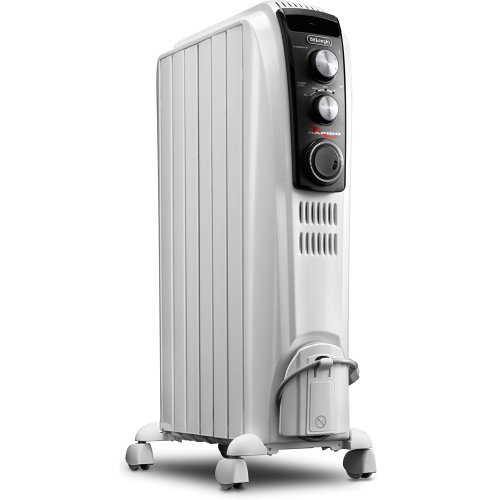
De'Longhi TRD40615TNo fan, so no noise and no moving dust — and the sealed oil keeps radiating after the element cuts out, which is why an oil-filled unit feels steadier than a ceramic one at the same wattage.
The rare heater whose published coverage claim survives the arithmetic: 1,500 W is a genuine 300 sq ft at 10 W/sq ft, and Dreo publishes that number rather than implying more.
Rated power
1,500 W
Covers (computed)
150 sq ft
Draw (computed)
12.5 A at 120 V
Cost per hour
27.5¢
Coverage at 10 W/sq ft, average insulation, 8 ft ceiling = 5,118 BTU/h. Cost at 18.34¢/kWh; an eight-hour night at full output is $2.20. Exceeds the 12 A continuous limit of a 15 A circuit — check what else shares the breaker.
What works
A digital thermostat with numbers on it — you can set 68°F rather than guess at a dial
The published 300 sq ft claim matches the standard sizing rule instead of exceeding it
8 lb and 8 inches square: it moves room to room without a project
What does not
1,500 W is 1,500 W — nothing here heats faster than any other 1,500 W heater
Dreo does not publish a noise figure in decibels on the product page
Tall and narrow, which is a tipping profile: the tip-over cutoff matters more here
A living room, bedroom or den at or under 300 sq ft with average insulation and an 8-foot ceiling, where you want to set a temperature and stop thinking about it.
What it is not for
A garage, an uninsulated basement, or anything over about 300 sq ft. It is not under-powered — 1,500 W is the plug-in ceiling — the room is simply too big for one outlet.
No fan, so no noise and no moving dust — and the sealed oil keeps radiating after the element cuts out, which is why an oil-filled unit feels steadier than a ceramic one at the same wattage.
Rated power
1,500 W
Covers (computed)
150 sq ft
Draw (computed)
12.5 A at 120 V
Cost per hour
27.5¢
Coverage at 10 W/sq ft, average insulation, 8 ft ceiling = 5,118 BTU/h. Cost at 18.34¢/kWh; an eight-hour night at full output is $2.20. Exceeds the 12 A continuous limit of a 15 A circuit — check what else shares the breaker.
What works
Genuinely silent: there is no fan to hear at 3 a.m.
The oil holds heat, so the room temperature swings less between thermostat cycles
Nothing blows air, so nothing stirs up dust in a bedroom
What does not
Slow. It takes 20–30 minutes to feel like it is doing anything
Heavy — the wheels are not a courtesy, they are a requirement
The surface gets genuinely hot; this is a radiator, not a cool-touch case
Published specification
Rated power
1,500 W at 120 V
Controls
Mechanical, with a programmable 24-hour timer
Fluid
Permanently sealed diathermic oil — never needs refilling
Maker's claim
Up to 75% more radiant surface area
Mobility
Front and rear handles, snap-on wheels
Heat type
Oil-filled
Maker’s coverage claim
None published — the coverage figure above is ours
Safety listing
No listing mark published in the listing text; verify the UL or ETL mark on the rating plate.
Who it is for
A bedroom, a nursery at a safe distance, or anywhere the fan noise of a ceramic heater is the actual problem you are trying to solve.
What it is not for
Fast heat, and not a room you only occupy for twenty minutes. It also should never be tucked beside a bed or curtain — hot surface, 3-foot rule.
Is it cheaper to use a space heater or central heat?+
Cheaper to use a space heater only if you turn the central system down and heat one room. Per unit of heat, natural gas typically costs two to five times less than electric resistance, so the saving comes entirely from heating less space.
How many space heaters before central heat is cheaper?+
Roughly two rooms is the break-even against a gas furnace, and three rooms is clearly worse. Against electric baseboard or an electric furnace, zone heating stays ahead for longer because there is no fuel penalty.
Does turning the thermostat down and using a space heater really save money?+
Yes, when you heat one room instead of the house. The mechanism is volume, not efficiency — you are paying more per BTU but buying far fewer BTUs.
Is a space heater cheaper than a gas furnace?+
Not per unit of heat. Gas is usually two to five times cheaper per delivered BTU. A space heater wins only by heating a small fraction of the space the furnace would heat.
You sit still for hours, the room has no fourth wall, and the floor is full of feet. Picked on those three.
Written by Scooter M., an enthusiast — not a tester and not a certified anything. Every figure on this page is either published by the manufacturer, taken from a live retail listing, or computed from the published wattage using the formulas we publish. Found an error? Tell us and we will correct it, visibly and with a date on it.