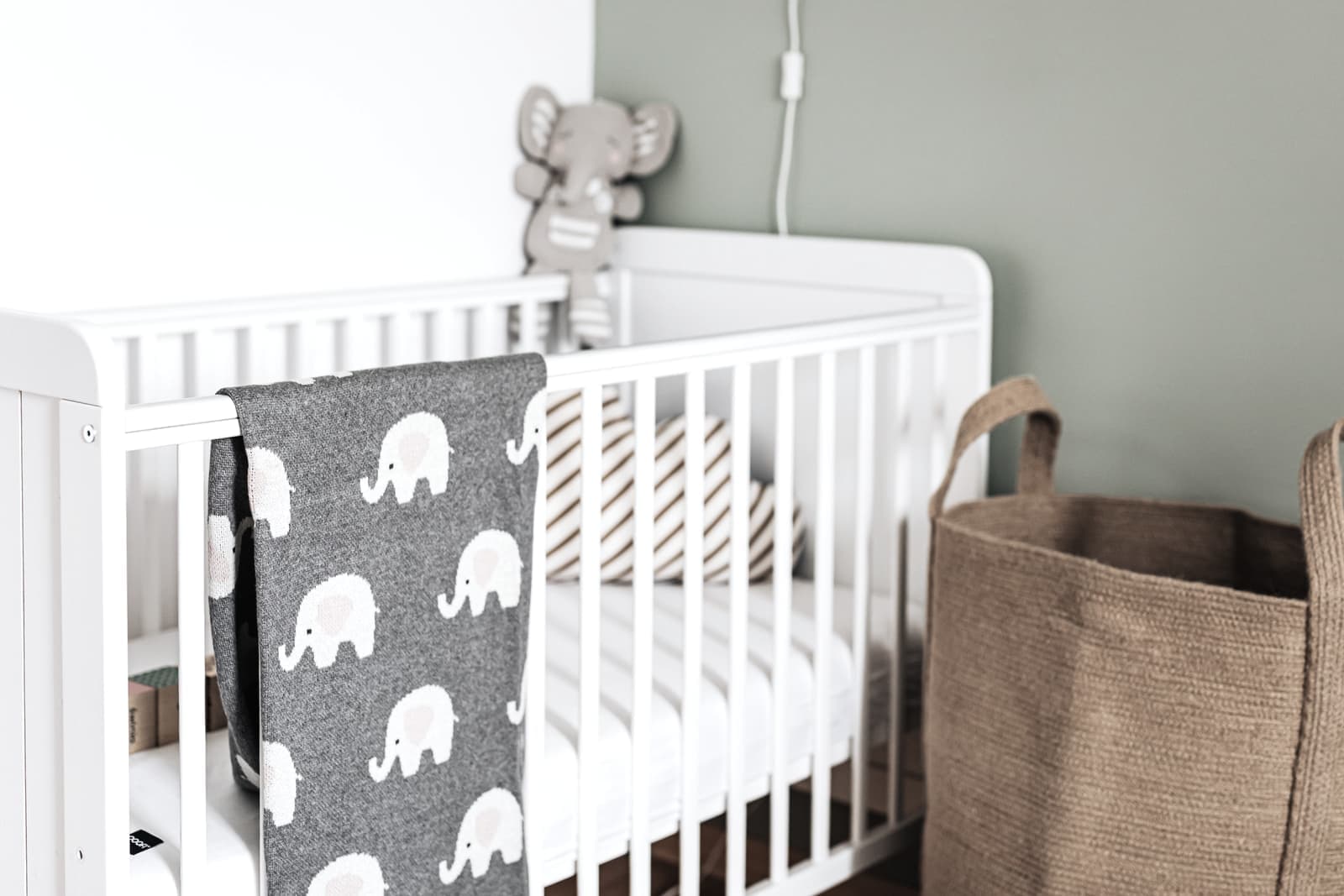
The nursery is the room with the strictest requirements and the least floor space to meet them in. A child lock is not optional here.
By Scooter M. · Published August 31, 2026 · Last reviewed August 31, 2026
How this page is funded: we earn a commission if you buy through the links here, at no extra cost to you. Picks are chosen before links are attached, which is why every roundup names something to skip. Full disclosure.
A nursery heater must publish three things: a child lock, a tip-over cutoff, and a cool-touch housing — or be wall-mounted out of reach entirely. It also needs three feet of clearance from the crib in every direction, which is the constraint most nurseries actually fail.
Start with the room, because the room is the problem
A nursery is typically 90–130 sq ft, so at 10 W per square foot it needs 900–1,300 W and any 1,500 W heater has ample output. Heat is not the hard part. The hard part is that the room contains a crib full of soft bedding, a changing table, a nursing chair and a rug, and the safety rule is three feet of clear space around the heater in every direction.
Measure that before you shop. In many nurseries there is exactly one wall segment where a floor heater can legally stand, and in some there is none — which is not a reason to place it closer, it is a reason to mount it on a wall.
The three published features, and why each
A child lock freezes the control panel. Every heater in a nursery ends up at floor height with a mobile child in the room eventually, and controls at floor height get pressed. Without a lock, the mechanism that prevents a toddler setting a heater to maximum is that nobody has thought of it yet.
A tip-over cutoff de-energizes the element the moment the unit is no longer upright. In a nursery this is not a hypothetical: a heater is exactly the size and stability of the objects toddlers pull themselves upright on.
Cool-touch housing, or wall mounting. The realistic contact scenario is a hand on the case, not a fire. A cool-touch exterior makes that a non-event. Mounting the unit above reach makes it impossible, which is better.
The picks
Quick picks
Ranked for fit, not for hype. Coverage and current draw are computed from each unit’s published wattage. Tap a row for the full write-up, or go straight to the listing.
#
Product
Best for
Covers
Draw
Price
1
LaskoNo photo
Lasko Ellipse CD12950The short answer to “which small heater has a child lock”: a tabletop unit that publishes a tip-over switch, a child lock and an auto-eco mode rather than leaving you to guess.
Heat Storm HS-1500-PHXWall-mounted, which removes the entire tip-over failure mode rather than mitigating it — and Wi-Fi scheduling means it can heat a bathroom before you get in it.
Dreo Solaris 718The rare heater whose published coverage claim survives the arithmetic: 1,500 W is a genuine 300 sq ft at 10 W/sq ft, and Dreo publishes that number rather than implying more.
Vornado VH200Circulates the room's air instead of aiming a hot jet at your shins — the difference you feel is uniformity, not output, because the output is the same 1,500 W as everything else.
The short answer to “which small heater has a child lock”: a tabletop unit that publishes a tip-over switch, a child lock and an auto-eco mode rather than leaving you to guess.
Rated power
1,500 W
Covers (computed)
150 sq ft
Draw (computed)
12.5 A at 120 V
Cost per hour
27.5¢
Coverage at 10 W/sq ft, average insulation, 8 ft ceiling = 5,118 BTU/h. Cost at 18.34¢/kWh; an eight-hour night at full output is $2.20. Exceeds the 12 A continuous limit of a 15 A circuit — check what else shares the breaker.
What works
Child lock and tip-over switch are both published, not inferred from a photo
Tabletop height gets the outlet cord off the floor, which is where cords get stepped on
AutoECO cycles rather than running flat out, which is the only real way a heater saves money
What does not
Still 1,500 W: on a desk it will heat the room, not just you, and cost accordingly
No published coverage figure
Tabletop placement means it needs 3 feet of clear space on a surface that usually has none
Published specification
Rated power
1,500 W at 120 V
Maker's coverage claim
None published
Controls
Digital display, thermostat, AutoECO mode, remote
Oscillation
Wide oscillation
Safety
Tip-over switch, child lock
Heat type
Ceramic (PTC)
Maker’s coverage claim
None published — the coverage figure above is ours
Safety listing
No listing mark is published in the Amazon listing text; verify the UL or ETL mark on the rating plate.
Who it is for
A small room — a nursery, a home office, a bedroom under about 150 sq ft — where the controls need to be lockable.
What it is not for
An open-plan living room. A tabletop unit oscillating across a desk is not going to move 1,500 W of heat around 400 sq ft.
Wall-mounted, which removes the entire tip-over failure mode rather than mitigating it — and Wi-Fi scheduling means it can heat a bathroom before you get in it.
Rated power
1,500 W
Covers (computed)
150 sq ft
Draw (computed)
12.5 A at 120 V
Cost per hour
27.5¢
Coverage at 10 W/sq ft, average insulation, 8 ft ceiling = 5,118 BTU/h. Cost at 18.34¢/kWh; an eight-hour night at full output is $2.20. Exceeds the 12 A continuous limit of a 15 A circuit — check what else shares the breaker.
What works
On a wall it cannot be tipped, and it cannot be crowded by a curtain that moved
Scheduling from the app is the practical answer to bathroom and workshop use
The published 5,200 BTU/h figure matches 1,500 W exactly — no inflated claim
What does not
It is a mounting job, not an unbox-and-plug — and it needs an outlet where you mount it
Wi-Fi adds a failure mode a knob does not have
Wall-mounted radiant heat is directional; you feel it where it points
Published specification
Rated power
1,500 W at 120 V
Published output
5,200 BTU/h
Mounting
Wall-mounted
Control
Wi-Fi app, remote scheduling
Element
Infrared quartz
Heat type
Infrared quartz
Maker’s coverage claim
None published — the coverage figure above is ours
Safety listing
No listing mark published in the listing text; check the rating plate for the UL or ETL mark.
Who it is for
A bathroom, a small bedroom, a workshop corner — anywhere floor space is gone and a heater on the ground is a hazard.
What it is not for
Renters who cannot drill, and rooms where you want the heater to move with you.
The rare heater whose published coverage claim survives the arithmetic: 1,500 W is a genuine 300 sq ft at 10 W/sq ft, and Dreo publishes that number rather than implying more.
Rated power
1,500 W
Covers (computed)
150 sq ft
Draw (computed)
12.5 A at 120 V
Cost per hour
27.5¢
Coverage at 10 W/sq ft, average insulation, 8 ft ceiling = 5,118 BTU/h. Cost at 18.34¢/kWh; an eight-hour night at full output is $2.20. Exceeds the 12 A continuous limit of a 15 A circuit — check what else shares the breaker.
What works
A digital thermostat with numbers on it — you can set 68°F rather than guess at a dial
The published 300 sq ft claim matches the standard sizing rule instead of exceeding it
8 lb and 8 inches square: it moves room to room without a project
What does not
1,500 W is 1,500 W — nothing here heats faster than any other 1,500 W heater
Dreo does not publish a noise figure in decibels on the product page
Tall and narrow, which is a tipping profile: the tip-over cutoff matters more here
A living room, bedroom or den at or under 300 sq ft with average insulation and an 8-foot ceiling, where you want to set a temperature and stop thinking about it.
What it is not for
A garage, an uninsulated basement, or anything over about 300 sq ft. It is not under-powered — 1,500 W is the plug-in ceiling — the room is simply too big for one outlet.
Circulates the room's air instead of aiming a hot jet at your shins — the difference you feel is uniformity, not output, because the output is the same 1,500 W as everything else.
Rated power
1,500 W
Covers (computed)
150 sq ft
Draw (computed)
12.5 A at 120 V
Cost per hour
27.5¢
Coverage at 10 W/sq ft, average insulation, 8 ft ceiling = 5,118 BTU/h. Cost at 18.34¢/kWh; an eight-hour night at full output is $2.20. Exceeds the 12 A continuous limit of a 15 A circuit — check what else shares the breaker.
What works
Cool-touch case: the outside does not become the hazard the inside is
A 5-year warranty on a $75 heater is an unusual amount of skin in the game
Whole-room circulation means fewer cold corners at the same wattage
What does not
A control knob, not a digital thermostat — you cannot set a number
Vornado's own page does not publish wattage, coverage or a decibel figure
It is a fan. Air movement you can hear is how the design works, not a defect
Published specification
Rated power
1,500 W at 120 V (retail listings; Vornado publishes settings, not watts)
Heat settings
3
Thermostat
Thermostatic control knob
Safety
Tip-over switch, automatic safety shut-off, cool-touch case
Warranty
5-year limited
Heat type
Fan-forced
Maker’s coverage claim
None published — the coverage figure above is ours
Safety listing
Vornado's product page publishes an “Automatic Safety Shut-off System” and a tip-over switch but does not name a listing mark; check the rating plate.
Who it is for
A bedroom or living room where the complaint is “one end is warm and the other isn't”, rather than “it never gets warm”.
What it is not for
Silent operation, and not a garage. A moving-air heater in an uninsulated space is heating the outdoors with extra steps.
Every roundup on this site names something to skip. It costs us nothing to publish and it is the fastest way to tell whether a buying guide was written for you or for its commission.
An oil-filled radiator or mica panel at floor level in a nursery
This is the recommendation that most surprises people, because oil-filled radiators are the top pick in our bedroom roundup and they are silent, which a nursery wants. The problem is the surface. An oil-filled radiator and a mica panel both work by getting genuinely hot on the outside — that is the mechanism, not a defect — and a crawling child reaching a hot metal fin is a contact burn, not a fire. In an adult bedroom that risk is managed by not touching it. In a nursery it is not manageable, unless the unit is wall-mounted well out of reach.
Any heater inside a crib's reach, whatever its safety features
A tip-over cutoff and a child lock protect against the heater being knocked over and against its settings being changed. Neither does anything about a blanket pulled through the bars onto a heater 18 inches away, and blankets are exactly what a nursery has. Three feet of clearance from the crib, in every direction, is the requirement — and if the room is too small to allow it, the answer is a wall-mounted unit or no heater, not a compromise on the distance.
Running it overnight
The USFA guidance — turn heaters off when you leave the room or go to bed — does not have a nursery exemption, and a nursery is by definition a room where nobody who can act is awake. The practical resolution is the same as in any bedroom: warm the room before bedtime and let a timer shut the heater off, rather than running it unattended until morning. A wall-mounted unit with app scheduling does this without you being in the room to set it.
How these were picked
A published child lock is the entry requirement. Not a recessed button, not “tamper resistant” — a stated lock.
A published tip-over cutoff, because a nursery floor is where a toddler pulls on things.
Cool-touch housing or wall mounting, so contact is a non-event rather than a burn.
Quiet enough for a sleeping child, which rules out anything with a loud fan.
A timer, strongly preferred, so the heater is not running unattended through the night.
And what we did not do: we have not tested these units, owned them, measured them or run them in a room. Everything above is compiled from published manufacturer specifications and live retail listings, with the electrical load, room coverage and running cost computed by us from the published wattage. The full method.
Questions people actually ask
Is it safe to use a space heater in a nursery?+
With a child lock, a tip-over cutoff, a cool-touch housing or wall mounting, and three feet of clearance from the crib in every direction, yes. Without all of those, the room is better served by a draft fix and an extra sleep layer.
What temperature should a nursery be?+
Pediatric guidance generally favors a comfortably cool room rather than a warm one, since overheating is a recognized infant risk. That is a question for your pediatrician, not for a heater site — we cover what a heater can safely do, not what temperature a child needs.
Where should a space heater go in a nursery?+
On an exterior wall if possible, at least three feet from the crib, the changing table and any curtains, plugged directly into a wall outlet. If three feet of clearance does not exist, mount the heater on the wall instead of moving it closer.
Are oil-filled radiators safe for a nursery?+
Not at floor level. They are silent and steady, which a nursery wants, but the fins get genuinely hot to the touch and a crawling child can reach them. Wall-mounted or nothing, in that room.
The only feature that actually cuts the bill, because it is the only one that turns the heater off.
Written by Scooter M., an enthusiast — not a tester and not a certified anything. Every figure on this page is either published by the manufacturer, taken from a live retail listing, or computed from the published wattage using the formulas we publish. Found an error? Tell us and we will correct it, visibly and with a date on it.