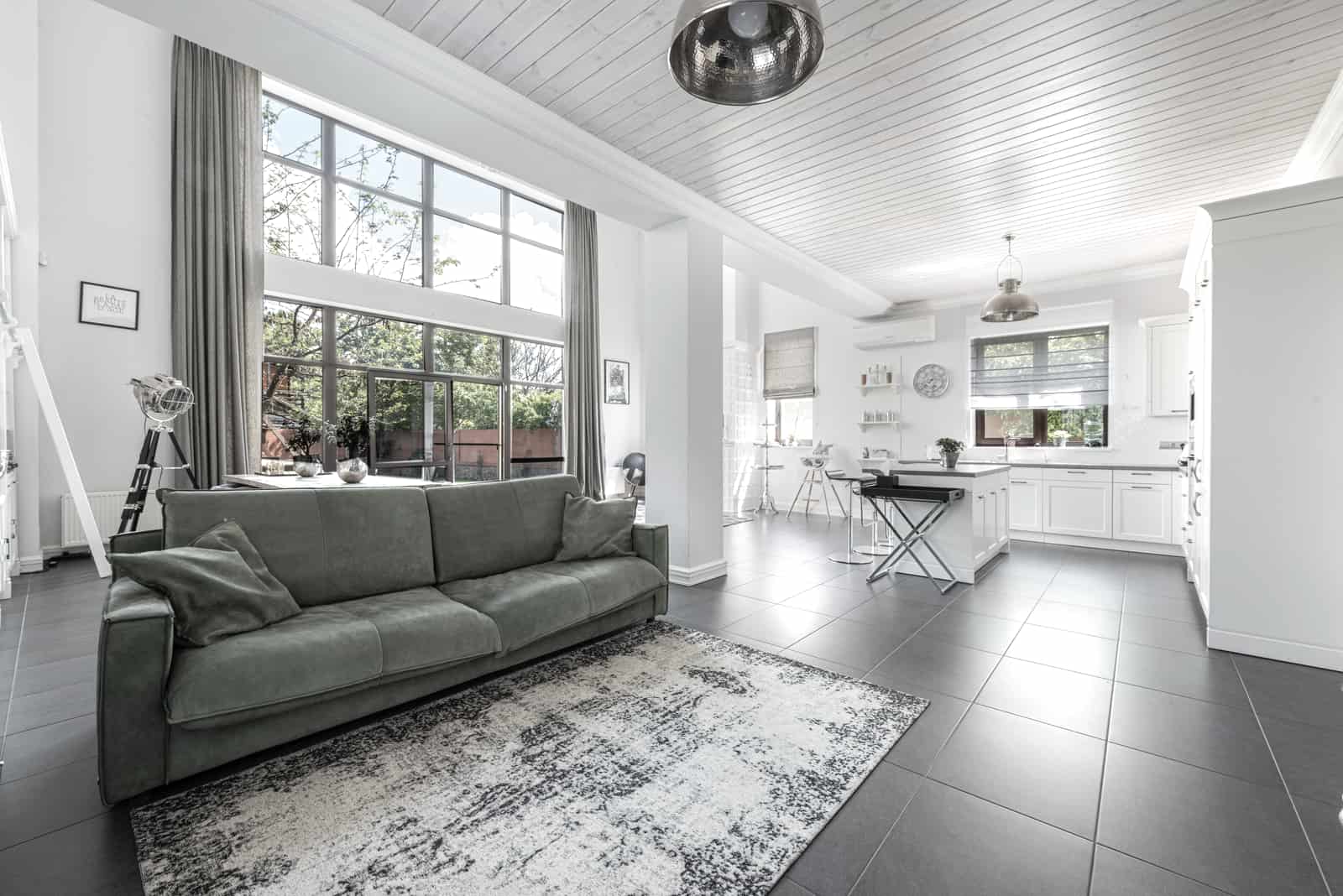
A 500 sq ft space needs about 5,000 W at average insulation and an 8-foot ceiling — more than three plug-in heaters. At this size the practical options are radiant spot heating for the area you occupy, or a hardwired 240 V unit.
500 sq ft × 10 W = 5,000 W, or 3.3 plug-in heaters, drawing 41.7 A between them. For scale, a typical residential branch circuit is rated 15 A and a whole house is commonly served by 100–200 A. Heating one 500 sq ft room with plug-in appliances would consume a quarter to a fifth of a small house's entire electrical service.
| Room size | Watts needed | BTU/h | Plug-in heaters |
|---|
| 400 sq ft | 4,000 W | 13,649 | 3 (different circuits) |
| 500 sq ft | 5,000 W | 17,061 | 4 (different circuits) |
| 600 sq ft | 6,000 W | 20,473 | 4 (different circuits) |
Computed as square feet x 10 W x insulation factor x (ceiling / 8 ft), for an average heated room — 10 W/sq ft, 8 ft ceiling. Heater count assumes the 1,500 W plug-in ceiling.
This is the size at which the honest advice stops being about which heater and starts being about which strategy — and a buying guide that does not say so is one that would rather sell you three heaters.
Heat the person, not the volume. A radiant heater aimed at a sofa or a workbench makes the occupant comfortable without raising 4,000 cubic feet of air by ten degrees. At 500 sq ft this is not a compromise, it is the correct approach: it is what the infrared type is genuinely good at.
Partition the space. A studio apartment is 500 sq ft on the floor plan and often two usable zones in practice. A door, a curtain or a bookcase turns an unheatable volume into a heatable one, and a 150 sq ft sleeping area is a job one heater does easily.
Go to 240 V, if the space justifies it. A hardwired unit heater delivers 5,000 W on a dedicated circuit and is the only electric option that meets this demand outright. It is an electrician's job. For a garage or workshop that is a reasonable investment; for a rented studio it is not available.
Use the main system and supplement. In a house, a 500 sq ft room is normally on the central system already, and a space heater's job is to add the last few degrees to one corner. That works well. Replacing the central system's contribution is what does not.
| Wattage | Per hour | 1 h | 4 h | 8 h |
|---|
| 1,500 W | 27.5¢ | $0.28 | $1.10 | $2.20 |
| 3,000 W | 55.0¢ | $0.55 | $2.20 | $4.40 |
| 5,000 W | 91.7¢ | $0.92 | $3.67 | $7.34 |
Computed at 18.34¢/kWh — the U.S. residential average for June 2026 (EIA, Electric Power Monthly, Table 5.6.A, released August 26, 2026). Your rate is on your own bill; substitute it and the arithmetic still holds. Figures assume full output for the whole period.
An eight-hour day at genuine 5,000 W demand is about $7.30 at our published rate — roughly $220 a month. That is the real price of electrically heating 500 sq ft to comfort, and it is worth knowing before the decision rather than after the bill. It is also the number that makes a heat pump comparison worth reading at this scale, since a heat pump delivering the same heat would consume a fraction of it.
Quick picks
Ranked for fit, not for hype. Coverage and current draw are computed from each unit’s published wattage. Tap a row for the full write-up, or go straight to the listing.
| # | Product | Best for | Covers | Draw | Price |
|---|
| 1 | Dr Infrared DR-968The one listing in this category that publishes its amp draw and its noise level, which is exactly the arithmetic everyone else leaves you to do — 12.5 A and 39 dB, both stated. | The published numbers | 150 sq ft | 12.5 A | $104.99 · Check on Amazon−16% |
| 2 | Dreo Solaris 718The rare heater whose published coverage claim survives the arithmetic: 1,500 W is a genuine 300 sq ft at 10 W/sq ft, and Dreo publishes that number rather than implying more. | A whole living room | 150 sq ft | 12.5 A | $129.99 · Check on Amazon |
| 3 | Fahrenheat FUH54The honest answer to garage heating: 5,000 W on a 240 V circuit is 3.3 times what any outlet can deliver, which is why plug-in heaters never work out there. | A garage that actually gets warm | 500 sq ft | 20.8 A | $617.40 · Check on Amazon |
Coverage computed at 10 W/sq ft, average insulation, 8 ft ceiling. Draw computed as watts ÷ volts. Neither figure is a manufacturer claim.
#ad · how this site is funded · price as of October 18, 2026
Top pick · The published numbers
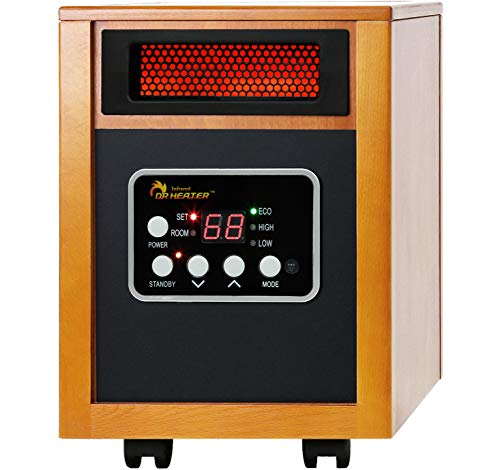
Dr Infrared Heater DR-968 Portable Space Heater
The one listing in this category that publishes its amp draw and its noise level, which is exactly the arithmetic everyone else leaves you to do — 12.5 A and 39 dB, both stated.
- Rated power
- 1,500 W
- Covers (computed)
- 150 sq ft
- Draw (computed)
- 12.5 A at 120 V
- Cost per hour
- 27.5¢
Coverage at 10 W/sq ft, average insulation, 8 ft ceiling = 5,118 BTU/h. Cost at 18.34¢/kWh; an eight-hour night at full output is $2.20. Exceeds the 12 A continuous limit of a 15 A circuit — check what else shares the breaker.
What works
- Publishes 12.5 A, which is the number that decides whether it fits your circuit
- Publishes 39 dB, which is the number that decides whether it fits your bedroom
- A wooden-cabinet infrared unit runs cooler on the outside than a bare panel
What does not
- 19 lb with wheels: this is furniture, not a portable you carry between rooms
- 12.5 A against a 15 A circuit's 12 A continuous limit — it does not legally fit, see the circuit-load guide
- Dated cabinet styling that will not disappear into a modern room
| Published specification |
|---|
| Rated power | 1,500 W at 120 V |
| Current draw | 12.5 A (published) |
| Noise | 39 dB (published) |
| Element | Infrared quartz tube plus PTC |
| Thermostat | Electronic, 50–85°F |
| Other | 12-hour auto-off timer, IR remote, caster wheels, 19 lb |
| Heat type | Infrared quartz |
| Maker’s coverage claim | None published — the coverage figure above is ours |
| Safety listing | No listing mark published in the listing text; check the cabinet's rating plate for the UL or ETL mark. |
Who it is for
A reader who wants to compute the load rather than trust a claim: the published amp draw and decibel figure make it the easiest unit on this site to check.
What it is not for
A 15 A circuit shared with anything else, and not a small room where a 19 lb cabinet on wheels is in the way.
2 · A whole living room
Dreo Solaris 718 Oscillating Tower Heater (30 in)
The rare heater whose published coverage claim survives the arithmetic: 1,500 W is a genuine 300 sq ft at 10 W/sq ft, and Dreo publishes that number rather than implying more.
- Rated power
- 1,500 W
- Covers (computed)
- 150 sq ft
- Draw (computed)
- 12.5 A at 120 V
- Cost per hour
- 27.5¢
Coverage at 10 W/sq ft, average insulation, 8 ft ceiling = 5,118 BTU/h. Cost at 18.34¢/kWh; an eight-hour night at full output is $2.20. Exceeds the 12 A continuous limit of a 15 A circuit — check what else shares the breaker.
What works
- A digital thermostat with numbers on it — you can set 68°F rather than guess at a dial
- The published 300 sq ft claim matches the standard sizing rule instead of exceeding it
- 8 lb and 8 inches square: it moves room to room without a project
What does not
- 1,500 W is 1,500 W — nothing here heats faster than any other 1,500 W heater
- Dreo does not publish a noise figure in decibels on the product page
- Tall and narrow, which is a tipping profile: the tip-over cutoff matters more here
| Published specification |
|---|
| Rated power | 1,500 W at 120 V |
| Maker's coverage claim | 300 sq ft |
| Thermostat | 41–95°F digital, 1°F increments |
| Oscillation | 30° / 60° / 90° / 120° |
| Dimensions | 7.9" D x 7.9" W x 29.7" H, 8 lb |
| Safety | Tip-over cutoff, overheat cutoff, child lock, thermal cutoff |
| Heat type | Ceramic (PTC) |
| Maker’s coverage claim | 300 sq ft |
| Safety listing | ETL listed (stated by Dreo on the product page) |
Who it is for
A living room, bedroom or den at or under 300 sq ft with average insulation and an 8-foot ceiling, where you want to set a temperature and stop thinking about it.
What it is not for
A garage, an uninsulated basement, or anything over about 300 sq ft. It is not under-powered — 1,500 W is the plug-in ceiling — the room is simply too big for one outlet.
3 · A garage that actually gets warm
Fahrenheat FUH54 Ceiling-Mounted Garage Unit Heater
The honest answer to garage heating: 5,000 W on a 240 V circuit is 3.3 times what any outlet can deliver, which is why plug-in heaters never work out there.
- Rated power
- 5,000 W
- Covers (computed)
- 500 sq ft
- Draw (computed)
- 20.8 A at 240 V
- Cost per hour
- 91.7¢
Coverage at 10 W/sq ft, average insulation, 8 ft ceiling = 17,061 BTU/h. Cost at 18.34¢/kWh; an eight-hour night at full output is $7.34. Hardwired 240 V: this is an electrician's installation, not a plug-in appliance.
What works
- Actually sized for a two-car garage, which no 1,500 W plug-in heater is
- Ceiling-mounted, so it is not in the way and cannot be knocked over
- Published coverage, wattage, amps and BTU — all four numbers are on the listing
What does not
- Needs a dedicated 240 V circuit and an electrician: this is a wiring job, not a purchase
- 20.8 A of draw needs a circuit rated for 26.1 A once the continuous-load rule is applied — a real allocation on a panel that may not have room for it
- Overkill and unusable indoors — there is no 240 V outlet in your living room
| Published specification |
|---|
| Rated power | 5,000 W at 240 V (also configurable at 2,500 W) |
| Current draw | 20.8 A at 240 V (5,000 ÷ 240) |
| Minimum circuit ampacity | 26.1 A — 125% of the draw under the NEC continuous-load rule; sets the breaker |
| Published output | 17,065 BTU/h |
| Maker's coverage claim | 500 sq ft |
| Installation | Hardwired, ceiling- or wall-mounted. Not a plug-in appliance |
| Heat type | Fan-forced |
| Maker’s coverage claim | 500 sq ft |
| Safety listing | No listing mark published in the listing text; a hardwired 240 V unit must be installed to NEC and its rating plate checked by whoever wires it. |
Who it is for
A garage, workshop or outbuilding you want genuinely warm, where you have panel capacity and are willing to pay an electrician.
What it is not for
Anyone looking for a plug-in solution. If you want to plug it in, this is not the product and no product is — read the garage roundup first.