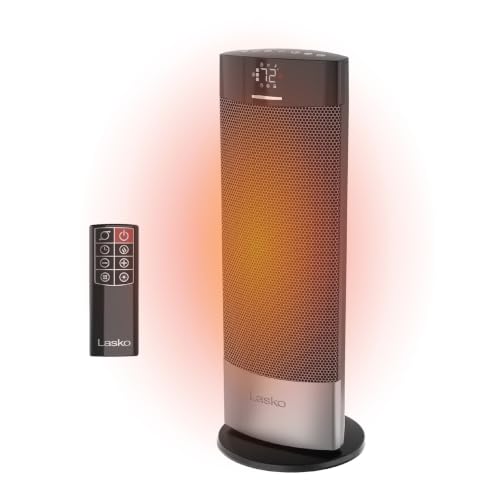
Sweeping the heat around a room is a distribution feature, not an output one. Here is when that helps, when it hurts, and which units publish the arc.
By Scooter M. · Published September 21, 2026 · Last reviewed September 21, 2026
How this page is funded: we earn a commission if you buy through the links here, at no extra cost to you. Picks are chosen before links are attached, which is why every roundup names something to skip. Full disclosure.
Oscillation spreads a heater's fixed output across a wider arc, so the room warms more evenly and slightly more slowly. It adds no heat: a 1,500 W heater delivers 5,118 BTU/h whether it sweeps or not. It helps in rooms you move around in and hurts if you sit in one place.
What sweeping does to the heat
A fixed fan heater produces a plume. Stand in it and you are warm immediately; stand four feet to the side and you are waiting for the room's air to circulate. An oscillating heater takes the same plume and walks it across an arc, so every part of that arc gets the heat for a share of each cycle instead of one part getting it continuously.
The result is a room that comes up more uniformly, with less of the hot-shins-cold-back effect that fixed heaters produce. It is genuinely pleasant. What it is not is more heat — and because any given spot is only being heated for part of each sweep, a room with an oscillating heater in it typically takes slightly longer to reach temperature than the same room with the same heater aimed at one place.
Horizontal and vertical are different features
Three of the picks below sweep side to side. One — the Dreo WH719S wall unit — sweeps vertically, through 120 degrees, and it is solving a different problem. A wall-mounted heater is mounted above head height, so its natural output path is across the ceiling. Vertical oscillation walks that plume down the room toward the floor, which is where the people are.
If you are comparing a wall heater with a floor tower, that is the distinction to hold on to: horizontal sweeping is about covering a room's width, vertical sweeping is about getting heat down from a mounting point. Neither is better; they answer different questions. The wall-mounted options in full.
What the four publish
Arc published
Axis
Tip-over
Child lock
Dreo Solaris 718
30° / 60° / 90° / 120°, selectable
Horizontal
Published
Published
Lasko Ellipse CT18950
“Wide oscillation”
Horizontal
Published
Published
Lasko 755320
“Oscillation”
Horizontal
Not published
Not published
Dreo WH719S
120°
Vertical
Not published
Not published
Published by the maker, or by the retail listing where the maker's page was unreachable.
Only the Solaris 718 publishes selectable angles in degrees, which is the difference between choosing how wide the sweep is and accepting whatever the manufacturer set. On a heater sold specifically for its sweeping, that specificity is the reason it leads this page.
None of this changes the sizing or the cost
Room size
Watts needed
BTU/h
Plug-in heaters
100 sq ft
1,000 W
3,412
1
150 sq ft
1,500 W
5,118
1
200 sq ft
2,000 W
6,824
2 (different circuits)
Computed as square feet x 10 W x insulation factor x (ceiling / 8 ft), for an average heated room — 10 W/sq ft, 8 ft ceiling. Heater count assumes the 1,500 W plug-in ceiling.
Wattage
Per hour
1 h
8 h
1,500 W
27.5¢
$0.28
$2.20
Computed at 18.34¢/kWh — the U.S. residential average for June 2026 (EIA, Electric Power Monthly, Table 5.6.A, released August 26, 2026). Your rate is on your own bill; substitute it and the arithmetic still holds. Figures assume full output for the whole period.
150 square feet and 27.5 cents an hour, the same as every other 1,500 W heater on this site. A wider arc does not buy a bigger room. If the table above says your room needs more than 1,500 W, oscillation will make the shortfall more evenly distributed and no smaller. Best space heaters for large rooms covers what to do instead.
This is the most recent month EIA has published. Residential rates move seasonally and vary enormously by state — from roughly a dime per kilowatt-hour in parts of the South to more than 40¢ in Hawaii — so treat it as a national reference point, not as your rate.
The picks
Quick picks
Ranked for fit, not for hype. Coverage and current draw are computed from each unit’s published wattage. Tap a row for the full write-up, or go straight to the listing.
#
Product
Best for
Covers
Draw
Price
1
Dreo Solaris 718The rare heater whose published coverage claim survives the arithmetic: 1,500 W is a genuine 300 sq ft at 10 W/sq ft, and Dreo publishes that number rather than implying more.
Lasko Ellipse CT18950The short Ellipse tower is the one that publishes the two things the taller Laskos do not: a tip-over switch and a child lock, on top of a digital display and wide oscillation.
The only tower here with both cutoffs and a child lock
Lasko 755320A 23-inch digital tower with a thermostat, an 8-hour timer and a remote — and the only heater here whose published coverage figure lands exactly where our own sizing rule puts it.
The maker's coverage claim that matches the arithmetic
Dreo WH719SThe one heater here whose maker publishes genuine app scheduling rather than voice control alone — which matters, because a schedule is the only smart feature that lowers a bill.
The rare heater whose published coverage claim survives the arithmetic: 1,500 W is a genuine 300 sq ft at 10 W/sq ft, and Dreo publishes that number rather than implying more.
Rated power
1,500 W
Covers (computed)
150 sq ft
Draw (computed)
12.5 A at 120 V
Cost per hour
27.5¢
Coverage at 10 W/sq ft, average insulation, 8 ft ceiling = 5,118 BTU/h. Cost at 18.34¢/kWh; an eight-hour night at full output is $2.20. Exceeds the 12 A continuous limit of a 15 A circuit — check what else shares the breaker.
What works
A digital thermostat with numbers on it — you can set 68°F rather than guess at a dial
The published 300 sq ft claim matches the standard sizing rule instead of exceeding it
8 lb and 8 inches square: it moves room to room without a project
What does not
1,500 W is 1,500 W — nothing here heats faster than any other 1,500 W heater
Dreo does not publish a noise figure in decibels on the product page
Tall and narrow, which is a tipping profile: the tip-over cutoff matters more here
A living room, bedroom or den at or under 300 sq ft with average insulation and an 8-foot ceiling, where you want to set a temperature and stop thinking about it.
What it is not for
A garage, an uninsulated basement, or anything over about 300 sq ft. It is not under-powered — 1,500 W is the plug-in ceiling — the room is simply too big for one outlet.
The short Ellipse tower is the one that publishes the two things the taller Laskos do not: a tip-over switch and a child lock, on top of a digital display and wide oscillation.
Rated power
1,500 W
Covers (computed)
150 sq ft
Draw (computed)
12.5 A at 120 V
Cost per hour
27.5¢
Coverage at 10 W/sq ft, average insulation, 8 ft ceiling = 5,118 BTU/h. Cost at 18.34¢/kWh; an eight-hour night at full output is $2.20. Exceeds the 12 A continuous limit of a 15 A circuit — check what else shares the breaker.
What works
A published tip-over switch AND a published child lock — no other tower in this registry publishes both, and they are exactly what a tall heater in a family room needs
An 18-inch tower has a lower center of gravity than the 23- and 30-inch units it competes with
Digital display, thermostat, remote and a timer at a price close to the simpler towers
What does not
Lasko's own product page for this model was unreachable when we checked, so every figure here is from the retail listing rather than the manufacturer
The wattage of the three heat modes is not published, so only the 1,500 W maximum can be costed
No coverage claim and no listing mark named — at 1,500 W our own figure is 150 sq ft either way
Published specification
Rated power
1,500 W at 120 V
Heat modes
Three, plus two fan settings; the per-mode wattage is not published
Controls
Digital display, thermostat, remote, timer
Oscillation
Wide oscillation
Height
18"
Safety
Tip-over switch and child lock, both published in the listing
Heat type
Ceramic (PTC)
Maker’s coverage claim
None published — the coverage figure above is ours
Safety listing
The listing publishes a tip-over switch and a child lock but names no UL or ETL mark. Lasko's own product page for this model could not be reached, so check the rating plate on the unit.
Who it is for
A living room, family room or home office where children or animals move past the heater and a tip-over switch plus a child lock are worth more than an extra five inches of tower.
What it is not for
Anyone who needs to compute the cost of a low setting, or who wants the manufacturer's own specification sheet before buying — for this model it was not reachable.
3 · The maker's coverage claim that matches the arithmetic
Lasko 755320 Oscillating Digital Ceramic Tower Heater (23 in)
A 23-inch digital tower with a thermostat, an 8-hour timer and a remote — and the only heater here whose published coverage figure lands exactly where our own sizing rule puts it.
Rated power
1,500 W / 900 W low
Covers (computed)
150 sq ft
Draw (computed)
12.5 A at 120 V
Cost per hour
27.5¢
Coverage at 10 W/sq ft, average insulation, 8 ft ceiling = 5,118 BTU/h. Cost at 18.34¢/kWh; an eight-hour night at full output is $2.20. Exceeds the 12 A continuous limit of a 15 A circuit — check what else shares the breaker.
What works
Lasko publishes 150 sq ft, and 1,500 W at 10 W per square foot is 150 sq ft — the claim and the arithmetic agree exactly, which almost never happens
A published 900 W low setting, so the economical mode has a computable cost
Digital thermostat, 8-hour timer and a remote at a price where a two-position knob is the norm
What does not
No child lock published, which rules it out of a nursery on this site's criteria
Tall, narrow and 7 lb — that is a tipping profile, and there is no published tip-over cutoff in Lasko's specification
Oscillation and a fan mean it is audible; the silent types are elsewhere in this roundup
Published specification
Rated power
900 W to 1,500 W (Lasko's published range)
Heat settings
Two
Thermostat
Adjustable, with a digital display
Oscillation
Yes
Timer
8 hours
Remote
Included, with onboard storage
Size
23" H x 7.25" D x 7.00" W, 7.29 lb
Safety
Cool-touch housing, automatic overheat protection
Warranty
3 years
Heat type
Ceramic (PTC)
Maker’s coverage claim
150 sq ft
Safety listing
ETL listed, stated on Lasko's own product page.
Who it is for
A home office, family room or bedroom at or under 150 sq ft where you want a real thermostat and a timer without paying for a metal cabinet.
What it is not for
A nursery, or a room where a curious pet or toddler can reach it. No child lock and no published tip-over switch is the wrong combination at floor height.
4 · Scheduling from the app, not just shouting at it
Dreo WH719S Smart Wall-Mounted Heater
The one heater here whose maker publishes genuine app scheduling rather than voice control alone — which matters, because a schedule is the only smart feature that lowers a bill.
Rated power
1,500 W
Covers (computed)
150 sq ft
Draw (computed)
12.5 A at 120 V
Cost per hour
27.5¢
Coverage at 10 W/sq ft, average insulation, 8 ft ceiling = 5,118 BTU/h. Cost at 18.34¢/kWh; an eight-hour night at full output is $2.20. Exceeds the 12 A continuous limit of a 15 A circuit — check what else shares the breaker.
What works
Dreo publishes scheduling, not just voice. “Schedule room heating hours to match your routine” is on Dreo's own page, and a schedule is the only smart feature that reduces running hours
41–95°F in 1°F increments is a specification rather than an adjective, and it is Dreo's own figure
Wall mounting removes tipping, floor clearance and cord routing in one decision
What does not
Dreo does not publish the wattage of the three heat settings, so the cost of anything below full output cannot be computed — only the 1,500 W maximum
No listing mark on Dreo's page for this model, which is odd given that Dreo does publish ETL for its Solaris 718
It goes on a wall. That is a decision and a drill, not an appliance you move between rooms
Published specification
Rated power
1,500 W at 120 V (retail listing; Dreo publishes “1500W Max”, not per-setting wattages)
Thermostat
41–95°F, 1°F increments (Dreo's published figure)
Smart control
Wi-Fi, Dreo app with heating schedules, Alexa and Google Home
Oscillation
120° vertical
Timer
24 hours
Mounting
Wall-mounted — not a portable unit
Heat type
Ceramic (PTC)
Maker’s coverage claim
None published — the coverage figure above is ours
Safety listing
Dreo's product page for this model does not publish a UL or ETL mark — unlike its Solaris 718 page, which does. Check the rating plate.
Who it is for
A bedroom or home office where you want heat on a schedule — warm before you wake, off after you leave — without being in the room to arrange it.
What it is not for
A renter who cannot drill, or anyone who wants to move the heater around. For that, the portable picks on the other roundups are the right shape.
A published arc beats the word “oscillating”. One of these four publishes four selectable angles in degrees; the others publish the feature and nothing else. Specificity ranks.
Judged on whether oscillation suits the room the unit is sold for — it helps in a room you move around and hurts in a room where you sit in one place.
Cutoffs still outrank convenience. A sweeping heater is a moving heater; a published tip-over switch and child lock rank above the width of the arc.
Vertical oscillation counted as a different feature, not a lesser one, because it solves a different problem — see the section on it below.
No output claims accepted for oscillation. Sweeping redistributes a fixed 1,500 W. It cannot add heat and we have not credited it with any.
And what we did not do: we have not tested these units, owned them, measured them or run them in a room. Everything above is compiled from published manufacturer specifications and live retail listings, with the electrical load, room coverage and running cost computed by us from the published wattage. The full method.
What we’d skip, and why
Every roundup on this site names something to skip. It costs us nothing to publish and it is the fastest way to tell whether a buying guide was written for you or for its commission.
Oscillation, if you sit in one place
This is the honest caveat the feature is never sold with. If you are at a desk, in an armchair or in bed — one position, for hours — oscillation spends most of its cycle pointing the heat somewhere you are not. A fixed heater aimed at you delivers more warmth to you per watt, because none of it is being swept past an empty corner. Oscillation is for rooms you move around in. For a desk specifically, the answer is a different product class entirely: under-desk panels at 170 W.
Any heater claiming oscillation makes it heat a larger room
It does the opposite, slightly. A 1,500 W heater puts 5,118 BTU/h into the room whether it sweeps or not. Spreading that output over a wider arc means any given part of the room receives it for a fraction of each cycle, so the room reaches temperature more slowly and more evenly than it would with a fixed heater. Evenness is the benefit. Coverage is not — that is still 150 sq ft at 10 W per square foot.
Questions people actually ask
Does an oscillating heater heat a room faster?+
Slightly slower, in fact. Oscillation spreads a fixed output across a wider arc, so any given part of the room receives heat for a fraction of each cycle. The room ends up more evenly warmed, which is the real benefit, but it does not get there quicker and it does not get warmer.
Is oscillation worth it on a space heater?+
In a room you move around, yes — it removes the hot-spot-and-cold-corner effect a fixed heater produces. If you sit in one place for hours, it is worth less than nothing: the heater spends most of each cycle pointing away from you.
What is vertical oscillation on a heater?+
A sweep up and down rather than side to side. It is used on wall-mounted heaters, which are fixed above head height and would otherwise send their output across the ceiling. Vertical sweeping walks the warm air down into the occupied part of the room.
Does oscillating use more electricity?+
No meaningful amount. The oscillation motor is a tiny fraction of the heater's draw next to a 1,500 W element — the running cost is set by the element and stays about 27.5 cents an hour either way.
Should I leave oscillation on all the time?+
Only if you are moving around the room. Leave it off when you are stationary and want the heat aimed at you, and on when you want the whole room even. It is a setting to use deliberately rather than a mode to leave running.
A desk does not need a room heater. 170 W of radiant panel against 1,500 W — the arithmetic and the picks.
Written by Scooter M., an enthusiast — not a tester and not a certified anything. Every figure on this page is either published by the manufacturer, taken from a live retail listing, or computed from the published wattage using the formulas we publish. Found an error? Tell us and we will correct it, visibly and with a date on it.