The least-known type on this site, and arguably the most sensible compromise: silent like a radiator, fast like a ceramic, thin enough to hang on a wall.
By Scooter M. · Published August 31, 2026 · Last reviewed August 31, 2026
How this page is funded: we earn a commission if you buy through the links here, at no extra cost to you. Picks are chosen before links are attached, which is why every roundup names something to skip. Full disclosure.
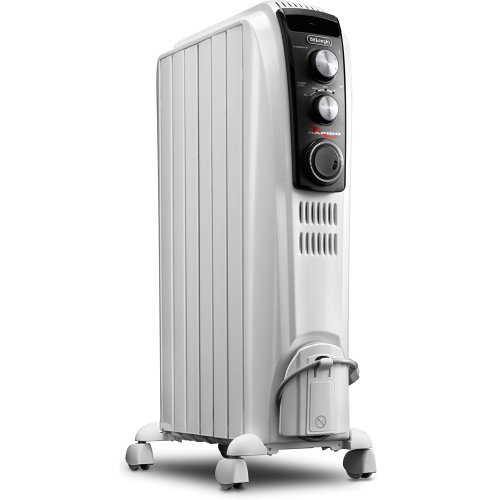
A micathermic heater has a heating element sheathed in sheets of mica, a mineral that radiates heat efficiently. It produces roughly half radiant and half convected heat with no fan, in a panel a few inches thick that can stand on the floor or hang on a wall.
What mica is doing there
Mica is a naturally layered silicate mineral that is an excellent electrical insulator, tolerates high temperatures, and radiates heat well. Wrapping a resistive element in mica sheets gives you a large, thin, electrically safe radiating surface — which is exactly what a radiant panel wants and what a coil of wire is not.
The result sits between the two types either side of it. Like an oil-filled radiator it has no fan, so it is silent and moves no dust. Unlike an oil-filled radiator it has almost no thermal mass to warm up first, so it reaches working temperature in a couple of minutes rather than twenty. And because it radiates as well as convects, you feel it directly before the room's air has caught up.
The three-way comparison
Micathermic
Oil-filled radiator
Ceramic fan
Fan
No
No
Yes
Noise
Silent
Silent (some ticking)
45–55 dB
Warm-up
2–5 minutes
20–30 minutes
1–2 minutes
Heat mechanism
~50% radiant, ~50% convection
Mostly convection
Convection
Depth
About 3–4 inches
About 10 inches
Varies
Wall-mountable
Usually
No
Rarely
Surface temperature
Hot
Hot
Often cool-touch
Heat after switch-off
Very little
Substantial
None
Cost per hour at 1,500 W
27.5¢
27.5¢
27.5¢
Cost computed at 18.34¢/kWh (EIA, June 2026).
What it is genuinely good for
Small rooms where floor space is the constraint. Three or four inches deep against a wall, or mounted on it, is a fundamentally different footprint from a ten-inch radiator on castors.
Silence with a short warm-up. The one combination neither of the other types offers.
Dust sensitivity. No fan means nothing airborne — the same benefit as an oil-filled unit, without the twenty-minute wait.
Hallways, landings and studies — spaces you pass through or occupy briefly, where a radiator would still be warming up when you left.
What it is not good for
Anywhere a child or pet can touch it. The panel surface gets genuinely hot — that is the mechanism. Micathermic units are not cool-touch and are not sold as such. In a nursery they belong on a wall, out of reach, or not at all.
Rooms where you want heat to persist. With very little thermal mass, output stops when the element does. An oil-filled radiator keeps a bedroom drifting gently for half an hour after cutting out; a mica panel does not.
Large or drafty spaces. Same as every other 1,500 W plug-in heater: the sizing rule applies and there is no way around it.
Having no fan does buy one thing beyond silence: a mica panel does not circulate settled dust the way a ceramic heater does. It does not change the room's humidity either — nothing does — and do space heaters dry out the air? separates those two complaints, because they get reported as the same one.
Micathermic and adjacent picks
Quick picks
Ranked for fit, not for hype. Coverage and current draw are computed from each unit’s published wattage. Tap a row for the full write-up, or go straight to the listing.
#
Product
Best for
Covers
Draw
Price
1
De'Longhi HMP1500A micathermic panel is a radiator that gave up its bulk: it radiates like oil-filled and warms up like ceramic, and it is about three inches deep so it can live against a wall.
De'Longhi TRD40615TNo fan, so no noise and no moving dust — and the sealed oil keeps radiating after the element cuts out, which is why an oil-filled unit feels steadier than a ceramic one at the same wattage.
Dreo Solaris 718The rare heater whose published coverage claim survives the arithmetic: 1,500 W is a genuine 300 sq ft at 10 W/sq ft, and Dreo publishes that number rather than implying more.
A micathermic panel is a radiator that gave up its bulk: it radiates like oil-filled and warms up like ceramic, and it is about three inches deep so it can live against a wall.
Rated power
1,500 W / 750 W low
Covers (computed)
150 sq ft
Draw (computed)
12.5 A at 120 V
Cost per hour
27.5¢
Coverage at 10 W/sq ft, average insulation, 8 ft ceiling = 5,118 BTU/h. Cost at 18.34¢/kWh; an eight-hour night at full output is $2.20. Exceeds the 12 A continuous limit of a 15 A circuit — check what else shares the breaker.
What works
No fan, so no noise and nothing blown around a room
Warms up far faster than an oil-filled radiator of the same wattage
Wall-mountable, which gets it out of the floor space it would otherwise eat
What does not
The panel surface is hot to the touch — this is not a cool-touch design
No published coverage figure
Radiant heat is directional: stand behind it and you will not feel much
No fan, so no noise and no moving dust — and the sealed oil keeps radiating after the element cuts out, which is why an oil-filled unit feels steadier than a ceramic one at the same wattage.
Rated power
1,500 W
Covers (computed)
150 sq ft
Draw (computed)
12.5 A at 120 V
Cost per hour
27.5¢
Coverage at 10 W/sq ft, average insulation, 8 ft ceiling = 5,118 BTU/h. Cost at 18.34¢/kWh; an eight-hour night at full output is $2.20. Exceeds the 12 A continuous limit of a 15 A circuit — check what else shares the breaker.
What works
Genuinely silent: there is no fan to hear at 3 a.m.
The oil holds heat, so the room temperature swings less between thermostat cycles
Nothing blows air, so nothing stirs up dust in a bedroom
What does not
Slow. It takes 20–30 minutes to feel like it is doing anything
Heavy — the wheels are not a courtesy, they are a requirement
The surface gets genuinely hot; this is a radiator, not a cool-touch case
Published specification
Rated power
1,500 W at 120 V
Controls
Mechanical, with a programmable 24-hour timer
Fluid
Permanently sealed diathermic oil — never needs refilling
Maker's claim
Up to 75% more radiant surface area
Mobility
Front and rear handles, snap-on wheels
Heat type
Oil-filled
Maker’s coverage claim
None published — the coverage figure above is ours
Safety listing
No listing mark published in the listing text; verify the UL or ETL mark on the rating plate.
Who it is for
A bedroom, a nursery at a safe distance, or anywhere the fan noise of a ceramic heater is the actual problem you are trying to solve.
What it is not for
Fast heat, and not a room you only occupy for twenty minutes. It also should never be tucked beside a bed or curtain — hot surface, 3-foot rule.
The rare heater whose published coverage claim survives the arithmetic: 1,500 W is a genuine 300 sq ft at 10 W/sq ft, and Dreo publishes that number rather than implying more.
Rated power
1,500 W
Covers (computed)
150 sq ft
Draw (computed)
12.5 A at 120 V
Cost per hour
27.5¢
Coverage at 10 W/sq ft, average insulation, 8 ft ceiling = 5,118 BTU/h. Cost at 18.34¢/kWh; an eight-hour night at full output is $2.20. Exceeds the 12 A continuous limit of a 15 A circuit — check what else shares the breaker.
What works
A digital thermostat with numbers on it — you can set 68°F rather than guess at a dial
The published 300 sq ft claim matches the standard sizing rule instead of exceeding it
8 lb and 8 inches square: it moves room to room without a project
What does not
1,500 W is 1,500 W — nothing here heats faster than any other 1,500 W heater
Dreo does not publish a noise figure in decibels on the product page
Tall and narrow, which is a tipping profile: the tip-over cutoff matters more here
A living room, bedroom or den at or under 300 sq ft with average insulation and an 8-foot ceiling, where you want to set a temperature and stop thinking about it.
What it is not for
A garage, an uninsulated basement, or anything over about 300 sq ft. It is not under-powered — 1,500 W is the plug-in ceiling — the room is simply too big for one outlet.
A heater whose element is sheathed in sheets of mica, a mineral that radiates heat efficiently. It produces roughly half radiant and half convected heat with no fan, in a panel a few inches thick.
Are micathermic heaters better than oil-filled radiators?+
They warm up far faster and take up much less space, and both are silent. Oil-filled radiators hold heat better after switching off and give a steadier room temperature. Neither is more efficient.
Do micathermic heaters get hot to the touch?+
Yes. The panel surface radiating heat is how they work, so they are not cool-touch. Keep them away from where children or pets can touch them, or wall-mount them out of reach.
Can you wall-mount a micathermic heater?+
Most models are designed for it, which is one of the type's main advantages. Mounting frees the floor entirely and puts the hot surface out of reach.
No heater removes water from a room. Warming air lowers relative humidity — the feeling is real, the cause is not the heater.
Written by Scooter M., an enthusiast — not a tester and not a certified anything. Every figure on this page is either published by the manufacturer, taken from a live retail listing, or computed from the published wattage using the formulas we publish. Found an error? Tell us and we will correct it, visibly and with a date on it.