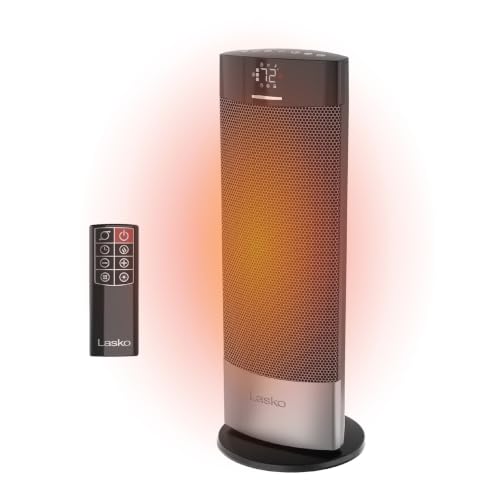
This is the size where the arithmetic finally works in your favor: 100 square feet wants 1,000 watts, and an outlet gives you 1,500.
By Scooter M. · Published September 21, 2026 · Last reviewed September 21, 2026
How this page is funded: we earn a commission if you buy through the links here, at no extra cost to you. Picks are chosen before links are attached, which is why every roundup names something to skip. Full disclosure.
A 100 sq ft room needs about 1,000 W at average insulation and an 8-foot ceiling. A plug-in heater delivers up to 1,500 W, so a single unit has roughly 50% headroom: it will reach temperature and then cycle off rather than running continuously.
The arithmetic, and the surplus
100 sq ft × 10 W = 1,000 W. One heater is 1,500 W. For once the shortfall is a surplus — 500 W of it.
Room size
Watts needed
BTU/h
Plug-in heaters
100 sq ft
1,000 W
3,412
1
Computed as square feet x 10 W x insulation factor x (ceiling / 8 ft), for an average heated room — 10 W/sq ft, 8 ft ceiling. Heater count assumes the 1,500 W plug-in ceiling.
A 100 sq ft room is a small bedroom, a box room, a home office, a large walk-in closet or a study: roughly 10 × 10 feet. It is the most common single-room heating job in the house and the one where the standard plug-in heater is genuinely well matched rather than heroically undersized.
Why headroom changes what you should buy
On the larger room-size pages on this site, the advice narrows to "buy the most output you can and accept it will run flat out." Here that advice inverts, and the reason is worth understanding.
A heater with surplus capacity reaches the set temperature and then cycles — the thermostat cuts the element, the room coasts, the element comes back. A heater without surplus never gets there and never cycles, so it runs at full output for every hour it is on. That difference is the single largest variable in what a heater costs you, and at 100 sq ft you are on the right side of it.
Wattage
Per hour
1 h
8 h
750 W
13.8¢
$0.14
$1.10
900 W
16.5¢
$0.17
$1.32
1,500 W
27.5¢
$0.28
$2.20
Computed at 18.34¢/kWh — the U.S. residential average for June 2026 (EIA, Electric Power Monthly, Table 5.6.A, released August 26, 2026). Your rate is on your own bill; substitute it and the arithmetic still holds. Figures assume full output for the whole period.
This is the most recent month EIA has published. Residential rates move seasonally and vary enormously by state — from roughly a dime per kilowatt-hour in parts of the South to more than 40¢ in Hawaii — so treat it as a national reference point, not as your rate.
The 750–900 W option is real here
At 100 sq ft, a heater's low setting is not a compromise — it is close to exactly what the room asks for. 900 W covers 90 sq ft at the standard rule and 750 W covers 75 sq ft, so in a well-insulated 100 sq ft room a low setting will often hold temperature on its own once the room is warm.
That matters for two reasons beyond the bill. A heater on low is quieter, because the fan is working less. And it draws 6.3 A at 750 W or 7.5 A at 900 W instead of 12.5 A — comfortably inside a 15 A circuit's 12 A continuous allowance, with room left for a lamp, a laptop and a phone charger on the same circuit.
Heater
Draw at 120 V
15 A circuit (12 A limit)
20 A circuit (16 A limit)
750 W
6.3 A
Fits
Fits
900 W
7.5 A
Fits
Fits
1,500 W
12.5 A
Over the limit
Fits
Maximum continuous
—
12 A = 1,440 W
16 A = 1,920 W
Draw computed as watts / 120 V. The continuous limit is 80% of the breaker rating, which follows from the NEC's requirement to size a circuit at 125% of a continuous load (NFPA 70, 210.19(A)(1) and 210.20(A)).
This is the one room size where you can genuinely plan to run the heater on its low setting most of the time, which is why every pick below publishes one or is small enough not to need one. The full circuit arithmetic.
Corrections, if your 100 sq ft is not average
The 1,000 W figure assumes average insulation and an 8-foot ceiling. Two corrections apply and at this size they are still survivable:
Drafty room — multiply by 1.25. 100 sq ft becomes 1,250 W. Still inside one heater, with less headroom.
Unheated envelope — multiply by 1.5. 100 sq ft becomes 1,500 W, which is exactly one heater at full output and no margin. A 100 sq ft sunroom or a converted garage corner sits here. Sunroom picks.
Higher ceilings. The rule is per square foot of floor at 8 feet. A 10-foot ceiling is 25% more air to heat.
In other words, 100 sq ft is the largest room a single plug-in heater comfortably handles once you assume the worst about the envelope — which is a useful way to remember where the plug-in ceiling really sits. Where the corrections come from.
What to buy for 100 square feet
Picked for a room that does not need maximum output: a published low setting, a thermostat that will actually cycle, and — because a 100 sq ft room is usually one somebody sleeps or works in — quiet options and published cutoffs.
Quick picks
Ranked for fit, not for hype. Coverage and current draw are computed from each unit’s published wattage. Tap a row for the full write-up, or go straight to the listing.
#
Product
Best for
Covers
Draw
Price
1
Lasko 754201The 900 W low setting is the whole point: it is the rare listing that publishes both settings, so you can compute what the cheap mode actually costs instead of guessing.
Honeywell HCE220BA shoebox-sized ceramic heater that publishes four preset temperatures and a 2/4/8-hour auto-off — specificity almost nothing else this size offers.
A thermostat with numbers on it, on a small heater
De'Longhi HMP1500A micathermic panel is a radiator that gave up its bulk: it radiates like oil-filled and warms up like ceramic, and it is about three inches deep so it can live against a wall.
Lasko Ellipse CT18950The short Ellipse tower is the one that publishes the two things the taller Laskos do not: a tip-over switch and a child lock, on top of a digital display and wide oscillation.
The only tower here with both cutoffs and a child lock
The 900 W low setting is the whole point: it is the rare listing that publishes both settings, so you can compute what the cheap mode actually costs instead of guessing.
Rated power
1,500 W / 900 W low
Covers (computed)
150 sq ft
Draw (computed)
12.5 A at 120 V
Cost per hour
27.5¢
Coverage at 10 W/sq ft, average insulation, 8 ft ceiling = 5,118 BTU/h. Cost at 18.34¢/kWh; an eight-hour night at full output is $2.20. Exceeds the 12 A continuous limit of a 15 A circuit — check what else shares the breaker.
What works
Both wattages are published, which is what makes an honest cost comparison possible
9 inches tall: it fits under a desk without being in the way
Manual top-mounted controls — nothing to relearn, nothing to lose the remote for
What does not
A dial thermostat with no numbers on it: you cannot set 68°F, only “about there”
No child lock, so the dial is reachable by anyone who can reach the unit
Fan noise is the price of a small ceramic unit moving 1,500 W of heat
ETL listed, per Lasko's published specification — one of the few in this roundup that names a mark rather than leaving it to the rating plate.
Who it is for
A desk, a small office, a dorm room — somewhere you want heat on a person rather than in a room.
What it is not for
A nursery, and not unattended use. It publishes a tip-over switch and overheat protection, but no child lock — and the USFA's advice to switch a heater off when you leave the room applies to every unit on this site, listed or not.
2 · A thermostat with numbers on it, on a small heater
Honeywell HCE220B UberHeat Plus Ceramic Heater
A shoebox-sized ceramic heater that publishes four preset temperatures and a 2/4/8-hour auto-off — specificity almost nothing else this size offers.
Rated power
1,500 W
Covers (computed)
150 sq ft
Draw (computed)
12.5 A at 120 V
Cost per hour
27.5¢
Coverage at 10 W/sq ft, average insulation, 8 ft ceiling = 5,118 BTU/h. Cost at 18.34¢/kWh; an eight-hour night at full output is $2.20. Exceeds the 12 A continuous limit of a 15 A circuit — check what else shares the breaker.
What works
Four preset temperatures rather than an unmarked dial — on a heater this small and this cheap, being able to ask for 70°F is unusual
Two independent overheat mechanisms are published — a high-temperature sensor and a thermal cut-off fuse — plus a tip-over switch
A 2/4/8-hour auto-off means it can stop by itself, which is what actually reduces the bill
What does not
No UL or ETL mark published by Honeywell, which is the one thing we would want stated at this size and price
Four presets is not the same as a full range: if you want 68°F you are choosing between 65 and 70
2.8 lb and shoebox-sized means it is a personal heater, not a room heater, whatever the 1,500 W suggests
Published specification
Rated power
1,500 W maximum at 120 V
Heat settings
2 (high and low)
Thermostat
Four preset comfort levels — 65°, 70°, 75° and 80°F
Auto-off timer
2, 4 or 8 hours
Safety
Tip-over switch; 2x overheat protection (high-temperature sensor plus a thermal cut-off fuse); cool-touch housing
Size
8.5" x 4.5" x 8.86", 2.8 lb
Warranty
3-year limited
Heat type
Ceramic (PTC)
Maker’s coverage claim
None published — the coverage figure above is ours
Safety listing
Honeywell does not publish a UL or ETL mark for this model; it does publish two independent overheat mechanisms. Check the rating plate.
Who it is for
A small office, a bedside table or a desk, where the heater needs to hold roughly a known temperature and switch itself off after a few hours.
What it is not for
A large or drafty room, and not a nursery — no child lock is published and the presets are reachable by anyone who can reach the unit.
A micathermic panel is a radiator that gave up its bulk: it radiates like oil-filled and warms up like ceramic, and it is about three inches deep so it can live against a wall.
Rated power
1,500 W / 750 W low
Covers (computed)
150 sq ft
Draw (computed)
12.5 A at 120 V
Cost per hour
27.5¢
Coverage at 10 W/sq ft, average insulation, 8 ft ceiling = 5,118 BTU/h. Cost at 18.34¢/kWh; an eight-hour night at full output is $2.20. Exceeds the 12 A continuous limit of a 15 A circuit — check what else shares the breaker.
What works
No fan, so no noise and nothing blown around a room
Warms up far faster than an oil-filled radiator of the same wattage
Wall-mountable, which gets it out of the floor space it would otherwise eat
What does not
The panel surface is hot to the touch — this is not a cool-touch design
No published coverage figure
Radiant heat is directional: stand behind it and you will not feel much
The short Ellipse tower is the one that publishes the two things the taller Laskos do not: a tip-over switch and a child lock, on top of a digital display and wide oscillation.
Rated power
1,500 W
Covers (computed)
150 sq ft
Draw (computed)
12.5 A at 120 V
Cost per hour
27.5¢
Coverage at 10 W/sq ft, average insulation, 8 ft ceiling = 5,118 BTU/h. Cost at 18.34¢/kWh; an eight-hour night at full output is $2.20. Exceeds the 12 A continuous limit of a 15 A circuit — check what else shares the breaker.
What works
A published tip-over switch AND a published child lock — no other tower in this registry publishes both, and they are exactly what a tall heater in a family room needs
An 18-inch tower has a lower center of gravity than the 23- and 30-inch units it competes with
Digital display, thermostat, remote and a timer at a price close to the simpler towers
What does not
Lasko's own product page for this model was unreachable when we checked, so every figure here is from the retail listing rather than the manufacturer
The wattage of the three heat modes is not published, so only the 1,500 W maximum can be costed
No coverage claim and no listing mark named — at 1,500 W our own figure is 150 sq ft either way
Published specification
Rated power
1,500 W at 120 V
Heat modes
Three, plus two fan settings; the per-mode wattage is not published
Controls
Digital display, thermostat, remote, timer
Oscillation
Wide oscillation
Height
18"
Safety
Tip-over switch and child lock, both published in the listing
Heat type
Ceramic (PTC)
Maker’s coverage claim
None published — the coverage figure above is ours
Safety listing
The listing publishes a tip-over switch and a child lock but names no UL or ETL mark. Lasko's own product page for this model could not be reached, so check the rating plate on the unit.
Who it is for
A living room, family room or home office where children or animals move past the heater and a tip-over switch plus a child lock are worth more than an extra five inches of tower.
What it is not for
Anyone who needs to compute the cost of a low setting, or who wants the manufacturer's own specification sheet before buying — for this model it was not reachable.
If the room is a bedroom specifically, silence is worth more than any other feature at this size, and a fanless mica panel or oil-filled radiator will hold 100 sq ft without a sound. The quietest options.
Questions people actually ask
What size space heater do I need for a 100 square foot room?+
About 1,000 W, at 10 watts per square foot with average insulation and an 8-foot ceiling. A standard 1,500 W plug-in heater comfortably exceeds that, which means it will reach temperature and cycle off rather than running continuously.
Is 1,500 watts too much for a small room?+
Not too much — it just means the heater spends much of its time switched off by the thermostat, which is the cheapest way for it to run. What matters at this size is that the thermostat works well, not that the wattage is high. Many 100 sq ft rooms will hold temperature on a 750 or 900 W setting.
How much does it cost to heat a 100 sq ft room?+
Less than the headline figure, because the heater cycles. A 1,500 W unit running flat out for eight hours is about $2.20 at the U.S. average rate; the same heater cycling in a correctly sized 100 sq ft room is closer to $1.30 for those eight hours.
Will a 750 watt heater heat a 100 sq ft room?+
It covers about 75 sq ft at the standard rule, so it will warm a 100 sq ft room more slowly and may not hold temperature in cold weather or a drafty space. In a well-insulated room it is often enough to maintain warmth once a higher setting has done the initial work.
What size heater for a 10x10 room?+
A 10 × 10 room is 100 square feet and needs about 1,000 W. One 1,500 W plug-in heater covers it with roughly 50% headroom — multiply by 1.25 if the room is drafty and by 1.5 if it is outside the main heating system.
Silent, timed and safe overnight — the units that solve the bedroom's three actual problems.
Written by Scooter M., an enthusiast — not a tester and not a certified anything. Every figure on this page is either published by the manufacturer, taken from a live retail listing, or computed from the published wattage using the formulas we publish. Found an error? Tell us and we will correct it, visibly and with a date on it.