The one feature that genuinely reduces what a heater costs you — because it is the only one that makes the heater stop.
By Scooter M. · Published September 13, 2026 · Last reviewed September 13, 2026
How this page is funded: we earn a commission if you buy through the links here, at no extra cost to you. Picks are chosen before links are attached, which is why every roundup names something to skip. Full disclosure.
A thermostat is the only space heater feature that reliably lowers your bill, because it is the only one that makes the heater stop. Every electric heater costs the same per hour at the same wattage, so the only lever is hours — and a thermostat that holds a set temperature pulls that lever automatically.
Why this is the feature that matters
Everything else on this site keeps arriving at the same wall: at equal wattage, every electric resistance heater costs exactly the same to run. You cannot buy a heater that produces more warmth per cent. There is no efficient type, no efficient element and no efficient brand.
Which leaves hours. A 1,500 W heater costs 27.5 cents an hour at the U.S. average rate; run it eight hours a night for a month and that is about $66. If a thermostat cycles the element off for a third of that time because the room is already at the temperature you asked for, you have saved roughly $22 a month without noticing anything except a room that stopped overheating. That is the entire economic case for this page, and it is a real one.
Wattage
Per hour
1 h
4 h
8 h
750 W
13.8¢
$0.14
$0.55
$1.10
900 W
16.5¢
$0.17
$0.66
$1.32
1,500 W
27.5¢
$0.28
$1.10
$2.20
Computed at 18.34¢/kWh — the U.S. residential average for June 2026 (EIA, Electric Power Monthly, Table 5.6.A, released August 26, 2026). Your rate is on your own bill; substitute it and the arithmetic still holds. Figures assume full output for the whole period.
This is the most recent month EIA has published. Residential rates move seasonally and vary enormously by state — from roughly a dime per kilowatt-hour in parts of the South to more than 40¢ in Hawaii — so treat it as a national reference point, not as your rate.
The three kinds of control sold as “thermostat”
Control
What it does
What it cannot do
Unmarked dial (min-to-max)
Cycles the element off at some temperature; genuinely saves money
Tell you what temperature that is, or hold it when the weather changes
Digital thermostat
Holds a temperature you set, in degrees, and cycles to maintain it
Nothing relevant — this is the one to want
ECO / power-modulating mode
Reduces wattage as the room approaches target, smoothing the swing
Substitute for a set temperature; it regulates output, not a target
All three are called a thermostat. Only one of them holds a number you chose.
All three appear on this page. The Dreo publishes the most specific version of the second kind — 41-95°F in 1°F increments, which is a specification rather than an adjective — and the De'Longhi Dragon adds the third on top of a 24-hour programmable timer, which is the combination that suits an overnight room best.
A timer is a thermostat with a different shape
It is worth saying plainly, because timers are usually listed as a convenience feature: a heater that switches itself off after eight hours has saved you exactly as much money as a thermostat that cycled for the equivalent time. Both work on hours, which is the only variable there is. For a bedroom in particular, a timer is arguably the more reliable of the two, because it does not depend on where in the room the temperature sensor happens to be sitting.
Size it first, then let the thermostat do its job
A thermostat cannot rescue an undersized heater. If the room needs more watts than the heater has, the element simply never cycles off and you have bought a control that does nothing. Size the room first — 10 watts per square foot, average insulation, 8-foot ceiling — and the thermostat becomes the useful feature it is supposed to be.
Room size
Watts needed
BTU/h
Plug-in heaters
100 sq ft
1,000 W
3,412
1
150 sq ft
1,500 W
5,118
1
200 sq ft
2,000 W
6,824
2 (different circuits)
300 sq ft
3,000 W
10,236
2 (different circuits)
Computed as square feet x 10 W x insulation factor x (ceiling / 8 ft), for an average heated room — 10 W/sq ft, 8 ft ceiling. Heater count assumes the 1,500 W plug-in ceiling.
If the table above says your room needs more than 1,500 W, no thermostat on any plug-in heater will help, because 1,500 W is the ceiling for a U.S. wall outlet. Best space heaters for large rooms covers what to do instead.
The picks
Two fan-driven units and two silent ones, so this page works whether the room is an office or a bedroom. Ranked by how specific the published control is.
There is one more way to buy the same saving: a heater that schedules its own hours from an app, so the thermostat does not have to be told anything in the moment. That is a narrower feature than the marketing suggests — voice control alone saves nothing — and best smart and Wi-Fi space heaters separates the tiers.
Quick picks
Ranked for fit, not for hype. Coverage and current draw are computed from each unit’s published wattage. Tap a row for the full write-up, or go straight to the listing.
#
Product
Best for
Covers
Draw
Price
1
Dreo Solaris 718The rare heater whose published coverage claim survives the arithmetic: 1,500 W is a genuine 300 sq ft at 10 W/sq ft, and Dreo publishes that number rather than implying more.
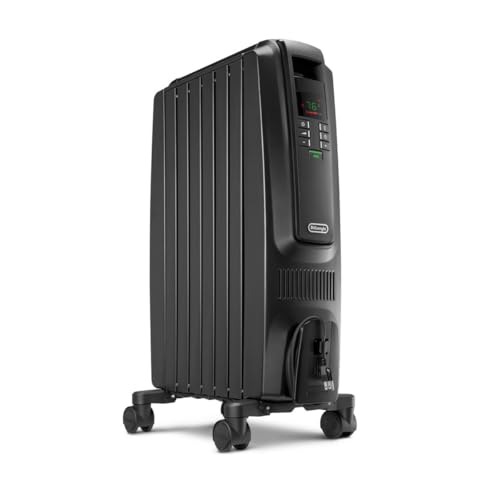
De'Longhi Dragon DigitalThe oil-filled radiator with a programmable timer, which is the version that matters overnight: it can bring a bedroom up before you wake and shut itself off, unattended, without you leaving it running all night.
Lasko 755320A 23-inch digital tower with a thermostat, an 8-hour timer and a remote — and the only heater here whose published coverage figure lands exactly where our own sizing rule puts it.
The maker's coverage claim that matches the arithmetic
Amazon Basics oil-filledThe rare budget radiator that names its safety certificate in the listing rather than leaving you to hunt for the rating plate.
The rare heater whose published coverage claim survives the arithmetic: 1,500 W is a genuine 300 sq ft at 10 W/sq ft, and Dreo publishes that number rather than implying more.
Rated power
1,500 W
Covers (computed)
150 sq ft
Draw (computed)
12.5 A at 120 V
Cost per hour
27.5¢
Coverage at 10 W/sq ft, average insulation, 8 ft ceiling = 5,118 BTU/h. Cost at 18.34¢/kWh; an eight-hour night at full output is $2.20. Exceeds the 12 A continuous limit of a 15 A circuit — check what else shares the breaker.
What works
A digital thermostat with numbers on it — you can set 68°F rather than guess at a dial
The published 300 sq ft claim matches the standard sizing rule instead of exceeding it
8 lb and 8 inches square: it moves room to room without a project
What does not
1,500 W is 1,500 W — nothing here heats faster than any other 1,500 W heater
Dreo does not publish a noise figure in decibels on the product page
Tall and narrow, which is a tipping profile: the tip-over cutoff matters more here
A living room, bedroom or den at or under 300 sq ft with average insulation and an 8-foot ceiling, where you want to set a temperature and stop thinking about it.
What it is not for
A garage, an uninsulated basement, or anything over about 300 sq ft. It is not under-powered — 1,500 W is the plug-in ceiling — the room is simply too big for one outlet.
De'Longhi Dragon Digital Oil-Filled Radiator (TRD40615EBK)
The oil-filled radiator with a programmable timer, which is the version that matters overnight: it can bring a bedroom up before you wake and shut itself off, unattended, without you leaving it running all night.
Rated power
1,500 W
Covers (computed)
150 sq ft
Draw (computed)
12.5 A at 120 V
Cost per hour
27.5¢
Coverage at 10 W/sq ft, average insulation, 8 ft ceiling = 5,118 BTU/h. Cost at 18.34¢/kWh; an eight-hour night at full output is $2.20. Exceeds the 12 A continuous limit of a 15 A circuit — check what else shares the breaker.
What works
A programmable timer is the honest answer to “can I leave it on overnight” — you don't have to
Silent, like every oil-filled unit: no fan, no moving air
Digital control means you set a temperature, not a knob position
What does not
Costs more than the mechanical TRD40615T for identical heat output
Same slow warm-up as any oil-filled radiator
Heavy and bulky for its coverage — 26 inches of steel you will not be carrying upstairs
Published specification
Rated power
1,500 W at 120 V
Controls
Digital, with a 24-hour programmable timer
ECO function
Regulates power and temperature rather than running at full output
Dimensions
16" x 10" x 26"
Fluid
Permanently sealed diathermic oil
Safety
Child lock, thermal cut-off
Maker's coverage claim
None published — sold as a full-room heater
Heat type
Oil-filled
Maker’s coverage claim
None published — the coverage figure above is ours
Safety listing
No listing mark published in the listing text; verify the UL or ETL mark on the rating plate.
Who it is for
A bedroom where the heater needs to run on a schedule rather than all night, and where noise would wake you.
What it is not for
A room you need warm in five minutes, or a tight space where a hot 26-inch radiator cannot keep 3 feet of clearance.
3 · The maker's coverage claim that matches the arithmetic
Lasko 755320 Oscillating Digital Ceramic Tower Heater (23 in)
A 23-inch digital tower with a thermostat, an 8-hour timer and a remote — and the only heater here whose published coverage figure lands exactly where our own sizing rule puts it.
Rated power
1,500 W / 900 W low
Covers (computed)
150 sq ft
Draw (computed)
12.5 A at 120 V
Cost per hour
27.5¢
Coverage at 10 W/sq ft, average insulation, 8 ft ceiling = 5,118 BTU/h. Cost at 18.34¢/kWh; an eight-hour night at full output is $2.20. Exceeds the 12 A continuous limit of a 15 A circuit — check what else shares the breaker.
What works
Lasko publishes 150 sq ft, and 1,500 W at 10 W per square foot is 150 sq ft — the claim and the arithmetic agree exactly, which almost never happens
A published 900 W low setting, so the economical mode has a computable cost
Digital thermostat, 8-hour timer and a remote at a price where a two-position knob is the norm
What does not
No child lock published, which rules it out of a nursery on this site's criteria
Tall, narrow and 7 lb — that is a tipping profile, and there is no published tip-over cutoff in Lasko's specification
Oscillation and a fan mean it is audible; the silent types are elsewhere in this roundup
Published specification
Rated power
900 W to 1,500 W (Lasko's published range)
Heat settings
Two
Thermostat
Adjustable, with a digital display
Oscillation
Yes
Timer
8 hours
Remote
Included, with onboard storage
Size
23" H x 7.25" D x 7.00" W, 7.29 lb
Safety
Cool-touch housing, automatic overheat protection
Warranty
3 years
Heat type
Ceramic (PTC)
Maker’s coverage claim
150 sq ft
Safety listing
ETL listed, stated on Lasko's own product page.
Who it is for
A home office, family room or bedroom at or under 150 sq ft where you want a real thermostat and a timer without paying for a metal cabinet.
What it is not for
A nursery, or a room where a curious pet or toddler can reach it. No child lock and no published tip-over switch is the wrong combination at floor height.
4 · A published ETL mark on an oil-filled radiator
Amazon Basics Oil-Filled Radiator, 7 Fins, 1500 W
The rare budget radiator that names its safety certificate in the listing rather than leaving you to hunt for the rating plate.
Rated power
1,500 W
Covers (computed)
150 sq ft
Draw (computed)
12.5 A at 120 V
Cost per hour
27.5¢
Coverage at 10 W/sq ft, average insulation, 8 ft ceiling = 5,118 BTU/h. Cost at 18.34¢/kWh; an eight-hour night at full output is $2.20. Exceeds the 12 A continuous limit of a 15 A circuit — check what else shares the breaker.
What works
Publishes an ETL certificate in the listing itself — on this site that is the single most useful thing a budget listing can do
Silent in the way every oil-filled radiator is silent, because there is no fan
A remote on a radiator is more useful than it sounds: these are heavy and you do not want to walk to them
What does not
The wattage of the three heat settings is not published, so only the 1,500 W figure can be costed
Seven fins is a modest radiator — thermal mass is the whole point of the type, and there are bigger ones
No timer and no digital temperature readout: the thermostat is a dial
Published specification
Rated power
1,500 W at 120 V
Fins
7 oil-filled fins
Heat settings
Three
Thermostat
Adjustable
Remote
Included
Safety
Tip-over and overheat protection; ETL safety certificate
Heat type
Oil-filled
Maker’s coverage claim
None published — the coverage figure above is ours
Safety listing
ETL certified — stated explicitly in the listing, which is more than most of this category manages.
Who it is for
A bedroom, nursery or study where silence is the requirement and you want a published safety certificate without paying a premium brand price.
What it is not for
Fast heat, or a large open-plan room. A radiator this size warms a small-to-average room slowly and steadily; that is the design, not a fault.
A number beats a dial. A thermostat you can set to 68°F is a different product from a knob marked min-to-max, and this page ranks the first kind above the second.
Cycling is the whole point. We judged each unit on whether its control genuinely switches the element off when the room is warm enough, rather than merely throttling it.
A timer counts as temperature control, because a heater that stops at 2 a.m. has saved you the same money as one that cycled — and two picks here publish 24-hour or 8-hour timers.
Published thermostat range preferred. One pick publishes 41-95°F in 1°F increments; that is a specification. “Adjustable thermostat” is a description.
Every saving on this page is from fewer running hours, never from efficiency. Nothing here heats more per watt, because nothing can.
And what we did not do: we have not tested these units, owned them, measured them or run them in a room. Everything above is compiled from published manufacturer specifications and live retail listings, with the electrical load, room coverage and running cost computed by us from the published wattage. The full method.
What we’d skip, and why
Every roundup on this site names something to skip. It costs us nothing to publish and it is the fastest way to tell whether a buying guide was written for you or for its commission.
A heater whose “thermostat” is an unmarked min-to-max dial
This is the most common control in the category and it is worth understanding what it does. It is a bimetallic strip that trips at some temperature you cannot read, so the way you use it is to turn it up until the heater runs, then back it off until it clicks out, then adjust again tomorrow when the weather changes. It does cycle the heater, so it does save money compared with no thermostat at all. What it cannot do is hold a temperature you chose, and it cannot tell you what that temperature is. If you are buying specifically for temperature control, buy a number.
A smart plug added to a heater as a substitute for a thermostat
A smart plug can schedule a heater, which is useful, and some will switch on a temperature reading, which sounds like the same thing. It is not. A heater that has been de-energized at the plug loses its own control state, and — more importantly — many heaters are explicitly not rated for use with one, because a 12.5 A continuous load is at or beyond what a great many smart plugs are designed to switch repeatedly. Use the heater's own thermostat and a timer built into the heater. This is the same reasoning as why extension cords fail with heaters.
Questions people actually ask
Does a thermostat actually save money on a space heater?+
Yes, and it is the only feature that does. Every electric heater costs the same per hour at the same wattage, so the only way to spend less is to run for fewer hours. A thermostat that cycles the element off when the room reaches temperature does exactly that, automatically.
What is the difference between a digital thermostat and a dial?+
A dial cycles the heater off at a temperature you cannot read and cannot reliably reproduce — you set it by trial and error. A digital thermostat holds a temperature you chose, in degrees, and re-establishes it when conditions change. Both save money; only one lets you decide how warm the room is.
What does ECO mode do on a space heater?+
It modulates the power the element draws as the room approaches the target temperature, rather than running flat out and then shutting off completely. It smooths the temperature swing and reduces average consumption. It is not a substitute for a set-point thermostat — it regulates output, not a target.
Can I use a smart plug instead of a thermostat?+
It is not a good substitute. A heater is a 12.5 A continuous load at 1,500 W, which is at or beyond what many smart plugs are designed to switch repeatedly, and cutting power at the plug discards the heater's own control state. Use the thermostat and timer built into the heater.
Why does my heater switch off before the room is warm?+
Almost always because its temperature sensor — which sits inside the heater, near its own outlet — has warmed up before the room has. This happens when the unit is in a corner, against furniture or under a desk. Give it clear space on all sides and the thermostat will read the room rather than itself.
A remote is worth what it can change. Ranked by how much control it actually hands you.
Written by Scooter M., an enthusiast — not a tester and not a certified anything. Every figure on this page is either published by the manufacturer, taken from a live retail listing, or computed from the published wattage using the formulas we publish. Found an error? Tell us and we will correct it, visibly and with a date on it.