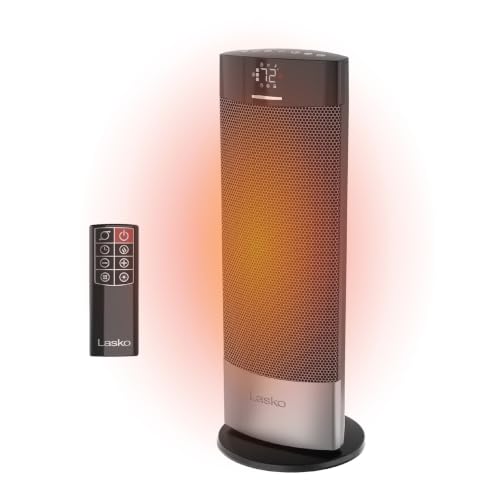
The form factor exists to save floor space. It also creates the one hazard a floor heater does not have, and only one of these four publishes the cutoff for it.
By Scooter M. · Published September 21, 2026 · Last reviewed September 21, 2026
How this page is funded: we earn a commission if you buy through the links here, at no extra cost to you. Picks are chosen before links are attached, which is why every roundup names something to skip. Full disclosure.
A tower heater trades floor area for height, which is why it suits small rooms. The trade-off is stability: tall, narrow and light is the shape most likely to be knocked over, and most towers do not publish a tip-over switch. Buy the one that does, or buy a different shape.
What the shape actually buys you
A tower occupies roughly seven inches square of floor. A cabinet heater of the same output occupies two or three times that. In a small bedroom, a home office with a desk in it, or a room where the heater has to live between furniture, that difference is the entire reason the form factor exists.
The height also does something useful for distribution. Warm air rises, so an outlet grille at 18 to 30 inches puts heat into the occupied part of the room rather than along the floor, and oscillation spreads it across a wider arc than a low cabinet can manage. That is a real advantage and it is why towers dominate the small-room shelf.
And the problem it creates
Every advantage above comes from the same geometry, and so does the drawback. These units weigh between about five and eight pounds and stand on a base that is narrower than they are tall by a factor of three or four. A dog leaning on one, a toddler pulling up on it, a vacuum cord catching the base — all of these tip a tower in a way they would not tip a 15-pound cabinet.
What the four makers actually publish
Lasko CT18950
Dreo Solaris 718
Lasko 755320
Lasko 751320
Height
18 in
29.7 in
23 in
22.5 in
Tip-over switch
Published
Published
Not published
Not published
Child lock
Published
Published
Not published
Not published
Published low wattage
Not published
Not published
900 W
900 W
Thermostat
Digital display
41–95°F, 1°F steps
Digital display
Adjustable
Timer
Yes
24 h auto-off
8 h
7 h
Oscillation
Wide
30/60/90/120°
Yes
Yes
Maker's coverage claim
Not published
300 sq ft
150 sq ft
150 sq ft
Our computed coverage
150 sq ft
150 sq ft
150 sq ft
150 sq ft
Safety listing
Not named
ETL
ETL
ETL
Warranty
Not published
Not published
3 years
3 years
Published specifications only. "Not published" means we checked the maker's page, or the retail listing where the maker's page was unreachable, and it was not there.
Two things fall out of that table. The two units that publish both cutoffs are the two that publish the least about everything else — no low wattage, no warranty, and in the CT18950's case no listing mark either. And the two Lasko claims that are published are the two that match our arithmetic exactly: Lasko says 150 sq ft, and 1,500 W at 10 W per square foot is 150 sq ft. Dreo's 300 sq ft is double that, on the same 1,500 W.
Sizing, which is identical for all four
Room size
Watts needed
BTU/h
Plug-in heaters
100 sq ft
1,000 W
3,412
1
150 sq ft
1,500 W
5,118
1
200 sq ft
2,000 W
6,824
2 (different circuits)
Computed as square feet x 10 W x insulation factor x (ceiling / 8 ft), for an average heated room — 10 W/sq ft, 8 ft ceiling. Heater count assumes the 1,500 W plug-in ceiling.
Every unit here tops out at 1,500 W, so every unit here covers about 150 square feet in an average-insulation room with an 8-foot ceiling. Multiply the wattage you need by 1.25 for a drafty room and 1.5 for an unheated one. No tower escapes this — the ceiling is set by the outlet, not the cabinet. Where the rule comes from.
Cost and circuit
Wattage
Per hour
1 h
8 h
900 W
16.5¢
$0.17
$1.32
1,500 W
27.5¢
$0.28
$2.20
Computed at 18.34¢/kWh — the U.S. residential average for June 2026 (EIA, Electric Power Monthly, Table 5.6.A, released August 26, 2026). Your rate is on your own bill; substitute it and the arithmetic still holds. Figures assume full output for the whole period.
27.5 cents an hour at full output, or about $66 a month at eight hours a day. The two Laskos that publish a 900 W setting can be run at 16.5 cents instead, which is also the difference between drawing 12.5 A and 7.5 A — and on a bedroom circuit already carrying lamps and a phone charger, that is the more useful half of the saving.
Heater
Draw at 120 V
15 A circuit (12 A limit)
20 A circuit (16 A limit)
900 W
7.5 A
Fits
Fits
1,500 W
12.5 A
Over the limit
Fits
Maximum continuous
—
12 A = 1,440 W
16 A = 1,920 W
Draw computed as watts / 120 V. The continuous limit is 80% of the breaker rating, which follows from the NEC's requirement to size a circuit at 125% of a continuous load (NFPA 70, 210.19(A)(1) and 210.20(A)).
This is the most recent month EIA has published. Residential rates move seasonally and vary enormously by state — from roughly a dime per kilowatt-hour in parts of the South to more than 40¢ in Hawaii — so treat it as a national reference point, not as your rate.
The picks
Ranked by the criterion at the top of the page: what the maker will put in writing about what happens when the heater falls over.
Quick picks
Ranked for fit, not for hype. Coverage and current draw are computed from each unit’s published wattage. Tap a row for the full write-up, or go straight to the listing.
#
Product
Best for
Covers
Draw
Price
1
Lasko Ellipse CT18950The short Ellipse tower is the one that publishes the two things the taller Laskos do not: a tip-over switch and a child lock, on top of a digital display and wide oscillation.
The only tower here with both cutoffs and a child lock
Dreo Solaris 718The rare heater whose published coverage claim survives the arithmetic: 1,500 W is a genuine 300 sq ft at 10 W/sq ft, and Dreo publishes that number rather than implying more.
Lasko 755320A 23-inch digital tower with a thermostat, an 8-hour timer and a remote — and the only heater here whose published coverage figure lands exactly where our own sizing rule puts it.
The maker's coverage claim that matches the arithmetic
Lasko 751320The 755320's shorter, simpler sibling: the same honest 150 sq ft claim and the same published 900 W low setting, with a 7-hour timer instead of an 8-hour one.
The short Ellipse tower is the one that publishes the two things the taller Laskos do not: a tip-over switch and a child lock, on top of a digital display and wide oscillation.
Rated power
1,500 W
Covers (computed)
150 sq ft
Draw (computed)
12.5 A at 120 V
Cost per hour
27.5¢
Coverage at 10 W/sq ft, average insulation, 8 ft ceiling = 5,118 BTU/h. Cost at 18.34¢/kWh; an eight-hour night at full output is $2.20. Exceeds the 12 A continuous limit of a 15 A circuit — check what else shares the breaker.
What works
A published tip-over switch AND a published child lock — no other tower in this registry publishes both, and they are exactly what a tall heater in a family room needs
An 18-inch tower has a lower center of gravity than the 23- and 30-inch units it competes with
Digital display, thermostat, remote and a timer at a price close to the simpler towers
What does not
Lasko's own product page for this model was unreachable when we checked, so every figure here is from the retail listing rather than the manufacturer
The wattage of the three heat modes is not published, so only the 1,500 W maximum can be costed
No coverage claim and no listing mark named — at 1,500 W our own figure is 150 sq ft either way
Published specification
Rated power
1,500 W at 120 V
Heat modes
Three, plus two fan settings; the per-mode wattage is not published
Controls
Digital display, thermostat, remote, timer
Oscillation
Wide oscillation
Height
18"
Safety
Tip-over switch and child lock, both published in the listing
Heat type
Ceramic (PTC)
Maker’s coverage claim
None published — the coverage figure above is ours
Safety listing
The listing publishes a tip-over switch and a child lock but names no UL or ETL mark. Lasko's own product page for this model could not be reached, so check the rating plate on the unit.
Who it is for
A living room, family room or home office where children or animals move past the heater and a tip-over switch plus a child lock are worth more than an extra five inches of tower.
What it is not for
Anyone who needs to compute the cost of a low setting, or who wants the manufacturer's own specification sheet before buying — for this model it was not reachable.
The rare heater whose published coverage claim survives the arithmetic: 1,500 W is a genuine 300 sq ft at 10 W/sq ft, and Dreo publishes that number rather than implying more.
Rated power
1,500 W
Covers (computed)
150 sq ft
Draw (computed)
12.5 A at 120 V
Cost per hour
27.5¢
Coverage at 10 W/sq ft, average insulation, 8 ft ceiling = 5,118 BTU/h. Cost at 18.34¢/kWh; an eight-hour night at full output is $2.20. Exceeds the 12 A continuous limit of a 15 A circuit — check what else shares the breaker.
What works
A digital thermostat with numbers on it — you can set 68°F rather than guess at a dial
The published 300 sq ft claim matches the standard sizing rule instead of exceeding it
8 lb and 8 inches square: it moves room to room without a project
What does not
1,500 W is 1,500 W — nothing here heats faster than any other 1,500 W heater
Dreo does not publish a noise figure in decibels on the product page
Tall and narrow, which is a tipping profile: the tip-over cutoff matters more here
A living room, bedroom or den at or under 300 sq ft with average insulation and an 8-foot ceiling, where you want to set a temperature and stop thinking about it.
What it is not for
A garage, an uninsulated basement, or anything over about 300 sq ft. It is not under-powered — 1,500 W is the plug-in ceiling — the room is simply too big for one outlet.
3 · The maker's coverage claim that matches the arithmetic
Lasko 755320 Oscillating Digital Ceramic Tower Heater (23 in)
A 23-inch digital tower with a thermostat, an 8-hour timer and a remote — and the only heater here whose published coverage figure lands exactly where our own sizing rule puts it.
Rated power
1,500 W / 900 W low
Covers (computed)
150 sq ft
Draw (computed)
12.5 A at 120 V
Cost per hour
27.5¢
Coverage at 10 W/sq ft, average insulation, 8 ft ceiling = 5,118 BTU/h. Cost at 18.34¢/kWh; an eight-hour night at full output is $2.20. Exceeds the 12 A continuous limit of a 15 A circuit — check what else shares the breaker.
What works
Lasko publishes 150 sq ft, and 1,500 W at 10 W per square foot is 150 sq ft — the claim and the arithmetic agree exactly, which almost never happens
A published 900 W low setting, so the economical mode has a computable cost
Digital thermostat, 8-hour timer and a remote at a price where a two-position knob is the norm
What does not
No child lock published, which rules it out of a nursery on this site's criteria
Tall, narrow and 7 lb — that is a tipping profile, and there is no published tip-over cutoff in Lasko's specification
Oscillation and a fan mean it is audible; the silent types are elsewhere in this roundup
Published specification
Rated power
900 W to 1,500 W (Lasko's published range)
Heat settings
Two
Thermostat
Adjustable, with a digital display
Oscillation
Yes
Timer
8 hours
Remote
Included, with onboard storage
Size
23" H x 7.25" D x 7.00" W, 7.29 lb
Safety
Cool-touch housing, automatic overheat protection
Warranty
3 years
Heat type
Ceramic (PTC)
Maker’s coverage claim
150 sq ft
Safety listing
ETL listed, stated on Lasko's own product page.
Who it is for
A home office, family room or bedroom at or under 150 sq ft where you want a real thermostat and a timer without paying for a metal cabinet.
What it is not for
A nursery, or a room where a curious pet or toddler can reach it. No child lock and no published tip-over switch is the wrong combination at floor height.
The 755320's shorter, simpler sibling: the same honest 150 sq ft claim and the same published 900 W low setting, with a 7-hour timer instead of an 8-hour one.
Rated power
1,500 W / 900 W low
Covers (computed)
150 sq ft
Draw (computed)
12.5 A at 120 V
Cost per hour
27.5¢
Coverage at 10 W/sq ft, average insulation, 8 ft ceiling = 5,118 BTU/h. Cost at 18.34¢/kWh; an eight-hour night at full output is $2.20. Exceeds the 12 A continuous limit of a 15 A circuit — check what else shares the breaker.
What works
Lasko publishes 150 sq ft and 1,500 W at 10 W per square foot is 150 sq ft — the claim and the arithmetic agree exactly, which is rare enough to be the reason to trust the rest of the sheet
A published 900 W low setting, so the economical mode has a computable cost and draws 7.5 A instead of 12.5 A
ETL listed and a 3-year warranty on a tower at the cheaper end of the category
What does not
No tip-over switch is published — and at 5.67 lb and 22.5 inches tall, this is the shape that most wants one
No child lock, which rules it out of a nursery on this site's criteria
A 7-hour timer rather than the 8-hour timer on the 755320, which is an odd place to save a feature
Published specification
Rated power
900 W to 1,500 W (Lasko's published range)
Heat settings
Two
Thermostat
Adjustable
Oscillation
Yes
Timer
7-hour auto-off
Remote
Included
Size
22.5" H x 7.25" W x 8.38" D, 5.67 lb
Safety
Cool-touch housing, overheat protection, self-regulating ceramic element
Warranty
3 years
Heat type
Ceramic (PTC)
Maker’s coverage claim
150 sq ft
Safety listing
ETL listed, stated on Lasko's own product page.
Who it is for
A home office or adult bedroom at or under 150 sq ft where a thermostat, a timer and a remote matter more than a metal cabinet, and the heater can stand in clear floor space.
What it is not for
A nursery or a room with a dog or a toddler. No published tip-over switch and no child lock on a tall, light tower is the wrong combination at floor height.
A published tip-over switch ranks above every other feature. A tower is the tallest, narrowest, lightest heater you can buy — it is the form factor that most needs the cutoff, and most of them do not publish one.
Coverage claims checked against 10 W per square foot. Two of these four publish a figure; one matches our arithmetic exactly and one is double it. Both are named.
Published low wattage preferred, because on a tower the low setting is also the quieter setting and drops the draw from 12.5 A to 7.5 A.
Height treated as a cost, not a feature. An 18-inch tower has a lower center of gravity than a 30-inch one, and that is worth more than the extra reach.
No noise ranking. Every tower here has a fan and none of these four publishes a decibel figure we could verify, so we have not invented one.
And what we did not do: we have not tested these units, owned them, measured them or run them in a room. Everything above is compiled from published manufacturer specifications and live retail listings, with the electrical load, room coverage and running cost computed by us from the published wattage. The full method.
What we’d skip, and why
Every roundup on this site names something to skip. It costs us nothing to publish and it is the fastest way to tell whether a buying guide was written for you or for its commission.
A tower heater in a room with a toddler or a large dog, unless it publishes a child lock AND a tip-over switch
This is the whole argument of the page. A tower puts its controls at chest height for a small child and its center of mass a long way above its base. Of the four units here, exactly one publishes both cutoffs. That is not a reason to avoid towers — it is a reason to buy the specific one that publishes them, or to buy a different shape entirely. The four tip-over mechanisms and how they differ.
Any tower sold on a coverage claim with no wattage basis stated
At 10 watts per square foot a 1,500 W heater covers 150 sq ft in an average room with an 8-foot ceiling. Every plug-in tower is capped at 1,500 W, so no tower covers more area than any other tower. When one claims 300 sq ft and another claims 150, you are reading two marketing departments, not two heaters. Size from the wattage and use the calculator.
What we could not tell you
Noise. Every tower here has a fan, and a fan moving 1,500 W of heat makes a sound. None of these four publishes a decibel figure we could verify at the manufacturer, so there is no noise ranking on this page. If quiet is the requirement rather than a preference, the type is wrong — the fanless options are here.
Lasko's own product page for the CT18950 was unreachable when we checked, returning a 404 on the product URL and a 403 on its support article. Everything recorded for that unit comes from its retail listing, which does publish the tip-over switch and the child lock by name. We have flagged it on the pick card rather than presenting listing copy as a manufacturer specification.
Questions people actually ask
Are tower heaters safe?+
As safe as the cutoffs their makers publish. A tower is tall, narrow and light, so it is the shape most likely to be knocked over — which makes a published tip-over switch more important here than on any other form factor. Of the four units on this page, two publish one and two do not.
What size room does a tower heater heat?+
About 150 square feet, at 10 watts per square foot with average insulation and an 8-foot ceiling. Every plug-in tower is capped at 1,500 W, so they all cover the same area regardless of what the box claims — one of these four claims 300 sq ft on exactly the same wattage.
Do tower heaters use more electricity than other space heaters?+
No. At 1,500 W a tower costs about 27.5 cents an hour, identical to a cabinet heater or an oil-filled radiator at the same wattage. The form factor changes where the heat goes, not how much of it there is.
Is a shorter tower heater better?+
For stability, yes — a lower center of gravity over the same base is harder to tip. The 18-inch unit on this page is the shortest and also the one that publishes both a tip-over switch and a child lock, which is why it leads.
Are tower heaters good for bedrooms?+
They suit the floor space, but every one of them has a fan, and fan noise is the most common reason a bedroom heater gets returned. If the room is a bedroom and silence matters, an oil-filled radiator or a mica panel is the better type.
Silent by design, not by adjective — the fanless types, plus the one unit that publishes a dB figure.
Written by Scooter M., an enthusiast — not a tester and not a certified anything. Every figure on this page is either published by the manufacturer, taken from a live retail listing, or computed from the published wattage using the formulas we publish. Found an error? Tell us and we will correct it, visibly and with a date on it.