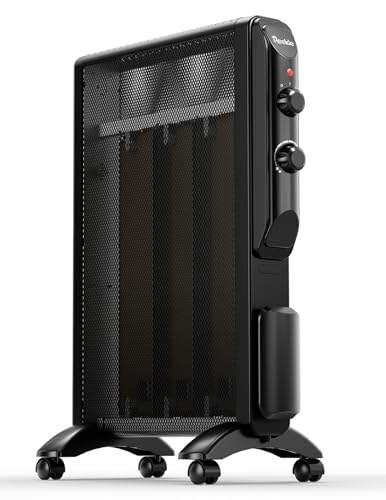
A mica panel is an oil-filled radiator that gave up its bulk: silent, radiant, three to five inches deep. The category's one brand-name unit left the market in October, which changes the answer.
By Scooter M. · Published November 21, 2026 · Last reviewed November 21, 2026
How this page is funded: we earn a commission if you buy through the links here, at no extra cost to you. Picks are chosen before links are attached, which is why every roundup names something to skip. Full disclosure.
Of the mica panels you can actually buy in November 2026, the Pasapair HP2501-15AW is the pick: it publishes three wattages (600 / 900 / 1,500 W), a 41-97°F set-point, an anti-frost mode, and it is the only one that comes with a wall-mount kit — which is the whole point of a three-inch-deep heater. If you want the lowest hourly cost, the Reekie HV1901-15 publishes a 750 W low step, the lowest in the category. The De'Longhi HMP1500 is no longer purchasable, and it is what most people searching for a mica heater have in mind.
What a micathermic heater actually is
A mica panel is a resistance element sandwiched between sheets of mica, a mineral that spreads heat across a flat surface and radiates it. The result sits between the two types most people know: it radiates like an oil-filled radiator and it warms up in well under a minute like a ceramic heater, because there is no oil to bring up to temperature. There is no fan, so there is no noise and nothing blown around the room.
The price of all that is depth, or rather the lack of it. A mica panel is typically three to five inches deep and roughly two feet square, which is why the category exists at all: it is the fanless heater that does not eat the floor. Our explainer on the type goes further into how the element works.
Mica panel
Oil-filled radiator
Ceramic fan heater
Time to feel warmth
Under a minute
15-30 minutes
Under a minute
Noise
None — no fan
None — no fan
Audible fan
Heat after it switches off
Minutes
Up to an hour — the oil is the store
Seconds
Depth
3-5 in
9-14 in
6-10 in
Surface temperature
Hot to the touch by design
Hot, but spread over more area
Housing usually cool-touch
Wall-mountable
Sometimes — check, most are not
No
Some models
Cost per hour at 1,500 W
27.5¢
27.5¢
27.5¢
The three fanless-or-nearly types, compared on the attributes that separate them. Costs are identical at identical wattage, because every electric resistance heater converts essentially all of its input into heat.
The state of this category in November 2026, which is the real answer
Mica is the one product type on this site where the honest roundup has to start with what is missing. De'Longhi's HMP1500 was the category's reference unit — it published its wattages, its voltage, its thermostat behavior, its anti-freeze setting, its tip-over switch and its wall bracket, on De'Longhi's own site. It went out of stock in October 2026 and its Amazon listing left the catalogue entirely.
What is left is one brand that publishes a reasonable specification sheet on its retail listing and a cluster of unbranded panels of varying honesty. That is not a reason to avoid mica — the type does something no other type does — but it changes what you are buying. You are buying a form factor, not a brand, and the specification you can verify is whatever the listing says, because for most of these there is no manufacturer site at all.
What mica costs to run, at every wattage these units publish
Setting
Current at 120 V
Covers (10 W/sq ft)
Per hour
A month at 8 h/day
1,500 W
12.50 A
150 sq ft
27.5¢
$66.02
1,000 W
8.33 A
100 sq ft
18.3¢
$44.02
900 W
7.50 A
90 sq ft
16.5¢
$39.61
750 W
6.25 A
75 sq ft
13.8¢
$33.01
600 W
5.00 A
60 sq ft
11.0¢
$26.41
Computed at 18.34¢/kWh — the U.S. residential average for June 2026 (EIA, Electric Power Monthly, Table 5.6.A). Coverage is watts ÷ 10 at this site's baseline sizing rule: average insulation, 8-foot ceiling. Current is watts ÷ 120 V.
Two things fall out of that table. First, a mica panel is not cheaper to run than any other heater of the same wattage — the "energy saving" language the category leans on describes the low setting, not the technology. Second, the low setting is where mica earns its keep: these are heaters you leave on for hours in one room, and 600 W for five hours costs 55 cents while 1,500 W for the same five hours costs $1.38. Why no heater is cheaper to run is the longer version of that argument.
The picks
Quick picks
Ranked for fit, not for hype. Coverage and current draw are computed from each unit’s published wattage. Tap a row for the full write-up, or go straight to the listing.
#
Product
Best for
Covers
Draw
Price
1
Pasapair HP2501-15AWThe rare mica panel that publishes all three of its wattages and a thermostat you can set to the degree — which is what makes the cheap settings costable instead of guessable.
Reekie HV1506S-15DThe only mica panel here with four modes, a remote, a 24-hour timer and an anti-frost preset, and it publishes both of its wattages — which is the minimum this site needs before it can cost a heater at all.
Reekie HV1901-15The mica panel to buy if you want to run it low all evening: 750 watts is the lowest published step in this category, and it is the only mica heater here that publishes a decibel figure at all.
Reekie HV1201The entry point to the category: two knobs, two published wattages, four casters and a cord winder. Nothing it does is clever and nothing it claims is impossible.
Top pick · A slim fanless panel, on the wall or on castors
Pasapair HP2501-15AW Mica Panel Heater
The rare mica panel that publishes all three of its wattages and a thermostat you can set to the degree — which is what makes the cheap settings costable instead of guessable.
Rated power
1,500 W / 600 W low
Covers (computed)
150 sq ft
Draw (computed)
12.5 A at 120 V
Cost per hour
27.5¢
Coverage at 10 W/sq ft, average insulation, 8 ft ceiling = 5,118 BTU/h. Cost at 18.34¢/kWh; an eight-hour night at full output is $2.20. Exceeds the 12 A continuous limit of a 15 A circuit — check what else shares the breaker.
What works
All three wattages are published — 600 W, 900 W and 1,500 W — so the economical settings cost 11.0¢ and 16.5¢ an hour rather than an unknown amount
A thermostat set to the degree from 41 to 97°F, plus an anti-frost mode preset at 41°F for a room you are only keeping above freezing
Fanless by construction: mica panels radiate and convect, so there is no blower to hear and nothing blown off the floor
The wall-mount kit and the castors are both in the box, so the floor-space decision is not an extra purchase
What does not
The brand publishes nothing outside this listing. We could find no manufacturer site or spec sheet for Pasapair, so every figure here has exactly one source — unlike the De'Longhi it replaces, whose maker published its own page
The 250 sq ft coverage claim is 6 W per square foot. At the 10 W per square foot this site sizes by, 1,500 W covers about 150 sq ft, and in a drafty room about 120
No UL or ETL mark is published anywhere in the listing; the IP24 figure in the title is water ingress and is not a safety listing
The app needs 2.4 GHz Wi-Fi, the remote's batteries are not included, and the listing's own dimension fields are implausible for a 1,500 W panel — so we do not publish a size for it
Published specification
Rated power
600 W / 900 W / 1,500 W at 120 V — all three published on the listing
Element
Mica panels behind a perforated metal front panel; no fan
Thermostat
41–97°F set-point
Modes
Comfort, ECO, Anti-Frost (preset at 41°F) and Open Window Detection
Controls
Touch panel, remote (2 AAA, not included), Smart Life app and Alexa; 2.4 GHz Wi-Fi only
Timer
24/7 weekly scheduling through the app
Mounting
Wall-mount kit and 360° swivel castors both in the box; rear carry handle
Safety
Overheat protection and a tip-over switch
Maker's coverage claim
“rooms up to 250 sq. ft.” — our figure is 150 sq ft at 10 W per square foot
Warranty
12 months
Heat type
Micathermic
Maker’s coverage claim
250 sq ft
Safety listing
No UL or ETL mark is published in the listing. The title's IP24 claim is a water-ingress rating, not a safety listing — check the rating plate.
Who it is for
A small bedroom, study or hallway where floor space is tight and fan noise is the thing you are trying to avoid, and where being able to run 600 W rather than 1,500 W all evening matters.
What it is not for
A nursery or a home with toddlers at floor level — a mica panel is hot to the touch by design, and there is no child lock. Also not a large or drafty room: 1,500 W is 1,500 W whatever the listing claims.
The only mica panel here with four modes, a remote, a 24-hour timer and an anti-frost preset, and it publishes both of its wattages — which is the minimum this site needs before it can cost a heater at all.
Rated power
1,500 W / 1,000 W low
Covers (computed)
150 sq ft
Draw (computed)
12.5 A at 120 V
Cost per hour
27.5¢
Coverage at 10 W/sq ft, average insulation, 8 ft ceiling = 5,118 BTU/h. Cost at 18.34¢/kWh; an eight-hour night at full output is $2.20. Exceeds the 12 A continuous limit of a 15 A circuit — check what else shares the breaker.
What works
Both wattages are published, so both settings can be costed — 27.5 cents an hour on high and 18.3 on the 1,000 W step
An anti-frost mode and a 24-hour timer, which together make it the only mica panel here that can be left to hold a spare room
Four modes and a remote, on a form factor that is usually sold with two knobs
No fan, so no noise, no blown dust and nothing to seize
What does not
The listing claims "97.68% conversion efficiency" and the number means nothing. Every electric resistance heater converts essentially 100% of its input into heat; a mica panel cannot beat a ceramic heater on efficiency and nobody can be 97.68% of the way to a limit they are already at
No wall-mounting, which is half of what a three-inch-deep panel is normally for — this one is a floor unit on casters
No safety devices are itemised and no listing mark is published. "Safety protection" is not a specification
The brand publishes nothing outside the retail listing — no manufacturer site, no manual, no warranty statement that we could find
The panel surface is hot by design: this is not a cool-touch heater and there is no child lock
Published specification
Rated power
1,500 W / 1,000 W, both published
Modes
Comfort, ECO, Anti-frost and Manual
Controls
Touch screen on the unit plus a remote (2x AAA not included)
Timer
24 hours
Element
Three-piece mica panel — radiant plus convection, no fan
Current draw
12.5 A on high, 8.33 A on the 1,000 W step, at 120 V
Size
28 in wide x 26.2 in high x 10.2 in deep, 10.8 lb
Maker's coverage claim
None published. Our figure is 150 sq ft on high at 10 W per square foot, about 100 sq ft on the 1,000 W step
Safety
Not itemised in the listing beyond "safety protection". No listing mark published
Heat type
Micathermic
Maker’s coverage claim
None published — the coverage figure above is ours
Safety listing
No UL or ETL mark is published in the listing, and no manufacturer site for this brand could be found. Check the rating plate.
Who it is for
A bedroom or study where silence matters more than anything else and where a timer and a set-point are worth more than a brand name.
What it is not for
A nursery or a home with toddlers — a mica panel is hot to the touch and this one has no child lock. Also not a wall installation, despite what the category usually offers.
The mica panel to buy if you want to run it low all evening: 750 watts is the lowest published step in this category, and it is the only mica heater here that publishes a decibel figure at all.
Rated power
1,500 W / 750 W low
Covers (computed)
150 sq ft
Draw (computed)
12.5 A at 120 V
Cost per hour
27.5¢
Coverage at 10 W/sq ft, average insulation, 8 ft ceiling = 5,118 BTU/h. Cost at 18.34¢/kWh; an eight-hour night at full output is $2.20. Exceeds the 12 A continuous limit of a 15 A circuit — check what else shares the breaker.
What works
A published 750 W low step — the lowest in the mica category here, and the one that makes an all-evening run cost 13.8 cents an hour instead of 27.5
A published decibel figure, which almost nothing in this category offers. 23 dB is a claim about a heater with no fan, so it is at least a plausible one
Tip-over protection with a stated angle, which is a specification rather than a reassurance
The slimmest mica panel here at 5.7 inches deep, and the cheapest
What does not
"96.53% efficiency" is not a feature. All electric resistance heat is essentially 100% efficient; the number is decoration and its presence is a reason to read the rest of the listing carefully
Two knobs and nothing else — no timer, no remote, no anti-frost mode and no numbers on the thermostat, so "hold this room at 65" is not a thing you can ask it to do
No wall-mounting and no listing mark published
"29 seconds" to warmth is a surface-temperature claim, not a room claim. A 1,500 W panel warms a 150 sq ft room at the same rate as any other 1,500 W heater
Hot to the touch by design, with no child lock
Published specification
Rated power
1,500 W ('II') / 750 W ('I'), both published
Published noise
23 dB (the maker's figure; we have no way to verify it)
Controls
Two knobs — a thermostat knob and a power-level knob. No timer, no remote, no set-point numbers
Current draw
6.25 A on the 750 W step, 12.5 A on high, at 120 V
Safety
45-degree tip-over protection, overheat protection, V0 flame-retardant material. No listing mark published
Size
19.5 in wide x 21.3 in high x 5.7 in deep
Maker's coverage claim
None published. Our figure is 150 sq ft on high, about 75 sq ft on the 750 W step
Element
Mica panel — far-infrared plus convection, no fan
Heat type
Micathermic
Maker’s coverage claim
None published — the coverage figure above is ours
Safety listing
No UL or ETL mark is published in the listing, and no manufacturer site for this brand could be found. The listing does name V0 flame-retardant material and 45-degree tip-over protection. Check the rating plate.
Who it is for
A small bedroom or study where the heater will be left on a low setting for hours and silence is the whole point.
What it is not for
Anyone who wants to set a temperature by number, mount it on a wall, or leave it running to a schedule.
The entry point to the category: two knobs, two published wattages, four casters and a cord winder. Nothing it does is clever and nothing it claims is impossible.
Rated power
1,500 W / 1,000 W low
Covers (computed)
150 sq ft
Draw (computed)
12.5 A at 120 V
Cost per hour
27.5¢
Coverage at 10 W/sq ft, average insulation, 8 ft ceiling = 5,118 BTU/h. Cost at 18.34¢/kWh; an eight-hour night at full output is $2.20. Exceeds the 12 A continuous limit of a 15 A circuit — check what else shares the breaker.
What works
Both wattages published, which is the whole bar for inclusion here and which a third of this category fails
A cool-touch handle and four caster wheels, so the one thing a hot panel should never need — picking it up by the body — is designed out
The cheapest mica panel with a live offer, by a clear margin
No fan: silent, and nothing blown around a bedroom
What does not
No wall mount, no timer, no remote and no numbers on the thermostat — this is the plainest unit in the category
The listing's own warning that "slight white smoke on initial or prolonged non-use is normal" is honest and also exactly what you do not want to read about a heater you intend to leave in a spare room
No listing mark, no warranty statement and no manufacturer site we could find
The 1,000 W low step is higher than the 750 W this site prefers for an all-evening hold
Hot panel, no child lock
Published specification
Rated power
1,500 W ('II') / 1,000 W ('I'), both published
Controls
Thermostat knob and power-level knob. No timer, no remote
Current draw
8.33 A on the 1,000 W step, 12.5 A on high, at 120 V
Safety
Overheat protection and tip-over protection. No listing mark published
Mobility
Four swivel caster wheels, a cool-touch handle and a cord winder
Size
19.3 in wide x 27.2 in high x 5.1 in deep, 7.9 lb
Element
Mica panel — far-infrared plus convection, no fan
Maker's coverage claim
None published. Our figure is 150 sq ft on high, about 100 sq ft on the 1,000 W step
Heat type
Micathermic
Maker’s coverage claim
None published — the coverage figure above is ours
Safety listing
No UL or ETL mark is published in the listing, and no manufacturer site for this brand could be found. The listing names overheat and tip-over protection. Check the rating plate.
Who it is for
A spare room, study or small bedroom where the brief is silent heat for as little money as the category allows.
What it is not for
A nursery, a wall installation, or anyone who needs the heater to turn itself off.
A published rated wattage, or it is not on this page. Every cost and sizing figure on this site is computed from watts, so a mica panel that publishes "three heat settings" and no numbers cannot be costed and cannot be ranked. This excluded more of the category than any other rule.
A published low step counts for a lot. Mica's job is holding a room quietly for hours, and the hourly cost of holding it is set entirely by the wattage you can choose.
A live, in-stock offer on the day of writing, verified through the Amazon catalogue API rather than assumed from a cached page.
Controls that let you name a temperature, or at least a mode. A thermostat knob with no numbers is a guess you re-make every evening.
Efficiency percentages were treated as a demerit, not a feature. Every electric resistance heater converts essentially all of its input into heat; a listing advertising 96.53% or 97.68% conversion is telling you about its copywriter, not its element.
No claim of ours about build quality, longevity or how any of these feel in a room. We have not run them. What follows is what each maker publishes, checked against arithmetic.
And what we did not do: we have not tested these units, owned them, measured them or run them in a room. Everything above is compiled from published manufacturer specifications and live retail listings, with the electrical load, room coverage and running cost computed by us from the published wattage. The full method.
What we’d skip, and why
Every roundup on this site names something to skip. It costs us nothing to publish and it is the fastest way to tell whether a buying guide was written for you or for its commission.
Any mica panel that does not publish its wattage
This is the single biggest problem in the category, and the Ballu panels are the clearest example: they publish a two-year warranty, a programmable thermostat and Wi-Fi app control, and no wattage anywhere in the listing. Without rated watts there is no running cost, no coverage figure and no current draw — three of the four things you need to know before plugging a 12.5 A appliance into a bedroom wall. A heater whose consumption is unstated is not cheap or expensive; it is unknown.
A mica panel sold on a coverage claim with no wattage behind it
One live panel claims "Coverage up to 400 Sq.ft." and publishes no rated power at all. Four hundred square feet needs about 4,000 W at 10 watts per square foot; a 120 V outlet tops out at 1,500 W, which is about 150 sq ft. The claim is not a stretch, it is arithmetically impossible on the circuit the heater plugs into — and the giveaway is that the listing never states the watts that would let you check it.
The De'Longhi HMP1500, which is the one most people are actually looking for
Not because it was bad — it was the best-documented mica panel sold in the US, and it is why half the search traffic for "micathermic heater" exists. It has simply stopped being purchasable: its Amazon listing left the catalogue in October 2026, and De'Longhi's own US page reads "Out of stock" with a notify-me button. The only HMP1500 listing left is a French-market import at roughly triple the price, which is a different product for a different grid. Our review of it stays up as a record of what the category used to publish.
What a mica panel will not fix
It will not be safe around a toddler. The whole front face is the heat exchanger and it is hot to the touch by design — that is not a flaw, it is how a fanless radiant panel works, and it is the one hard reason to buy something else. None of the panels here publishes a child lock except by implication, and a hot surface at knee height is a burn risk a cutoff cannot prevent. The nursery roundup exists for exactly this reason, and nothing on this page belongs on it.
It will not heat a room its wattage cannot heat. 1,500 W is 1,500 W, whatever the listing says about far-infrared or three-dimensional heating. If the room is 300 sq ft, no 120 V panel will hold it on a cold night, and the honest options are a bigger circuit or a smaller expectation — the sizing page does the arithmetic properly.
It will not dry the air out, and it will not humidify it either. No electric heater removes water from a room; what it does is raise the air temperature, which lowers the relative humidity at the same absolute moisture content. A fanless panel does less of the drying-feeling than a fan heater because it is not moving air across your skin, which is a real comfort difference and not a humidity one. The full explanation.
It will not run silently if it has a fan, and a handful of listings now call a fan-forced panel "mica infrared" because the element has mica in it. If the listing mentions CFM, airflow or "fast circulation", it is a fan heater in a flat case. The panels on this page have no fan at all, which is why they are here.
Questions people actually ask
Are micathermic heaters any good?+
For one specific job, yes: silent radiant heat from something three to five inches deep. They warm up in seconds like a ceramic heater and radiate like an oil-filled radiator, with no fan noise and nothing blown around the room. They are a poor choice anywhere a hot surface is a problem, and they are no cheaper to run than any other heater of the same wattage.
Are micathermic heaters cheap to run?+
They cost exactly what any other electric heater of the same wattage costs: 27.5 cents an hour at 1,500 W, 13.8 cents at 750 W, computed at 18.34¢/kWh. There is no efficiency advantage to mica — every electric resistance heater converts essentially 100% of its input into heat. What makes a mica panel cheap to run is choosing a low setting and leaving it there, which is why a published low wattage matters more than the element type.
Are micathermic heaters energy efficient?+
No more and no less than a $20 ceramic heater. The listings in this category are unusually fond of efficiency percentages — 96.53%, 97.68% — and those numbers are meaningless: all resistance heating is essentially 100% efficient at converting electricity to heat, so there is no headroom for one element to beat another. Efficiency in heating comes from the thermostat and the hours, not the technology.
Are micathermic heaters safe?+
They have no fan and no visibly glowing element, and the units on this page publish overheat and tip-over cut-outs. The real hazard is the surface: a mica panel is hot to the touch across its whole face, so it needs the same three feet of clearance from combustibles as any heater and it is the wrong choice around small children or pets at floor level. None of the panels here publishes a UL or ETL mark, which is a genuine gap — check the rating plate on the unit itself.
Micathermic or oil-filled: which should I buy?+
Mica if you want heat within a minute and you cannot spare the floor space; oil-filled if you want a maker who publishes a manual, a warranty and a safety listing, and you do not mind waiting twenty minutes for the oil to come up to temperature. Oil-filled also keeps giving heat after the thermostat cuts out, because the oil is a thermal store; mica stops almost immediately. Our comparison of the two types goes into the detail.
Can you wall-mount a micathermic heater?+
Some of them, and it is worth checking before you buy, because a three-inch panel on the wall is the configuration the form factor exists for. Of the live panels here, the Pasapair ships with a wall-mount kit; the Reekie units are floor-standing on casters. A wall-mounted panel also solves the hot-surface problem by putting the surface out of reach.
What size mica heater do I need?+
The same rule as any other heater: about 10 watts per square foot with average insulation and an 8-foot ceiling. That makes 1,500 W about 150 sq ft, 1,000 W about 100 sq ft and 750 W about 75 sq ft. In a drafty room, or one with an outside wall on two sides, take 20% off. Our calculator does it with your own numbers.
A child lock, a metal cabinet, a published ETL mark, a 28 dB figure — six heaters that each bring one of them in under $100.
Written by Scooter M., an enthusiast — not a tester and not a certified anything. Every figure on this page is either published by the manufacturer, taken from a live retail listing, or computed from the published wattage using the formulas we publish. Found an error? Tell us and we will correct it, visibly and with a date on it.