For a bedroom, an oil-filled radiator or a micathermic panel with a programmable timer is the strongest combination: no fan means no noise, the sealed oil keeps the temperature steady between cycles, and the timer lets you heat the room without leaving a heater running unattended all night.
Noise. Every fan-forced heater makes sound, and a sound that is unnoticeable at 9 p.m. is not unnoticeable at 3 a.m. Only two heater types are genuinely silent: oil-filled radiators and micathermic panels, both of which have no fan at all.
Unattended running. The safety guidance here is unambiguous — the USFA says to turn space heaters off when you leave the room or go to bed — and the fatality data behind that guidance is set out on our fire-risk page. A programmable timer resolves the tension: the heater warms the room while you fall asleep, then stops.
Temperature swing. A heater that overshoots and then lets the room fall five degrees will wake you twice a night. This is where oil-filled units have a genuine physical advantage: the oil keeps radiating after the element cuts out, so the room drifts rather than dropping.
Bedrooms are usually small, so this is a room where the low setting is often the right setting. Here is an eight-hour night at three wattages.
| Wattage | Per hour | 8 hours |
|---|
| 750 W | 13.8¢ | $1.10 |
| 1,000 W | 18.3¢ | $1.47 |
| 1,500 W | 27.5¢ | $2.20 |
Computed at 18.34¢/kWh — the U.S. residential average for June 2026 (EIA, Electric Power Monthly, Table 5.6.A, released August 26, 2026). Your rate is on your own bill; substitute it and the arithmetic still holds. Figures assume full output for the whole period.
And that is the worst case — full output for the entire night. A correctly sized heater with a working thermostat in a closed bedroom will typically cycle at somewhere between 40% and 60% duty once the room is up to temperature, so halve those figures for a realistic month.
Quick picks
Ranked for fit, not for hype. Coverage and current draw are computed from each unit’s published wattage. Tap a row for the full write-up, or go straight to the listing.
| # | Product | Best for | Covers | Draw | Price |
|---|
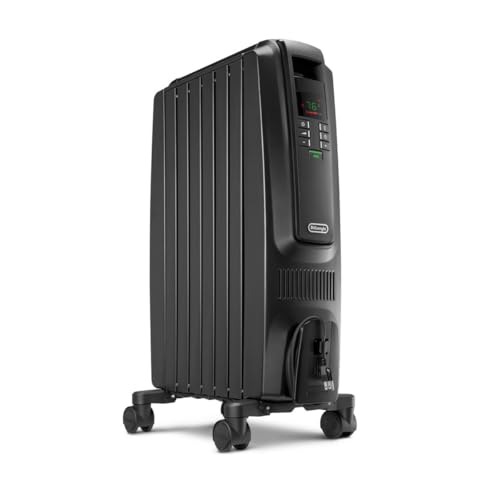
| 1 | De'Longhi Dragon DigitalThe oil-filled radiator with a programmable timer, which is the version that matters overnight: it can bring a bedroom up before you wake and shut itself off, unattended, without you leaving it running all night. | Overnight, on a schedule | 150 sq ft | 12.5 A | $189.95 · Check on Amazon |
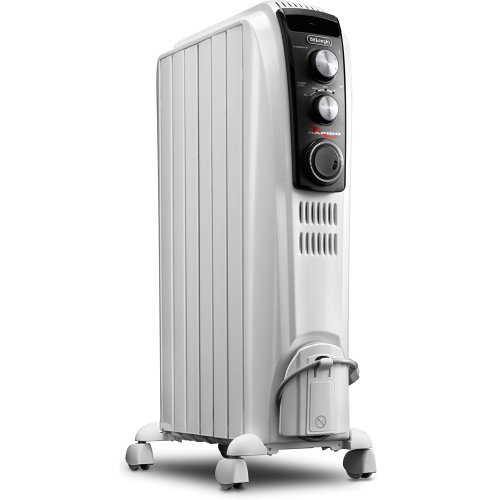
| 2 | De'Longhi TRD40615TNo fan, so no noise and no moving dust — and the sealed oil keeps radiating after the element cuts out, which is why an oil-filled unit feels steadier than a ceramic one at the same wattage. | Silence, and a bedroom | 150 sq ft | 12.5 A | $159.95 · Check on Amazon |
| 3 | De'Longhi HMP1500A micathermic panel is a radiator that gave up its bulk: it radiates like oil-filled and warms up like ceramic, and it is about three inches deep so it can live against a wall. | A slim profile against a wall | 150 sq ft | 12.5 A | $129.95 · Check on Amazon |
| 4 | VornadoNo photo Vornado VH200Circulates the room's air instead of aiming a hot jet at your shins — the difference you feel is uniformity, not output, because the output is the same 1,500 W as everything else. | Even heat, not a hot spot | 150 sq ft | 12.5 A | Check price on Amazon |
Coverage computed at 10 W/sq ft, average insulation, 8 ft ceiling. Draw computed as watts ÷ volts. Neither figure is a manufacturer claim.
#ad · how this site is funded · price as of October 18, 2026
Top pick · Overnight, on a schedule
De'Longhi Dragon Digital Oil-Filled Radiator (TRD40615EBK)
The oil-filled radiator with a programmable timer, which is the version that matters overnight: it can bring a bedroom up before you wake and shut itself off, unattended, without you leaving it running all night.
- Rated power
- 1,500 W
- Covers (computed)
- 150 sq ft
- Draw (computed)
- 12.5 A at 120 V
- Cost per hour
- 27.5¢
Coverage at 10 W/sq ft, average insulation, 8 ft ceiling = 5,118 BTU/h. Cost at 18.34¢/kWh; an eight-hour night at full output is $2.20. Exceeds the 12 A continuous limit of a 15 A circuit — check what else shares the breaker.
What works
- A programmable timer is the honest answer to “can I leave it on overnight” — you don't have to
- Silent, like every oil-filled unit: no fan, no moving air
- Digital control means you set a temperature, not a knob position
What does not
- Costs more than the mechanical TRD40615T for identical heat output
- Same slow warm-up as any oil-filled radiator
- Heavy and bulky for its coverage — 26 inches of steel you will not be carrying upstairs
| Published specification |
|---|
| Rated power | 1,500 W at 120 V |
| Controls | Digital, with a 24-hour programmable timer |
| ECO function | Regulates power and temperature rather than running at full output |
| Dimensions | 16" x 10" x 26" |
| Fluid | Permanently sealed diathermic oil |
| Safety | Child lock, thermal cut-off |
| Maker's coverage claim | None published — sold as a full-room heater |
| Heat type | Oil-filled |
| Maker’s coverage claim | None published — the coverage figure above is ours |
| Safety listing | No listing mark published in the listing text; verify the UL or ETL mark on the rating plate. |
Who it is for
A bedroom where the heater needs to run on a schedule rather than all night, and where noise would wake you.
What it is not for
A room you need warm in five minutes, or a tight space where a hot 26-inch radiator cannot keep 3 feet of clearance.
2 · Silence, and a bedroom
De'Longhi TRD40615T Oil-Filled Radiator Heater
No fan, so no noise and no moving dust — and the sealed oil keeps radiating after the element cuts out, which is why an oil-filled unit feels steadier than a ceramic one at the same wattage.
- Rated power
- 1,500 W
- Covers (computed)
- 150 sq ft
- Draw (computed)
- 12.5 A at 120 V
- Cost per hour
- 27.5¢
Coverage at 10 W/sq ft, average insulation, 8 ft ceiling = 5,118 BTU/h. Cost at 18.34¢/kWh; an eight-hour night at full output is $2.20. Exceeds the 12 A continuous limit of a 15 A circuit — check what else shares the breaker.
What works
- Genuinely silent: there is no fan to hear at 3 a.m.
- The oil holds heat, so the room temperature swings less between thermostat cycles
- Nothing blows air, so nothing stirs up dust in a bedroom
What does not
- Slow. It takes 20–30 minutes to feel like it is doing anything
- Heavy — the wheels are not a courtesy, they are a requirement
- The surface gets genuinely hot; this is a radiator, not a cool-touch case
| Published specification |
|---|
| Rated power | 1,500 W at 120 V |
| Controls | Mechanical, with a programmable 24-hour timer |
| Fluid | Permanently sealed diathermic oil — never needs refilling |
| Maker's claim | Up to 75% more radiant surface area |
| Mobility | Front and rear handles, snap-on wheels |
| Heat type | Oil-filled |
| Maker’s coverage claim | None published — the coverage figure above is ours |
| Safety listing | No listing mark published in the listing text; verify the UL or ETL mark on the rating plate. |
Who it is for
A bedroom, a nursery at a safe distance, or anywhere the fan noise of a ceramic heater is the actual problem you are trying to solve.
What it is not for
Fast heat, and not a room you only occupy for twenty minutes. It also should never be tucked beside a bed or curtain — hot surface, 3-foot rule.
3 · A slim profile against a wall
De'Longhi HMP1500 Mica Panel Heater
A micathermic panel is a radiator that gave up its bulk: it radiates like oil-filled and warms up like ceramic, and it is about three inches deep so it can live against a wall.
- Rated power
- 1,500 W / 750 W low
- Covers (computed)
- 150 sq ft
- Draw (computed)
- 12.5 A at 120 V
- Cost per hour
- 27.5¢
Coverage at 10 W/sq ft, average insulation, 8 ft ceiling = 5,118 BTU/h. Cost at 18.34¢/kWh; an eight-hour night at full output is $2.20. Exceeds the 12 A continuous limit of a 15 A circuit — check what else shares the breaker.
What works
- No fan, so no noise and nothing blown around a room
- Warms up far faster than an oil-filled radiator of the same wattage
- Wall-mountable, which gets it out of the floor space it would otherwise eat
What does not
- The panel surface is hot to the touch — this is not a cool-touch design
- No published coverage figure
- Radiant heat is directional: stand behind it and you will not feel much
| Published specification |
|---|
| Rated power | 1,500 W high / 750 W low, at 120 V |
| Element | Mica panel — radiant plus convection, no fan |
| Mounting | Freestanding or wall-mountable |
| Controls | Adjustable thermostat, two heat settings |
| Frost mode | Standby setting holding the room above 41°F |
| Safety | Thermal shut-off, internal tip-over switch, standby setting |
| Heat type | Micathermic |
| Maker’s coverage claim | None published — the coverage figure above is ours |
| Safety listing | No listing mark published in the listing text; verify the UL or ETL mark on the rating plate. |
Who it is for
A room where floor space is tight and fan noise is unwelcome — a small bedroom, a study, a hallway landing.
What it is not for
A nursery or a household with toddlers, unless it is wall-mounted well out of reach. A hot panel at knee height is a burn, not a fire.
VornadoNo photo
4 · Even heat, not a hot spot
Vornado VH200 Whole Room Vortex Heater
Circulates the room's air instead of aiming a hot jet at your shins — the difference you feel is uniformity, not output, because the output is the same 1,500 W as everything else.
- Rated power
- 1,500 W
- Covers (computed)
- 150 sq ft
- Draw (computed)
- 12.5 A at 120 V
- Cost per hour
- 27.5¢
Coverage at 10 W/sq ft, average insulation, 8 ft ceiling = 5,118 BTU/h. Cost at 18.34¢/kWh; an eight-hour night at full output is $2.20. Exceeds the 12 A continuous limit of a 15 A circuit — check what else shares the breaker.
What works
- Cool-touch case: the outside does not become the hazard the inside is
- A 5-year warranty on a $75 heater is an unusual amount of skin in the game
- Whole-room circulation means fewer cold corners at the same wattage
What does not
- A control knob, not a digital thermostat — you cannot set a number
- Vornado's own page does not publish wattage, coverage or a decibel figure
- It is a fan. Air movement you can hear is how the design works, not a defect
| Published specification |
|---|
| Rated power | 1,500 W at 120 V (retail listings; Vornado publishes settings, not watts) |
| Heat settings | 3 |
| Thermostat | Thermostatic control knob |
| Safety | Tip-over switch, automatic safety shut-off, cool-touch case |
| Warranty | 5-year limited |
| Heat type | Fan-forced |
| Maker’s coverage claim | None published — the coverage figure above is ours |
| Safety listing | Vornado's product page publishes an “Automatic Safety Shut-off System” and a tip-over switch but does not name a listing mark; check the rating plate. |
Who it is for
A bedroom or living room where the complaint is “one end is warm and the other isn't”, rather than “it never gets warm”.
What it is not for
Silent operation, and not a garage. A moving-air heater in an uninsulated space is heating the outdoors with extra steps.
Every roundup on this site names something to skip. It costs us nothing to publish and it is the fastest way to tell whether a buying guide was written for you or for its commission.
Any heater without a timer, if the plan is to run it all night
This is the one skip on this site that is about a behavior rather than a product. The U.S. Fire Administration's guidance is to turn space heaters off when you go to bed, and unattended equipment is a named contributing factor in its portable heater report. A programmable timer is what lets you follow that guidance and still be warm: it heats the room while you fall asleep and stops. A heater with no timer forces the choice, and people choose wrong at midnight. The full overnight discussion is here.
A fan-forced ceramic tower, if noise is why you are shopping
Ceramic towers are excellent heaters and several of them appear elsewhere on this site. In a bedroom they have an unavoidable problem: the fan is not a feature you can turn off, it is how the design moves heat. “Whisper quiet” is a marketing phrase; 39 dB is a specification. If the listing does not publish a decibel figure, assume you will hear it, and buy a unit with no fan at all instead.
Not beside the bed. The single most common arrangement in the fatal-fire data is a heat source too close to something that burns, and a bedroom contains more soft furnishings per square foot than any other room in the house. Keep the three feet of clearance from the duvet, the curtains and the laundry pile, plug it directly into the wall rather than an extension cord, and put it on a hard floor surface rather than on a rug if you can.
If your bedroom genuinely has no three feet of clear floor — which is common in a small room — a wall-mounted unit sidesteps the whole problem, and a tabletop heater on a clear hard surface is the next best thing.
- No fan, or a published noise figure. A heater you can hear at 3 a.m. is a heater you turn off, which makes every other feature irrelevant.
- A timer. The safety guidance is not to run a heater unattended overnight; a programmable shut-off is how you get warmth at bedtime without leaving it running until morning.
- Temperature stability. A unit that swings the room by 5°F will wake you as reliably as a fan will.
- Clearance realism. Bedrooms are full of bedding and curtains, which is the exact combustible-proximity failure the fire data describes.
And what we did not do: we have not tested these units, owned them, measured them or run them in a room. Everything above is compiled from published manufacturer specifications and live retail listings, with the electrical load, room coverage and running cost computed by us from the published wattage. The full method.