“Whisper quiet” appears on nearly every listing in this category and means nothing. Two heater types have no fan at all, and one unit publishes an actual number.
By Scooter M. · Published August 31, 2026 · Last reviewed August 31, 2026
How this page is funded: we earn a commission if you buy through the links here, at no extra cost to you. Picks are chosen before links are attached, which is why every roundup names something to skip. Full disclosure.
The genuinely silent heaters are oil-filled radiators and micathermic panels, because neither has a fan. Every ceramic and fan-forced heater makes noise by design, since moving air is how it distributes heat. Almost no manufacturer publishes a decibel figure.
Silence is a design decision, not a quality difference
A heater is silent if and only if it has no fan. That is the whole test, and it maps exactly onto heater type: oil-filled radiators and micathermic panels distribute heat by radiation and natural convection, so nothing moves. Ceramic, fan-forced and most infrared units use a fan, and the fan is not an accessory — it is how 1,500 W of heat gets from a hot element into a room.
This means the noise question is settled before you compare brands. A premium fan-forced heater is a quieter fan-forced heater; it is not a silent one. If the reason you are shopping is that your current heater keeps you awake, the fix is a type change, not an upgrade.
The one number worth having
Among fan-forced units, exactly one on this site publishes a noise figure: 39 dB. For scale, a quiet library is around 40 dB and a refrigerator hum is around 40–45 dB, so a genuinely 39 dB heater is at the threshold where it stops being an event and becomes background. That figure being published at all is unusual enough to be worth rewarding.
The picks
Quick picks
Ranked for fit, not for hype. Coverage and current draw are computed from each unit’s published wattage. Tap a row for the full write-up, or go straight to the listing.
#
Product
Best for
Covers
Draw
Price
1
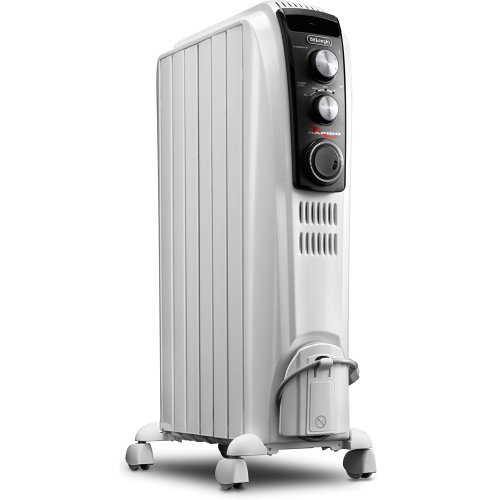
De'Longhi TRD40615TNo fan, so no noise and no moving dust — and the sealed oil keeps radiating after the element cuts out, which is why an oil-filled unit feels steadier than a ceramic one at the same wattage.
De'Longhi HMP1500A micathermic panel is a radiator that gave up its bulk: it radiates like oil-filled and warms up like ceramic, and it is about three inches deep so it can live against a wall.
De'Longhi Dragon DigitalThe oil-filled radiator with a programmable timer, which is the version that matters overnight: it can bring a bedroom up before you wake and shut itself off, unattended, without you leaving it running all night.
Dr Infrared DR-968The one listing in this category that publishes its amp draw and its noise level, which is exactly the arithmetic everyone else leaves you to do — 12.5 A and 39 dB, both stated.
No fan, so no noise and no moving dust — and the sealed oil keeps radiating after the element cuts out, which is why an oil-filled unit feels steadier than a ceramic one at the same wattage.
Rated power
1,500 W
Covers (computed)
150 sq ft
Draw (computed)
12.5 A at 120 V
Cost per hour
27.5¢
Coverage at 10 W/sq ft, average insulation, 8 ft ceiling = 5,118 BTU/h. Cost at 18.34¢/kWh; an eight-hour night at full output is $2.20. Exceeds the 12 A continuous limit of a 15 A circuit — check what else shares the breaker.
What works
Genuinely silent: there is no fan to hear at 3 a.m.
The oil holds heat, so the room temperature swings less between thermostat cycles
Nothing blows air, so nothing stirs up dust in a bedroom
What does not
Slow. It takes 20–30 minutes to feel like it is doing anything
Heavy — the wheels are not a courtesy, they are a requirement
The surface gets genuinely hot; this is a radiator, not a cool-touch case
Published specification
Rated power
1,500 W at 120 V
Controls
Mechanical, with a programmable 24-hour timer
Fluid
Permanently sealed diathermic oil — never needs refilling
Maker's claim
Up to 75% more radiant surface area
Mobility
Front and rear handles, snap-on wheels
Heat type
Oil-filled
Maker’s coverage claim
None published — the coverage figure above is ours
Safety listing
No listing mark published in the listing text; verify the UL or ETL mark on the rating plate.
Who it is for
A bedroom, a nursery at a safe distance, or anywhere the fan noise of a ceramic heater is the actual problem you are trying to solve.
What it is not for
Fast heat, and not a room you only occupy for twenty minutes. It also should never be tucked beside a bed or curtain — hot surface, 3-foot rule.
A micathermic panel is a radiator that gave up its bulk: it radiates like oil-filled and warms up like ceramic, and it is about three inches deep so it can live against a wall.
Rated power
1,500 W / 750 W low
Covers (computed)
150 sq ft
Draw (computed)
12.5 A at 120 V
Cost per hour
27.5¢
Coverage at 10 W/sq ft, average insulation, 8 ft ceiling = 5,118 BTU/h. Cost at 18.34¢/kWh; an eight-hour night at full output is $2.20. Exceeds the 12 A continuous limit of a 15 A circuit — check what else shares the breaker.
What works
No fan, so no noise and nothing blown around a room
Warms up far faster than an oil-filled radiator of the same wattage
Wall-mountable, which gets it out of the floor space it would otherwise eat
What does not
The panel surface is hot to the touch — this is not a cool-touch design
No published coverage figure
Radiant heat is directional: stand behind it and you will not feel much
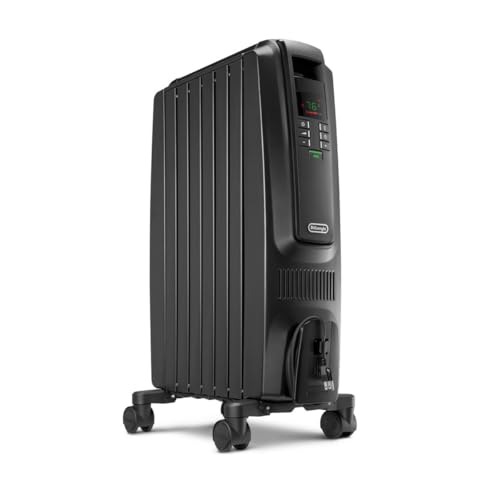
De'Longhi Dragon Digital Oil-Filled Radiator (TRD40615EBK)
The oil-filled radiator with a programmable timer, which is the version that matters overnight: it can bring a bedroom up before you wake and shut itself off, unattended, without you leaving it running all night.
Rated power
1,500 W
Covers (computed)
150 sq ft
Draw (computed)
12.5 A at 120 V
Cost per hour
27.5¢
Coverage at 10 W/sq ft, average insulation, 8 ft ceiling = 5,118 BTU/h. Cost at 18.34¢/kWh; an eight-hour night at full output is $2.20. Exceeds the 12 A continuous limit of a 15 A circuit — check what else shares the breaker.
What works
A programmable timer is the honest answer to “can I leave it on overnight” — you don't have to
Silent, like every oil-filled unit: no fan, no moving air
Digital control means you set a temperature, not a knob position
What does not
Costs more than the mechanical TRD40615T for identical heat output
Same slow warm-up as any oil-filled radiator
Heavy and bulky for its coverage — 26 inches of steel you will not be carrying upstairs
Published specification
Rated power
1,500 W at 120 V
Controls
Digital, with a 24-hour programmable timer
ECO function
Regulates power and temperature rather than running at full output
Dimensions
16" x 10" x 26"
Fluid
Permanently sealed diathermic oil
Safety
Child lock, thermal cut-off
Maker's coverage claim
None published — sold as a full-room heater
Heat type
Oil-filled
Maker’s coverage claim
None published — the coverage figure above is ours
Safety listing
No listing mark published in the listing text; verify the UL or ETL mark on the rating plate.
Who it is for
A bedroom where the heater needs to run on a schedule rather than all night, and where noise would wake you.
What it is not for
A room you need warm in five minutes, or a tight space where a hot 26-inch radiator cannot keep 3 feet of clearance.
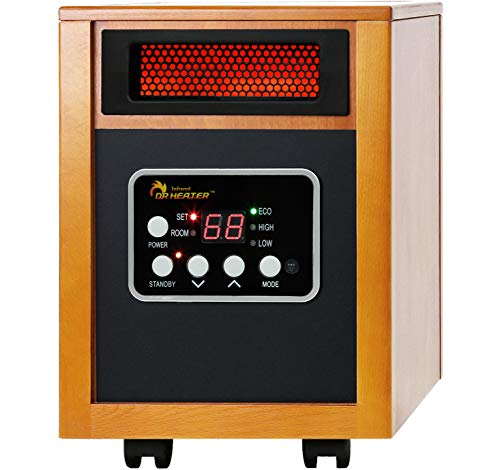
The one listing in this category that publishes its amp draw and its noise level, which is exactly the arithmetic everyone else leaves you to do — 12.5 A and 39 dB, both stated.
Rated power
1,500 W
Covers (computed)
150 sq ft
Draw (computed)
12.5 A at 120 V
Cost per hour
27.5¢
Coverage at 10 W/sq ft, average insulation, 8 ft ceiling = 5,118 BTU/h. Cost at 18.34¢/kWh; an eight-hour night at full output is $2.20. Exceeds the 12 A continuous limit of a 15 A circuit — check what else shares the breaker.
What works
Publishes 12.5 A, which is the number that decides whether it fits your circuit
Publishes 39 dB, which is the number that decides whether it fits your bedroom
A wooden-cabinet infrared unit runs cooler on the outside than a bare panel
What does not
19 lb with wheels: this is furniture, not a portable you carry between rooms
12.5 A against a 15 A circuit's 12 A continuous limit — it does not legally fit, see the circuit-load guide
Dated cabinet styling that will not disappear into a modern room
Published specification
Rated power
1,500 W at 120 V
Current draw
12.5 A (published)
Noise
39 dB (published)
Element
Infrared quartz tube plus PTC
Thermostat
Electronic, 50–85°F
Other
12-hour auto-off timer, IR remote, caster wheels, 19 lb
Heat type
Infrared quartz
Maker’s coverage claim
None published — the coverage figure above is ours
Safety listing
No listing mark published in the listing text; check the cabinet's rating plate for the UL or ETL mark.
Who it is for
A reader who wants to compute the load rather than trust a claim: the published amp draw and decibel figure make it the easiest unit on this site to check.
What it is not for
A 15 A circuit shared with anything else, and not a small room where a 19 lb cabinet on wheels is in the way.
Every roundup on this site names something to skip. It costs us nothing to publish and it is the fastest way to tell whether a buying guide was written for you or for its commission.
Any fan-forced heater sold as “whisper quiet” with no decibel figure
The phrase is unregulated and near-universal — it appears on tower heaters, on personal desk units and on 1,500 W ceramic blowers alike. A fan moving enough air to distribute 1,500 W of heat makes a sound in the 45–55 dB range, which is conversational-speech territory and unmissable in a quiet bedroom. If a listing wants credit for being quiet, it can publish a number; the Dr. Infrared DR-968 publishes 39 dB, which is how it earned a place in this roundup as the only fan-forced unit here.
An oil-filled radiator, if what bothers you is ticking rather than airflow
This is the honest caveat on the top pick. Oil-filled radiators have no fan, but they are large steel assemblies that expand as they heat and contract as they cool, and that movement makes an intermittent tick or click as the thermostat cycles. Most people never notice it. A minority find it worse than a steady fan, precisely because it is intermittent — a constant hum disappears into the background and an irregular tick does not. If that is you, a micathermic panel has far less metal mass and correspondingly less of it.
Placement changes perceived noise more than you would expect
A fan-forced heater on a hard floor against a bare wall is measurably louder in the room than the same unit on a rug in a furnished corner, because hard parallel surfaces reflect and reinforce. If you are stuck with a fan unit, moving it off a laminate floor and away from a corner is free and does more than most people expect.
The fanless types on this page have a second, quieter advantage: with no blower they do not lift settled dust into the room, which is the one genuine air-quality difference between heater types. Do space heaters dry out the air? works through that — and through why the dryness people blame on a heater is not something the heater did.
How these were picked
Fanless designs first. An oil-filled radiator or a mica panel has no moving parts in the heat path. That is silence you can rely on rather than describe.
A published decibel figure second. If a fan-forced unit is going to be considered at all, its noise has to be a number.
Marketing adjectives excluded entirely. “Whisper quiet” carries no information and appears on units that are audibly not.
Ticking accounted for, because metal expansion noise is the thing that actually wakes people with an otherwise silent heater.
And what we did not do: we have not tested these units, owned them, measured them or run them in a room. Everything above is compiled from published manufacturer specifications and live retail listings, with the electrical load, room coverage and running cost computed by us from the published wattage. The full method.
Questions people actually ask
Which space heater is the quietest?+
An oil-filled radiator or a micathermic panel — neither has a fan, so both are effectively silent apart from occasional expansion ticking. Among fan-forced units, look for a published decibel figure rather than the phrase “whisper quiet”.
How loud is a typical space heater?+
Fan-forced units generally sit in the 45–55 dB range, comparable to conversational speech. Very few manufacturers publish a figure, which is itself informative.
Do oil-filled radiators make noise?+
No fan noise. They do sometimes tick or click as the steel expands and contracts when the thermostat cycles. Most people never notice it; a minority find intermittent ticking more disruptive than a steady hum.
Are infrared heaters quiet?+
It depends on the design. A wall-mounted infrared panel with no fan is silent. A cabinet-style infrared unit usually has a blower to distribute the heat, and then it is as loud as any other fan-forced heater unless the maker publishes otherwise.
You sit still for hours, the room has no fourth wall, and the floor is full of feet. Picked on those three.
Written by Scooter M., an enthusiast — not a tester and not a certified anything. Every figure on this page is either published by the manufacturer, taken from a live retail listing, or computed from the published wattage using the formulas we publish. Found an error? Tell us and we will correct it, visibly and with a date on it.