Six decisions, and the order matters more than any of them individually. The first one eliminates most of the market, and almost nobody makes it first.
By Scooter M. · Published October 17, 2026 · Last reviewed October 17, 2026
How this page is funded: we earn a commission if you buy through the links here, at no extra cost to you. Picks are chosen before links are attached, which is why every roundup names something to skip. Full disclosure.
Work in this order: size the room in watts, decide whether you are heating the room or the person, pick the type by how much noise you can tolerate, insist on a thermostat with numbers, check the cutoffs, and only then choose a shape that suits where it will live. Step one eliminates most of the market: at 10 watts per square foot, the 1,500 W ceiling on every plug-in heater is about 150 sq ft.
Why the order is the whole technique
Most heater shopping starts at step six — a shape that looks right — and works backwards, which is how people end up with a tower heater that cannot warm the room it was bought for. The six decisions below are not equally important and they are not independent. Each one narrows what the next can be, and the first narrows it hardest.
None of this is about finding a better heater. Every plug-in heater sold in the United States is capped at 1,500 W, which means they all produce the same heat and cost the same per hour to run. What varies is fit — and fit is a property of your room, not of the product.
1. Size the room, in watts
The rule is 10 watts per square foot for a room with average insulation and an 8-foot ceiling. Multiply by 1.25 for a drafty or single-glazed room, by 1.5 for a space outside the heated envelope — a garage, an uninsulated basement, a sunroom — and by the ceiling height over eight feet, because heating is a volume problem that a floor-area rule hides.
Room size
Watts needed
BTU/h
Plug-in heaters
100 sq ft
1,000 W
3,412
1
150 sq ft
1,500 W
5,118
1
200 sq ft
2,000 W
6,824
2 (different circuits)
300 sq ft
3,000 W
10,236
2 (different circuits)
Computed as square feet x 10 W x insulation factor x (ceiling / 8 ft), for an average heated room — 10 W/sq ft, 8 ft ceiling. Heater count assumes the 1,500 W plug-in ceiling.
Then compare the answer with 1,500 W, because that is the ceiling and it is not negotiable: a 120 V, 15 A branch circuit may not carry more as a continuous load. If your room needs more than about 1,500 W, no plug-in heater will heat it, and the choice is a 240 V hardwired unit, more than one circuit, or accepting a supplement to your central heat rather than a replacement for it. The sizing calculator does this for your room; the rule and its corrections explains where the 10 comes from.
2. Decide whether you are heating the room or the person
This is the decision with the largest spread in cost and the one most buyers never consider. If the complaint is "my legs are cold at my desk for six hours a day", heating 3,000 cubic feet of air to fix it is the expensive way round.
150 W panel
750 W setting
1,500 W heater
Per hour
2.8¢
13.8¢
27.5¢
An 8-hour day
22¢
$1.10
$2.20
A month at 8 h/day
$6.60
$33.01
$66.02
Current draw at 120 V
1.25 A
6.25 A
12.5 A
What it can actually warm
One person's legs
About 75 sq ft
About 150 sq ft
Computed at 18.34¢/kWh (EIA, June 2026) at full output. The 150 W column is a radiant panel aimed at a person; the 1,500 W column is a room heater.
A tenth of the running cost and a tenth of the current, for the only outcome you asked for. The trade is real and absolute: a 150 W panel will not raise a room's air temperature at all, so this only works where the problem is a stationary person rather than a cold room. Desk and under-desk heaters is the full version of that argument.
3. Choose the type, which is really a noise decision
At equal wattage the types produce identical heat and cost identical money. What differs is how fast the heat arrives, where it goes, and whether you can hear it — and the single cleanest test is whether the unit has a fan.
Each type's own page has the mechanism in full. Nothing here is an efficiency ranking, because at the same wattage there is nothing to rank.
Two rules fall out of that table. If the heater is going in a bedroom, buy a fanless type — the noise is the thing that makes people stop using a heater, and it is the one property you cannot fix later. If the room is leaky or you only occupy it for twenty minutes at a time, buy radiant — convection spends its first twenty minutes heating air that is on its way outside.
4. Insist on a thermostat with numbers on it
Once the room is sized and the type is chosen, the thermostat is the only remaining lever on your bill, because the only variable left is hours. A heater you can set to 68°F cycles off and stays off. A dial marked low-to-high gets set too high, overshoots, and gets switched off by hand an hour later than it should have been.
Only 7 of the 29 purchasable heaters we track publish a thermostat range in degrees. That is the single most useful filter in this entire guide, and it is nearly free to apply: if the listing cannot tell you what temperatures the thermostat covers, the thermostat is a knob. A published low wattage is the companion specification — "three heat settings" with no wattages gives you one costable number out of three, while a published 750 W step is exactly half the running cost of 1,500 W with no efficiency penalty.
A timer is the third control worth paying for, and it is the honest answer to overnight running: the U.S. Fire Administration's guidance is to switch a heater off when you go to bed, and a unit that warms the room and then shuts itself off lets you comply without being cold. Running a heater overnight has the arithmetic — two timed hours at bedtime is about 55 cents against $2.20 for a full night.
5. Check the cutoffs, and the lock if it is relevant
Two cutoffs are close to universal in this registry and both should be published, not assumed: an overheat cutoff that opens when airflow is restricted, and a tip-over switch that kills the element when the unit is not upright. How each one works.
A child lock is rare and it is not the same thing as a tip-over switch. If a toddler can reach the controls, this is the specification to filter on — and most listings do not have it. Nursery picks and pet-safe picks are built on exactly this.
Cool-touch housings are a ceramic-type advantage, because a self-limiting PTC element makes a genuinely cool exterior easier to achieve. A radiator or a mica panel is hot by design — that is not a defect, it is how it radiates.
A named safety listing beats a reassuring photograph. UL and ETL both test portable room heaters to the same standard, UL 1278, so neither mark is superior and a unit with either is listed. What the marks mean.
Nothing goes on an extension cord or a power strip. A 1,500 W heater is a 12.5 A continuous load, and this is the most common way a heater starts a fire. Why cords fail.
6. Only now choose a shape
Shape is last because it is the constraint that is easiest to satisfy once everything above is fixed, and the one most likely to override a correct decision if you let it go first.
Tower — a tall footprint in little floor area, oscillating, and the shape most likely to be knocked over by a dog or a vacuum cleaner. Tower picks.
Tabletop — fits a desk or a shelf, puts the cord where it gets stepped on.
Radiator on castors — heavy, silent, steady, and it stays where you put it. Oil-filled picks.
Wall-mounted — removes the tip-over failure mode entirely rather than mitigating it, and frees the floor. It is a mounting job. Wall-mounted picks.
Hardwired 240 V — the only route past 1,500 W, and an electrician's job with a permit attached. 240 V unit heaters.
And check the circuit the shape implies. A 1,500 W heater is 12.5 A against the 12 A a 15 A circuit may carry continuously, which means one heater per circuit and nothing else significant on it:
Heater
Draw at 120 V
15 A circuit (12 A limit)
20 A circuit (16 A limit)
750 W
6.3 A
Fits
Fits
900 W
7.5 A
Fits
Fits
1,200 W
10.0 A
Fits
Fits
1,500 W
12.5 A
Over the limit
Fits
Maximum continuous
—
12 A = 1,440 W
16 A = 1,920 W
Draw computed as watts / 120 V. The continuous limit is 80% of the breaker rating, which follows from the NEC's requirement to size a circuit at 125% of a continuous load (NFPA 70, 210.19(A)(1) and 210.20(A)).
What not to decide on
Brand. What separates the brands in our registry is how much each one publishes, not how warm it gets — the brand disclosure table is the honest version of a brand ranking.
BTU claims. 1 W is 3.412142 BTU/h exactly, so a 1,500 W heater is 5,118 BTU/h and nothing can exceed it. A plug-in heater advertising 10,000 BTU is the clearest signal in this category that nothing else on the listing is reliable either.
Coverage claims. Most are 10 W per square foot computed backwards, which is correct for a room inside the house and optimistic for anywhere else. Size the room yourself and compare.
"Energy efficient" and "eco". Every electric resistance heater is essentially 100% efficient, which is why there is no ENERGY STAR category for them. What genuinely lowers consumption is a lower wattage setting, an accurate thermostat and fewer hours — the honest version.
Price as a proxy for heat. The cheapest heater in our registry and the most expensive one both produce 5,118 BTU/h for about 27.5 cents an hour. The premium buys control, build, silence and warranty. It does not buy warmth.
Five answers, one per decision path
These are not ranked against each other, because they answer different sets of answers to the six questions. Find the line that describes your room and the pick is the one beside it.
If your situation is
The deciding step
Pick
A living room up to about 300 sq ft, and you want to set a temperature
Step 4 — control precision
Dreo Solaris 718
A bedroom, and silence is the requirement
Step 3 — no fan
De'Longhi TRD40615T
Children or animals in the room, or no floor space to give up
Step 5 — out of reach beats a cutoff
Heat Storm HS-1500-PHX
One person at one desk, on a circuit that is already busy
Step 2 — heat the person
Cozy Legs CL
A garage or outbuilding that needs more than 1,500 W
Step 1 — the room is past the cap
Comfort Zone CZ230ER
The five picks below, in the same order, with the decision that selects each one.
Quick picks
Ranked for fit, not for hype. Coverage and current draw are computed from each unit’s published wattage. Tap a row for the full write-up, or go straight to the listing.
#
Product
Best for
Covers
Draw
Price
1
Dreo Solaris 718The rare heater whose published coverage claim survives the arithmetic: 1,500 W is a genuine 300 sq ft at 10 W/sq ft, and Dreo publishes that number rather than implying more.
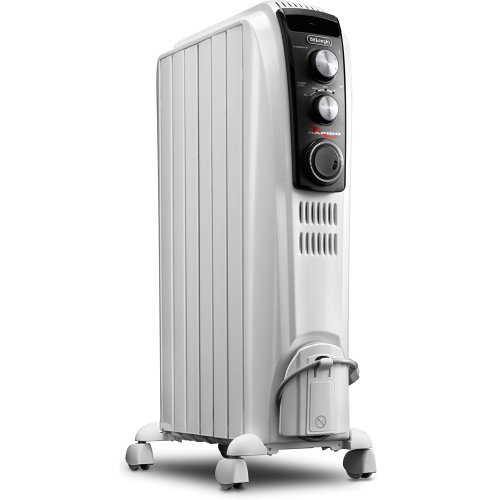
De'Longhi TRD40615TNo fan, so no noise and no moving dust — and the sealed oil keeps radiating after the element cuts out, which is why an oil-filled unit feels steadier than a ceramic one at the same wattage.
Heat Storm HS-1500-PHXWall-mounted, which removes the entire tip-over failure mode rather than mitigating it — and Wi-Fi scheduling means it can heat a bathroom before you get in it.
Cozy Legs CLA 150 W radiant panel that does one job — warm the legs in a footwell — and is the only heater in this registry whose maker publishes a zero-clearance safety listing on its own page.
Comfort Zone CZ230ER7,500 W with a digital thermostat, a remote and a 12-hour timer for less than the 5,000 W units cost — and its manual specifies the 40 A breaker and 8 AWG wire the load actually needs.
The rare heater whose published coverage claim survives the arithmetic: 1,500 W is a genuine 300 sq ft at 10 W/sq ft, and Dreo publishes that number rather than implying more.
Rated power
1,500 W
Covers (computed)
150 sq ft
Draw (computed)
12.5 A at 120 V
Cost per hour
27.5¢
Coverage at 10 W/sq ft, average insulation, 8 ft ceiling = 5,118 BTU/h. Cost at 18.34¢/kWh; an eight-hour night at full output is $2.20. Exceeds the 12 A continuous limit of a 15 A circuit — check what else shares the breaker.
What works
A digital thermostat with numbers on it — you can set 68°F rather than guess at a dial
The published 300 sq ft claim matches the standard sizing rule instead of exceeding it
8 lb and 8 inches square: it moves room to room without a project
What does not
1,500 W is 1,500 W — nothing here heats faster than any other 1,500 W heater
Dreo does not publish a noise figure in decibels on the product page
Tall and narrow, which is a tipping profile: the tip-over cutoff matters more here
A living room, bedroom or den at or under 300 sq ft with average insulation and an 8-foot ceiling, where you want to set a temperature and stop thinking about it.
What it is not for
A garage, an uninsulated basement, or anything over about 300 sq ft. It is not under-powered — 1,500 W is the plug-in ceiling — the room is simply too big for one outlet.
No fan, so no noise and no moving dust — and the sealed oil keeps radiating after the element cuts out, which is why an oil-filled unit feels steadier than a ceramic one at the same wattage.
Rated power
1,500 W
Covers (computed)
150 sq ft
Draw (computed)
12.5 A at 120 V
Cost per hour
27.5¢
Coverage at 10 W/sq ft, average insulation, 8 ft ceiling = 5,118 BTU/h. Cost at 18.34¢/kWh; an eight-hour night at full output is $2.20. Exceeds the 12 A continuous limit of a 15 A circuit — check what else shares the breaker.
What works
Genuinely silent: there is no fan to hear at 3 a.m.
The oil holds heat, so the room temperature swings less between thermostat cycles
Nothing blows air, so nothing stirs up dust in a bedroom
What does not
Slow. It takes 20–30 minutes to feel like it is doing anything
Heavy — the wheels are not a courtesy, they are a requirement
The surface gets genuinely hot; this is a radiator, not a cool-touch case
Published specification
Rated power
1,500 W at 120 V
Controls
Mechanical, with a programmable 24-hour timer
Fluid
Permanently sealed diathermic oil — never needs refilling
Maker's claim
Up to 75% more radiant surface area
Mobility
Front and rear handles, snap-on wheels
Heat type
Oil-filled
Maker’s coverage claim
None published — the coverage figure above is ours
Safety listing
No listing mark published in the listing text; verify the UL or ETL mark on the rating plate.
Who it is for
A bedroom, a nursery at a safe distance, or anywhere the fan noise of a ceramic heater is the actual problem you are trying to solve.
What it is not for
Fast heat, and not a room you only occupy for twenty minutes. It also should never be tucked beside a bed or curtain — hot surface, 3-foot rule.
Wall-mounted, which removes the entire tip-over failure mode rather than mitigating it — and Wi-Fi scheduling means it can heat a bathroom before you get in it.
Rated power
1,500 W
Covers (computed)
150 sq ft
Draw (computed)
12.5 A at 120 V
Cost per hour
27.5¢
Coverage at 10 W/sq ft, average insulation, 8 ft ceiling = 5,118 BTU/h. Cost at 18.34¢/kWh; an eight-hour night at full output is $2.20. Exceeds the 12 A continuous limit of a 15 A circuit — check what else shares the breaker.
What works
On a wall it cannot be tipped, and it cannot be crowded by a curtain that moved
Scheduling from the app is the practical answer to bathroom and workshop use
The published 5,200 BTU/h figure matches 1,500 W exactly — no inflated claim
What does not
It is a mounting job, not an unbox-and-plug — and it needs an outlet where you mount it
Wi-Fi adds a failure mode a knob does not have
Wall-mounted radiant heat is directional; you feel it where it points
Published specification
Rated power
1,500 W at 120 V
Published output
5,200 BTU/h
Mounting
Wall-mounted
Control
Wi-Fi app, remote scheduling
Element
Infrared quartz
Heat type
Infrared quartz
Maker’s coverage claim
None published — the coverage figure above is ours
Safety listing
No listing mark published in the listing text; check the rating plate for the UL or ETL mark.
Who it is for
A bathroom, a small bedroom, a workshop corner — anywhere floor space is gone and a heater on the ground is a hazard.
What it is not for
Renters who cannot drill, and rooms where you want the heater to move with you.
A 150 W radiant panel that does one job — warm the legs in a footwell — and is the only heater in this registry whose maker publishes a zero-clearance safety listing on its own page.
Rated power
150 W
Covers (computed)
15 sq ft
Draw (computed)
1.3 A at 120 V
Cost per hour
2.8¢
Coverage at 10 W/sq ft, average insulation, 8 ft ceiling = 512 BTU/h. Cost at 18.34¢/kWh; an eight-hour night at full output is $0.22. Fits a 15 A circuit as a continuous load.
What works
150 W is 1.25 A — about a tenth of a 1,500 W room heater, so it will not trouble a desk circuit already carrying a computer and two monitors
Silent by construction: a radiant panel has no fan and no moving parts at all
The maker publishes an ETL zero-clearance listing — a rarity in this registry, and the reason the panel can sit flat against a desk modesty board or a wall
What does not
No set-point. The thermostat is built in and no range is published, so there is nothing to dial and no timer — it runs until the in-cord switch goes off
Cozy Products publishes no coverage figure, no warranty terms and no panel dimensions on the product page, so none of the three can be checked
150 W warms your legs and nothing else. It is not a small room heater and it will not raise the air temperature of an office
Published specification
Rated power
150 W at 120 V, 60 Hz (Cozy Products' published figures)
Current draw
1.25 A (150 ÷ 120) — our figure. Cozy Products' page prints 1.3 A, which is the same draw rounded
Element
Radiant panel — no fan, no moving parts
Thermostat
Built-in; Cozy Products publishes no set-point range, so there is no temperature to choose
Controls
An in-cord roller switch
Size
Cozy Products publishes the shipping box at 25 x 20 x 2 inches and the weight at 8 lb, but not the panel's own dimensions — so we do not print a panel size
Surface temperature
Approximately 130°F (Cozy Products' published figure)
Safety
ETL Certified Zero-Clearance — no clearance required, which the maker states on its own page
Heat type
Radiant panel
Maker’s coverage claim
None published — the coverage figure above is ours
Safety listing
Cozy Products publishes an ETL Certified Zero-Clearance rating on its own product page, which is why the panel may sit against a wall or other combustible surface.
Who it is for
A footwell where the complaint is cold legs, the circuit is already busy, and you want the lowest-draw honest answer rather than a 1,500 W heater in a small box.
What it is not for
Heating a room, or anywhere you need the heater to switch itself off. Without a timer or a set-point it is on until you switch it off at the cord, which makes the [unattended-heater guidance](/safety/overnight) matter more, not less.
Comfort Zone CZ230ER Digital Hard-Wired Ceiling-Mount Garage Heater
7,500 W with a digital thermostat, a remote and a 12-hour timer for less than the 5,000 W units cost — and its manual specifies the 40 A breaker and 8 AWG wire the load actually needs.
Rated power
7,500 W / 6,250 W low
Covers (computed)
750 sq ft
Draw (computed)
31.3 A at 240 V
Cost per hour
137.6¢
Coverage at 10 W/sq ft, average insulation, 8 ft ceiling = 25,591 BTU/h. Cost at 18.34¢/kWh; an eight-hour night at full output is $11.00. Hardwired 240 V: this is an electrician's installation, not a plug-in appliance.
What works
The most heat here by half again, and it costs less than either 5,000 W pick
Its manual gets the hard part right: 31.3 A of draw, 40 A of breaker, 8 AWG of wire, stated as three separate specifications
A 12-hour timer with auto shut-off, which on a load this size is the feature that protects the bill
Fan-only mode makes it useful in summer, which no other pick here offers
What does not
40 A of two-pole capacity is a serious allocation — this is the pick most likely to run into a full panel
$1.38 an hour at full output, the highest running cost on this site
No certification mark published anywhere we could find, in the listing or the manual
Sold under two near-identical listings whose prices and stock move independently — on 2026-10-17 the CZ230ER listing was the cheaper one and in stock while the CZ230ERBK one was a few dollars more on a two-to-four-week lead time. Open both
The digital thermostat has no published set-point range, so the LED shows the room temperature rather than a target you chose
Published specification
Rated power
7,500 W high (default) / 6,250 W low at 208–240 V
Current draw (maker's figures)
31.3 A high / 26 A low — matches 7,500 ÷ 240 = 31.3 A
Recommended circuit breaker
40 A or larger, per the manual — the draw grossed up by the NEC continuous-load rule is 39.1 A
Recommended wire
8 AWG copper only, rated 167°F/75°C or larger, per the manual
Published output
25,590 BTU/h high / 21,240 BTU/h low
Horizontal air throw
18 ft (approximate), per the manual
Controls
Digital thermostat with an LED ambient-temperature display, remote, 12-hour timer with auto shut-off, fan-only mode. No set-point scale published
Weight
25–30 lb (approximate), per the manual
Warranty
One year against defects in quality or workmanship (World and Main)
Installation
Hardwired, ceiling- or wall-mounted. No plug, and extension cords are prohibited
Heat type
Fan-forced
Maker’s coverage claim
None published — the coverage figure above is ours
Safety listing
Neither the listing nor the CZ230ER Series manual names a certification mark. On a hardwired 240 V unit the rating plate is what the installer works from.
Who it is for
A two-car garage, a shop or an outbuilding of roughly 400–600 sq ft where you want it genuinely warm, and you have 40 A of two-pole space in the panel.
What it is not for
A single-car garage or a panel that is already full — 7,500 W is more heat than a small space needs and more current than a tight panel can give.
One pick per decision path, not a ranked list — each of the five below is the answer to a different set of answers to the six questions above it.
Published specifications only. Where a maker publishes a thermostat range, a wattage step or a safety mark, it counted; where a listing implies one without stating it, it did not.
Control precision ranked above everything except fit, because once a room is sized correctly the only remaining lever on the bill is hours.
The last pick is deliberately not a plug-in heater. If the honest answer to step one is "more than 1,500 W", recommending a plug-in unit would be selling you the wrong thing politely.
And what we did not do: we have not tested these units, owned them, measured them or run them in a room. Everything above is compiled from published manufacturer specifications and live retail listings, with the electrical load, room coverage and running cost computed by us from the published wattage. The full method.
If you remember one thing
Size the room before you look at a single product. Everything else on this page is a preference you can live with being wrong about; the sizing arithmetic is the one that decides whether the heater you buy can do the job at all. The calculator takes about thirty seconds.
Questions people actually ask
How do I choose the right size space heater?+
Multiply the room's floor area by 10 watts per square foot, then by 1.25 if it is drafty or 1.5 if it is outside the heated envelope, and by the ceiling height divided by eight. Compare the answer with 1,500 W — the ceiling on every plug-in heater — and if your room needs more, no plug-in unit will heat it.
What should I look for in a space heater?+
In order: a wattage that matches the room, a type whose noise you can live with, a thermostat with numbers rather than a dial, a published low wattage setting, published overheat and tip-over cutoffs, and a shape that suits where it will live. Only 7 of the 29 purchasable heaters we track publish a thermostat range in degrees, so that single filter removes most of the market.
Is a more expensive space heater better?+
Not for heat. Every plug-in heater is capped at 1,500 W, produces about 5,118 BTU/h and costs about 27.5 cents an hour to run. A higher price buys control precision, build quality, silence, warranty and sometimes a second appliance — never more warmth.
Which type of space heater should I buy?+
If it is going in a bedroom, a fanless type — an oil-filled radiator or a mica panel — because fan noise is the thing that makes people stop using a heater. If the room is drafty or you are only in it briefly, infrared, because radiant heat warms you without first warming all the air. Otherwise ceramic, which is fast, cheap and cool-touch.
Do I need a thermostat or is a dial enough?+
A dial works, but it costs you money every night: you cannot set it to a number, so it gets set too high and overshoots. A thermostat you can set in degrees is the only feature on a space heater that reliably lowers a bill, because once wattage is fixed the only variable left is hours.
How many watts do I need for a 12x12 room?+
A 12 by 12 room is 144 sq ft, so about 1,440 W with average insulation and an 8-foot ceiling — right at what a single 1,500 W heater delivers. Make it drafty and the requirement rises to about 1,800 W, which is past what any plug-in heater can supply.
Heating the air versus heating the things in it — the distinction under every other comparison.
Written by Scooter M., an enthusiast — not a tester and not a certified anything. Every figure on this page is either published by the manufacturer, taken from a live retail listing, or computed from the published wattage using the formulas we publish. Found an error? Tell us and we will correct it, visibly and with a date on it.