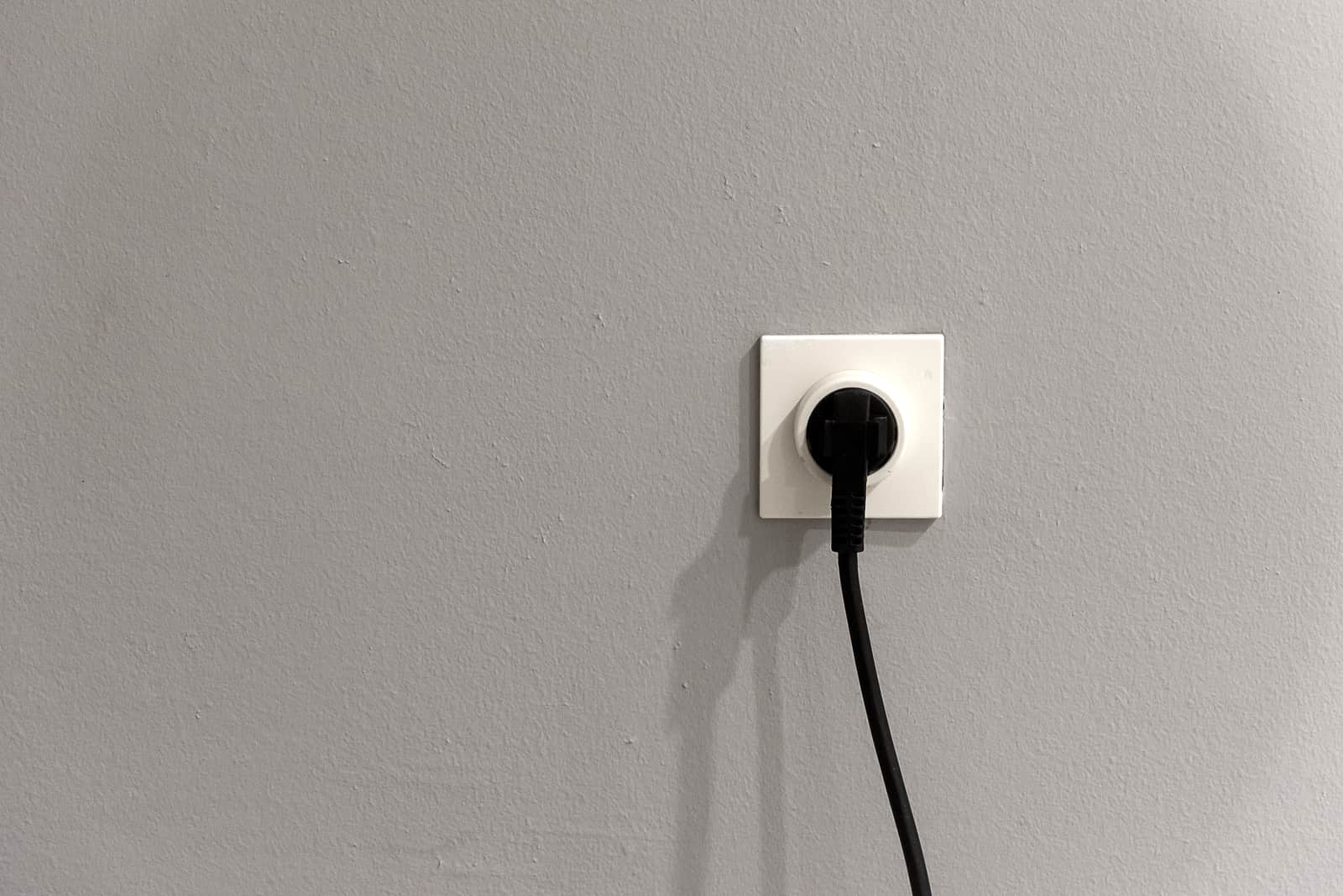
The answer is no, and the interesting part is why — because it is not the cord melting in the middle that gets people.
By Scooter M. · Published August 31, 2026 · Last reviewed August 31, 2026
How this page is funded: we earn a commission if you buy through the links here, at no extra cost to you. Picks are chosen before links are attached, which is why every roundup names something to skip. Full disclosure.
No. A 1,500 W heater draws 12.5 amps continuously, which exceeds the rating of most household extension cords and adds two connectors that heat under sustained load. Plug the heater directly into a wall outlet, and move the heater rather than extending the cord.
What actually fails
The mental image most people have is a cord melting along its length, and that is not usually what happens. The failure is at the connections: the point where the heater's plug meets the cord's socket, and where the cord's plug meets the wall outlet.
Every connection has some contact resistance, and resistance under current makes heat — proportional to the square of the current, so a 12.5 A load produces roughly four times the connector heating of a 6 A one. Heat oxidizes the contact surfaces, oxidation raises the resistance, and higher resistance makes more heat. It is a loop that tightens over weeks of continuous use, in a connector that is usually behind furniture where nobody looks.
An extension cord takes a circuit with two connections in it — the heater's plug and the outlet — and gives it four. That is the core of the objection, and it applies to a good cord as much as a cheap one.
The rating arithmetic
Extension cords are rated by wire gauge, and household cords are commonly 16 AWG, which is intended for light-duty loads well under 12.5 A. Heavier 14 AWG and 12 AWG cords carry more, but the derating that matters is length: resistance rises with distance, so a long cord at its nominal rating is a different proposition from a short one.
Cord type
Typical rating
1,500 W heater at 12.5 A
16 AWG light-duty household cord
Around 10 A, less when long
Over rating — do not use
14 AWG general-purpose cord
Around 13–15 A short lengths
At or near the limit
12 AWG heavy-duty cord
Around 15–20 A short lengths
Within rating, still adds connectors
Power strip / surge protector
Not intended for continuous 12.5 A
Do not use
Ratings vary by manufacturer and length — read the tag on your own cord. Even a cord that is within rating adds two connections to a continuous high-current circuit.
What to do when the outlet is in the wrong place
1.Move the heater, not the electricity. Heater placement is flexible; the large-room guidance prefers the coldest wall, but any wall with an outlet and three feet of clearance is workable.
2.Use a lower setting. At 750 W the draw is 6.25 A, which is inside a decent cord's rating with real margin. This is a genuine mitigation rather than a workaround, though the extra connectors still exist.
3.Choose a wall-mounted heater and mount it near an existing outlet. This is the cleanest answer to “there is no outlet where I need heat”.
4.Have an outlet added. For a room you heat every winter, an electrician adding an outlet — or a dedicated circuit — costs less than the alternatives being risked.
And two things not to do
Never run a cord under a rug or carpet. It traps the heat a loaded cord produces, and it puts the cord where it gets stepped on and crushed. This is a widely published rule and it exists for cords carrying far less than 12.5 A.
Never chain cords together. Two cords is four extra connections, and the second cord's rating does not add to the first's — the weakest link sets the limit.
Picks that avoid the problem entirely
Quick picks
Ranked for fit, not for hype. Coverage and current draw are computed from each unit’s published wattage. Tap a row for the full write-up, or go straight to the listing.
#
Product
Best for
Covers
Draw
Price
1
Heat Storm HS-1500-PHXWall-mounted, which removes the entire tip-over failure mode rather than mitigating it — and Wi-Fi scheduling means it can heat a bathroom before you get in it.
Honeywell HCE220BA shoebox-sized ceramic heater that publishes four preset temperatures and a 2/4/8-hour auto-off — specificity almost nothing else this size offers.
A thermostat with numbers on it, on a small heater
Wall-mounted, which removes the entire tip-over failure mode rather than mitigating it — and Wi-Fi scheduling means it can heat a bathroom before you get in it.
Rated power
1,500 W
Covers (computed)
150 sq ft
Draw (computed)
12.5 A at 120 V
Cost per hour
27.5¢
Coverage at 10 W/sq ft, average insulation, 8 ft ceiling = 5,118 BTU/h. Cost at 18.34¢/kWh; an eight-hour night at full output is $2.20. Exceeds the 12 A continuous limit of a 15 A circuit — check what else shares the breaker.
What works
On a wall it cannot be tipped, and it cannot be crowded by a curtain that moved
Scheduling from the app is the practical answer to bathroom and workshop use
The published 5,200 BTU/h figure matches 1,500 W exactly — no inflated claim
What does not
It is a mounting job, not an unbox-and-plug — and it needs an outlet where you mount it
Wi-Fi adds a failure mode a knob does not have
Wall-mounted radiant heat is directional; you feel it where it points
Published specification
Rated power
1,500 W at 120 V
Published output
5,200 BTU/h
Mounting
Wall-mounted
Control
Wi-Fi app, remote scheduling
Element
Infrared quartz
Heat type
Infrared quartz
Maker’s coverage claim
None published — the coverage figure above is ours
Safety listing
No listing mark published in the listing text; check the rating plate for the UL or ETL mark.
Who it is for
A bathroom, a small bedroom, a workshop corner — anywhere floor space is gone and a heater on the ground is a hazard.
What it is not for
Renters who cannot drill, and rooms where you want the heater to move with you.
2 · A thermostat with numbers on it, on a small heater
Honeywell HCE220B UberHeat Plus Ceramic Heater
A shoebox-sized ceramic heater that publishes four preset temperatures and a 2/4/8-hour auto-off — specificity almost nothing else this size offers.
Rated power
1,500 W
Covers (computed)
150 sq ft
Draw (computed)
12.5 A at 120 V
Cost per hour
27.5¢
Coverage at 10 W/sq ft, average insulation, 8 ft ceiling = 5,118 BTU/h. Cost at 18.34¢/kWh; an eight-hour night at full output is $2.20. Exceeds the 12 A continuous limit of a 15 A circuit — check what else shares the breaker.
What works
Four preset temperatures rather than an unmarked dial — on a heater this small and this cheap, being able to ask for 70°F is unusual
Two independent overheat mechanisms are published — a high-temperature sensor and a thermal cut-off fuse — plus a tip-over switch
A 2/4/8-hour auto-off means it can stop by itself, which is what actually reduces the bill
What does not
No UL or ETL mark published by Honeywell, which is the one thing we would want stated at this size and price
Four presets is not the same as a full range: if you want 68°F you are choosing between 65 and 70
2.8 lb and shoebox-sized means it is a personal heater, not a room heater, whatever the 1,500 W suggests
Published specification
Rated power
1,500 W maximum at 120 V
Heat settings
2 (high and low)
Thermostat
Four preset comfort levels — 65°, 70°, 75° and 80°F
Auto-off timer
2, 4 or 8 hours
Safety
Tip-over switch; 2x overheat protection (high-temperature sensor plus a thermal cut-off fuse); cool-touch housing
Size
8.5" x 4.5" x 8.86", 2.8 lb
Warranty
3-year limited
Heat type
Ceramic (PTC)
Maker’s coverage claim
None published — the coverage figure above is ours
Safety listing
Honeywell does not publish a UL or ETL mark for this model; it does publish two independent overheat mechanisms. Check the rating plate.
Who it is for
A small office, a bedside table or a desk, where the heater needs to hold roughly a known temperature and switch itself off after a few hours.
What it is not for
A large or drafty room, and not a nursery — no child lock is published and the presets are reachable by anyone who can reach the unit.
Can I plug a space heater into an extension cord?+
You should not. A 1,500 W heater draws 12.5 A continuously, which exceeds most household cords' ratings and adds two connectors that heat under sustained load. Plug it directly into a wall outlet.
Can I plug a space heater into a power strip?+
No. Power strips and surge protectors are designed for clusters of small electronic loads, not a single continuous 12.5 A appliance, and many carry an explicit warning against heaters.
What gauge extension cord for a 1500 watt heater?+
If you have no alternative at all, a short heavy-duty 12 AWG cord rated above 15 A is the least bad option — but the extra connections remain a real risk under continuous load, and moving the heater is still the correct answer.
Why do extension cords overheat with space heaters?+
Heating happens mainly at the connections rather than along the cord. Contact resistance under 12.5 A produces heat, heat oxidizes the contacts, oxidation raises resistance, and the cycle compounds over weeks of continuous use.
Six causes in order of likelihood. Only one means the heater is broken — and the fix is usually wattage.
Written by Scooter M., an enthusiast — not a tester and not a certified anything. Every figure on this page is either published by the manufacturer, taken from a live retail listing, or computed from the published wattage using the formulas we publish. Found an error? Tell us and we will correct it, visibly and with a date on it.