The type that works where every other type struggles — and the one whose weakness nobody selling it mentions.
By Scooter M. · Published September 13, 2026 · Last reviewed September 13, 2026
How this page is funded: we earn a commission if you buy through the links here, at no extra cost to you. Picks are chosen before links are attached, which is why every roundup names something to skip. Full disclosure.
Infrared heaters warm objects and people directly instead of warming the air, so they feel effective almost instantly and work in drafty, high-ceilinged or leaky spaces where convection heaters struggle. The trade-off is that the warmth stops at the first solid object — step out of the line of sight and it is gone.
The distinction that decides whether this is your type
A convection heater warms the air, and the warm air then warms you. That works beautifully in a sealed room and badly in a leaky one, because in a leaky room you are paying to heat air that is on its way outside. An infrared heater skips the air entirely: it emits radiation that passes through the air almost unaffected and converts to heat when it lands on something solid — a wall, a floor, a workbench, you.
That is why infrared is the right answer in a garage, a workshop, a drafty sunroom, a high-ceilinged room or a space you only occupy for an hour at a time. In all of those, warming the air is either impossible or wasteful, and warming the person directly is neither. The full physics is on convection vs radiant heating, and the type explainer is infrared space heaters explained.
It costs the same to run. All of them do.
Infrared marketing leans harder on efficiency than any other category on this site, so it is worth being blunt: an infrared heater at 1,500 W costs 27.5 cents an hour at the U.S. average rate, which is exactly what an oil-filled radiator at 1,500 W costs, which is exactly what a ceramic tower at 1,500 W costs. There is no infrared discount. The energy going in is the energy coming out, for every electric resistance heater ever made.
Wattage
Per hour
1 h
4 h
8 h
1,500 W
27.5¢
$0.28
$1.10
$2.20
Computed at 18.34¢/kWh — the U.S. residential average for June 2026 (EIA, Electric Power Monthly, Table 5.6.A, released August 26, 2026). Your rate is on your own bill; substitute it and the arithmetic still holds. Figures assume full output for the whole period.
Where a genuine saving can appear is in hours, not watts. If radiant warmth makes a drafty workshop usable after five minutes, and a convection heater would have needed forty minutes to make the same space tolerable, you ran the heater for less time and paid less. That saving is real, it is conditional on the room, and it is nothing at all like the device being more efficient.
This is the most recent month EIA has published. Residential rates move seasonally and vary enormously by state — from roughly a dime per kilowatt-hour in parts of the South to more than 40¢ in Hawaii — so treat it as a national reference point, not as your rate.
Sizing, and why the usual rule bends here
Our standard rule — 10 watts per square foot, average insulation, 8-foot ceiling — puts 1,500 W at 150 sq ft, and that still applies if you are trying to raise the air temperature of a whole room. But raising the air temperature is frequently not what you are doing with an infrared heater. In a garage or a workshop you are heating a person at a bench, and the relevant question is not the floor area of the building but whether the heater can see the person.
Room size
Watts needed
BTU/h
Plug-in heaters
100 sq ft
1,000 W
3,412
1
150 sq ft
1,500 W
5,118
1
200 sq ft
2,000 W
6,824
2 (different circuits)
300 sq ft
3,000 W
10,236
2 (different circuits)
Computed as square feet x 10 W x insulation factor x (ceiling / 8 ft), for an average heated room — 10 W/sq ft, 8 ft ceiling. Heater count assumes the 1,500 W plug-in ceiling.
Treat the table above as the answer to “can this warm the whole room” — usually no, in the kind of space you bought infrared for — and treat line of sight as the answer to “will this make me comfortable”, which is usually yes. For the uninsulated case specifically, best space heaters for a garage works the demand arithmetic all the way through and reaches an uncomfortable conclusion.
The picks
Three units, ordered by how much their makers are willing to publish and by whether they solve the floor-space problem that comes with putting a hot appliance in a working space.
Quick picks
Ranked for fit, not for hype. Coverage and current draw are computed from each unit’s published wattage. Tap a row for the full write-up, or go straight to the listing.
#
Product
Best for
Covers
Draw
Price
1
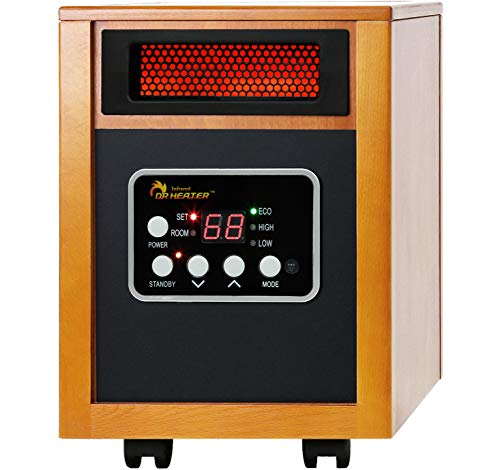
Dr Infrared DR-968The one listing in this category that publishes its amp draw and its noise level, which is exactly the arithmetic everyone else leaves you to do — 12.5 A and 39 dB, both stated.
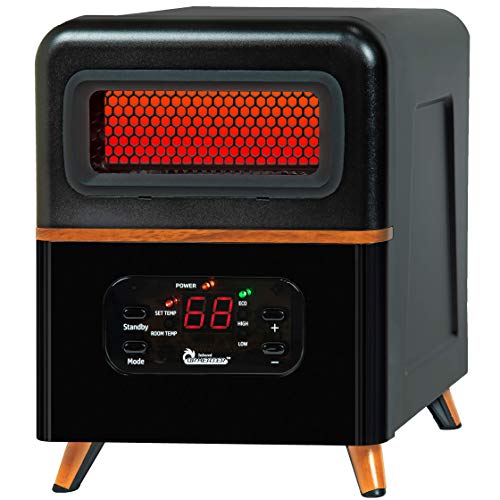
Dr Infrared DR-978A hybrid: infrared for the person in front of it and a blower to push convected heat into the rest of the room, which is a genuine answer to radiant heating's shadowing problem.
Heat Storm HS-1500-PHXWall-mounted, which removes the entire tip-over failure mode rather than mitigating it — and Wi-Fi scheduling means it can heat a bathroom before you get in it.
The one listing in this category that publishes its amp draw and its noise level, which is exactly the arithmetic everyone else leaves you to do — 12.5 A and 39 dB, both stated.
Rated power
1,500 W
Covers (computed)
150 sq ft
Draw (computed)
12.5 A at 120 V
Cost per hour
27.5¢
Coverage at 10 W/sq ft, average insulation, 8 ft ceiling = 5,118 BTU/h. Cost at 18.34¢/kWh; an eight-hour night at full output is $2.20. Exceeds the 12 A continuous limit of a 15 A circuit — check what else shares the breaker.
What works
Publishes 12.5 A, which is the number that decides whether it fits your circuit
Publishes 39 dB, which is the number that decides whether it fits your bedroom
A wooden-cabinet infrared unit runs cooler on the outside than a bare panel
What does not
19 lb with wheels: this is furniture, not a portable you carry between rooms
12.5 A against a 15 A circuit's 12 A continuous limit — it does not legally fit, see the circuit-load guide
Dated cabinet styling that will not disappear into a modern room
Published specification
Rated power
1,500 W at 120 V
Current draw
12.5 A (published)
Noise
39 dB (published)
Element
Infrared quartz tube plus PTC
Thermostat
Electronic, 50–85°F
Other
12-hour auto-off timer, IR remote, caster wheels, 19 lb
Heat type
Infrared quartz
Maker’s coverage claim
None published — the coverage figure above is ours
Safety listing
No listing mark published in the listing text; check the cabinet's rating plate for the UL or ETL mark.
Who it is for
A reader who wants to compute the load rather than trust a claim: the published amp draw and decibel figure make it the easiest unit on this site to check.
What it is not for
A 15 A circuit shared with anything else, and not a small room where a 19 lb cabinet on wheels is in the way.
Dr. Infrared Heater DR-978 Dual Heating Hybrid Space Heater
A hybrid: infrared for the person in front of it and a blower to push convected heat into the rest of the room, which is a genuine answer to radiant heating's shadowing problem.
Rated power
1,500 W
Covers (computed)
150 sq ft
Draw (computed)
12.5 A at 120 V
Cost per hour
27.5¢
Coverage at 10 W/sq ft, average insulation, 8 ft ceiling = 5,118 BTU/h. Cost at 18.34¢/kWh; an eight-hour night at full output is $2.20. Exceeds the 12 A continuous limit of a 15 A circuit — check what else shares the breaker.
What works
Addresses the one real weakness of pure radiant heat — everything outside the cone stays cold
Remote control, so the unit does not have to be within reach to be adjusted
Cabinet construction keeps the very hot quartz element behind a housing
What does not
The blower means it is not a silent heater, and no decibel figure is published for this model
Still 1,500 W: the hybrid design changes distribution, never total output
No published coverage figure, so sizing is entirely on you
Published specification
Rated power
1,500 W at 120 V
Element
Dual heating — infrared quartz plus convection
Control
Remote
Maker's coverage claim
None published
Heat type
Infrared quartz
Maker’s coverage claim
None published — the coverage figure above is ours
Safety listing
No listing mark published in the listing text; check the cabinet's rating plate for the UL or ETL mark.
Who it is for
A living room or basement where you want immediate radiant warmth on the sofa and the rest of the room to catch up rather than stay cold.
What it is not for
A bedroom where noise matters, and any space where the published specification list needs to be complete — this one is thinner than its DR-968 sibling.
Wall-mounted, which removes the entire tip-over failure mode rather than mitigating it — and Wi-Fi scheduling means it can heat a bathroom before you get in it.
Rated power
1,500 W
Covers (computed)
150 sq ft
Draw (computed)
12.5 A at 120 V
Cost per hour
27.5¢
Coverage at 10 W/sq ft, average insulation, 8 ft ceiling = 5,118 BTU/h. Cost at 18.34¢/kWh; an eight-hour night at full output is $2.20. Exceeds the 12 A continuous limit of a 15 A circuit — check what else shares the breaker.
What works
On a wall it cannot be tipped, and it cannot be crowded by a curtain that moved
Scheduling from the app is the practical answer to bathroom and workshop use
The published 5,200 BTU/h figure matches 1,500 W exactly — no inflated claim
What does not
It is a mounting job, not an unbox-and-plug — and it needs an outlet where you mount it
Wi-Fi adds a failure mode a knob does not have
Wall-mounted radiant heat is directional; you feel it where it points
Published specification
Rated power
1,500 W at 120 V
Published output
5,200 BTU/h
Mounting
Wall-mounted
Control
Wi-Fi app, remote scheduling
Element
Infrared quartz
Heat type
Infrared quartz
Maker’s coverage claim
None published — the coverage figure above is ours
Safety listing
No listing mark published in the listing text; check the rating plate for the UL or ETL mark.
Who it is for
A bathroom, a small bedroom, a workshop corner — anywhere floor space is gone and a heater on the ground is a hazard.
What it is not for
Renters who cannot drill, and rooms where you want the heater to move with you.
Judged on where radiant genuinely beats convection, which is drafty, leaky, tall or intermittently-occupied spaces — not a sealed bedroom, where the advantage disappears.
Published numbers rewarded heavily. This category is full of vague claims; one of our picks publishes its current draw *and* a decibel figure, which is rare enough to be the reason it leads.
The shadowing limitation stated on every pick, because it is the defining weakness of the type and no listing mentions it.
Mounting considered, since getting a heater off the floor solves a real safety problem in a garage or workshop.
No infrared-specific efficiency claims accepted. Infrared is 100% efficient in exactly the way every other electric heater is, and no more.
And what we did not do: we have not tested these units, owned them, measured them or run them in a room. Everything above is compiled from published manufacturer specifications and live retail listings, with the electrical load, room coverage and running cost computed by us from the published wattage. The full method.
What we’d skip, and why
Every roundup on this site names something to skip. It costs us nothing to publish and it is the fastest way to tell whether a buying guide was written for you or for its commission.
Any infrared heater sold as “more efficient” than other electric heaters
This claim is everywhere in this category and it is false as stated. An infrared heater converts essentially 100% of its electricity into heat, exactly like a ceramic heater and exactly like an oil-filled radiator. What is true — and worth buying for — is that radiant heat can make you feel warm without first warming the whole volume of air in the room, so in a space where the air is constantly being replaced you may get the comfort you wanted for fewer running hours. That is a usage saving in specific conditions, not an efficiency advantage in the device. Selling it as the latter is a marketing claim wearing a physics costume.
An infrared heater as the only heat in a room you sit around in
Radiant heat travels in straight lines and stops at the first solid object. Whatever is in the beam gets warm; whatever is behind that — the far side of the table, the person in the armchair, your back — does not. In a living room where people sit in several places, an infrared heater produces a warm spot and a set of complaints. For that room you want convection, and the picks are on best space heaters for large rooms.
A note on quartz tubes and cabinet temperature
Infrared quartz heaters run a genuinely hot element behind a grille, and the cabinets of the portable units here are designed to stay far cooler than that element. None of the three publishes a surface-temperature figure, so we are not going to characterise how warm any of them gets to the touch. What we will say is that the 3-foot clearance rule the U.S. Fire Administration gives applies to this type with no asterisks, and that a wall-mounted unit removes an entire class of problem — nothing gets knocked over, and nothing gets draped.
Questions people actually ask
Are infrared heaters cheaper to run than other space heaters?+
No. At the same wattage they cost exactly the same — about 27.5 cents an hour at 1,500 W and the U.S. average rate. Every electric resistance heater is essentially 100% efficient. Infrared can save money in a drafty space by making you comfortable in fewer running hours, which is a usage saving and not a property of the device.
What is the downside of an infrared heater?+
Shadowing. Radiant heat travels in straight lines and stops at the first solid object, so anything not in the heater's line of sight is not being heated — including the side of you facing away from it. In a room where people sit in several places, this produces a warm spot rather than a warm room.
Are infrared heaters good for a bedroom?+
They are not the obvious choice. A bedroom is usually a sealed, small, low-ceilinged space, which is exactly the case where convection works well and radiant offers no advantage — and most infrared units have fans, so they are not silent either. For a bedroom, see best space heaters for a bedroom or the oil-filled picks.
Do infrared heaters dry out the air?+
No heater adds or removes moisture from a room. What changes is relative humidity: warming air without adding water lowers the relative humidity, so the air feels drier. That happens with every heater type, including infrared, and it is a consequence of the temperature rise rather than anything the heater is doing to the water.
Is infrared the same as radiant?+
In this category, effectively yes — infrared is the part of the spectrum that carries the radiant heat these units emit. The useful distinction is not infrared versus radiant but radiant versus convection, which is the difference between heating objects and heating air. That comparison is on convection vs radiant heating.
Glass on three sides means the 1.5x correction. One plug-in heater runs out at about 100 sq ft.
Written by Scooter M., an enthusiast — not a tester and not a certified anything. Every figure on this page is either published by the manufacturer, taken from a live retail listing, or computed from the published wattage using the formulas we publish. Found an error? Tell us and we will correct it, visibly and with a date on it.