A glass room loses heat the way an uninsulated one does. The arithmetic says a single plug-in heater runs out at about 100 square feet.
By Scooter M. · Published September 21, 2026 · Last reviewed September 21, 2026
How this page is funded: we earn a commission if you buy through the links here, at no extra cost to you. Picks are chosen before links are attached, which is why every roundup names something to skip. Full disclosure.
A sunroom needs about 15 watts per square foot, not the usual 10, because it is mostly glazing and usually outside the main heating system. At the 1,500 W plug-in ceiling that is roughly 100 square feet. Above that, one heater cannot keep up and radiant heat aimed at people beats warming all the air.
Why a sunroom is its own sizing problem
This site's standard rule is 10 watts per square foot, for a room with average insulation and an 8-foot ceiling. It carries two published corrections: multiply by 1.25 for a drafty room and by 1.5 for an unheated one. A sunroom is the clearest case in the house for the second correction and often deserves it twice over.
Two things make it different from the room next door. It is glazed on two or three sides, and glazing loses heat far faster than an insulated wall does. And it is usually a later addition that the house's heating system was never extended into — which is exactly what "unheated envelope" means. Neither of those is a defect; they are what makes the room pleasant in April. They are also why it is unusable in January without help.
Room size
Watts needed
BTU/h
Plug-in heaters
100 sq ft
1,500 W
5,118
1
150 sq ft
2,250 W
7,677
2 (different circuits)
200 sq ft
3,000 W
10,236
2 (different circuits)
Computed as square feet x 10 W x insulation factor x (ceiling / 8 ft), for an unheated space (garage, unfinished basement) — 15 W/sq ft, 8 ft ceiling. Heater count assumes the 1,500 W plug-in ceiling.
That table has the unheated correction already applied, which is why the wattages are higher than the ones on the rest of this site. Read your sunroom's floor area across and the figure you get is what the room actually wants.
Why radiant wins here
In a well-sealed room, a convection heater warms the air and the air stays put long enough to warm you. In a sunroom, the air is being cooled continuously by several square feet of cold glass, so heating all of it is a treadmill — you are paying to warm air that is losing its heat through the windows as fast as you add it.
Radiant heat skips the air. An infrared heater warms the people and surfaces in its line of sight directly, so the glass can keep doing what glass does and you are still warm. That is the same reasoning that makes infrared the right answer in a garage, applied to a milder version of the same problem. The trade-off is the usual one for radiant: it warms what it can see, so placement matters and stepping out of its path ends the effect. Convection versus radiant, in full.
Get it off the floor if you can
Sunrooms tend to be furnished densely — chairs, plants, a table — on a tile or stone floor, with less clear space than the three feet of clearance a portable heater wants on every side. A wall-mounted unit removes the floor-space problem, the tipping problem and the cord-routing problem in one decision, and in a room with a lot of glass it also frees up the wall area that is not window.
The obvious caveat: mounting is a drill and a decision, and in a rented property it is usually not permitted. If that rules it out, the portable picks below are ordered to be useful anyway.
What it costs to run a losing battle
Wattage
Per hour
4 h
8 h
1,500 W
27.5¢
$1.10
$2.20
Computed at 18.34¢/kWh — the U.S. residential average for June 2026 (EIA, Electric Power Monthly, Table 5.6.A, released August 26, 2026). Your rate is on your own bill; substitute it and the arithmetic still holds. Figures assume full output for the whole period.
A single heater at full output is about 27.5 cents an hour, or $2.20 for an eight-hour day. The thing to notice for a sunroom specifically is that a heater in an under-sized room never cycles off — so unlike a correctly sized heater in a sealed room, you should expect to pay the full-output figure for every hour it is on rather than some fraction of it. Two heaters on two circuits doubles that.
This is the most recent month EIA has published. Residential rates move seasonally and vary enormously by state — from roughly a dime per kilowatt-hour in parts of the South to more than 40¢ in Hawaii — so treat it as a national reference point, not as your rate.
And if you are thinking of two heaters: they need to be on different circuits. Two 1,500 W units draw 25 A between them, which no residential 15 or 20 A circuit will carry. The circuit arithmetic.
The picks
Radiant first, because that is the reasoning above; then the wall-mounted option; then a convection unit for a small, well-sealed sunroom; then the silent choice for a room you sit and read in.
Quick picks
Ranked for fit, not for hype. Coverage and current draw are computed from each unit’s published wattage. Tap a row for the full write-up, or go straight to the listing.
#
Product
Best for
Covers
Draw
Price
1
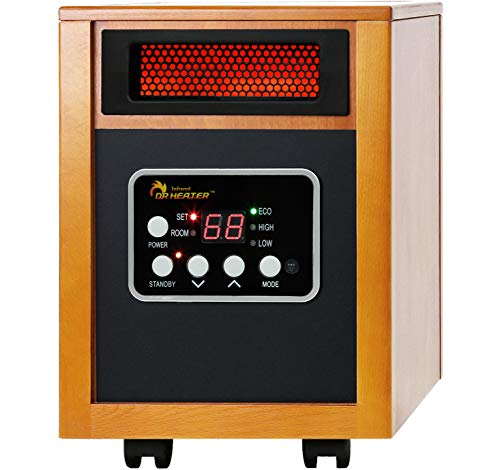
Dr Infrared DR-968The one listing in this category that publishes its amp draw and its noise level, which is exactly the arithmetic everyone else leaves you to do — 12.5 A and 39 dB, both stated.
Heat Storm HS-1500-PHXWall-mounted, which removes the entire tip-over failure mode rather than mitigating it — and Wi-Fi scheduling means it can heat a bathroom before you get in it.
Dreo Solaris 718The rare heater whose published coverage claim survives the arithmetic: 1,500 W is a genuine 300 sq ft at 10 W/sq ft, and Dreo publishes that number rather than implying more.
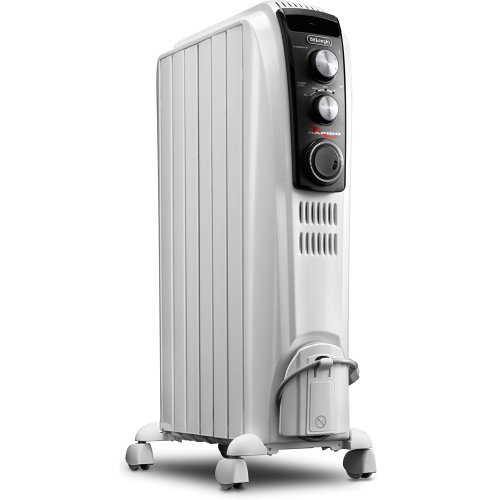
De'Longhi TRD40615TNo fan, so no noise and no moving dust — and the sealed oil keeps radiating after the element cuts out, which is why an oil-filled unit feels steadier than a ceramic one at the same wattage.
The one listing in this category that publishes its amp draw and its noise level, which is exactly the arithmetic everyone else leaves you to do — 12.5 A and 39 dB, both stated.
Rated power
1,500 W
Covers (computed)
150 sq ft
Draw (computed)
12.5 A at 120 V
Cost per hour
27.5¢
Coverage at 10 W/sq ft, average insulation, 8 ft ceiling = 5,118 BTU/h. Cost at 18.34¢/kWh; an eight-hour night at full output is $2.20. Exceeds the 12 A continuous limit of a 15 A circuit — check what else shares the breaker.
What works
Publishes 12.5 A, which is the number that decides whether it fits your circuit
Publishes 39 dB, which is the number that decides whether it fits your bedroom
A wooden-cabinet infrared unit runs cooler on the outside than a bare panel
What does not
19 lb with wheels: this is furniture, not a portable you carry between rooms
12.5 A against a 15 A circuit's 12 A continuous limit — it does not legally fit, see the circuit-load guide
Dated cabinet styling that will not disappear into a modern room
Published specification
Rated power
1,500 W at 120 V
Current draw
12.5 A (published)
Noise
39 dB (published)
Element
Infrared quartz tube plus PTC
Thermostat
Electronic, 50–85°F
Other
12-hour auto-off timer, IR remote, caster wheels, 19 lb
Heat type
Infrared quartz
Maker’s coverage claim
None published — the coverage figure above is ours
Safety listing
No listing mark published in the listing text; check the cabinet's rating plate for the UL or ETL mark.
Who it is for
A reader who wants to compute the load rather than trust a claim: the published amp draw and decibel figure make it the easiest unit on this site to check.
What it is not for
A 15 A circuit shared with anything else, and not a small room where a 19 lb cabinet on wheels is in the way.
Wall-mounted, which removes the entire tip-over failure mode rather than mitigating it — and Wi-Fi scheduling means it can heat a bathroom before you get in it.
Rated power
1,500 W
Covers (computed)
150 sq ft
Draw (computed)
12.5 A at 120 V
Cost per hour
27.5¢
Coverage at 10 W/sq ft, average insulation, 8 ft ceiling = 5,118 BTU/h. Cost at 18.34¢/kWh; an eight-hour night at full output is $2.20. Exceeds the 12 A continuous limit of a 15 A circuit — check what else shares the breaker.
What works
On a wall it cannot be tipped, and it cannot be crowded by a curtain that moved
Scheduling from the app is the practical answer to bathroom and workshop use
The published 5,200 BTU/h figure matches 1,500 W exactly — no inflated claim
What does not
It is a mounting job, not an unbox-and-plug — and it needs an outlet where you mount it
Wi-Fi adds a failure mode a knob does not have
Wall-mounted radiant heat is directional; you feel it where it points
Published specification
Rated power
1,500 W at 120 V
Published output
5,200 BTU/h
Mounting
Wall-mounted
Control
Wi-Fi app, remote scheduling
Element
Infrared quartz
Heat type
Infrared quartz
Maker’s coverage claim
None published — the coverage figure above is ours
Safety listing
No listing mark published in the listing text; check the rating plate for the UL or ETL mark.
Who it is for
A bathroom, a small bedroom, a workshop corner — anywhere floor space is gone and a heater on the ground is a hazard.
What it is not for
Renters who cannot drill, and rooms where you want the heater to move with you.
The rare heater whose published coverage claim survives the arithmetic: 1,500 W is a genuine 300 sq ft at 10 W/sq ft, and Dreo publishes that number rather than implying more.
Rated power
1,500 W
Covers (computed)
150 sq ft
Draw (computed)
12.5 A at 120 V
Cost per hour
27.5¢
Coverage at 10 W/sq ft, average insulation, 8 ft ceiling = 5,118 BTU/h. Cost at 18.34¢/kWh; an eight-hour night at full output is $2.20. Exceeds the 12 A continuous limit of a 15 A circuit — check what else shares the breaker.
What works
A digital thermostat with numbers on it — you can set 68°F rather than guess at a dial
The published 300 sq ft claim matches the standard sizing rule instead of exceeding it
8 lb and 8 inches square: it moves room to room without a project
What does not
1,500 W is 1,500 W — nothing here heats faster than any other 1,500 W heater
Dreo does not publish a noise figure in decibels on the product page
Tall and narrow, which is a tipping profile: the tip-over cutoff matters more here
A living room, bedroom or den at or under 300 sq ft with average insulation and an 8-foot ceiling, where you want to set a temperature and stop thinking about it.
What it is not for
A garage, an uninsulated basement, or anything over about 300 sq ft. It is not under-powered — 1,500 W is the plug-in ceiling — the room is simply too big for one outlet.
No fan, so no noise and no moving dust — and the sealed oil keeps radiating after the element cuts out, which is why an oil-filled unit feels steadier than a ceramic one at the same wattage.
Rated power
1,500 W
Covers (computed)
150 sq ft
Draw (computed)
12.5 A at 120 V
Cost per hour
27.5¢
Coverage at 10 W/sq ft, average insulation, 8 ft ceiling = 5,118 BTU/h. Cost at 18.34¢/kWh; an eight-hour night at full output is $2.20. Exceeds the 12 A continuous limit of a 15 A circuit — check what else shares the breaker.
What works
Genuinely silent: there is no fan to hear at 3 a.m.
The oil holds heat, so the room temperature swings less between thermostat cycles
Nothing blows air, so nothing stirs up dust in a bedroom
What does not
Slow. It takes 20–30 minutes to feel like it is doing anything
Heavy — the wheels are not a courtesy, they are a requirement
The surface gets genuinely hot; this is a radiator, not a cool-touch case
Published specification
Rated power
1,500 W at 120 V
Controls
Mechanical, with a programmable 24-hour timer
Fluid
Permanently sealed diathermic oil — never needs refilling
Maker's claim
Up to 75% more radiant surface area
Mobility
Front and rear handles, snap-on wheels
Heat type
Oil-filled
Maker’s coverage claim
None published — the coverage figure above is ours
Safety listing
No listing mark published in the listing text; verify the UL or ETL mark on the rating plate.
Who it is for
A bedroom, a nursery at a safe distance, or anywhere the fan noise of a ceramic heater is the actual problem you are trying to solve.
What it is not for
Fast heat, and not a room you only occupy for twenty minutes. It also should never be tucked beside a bed or curtain — hot surface, 3-foot rule.
Sized with the unheated-envelope correction applied, not the standard rule. A sunroom is usually outside the main heating system and mostly glazing, which is the case the 1.5x multiplier exists for.
Radiant ranked above convection, because in a room that leaks heat continuously, warming the person is achievable and warming all the air is a treadmill.
Getting the heater off the floor counted as a real advantage, since sunrooms are furnished tightly and often have tile or stone floors.
Silent options included, because a sunroom is frequently the room someone reads in.
No claim credited for glazing. We do not compute window heat loss — we apply the site's published envelope correction and say so.
And what we did not do: we have not tested these units, owned them, measured them or run them in a room. Everything above is compiled from published manufacturer specifications and live retail listings, with the electrical load, room coverage and running cost computed by us from the published wattage. The full method.
What we’d skip, and why
Every roundup on this site names something to skip. It costs us nothing to publish and it is the fastest way to tell whether a buying guide was written for you or for its commission.
One 1,500 W heater for a sunroom much over 100 sq ft
Here is the arithmetic the listings never do. The standard rule is 10 W per square foot; an unheated envelope needs 1.5x that, so a sunroom wants roughly 15 W per square foot. At 1,500 W — the ceiling for any U.S. outlet — that is 100 square feet. A 150 sq ft sunroom wants about 2,250 W and a 200 sq ft one about 3,000 W. A single heater in those rooms is not undersized by a little; it is delivering two-thirds or half of what the space needs, and it will run continuously without ever cycling.
A patio or outdoor heater brought inside for the job
Outdoor patio heaters are a different product class with different safety assumptions, and the propane ones are combustion appliances that have no business in an enclosed room — a sunroom is enclosed, whatever it feels like. Everything on this site is electric and indoor-rated. If the space is genuinely unenclosed, it is outside this site's scope and the honest answer is that no indoor heater is designed for it.
Questions people actually ask
What size heater do I need for a sunroom?+
About 15 watts per square foot — the standard 10 W/sq ft rule with the 1.5x unheated-envelope correction applied, because a sunroom is mostly glazing and usually outside the main heating system. A 100 sq ft sunroom wants about 1,500 W, a 150 sq ft one about 2,250 W.
Can one space heater heat a sunroom?+
Up to about 100 square feet, yes. Above that a single 1,500 W heater is delivering well under what the room needs and will run continuously without cycling. The options then are a second heater on a separate circuit, radiant heat aimed at people rather than the room, or treating it as a three-season space.
What is the best type of heater for a sunroom?+
Infrared or radiant, in most cases. A sunroom's air is cooled continuously by cold glass, so warming all of it is an uphill battle, while radiant heat warms people and surfaces directly and is unaffected by the air temperature. A convection heater suits only a small, well-sealed sunroom.
Are sunroom heaters expensive to run?+
They cost the same per hour as any other electric heater — about 27.5 cents at 1,500 W — but they run for more of those hours. A heater in an under-sized room never reaches its set point, so it does not cycle off, and you should budget for full output the whole time it is on.
Can I use a patio heater in a sunroom?+
No. Outdoor patio heaters are a different product class, and propane models are combustion appliances that should never run in an enclosed space — and a sunroom is enclosed. Everything on this site is electric and indoor-rated.
12.5 A against a 12 A continuous limit — the arithmetic nobody publishes, and what to do about it.
Written by Scooter M., an enthusiast — not a tester and not a certified anything. Every figure on this page is either published by the manufacturer, taken from a live retail listing, or computed from the published wattage using the formulas we publish. Found an error? Tell us and we will correct it, visibly and with a date on it.