The honest version first: low wattage buys you low current and a low bill, and it costs you the ability to warm a room. That is a real trade and for some buyers it is the right one.
By Scooter M. · Published October 17, 2026 · Last reviewed October 17, 2026
How this page is funded: we earn a commission if you buy through the links here, at no extra cost to you. Picks are chosen before links are attached, which is why every roundup names something to skip. Full disclosure.
For most people asking, the pick is the Cozy Legs CL at 150 W — 1.25 A, 2.8 cents an hour, and the only heater here whose maker publishes an ETL zero-clearance listing. It warms one person's legs and nothing else. If you need a room held on low wattage, the lowest honest figure in our registry is the Pelonis PSHO06MR6ASB's published 600 W step, which covers about 60 sq ft at 10 watts per square foot.
What each wattage actually buys
There is no efficiency trick anywhere in this category: every electric resistance heater converts essentially all of its electricity into heat, so the watts going in are the heat coming out. That makes the whole page a single table.
Rated power
Current at 120 V
Covers (10 W/sq ft)
Per hour
A month at 8 h/day
150 W
1.25 A
15 sq ft
2.8¢
$6.60
170 W
1.42 A
17 sq ft
3.1¢
$7.48
600 W
5.00 A
60 sq ft
11.0¢
$26.41
750 W
6.25 A
75 sq ft
13.8¢
$33.01
900 W
7.50 A
90 sq ft
16.5¢
$39.61
1,500 W
12.50 A
150 sq ft
27.5¢
$66.02
Current is watts ÷ 120 V. Coverage is watts ÷ 10 at our baseline sizing rule (average insulation, 8-foot ceiling). Cost is computed at 18.34¢/kWh — the U.S. residential average for June 2026 (EIA, Electric Power Monthly, Table 5.6.A).
Read the coverage column honestly and the category's limit is obvious. Nothing under about 600 W will change a room's temperature, and 600 W only holds a space the size of a small bathroom. What low wattage genuinely buys is in the other two columns: a tenth of the current, and a tenth of the bill.
Who this is actually for
Four situations, and they are the reason this page exists rather than redirecting you to a 1,500 W heater like everyone else does.
A circuit that is already busy. A desk with a computer, two monitors and a monitor-arm lamp is a real load, and adding 12.5 A of heater to it is how a breaker starts tripping. A 150 W panel adds 1.25 A and nothing notices.
An RV or a shore-power hookup with an amp budget. On a 30 A service the heater is competing with everything else on the rig, and the arithmetic is the whole decision — the RV version of this page does it in full.
A battery or a generator. A 1,500 W heater empties a 1,000 Wh power station in about 36 minutes; a 150 W panel runs about six hours on the same box. The outage arithmetic.
A space you heat continuously. Hours are what cost money, so the lowest wattage that holds the space is the cheapest way to hold it. 600 W continuously is about $79 a month against $198 for 1,500 W, and in a small well-insulated room 600 W may be all the room asks for.
The two classes, and why mixing them up is the mistake
Class one: genuinely low-wattage heaters. 150 to 200 W radiant panels, which is all our registry contains at that level, and all that exists in volume. They have no fan, no moving parts, and no ambition to heat a room. They are the correct answer when the problem is a stationary person rather than a cold space — the same argument the desk heater page makes about 170 W beating 1,500 W at a desk.
Class two: 1,500 W heaters with a published low step. These are room heaters you can choose to run at 600, 750 or 900 W. They are the right buy when you want the option of full output on the coldest night and low output for the other four months — but remember that the moment the element goes to high, your circuit sees the full 12.5 A. If the constraint is a hard amp ceiling rather than a bill, class one is the only honest option.
The picks
Quick picks
Ranked for fit, not for hype. Coverage and current draw are computed from each unit’s published wattage. Tap a row for the full write-up, or go straight to the listing.
#
Product
Best for
Covers
Draw
Price
1
Cozy Legs CLA 150 W radiant panel that does one job — warm the legs in a footwell — and is the only heater in this registry whose maker publishes a zero-clearance safety listing on its own page.
Global Industrial panelFunctionally the same 170 W under-desk panel as the QMark, with the one control the QMark lacks — an adjustable thermostat, so it cycles instead of running until you remember it.
Pelonis PSHO06MR6ASBThe digital Pelonis: all three of its wattages are published, the thermostat sets to the degree between 41 and 95°F, and it rolls on its own wheels.
A radiator with a real set-point and a 24-hour timer
BLACK+DECKER BHDC201The cheapest heater here that publishes its low wattage, which is the only way to know what the economical setting actually costs instead of guessing at it.
De'Longhi HMP1500A micathermic panel is a radiator that gave up its bulk: it radiates like oil-filled and warms up like ceramic, and it is about three inches deep so it can live against a wall.
A 150 W radiant panel that does one job — warm the legs in a footwell — and is the only heater in this registry whose maker publishes a zero-clearance safety listing on its own page.
Rated power
150 W
Covers (computed)
15 sq ft
Draw (computed)
1.3 A at 120 V
Cost per hour
2.8¢
Coverage at 10 W/sq ft, average insulation, 8 ft ceiling = 512 BTU/h. Cost at 18.34¢/kWh; an eight-hour night at full output is $0.22. Fits a 15 A circuit as a continuous load.
What works
150 W is 1.25 A — about a tenth of a 1,500 W room heater, so it will not trouble a desk circuit already carrying a computer and two monitors
Silent by construction: a radiant panel has no fan and no moving parts at all
The maker publishes an ETL zero-clearance listing — a rarity in this registry, and the reason the panel can sit flat against a desk modesty board or a wall
What does not
No set-point. The thermostat is built in and no range is published, so there is nothing to dial and no timer — it runs until the in-cord switch goes off
Cozy Products publishes no coverage figure, no warranty terms and no panel dimensions on the product page, so none of the three can be checked
150 W warms your legs and nothing else. It is not a small room heater and it will not raise the air temperature of an office
Published specification
Rated power
150 W at 120 V, 60 Hz (Cozy Products' published figures)
Current draw
1.25 A (150 ÷ 120) — our figure. Cozy Products' page prints 1.3 A, which is the same draw rounded
Element
Radiant panel — no fan, no moving parts
Thermostat
Built-in; Cozy Products publishes no set-point range, so there is no temperature to choose
Controls
An in-cord roller switch
Size
Cozy Products publishes the shipping box at 25 x 20 x 2 inches and the weight at 8 lb, but not the panel's own dimensions — so we do not print a panel size
Surface temperature
Approximately 130°F (Cozy Products' published figure)
Safety
ETL Certified Zero-Clearance — no clearance required, which the maker states on its own page
Heat type
Radiant panel
Maker’s coverage claim
None published — the coverage figure above is ours
Safety listing
Cozy Products publishes an ETL Certified Zero-Clearance rating on its own product page, which is why the panel may sit against a wall or other combustible surface.
Who it is for
A footwell where the complaint is cold legs, the circuit is already busy, and you want the lowest-draw honest answer rather than a 1,500 W heater in a small box.
What it is not for
Heating a room, or anywhere you need the heater to switch itself off. Without a timer or a set-point it is on until you switch it off at the cord, which makes the [unattended-heater guidance](/safety/overnight) matter more, not less.
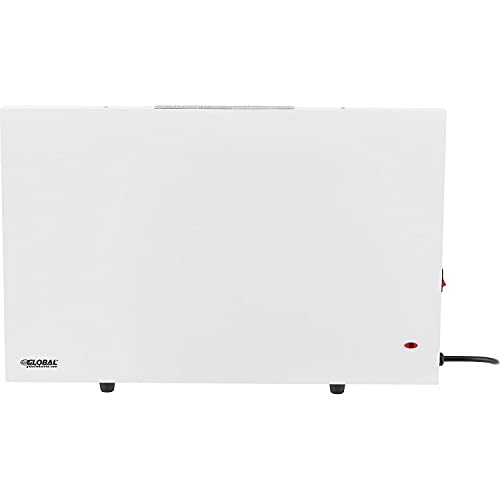
Global Industrial Under-Desk Radiant Panel Heater with Adjustable Thermostat
Functionally the same 170 W under-desk panel as the QMark, with the one control the QMark lacks — an adjustable thermostat, so it cycles instead of running until you remember it.
Rated power
170 W
Covers (computed)
17 sq ft
Draw (computed)
1.4 A at 120 V
Cost per hour
3.1¢
Coverage at 10 W/sq ft, average insulation, 8 ft ceiling = 580 BTU/h. Cost at 18.34¢/kWh; an eight-hour night at full output is $0.25. Fits a 15 A circuit as a continuous load.
What works
An adjustable thermostat, which is the single thing the QMark panel does not have
Same 170 W and the same 1.4 A class of draw — negligible against a desk circuit
Radiant panel format suits the enclosed footwell rather than fighting it
What does not
Near-identical to the QMark panel in size and output — you are choosing a control, not a different heater
No published listing mark in the listing text
Still a personal heater: it does nothing for the room, and it should not be bought expecting otherwise
Published specification
Rated power
170 W at 120 V
Controls
Adjustable thermostat
Dimensions
22-7/16" W x 14-14/16" H
Mounting
Floor mount, compact under-desk design
Finish
White
Heat type
Radiant panel
Maker’s coverage claim
None published — the coverage figure above is ours
Safety listing
No listing mark published in the listing text; check the rating plate for the UL or ETL mark.
Who it is for
The same desk-bound reader as the QMark, who would rather the panel cycled on a thermostat than stayed on until switched off.
What it is not for
Anyone wanting a room warm. It is a leg warmer with a thermostat, and that is the correct expectation to have of it.
3 · A radiator with a real set-point and a 24-hour timer
Pelonis PSHO06MR6ASB Oil-Filled Radiator
The digital Pelonis: all three of its wattages are published, the thermostat sets to the degree between 41 and 95°F, and it rolls on its own wheels.
Rated power
1,500 W / 600 W low
Covers (computed)
150 sq ft
Draw (computed)
12.5 A at 120 V
Cost per hour
27.5¢
Coverage at 10 W/sq ft, average insulation, 8 ft ceiling = 5,118 BTU/h. Cost at 18.34¢/kWh; an eight-hour night at full output is $2.20. Exceeds the 12 A continuous limit of a 15 A circuit — check what else shares the breaker.
What works
All three wattages are published — 600, 900 and 1,500 W — so the cost of every setting can be computed rather than guessed at, which is not true of most radiators at this price
A thermostat that sets to the degree from 41 to 95°F, on a type that usually ships with an unmarked dial
A 24-hour timer and an LED touchscreen with a remote, so the set-point and the shut-off can both be chosen rather than approximated
What does not
Pelonis publishes no coverage figure for this model, so there is no maker claim to check our 150 sq ft against — the 1,500 W ceiling is the only number either of us can stand behind
No UL or ETL mark is named, which is the one thing we would still want stated given everything else it publishes
No child lock is published — the model it replaces named one, and this one does not, which matters if the point was a heater a toddler cannot reset
Published specification
Rated power
600 W / 900 W / 1,500 W at 120 V (all three published)
Thermostat
41–95°F in 1°F increments
Modes
Energy-saving ECO mode
Timer
24 hours
Controls
LED touchscreen plus remote
Construction
Upgraded M-shaped fins; Pelonis publishes no fin count
Maker's noise claim
“Fan-free design ensures ultra-quiet performance” — no decibel figure is published
Portability
Universal wheels and handles
Safety
Tip-over protection, overheat protection and V0 flame-retardant materials
Heat type
Oil-filled
Maker’s coverage claim
None published — the coverage figure above is ours
Safety listing
Pelonis publishes V0 flame-retardant materials, tip-over protection and overheat protection, but does not name a UL or ETL mark and does not state a child lock. Check the rating plate.
Who it is for
A bedroom, nursery or study where silence is the requirement and you want to set an actual temperature and a shut-off time rather than a dial position.
What it is not for
Fast heat, or a room much over 150 sq ft on our arithmetic. It is a radiator: it warms slowly and steadily, and that is the design rather than a fault.
The cheapest heater here that publishes its low wattage, which is the only way to know what the economical setting actually costs instead of guessing at it.
Rated power
1,500 W / 750 W low
Covers (computed)
150 sq ft
Draw (computed)
12.5 A at 120 V
Cost per hour
27.5¢
Coverage at 10 W/sq ft, average insulation, 8 ft ceiling = 5,118 BTU/h. Cost at 18.34¢/kWh; an eight-hour night at full output is $2.20. Exceeds the 12 A continuous limit of a 15 A circuit — check what else shares the breaker.
What works
Publishes 750 W as well as 1,500 W — at this price that is genuinely unusual, and it halves the running cost when you do not need full output
A four-position mechanical switch has almost nothing in it to fail
Both cutoffs published, which is not a given at the bottom of the market
What does not
No published listing mark, so the rating plate is the only place to confirm UL or ETL
A dial thermostat with no numbers — you can set “warmer”, not 68°F
Personal-sized: this heats the person at the desk, not the room around them
Published specification
Rated power
1,500 W high / 750 W low, at 120 V
Controls
Four-position switch — off, fan, low, high
Thermostat
Adjustable
Other modes
Fan-only
Safety
Overheat protection and tip-over auto shut-off
Heat type
Ceramic (PTC)
Maker’s coverage claim
None published — the coverage figure above is ours
Safety listing
No listing mark is published in the listing text; check the rating plate for UL or ETL.
Who it is for
A desk, a home office or a small bedroom where the 750 W setting will do most of the work and the 1,500 W setting is there for the cold snap.
What it is not for
A large or drafty room. At 750 W it covers about 75 sq ft at our sizing rule, and at 1,500 W it is still a personal heater in a small cabinet.
A micathermic panel is a radiator that gave up its bulk: it radiates like oil-filled and warms up like ceramic, and it is about three inches deep so it can live against a wall.
Rated power
1,500 W / 750 W low
Covers (computed)
150 sq ft
Draw (computed)
12.5 A at 120 V
Cost per hour
27.5¢
Coverage at 10 W/sq ft, average insulation, 8 ft ceiling = 5,118 BTU/h. Cost at 18.34¢/kWh; an eight-hour night at full output is $2.20. Exceeds the 12 A continuous limit of a 15 A circuit — check what else shares the breaker.
What works
No fan, so no noise and nothing blown around a room
Warms up far faster than an oil-filled radiator of the same wattage
Wall-mountable, which gets it out of the floor space it would otherwise eat
What does not
The panel surface is hot to the touch — this is not a cool-touch design
No published coverage figure
Radiant heat is directional: stand behind it and you will not feel much
Ranked on draw, and the low figure has to be published. A listing that says "3 heat settings" without wattages has one costable number, not three, and it does not qualify as low-wattage here.
Two classes kept separate. Under 200 W is a personal heater and always will be; a 1,500 W heater with a published 600 or 750 W step is a room heater you can choose to run small.
Current computed for every pick as watts ÷ 120, because the reason most people want this is a circuit that is already carrying something else.
Honest coverage published even where it is embarrassing — watts ÷ 10 at our sizing rule, which makes a 150 W panel 15 sq ft.
No "equivalent to 1,500 W" claim accepted. Output equals input for every electric resistance heater, so a 400 W unit produces 400 W of heat and no marketing changes it.
And what we did not do: we have not tested these units, owned them, measured them or run them in a room. Everything above is compiled from published manufacturer specifications and live retail listings, with the electrical load, room coverage and running cost computed by us from the published wattage. The full method.
What we’d skip, and why
Every roundup on this site names something to skip. It costs us nothing to publish and it is the fastest way to tell whether a buying guide was written for you or for its commission.
Any heater sold as “low wattage” whose low setting is not published
This is the whole category's trick. A 1,500 W heater with an unmarked Low position is a 1,500 W heater as far as your circuit and your bill are concerned, because you cannot cost a setting whose wattage nobody states and you cannot tell whether "low" is 1,200 W or 600 W. Of the heaters we track, only a handful publish their low step as a number. Those are the only ones on this page, and the rest are a guess with a price tag.
A 400-600 W heater advertised as a room heater
At 10 watts per square foot a 500 W heater covers 50 sq ft — a walk-in closet, a small bathroom, a pump house. Sold against a photograph of a living room it is simply mis-sold, and the giveaway is a coverage claim with no wattage arithmetic behind it. A 600 W setting on a 1,500 W radiator is a different proposition entirely, because the radiator can step up when the room needs it.
What low wattage does not fix
It does not make a heater cheaper to run per unit of heat — 600 W for two hours and 1,200 W for one hour cost exactly the same, because both are 1.2 kWh. The saving is real only when the lower setting actually holds the room, so that the heater spends fewer watt-hours rather than the same ones more slowly. Why no heater is cheaper to run is the full version of that argument, and the energy-efficient roundup picks on the same three levers: wattage, thermostat accuracy and hours.
It also does not change the safety rules. A 150 W panel still needs clearance from combustibles, still should not live under a rug, and still belongs plugged into a wall rather than a power strip — the current is lower but the three-foot rule is about surface temperature, not amperage. The one thing it genuinely does improve is the circuit arithmetic, which is the leading cause of the complaint on the tripping-breaker page.
Questions people actually ask
What is the lowest wattage space heater that actually works?+
A 150 W radiant panel, provided you want to warm a person rather than a room. It draws 1.25 A, costs about 2.8 cents an hour, and covers about 15 sq ft at 10 watts per square foot — which is a footwell. Nothing under about 600 W will raise a room's air temperature.
Will a 500 watt heater heat a room?+
It will hold about 50 sq ft at 10 watts per square foot with average insulation and an 8-foot ceiling — a small bathroom or a large closet. In a bedroom it will take the edge off and no more, and in a drafty room the honest figure falls to about 40 sq ft.
How many amps does a low-wattage space heater draw?+
Watts divided by 120. A 150 W panel is 1.25 A, a 600 W setting is 5 A, a 750 W setting is 6.25 A and a full 1,500 W heater is 12.5 A — against the 12 A a 15 A branch circuit may carry continuously. That last comparison is why low wattage is often a circuit decision rather than a cost one.
Is a low-wattage heater cheaper to run?+
Per hour, yes and exactly in proportion: 750 W costs half of what 1,500 W costs, with no efficiency penalty. Per unit of heat, no — all electric resistance heaters are essentially 100% efficient, so the only real saving comes when the lower setting is enough to hold the room.
Can I run a low-wattage heater all day?+
The cost side is manageable: 150 W continuously is about $19.81 a month and 600 W is about $79. The safety guidance does not change with wattage, though — the U.S. Fire Administration's advice is to switch any portable heater off when you leave the room, and a panel with no timer and no set-point has to be switched off by hand.
What is the best low-wattage heater for an RV?+
Whichever one fits the amp budget you have left after the fridge and the converter, which is an arithmetic question rather than a product one. A 150 W panel is 1.25 A and is almost always affordable; a 1,500 W heater is 12.5 A and on a 30 A hookup it is half your service.
A 1,500 W heater is half a 30 A pedestal. The amp arithmetic first, then the units with a real low setting.
Written by Scooter M., an enthusiast — not a tester and not a certified anything. Every figure on this page is either published by the manufacturer, taken from a live retail listing, or computed from the published wattage using the formulas we publish. Found an error? Tell us and we will correct it, visibly and with a date on it.