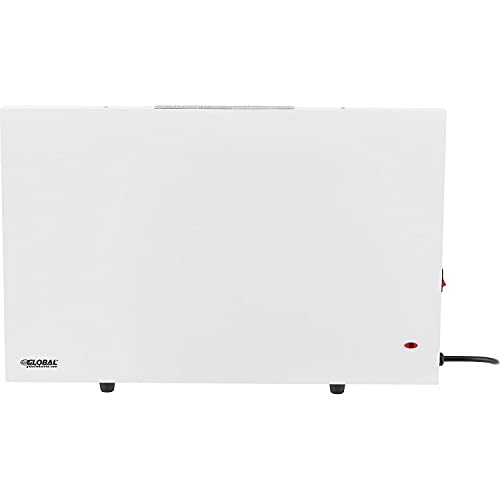
Almost everything sold as a “desk heater” is a 1,500 W room heater in a small box. At a desk that is the wrong tool, and the arithmetic says so plainly.
By Scooter M. · Published September 9, 2026 · Last reviewed September 9, 2026
How this page is funded: we earn a commission if you buy through the links here, at no extra cost to you. Picks are chosen before links are attached, which is why every roundup names something to skip. Full disclosure.
A desk needs a personal heater, not a room heater. An under-desk radiant panel draws about 170 W and 1.4 A, warming your legs directly. A typical “desk heater” is 1,500 W and 12.5 A — nine times the power and nine times the running cost, to heat a room you are not trying to heat.
The two numbers this whole page turns on
Search for a desk heater and nearly everything returned is a 1,500 W ceramic unit in a small enclosure. It is small, so it reads as a desk product. It is not: it is a room heater that happens to fit on a desk, and at a desk that distinction costs you on two separate axes.
Under-desk radiant panel
Typical “desk” ceramic heater
Rated power
170 W
1,500 W
Current draw at 120 V
1.4 A
12.5 A
Share of a 15 A circuit's 12 A continuous allowance
12%
104% — over on its own
Cost per hour at 18.34¢/kWh
3.1¢
27.5¢
What it heats
You
The room
Works in an enclosed footwell
Yes — designed for it
No — blocked airflow
Draw computed as watts ÷ 120 V; cost as kW × hours × rate at 18.34¢/kWh (EIA, June 2026). The panel column uses the published 170 W of our top pick; the second pick is 150 W, which is 1.25 A and 2.8¢ an hour.
The current row is the one that bites first. A desk is rarely a circuit on its own — it is a computer, two monitors, a dock, a phone charger and, in an office, a printer. Electrical code allows a 15 A branch circuit 12 A of continuous load, and a 1,500 W heater is 12.5 A of that by itself. Add the desk and you are over before anything unusual happens. The panel's 1.4 A is, by comparison, a rounding error. The full circuit arithmetic.
A manufacturer's cost claim, checked
Marley Engineered Products publishes, for its QMark 202SL panel, that it is “energy efficient — costs 1-2 cents per hour to operate”. That specific heater is no longer available (see the FAQ below), but Marley's page is still up, the claim is still on it, and the same claim shape is used across this whole product category — so it is worth checking rather than repeating. The 202SL drew 170 W, the same as our top pick.
Wattage
Per hour
1 h
8 h
170 W
3.1¢
$0.03
$0.25
900 W
16.5¢
$0.17
$1.32
1,500 W
27.5¢
$0.28
$2.20
Computed at 18.34¢/kWh — the U.S. residential average for June 2026 (EIA, Electric Power Monthly, Table 5.6.A, released August 26, 2026). Your rate is on your own bill; substitute it and the arithmetic still holds. Figures assume full output for the whole period.
170 W at 18.34¢/kWh is 3.1 cents an hour, not 1-2. For 1-2 cents you would need an electricity rate somewhere around 6-12¢/kWh, which is well below the current U.S. residential average. The claim was probably true when it was written, or is true in a cheap-power state, and it is not true for most American readers today.
That correction does not undermine the product class — 3.1 cents an hour is still about a ninth of what a 1,500 W heater costs, which is the actual argument for buying one. It is just not the number on the box, and you should have the real one. The same arithmetic applies to our 170 W top pick; the 150 W Sengoku below is lower again, at 2.8 cents an hour.
Why radiant, specifically, under a desk
The footwell is the one location in a house where the usual advice inverts. Everywhere else, a fan heater's ability to move air is an advantage — it is how heat gets distributed around a room. Under a desk there is no room to distribute into: it is a small enclosed volume bounded by a desk top, a chair, a computer tower and your legs.
Radiant heat does not need the air. An under-desk panel emits toward your legs and warms them directly, the way sunlight through a window warms your face while the air stays cold. In an enclosed space that is exactly right, and it is why this product category exists as a distinct thing rather than as a smaller version of a room heater. The mechanism in full.
The picks
Quick picks
Ranked for fit, not for hype. Coverage and current draw are computed from each unit’s published wattage. Tap a row for the full write-up, or go straight to the listing.
#
Product
Best for
Covers
Draw
Price
1
Global Industrial panelFunctionally the same 170 W under-desk panel as the QMark, with the one control the QMark lacks — an adjustable thermostat, so it cycles instead of running until you remember it.
Sengoku SP-160An inch-thick radiant panel that draws 150 W and nothing else — no fan, no noise, no controls to speak of, and about a tenth of the current a room heater pulls.
Lasko 754201The 900 W low setting is the whole point: it is the rare listing that publishes both settings, so you can compute what the cheap mode actually costs instead of guessing.
Honeywell HCE220BA shoebox-sized ceramic heater that publishes four preset temperatures and a 2/4/8-hour auto-off — specificity almost nothing else this size offers.
A thermostat with numbers on it, on a small heater
Global Industrial Under-Desk Radiant Panel Heater with Adjustable Thermostat
Functionally the same 170 W under-desk panel as the QMark, with the one control the QMark lacks — an adjustable thermostat, so it cycles instead of running until you remember it.
Rated power
170 W
Covers (computed)
17 sq ft
Draw (computed)
1.4 A at 120 V
Cost per hour
3.1¢
Coverage at 10 W/sq ft, average insulation, 8 ft ceiling = 580 BTU/h. Cost at 18.34¢/kWh; an eight-hour night at full output is $0.25. Fits a 15 A circuit as a continuous load.
What works
An adjustable thermostat, which is the single thing the QMark panel does not have
Same 170 W and the same 1.4 A class of draw — negligible against a desk circuit
Radiant panel format suits the enclosed footwell rather than fighting it
What does not
Near-identical to the QMark panel in size and output — you are choosing a control, not a different heater
No published listing mark in the listing text
Still a personal heater: it does nothing for the room, and it should not be bought expecting otherwise
Published specification
Rated power
170 W at 120 V
Controls
Adjustable thermostat
Dimensions
22-7/16" W x 14-14/16" H
Mounting
Floor mount, compact under-desk design
Finish
White
Heat type
Radiant panel
Maker’s coverage claim
None published — the coverage figure above is ours
Safety listing
No listing mark published in the listing text; check the rating plate for the UL or ETL mark.
Who it is for
The same desk-bound reader as the QMark, who would rather the panel cycled on a thermostat than stayed on until switched off.
What it is not for
Anyone wanting a room warm. It is a leg warmer with a thermostat, and that is the correct expectation to have of it.
An inch-thick radiant panel that draws 150 W and nothing else — no fan, no noise, no controls to speak of, and about a tenth of the current a room heater pulls.
Rated power
150 W
Covers (computed)
15 sq ft
Draw (computed)
1.3 A at 120 V
Cost per hour
2.8¢
Coverage at 10 W/sq ft, average insulation, 8 ft ceiling = 512 BTU/h. Cost at 18.34¢/kWh; an eight-hour night at full output is $0.22. Fits a 15 A circuit as a continuous load.
What works
150 W is 1.25 A — about a tenth of a 1,500 W room heater, so it will not trouble a desk circuit already carrying a computer and two monitors
Silent by construction: a radiant panel has no fan and no moving parts at all
An inch thick and 3.4 lb, which is the entire point in a footwell where floor space is the scarce thing
What does not
No controls. The thermostat is internal and self-regulating — there is no temperature to set and no timer, so it runs until you unplug it
No UL or ETL mark published, which at this price is the gap worth knowing about
150 W warms your legs and nothing else. It is not a small room heater and it will not raise the air temperature of an office
Published specification
Rated power
150 W at 120 V
Element
Radiant panel — no fan, no moving parts
Thermostat
Internal, self-regulating; there is no setting to choose
Size
15" x 1" x 21", 3.4 lb
Safety
Overheat protection; Sengoku states no hot surfaces
Heat type
Radiant panel
Maker’s coverage claim
None published — the coverage figure above is ours
Safety listing
Sengoku does not publish a UL or ETL mark on its product page or in the manual we could read; check the rating plate on the unit.
Who it is for
A footwell where the complaint is cold legs, the circuit is already busy, and you want the lowest-draw honest answer rather than a 1,500 W heater in a small box.
What it is not for
Heating a room, or anywhere you need the heater to switch itself off. Without a timer or a set-point it is on until you unplug it, which makes the [unattended-heater guidance](/safety/overnight) matter more, not less.
The 900 W low setting is the whole point: it is the rare listing that publishes both settings, so you can compute what the cheap mode actually costs instead of guessing.
Rated power
1,500 W / 900 W low
Covers (computed)
150 sq ft
Draw (computed)
12.5 A at 120 V
Cost per hour
27.5¢
Coverage at 10 W/sq ft, average insulation, 8 ft ceiling = 5,118 BTU/h. Cost at 18.34¢/kWh; an eight-hour night at full output is $2.20. Exceeds the 12 A continuous limit of a 15 A circuit — check what else shares the breaker.
What works
Both wattages are published, which is what makes an honest cost comparison possible
9 inches tall: it fits under a desk without being in the way
Manual top-mounted controls — nothing to relearn, nothing to lose the remote for
What does not
A dial thermostat with no numbers on it: you cannot set 68°F, only “about there”
No child lock, so the dial is reachable by anyone who can reach the unit
Fan noise is the price of a small ceramic unit moving 1,500 W of heat
ETL listed, per Lasko's published specification — one of the few in this roundup that names a mark rather than leaving it to the rating plate.
Who it is for
A desk, a small office, a dorm room — somewhere you want heat on a person rather than in a room.
What it is not for
A nursery, and not unattended use. It publishes a tip-over switch and overheat protection, but no child lock — and the USFA's advice to switch a heater off when you leave the room applies to every unit on this site, listed or not.
4 · A thermostat with numbers on it, on a small heater
Honeywell HCE220B UberHeat Plus Ceramic Heater
A shoebox-sized ceramic heater that publishes four preset temperatures and a 2/4/8-hour auto-off — specificity almost nothing else this size offers.
Rated power
1,500 W
Covers (computed)
150 sq ft
Draw (computed)
12.5 A at 120 V
Cost per hour
27.5¢
Coverage at 10 W/sq ft, average insulation, 8 ft ceiling = 5,118 BTU/h. Cost at 18.34¢/kWh; an eight-hour night at full output is $2.20. Exceeds the 12 A continuous limit of a 15 A circuit — check what else shares the breaker.
What works
Four preset temperatures rather than an unmarked dial — on a heater this small and this cheap, being able to ask for 70°F is unusual
Two independent overheat mechanisms are published — a high-temperature sensor and a thermal cut-off fuse — plus a tip-over switch
A 2/4/8-hour auto-off means it can stop by itself, which is what actually reduces the bill
What does not
No UL or ETL mark published by Honeywell, which is the one thing we would want stated at this size and price
Four presets is not the same as a full range: if you want 68°F you are choosing between 65 and 70
2.8 lb and shoebox-sized means it is a personal heater, not a room heater, whatever the 1,500 W suggests
Published specification
Rated power
1,500 W maximum at 120 V
Heat settings
2 (high and low)
Thermostat
Four preset comfort levels — 65°, 70°, 75° and 80°F
Auto-off timer
2, 4 or 8 hours
Safety
Tip-over switch; 2x overheat protection (high-temperature sensor plus a thermal cut-off fuse); cool-touch housing
Size
8.5" x 4.5" x 8.86", 2.8 lb
Warranty
3-year limited
Heat type
Ceramic (PTC)
Maker’s coverage claim
None published — the coverage figure above is ours
Safety listing
Honeywell does not publish a UL or ETL mark for this model; it does publish two independent overheat mechanisms. Check the rating plate.
Who it is for
A small office, a bedside table or a desk, where the heater needs to hold roughly a known temperature and switch itself off after a few hours.
What it is not for
A large or drafty room, and not a nursery — no child lock is published and the presets are reachable by anyone who can reach the unit.
Every roundup on this site names something to skip. It costs us nothing to publish and it is the fastest way to tell whether a buying guide was written for you or for its commission.
USB-powered “heaters”
This is arithmetic, not snobbery. A USB-A port supplies 2.5 W on USB 2.0 and 4.5 W on USB 3.0. Even a USB-C PD port negotiating a high profile is not what these gadgets use — they are built for ordinary ports. Set that against the 170 W of a real under-desk panel and you are looking at something in the region of a fiftieth of the output, which is why these things warm a mug and nothing else. There is no wattage at which they become a heater, because the port cannot supply it. If a product's power comes from a laptop's USB socket, it is a hand-warmer, and that is fine — just do not buy it expecting to stop being cold.
A 1,500 W fan heater crammed into the footwell
Two things go wrong at once. Airflow: a footwell is an enclosed cave bounded by a desk, a chair, a computer tower and your legs, and a fan heater needs clear intake and exhaust — blocked airflow is exactly what trips a thermal cutoff, and the repeated cut-and-restart people blame on a faulty unit is usually the unit working correctly. Clearance: the 3-foot rule applies under a desk as much as anywhere, and there is not three feet of anything down there, least of all away from a wastebasket and a tangle of cables. A radiant panel is designed for that space. A tower is designed for an open floor.
Getting the placement right
1.Plug it straight into the wall. Even at 1.4 A, the rule holds — and if you go the 1,500 W route it is not negotiable, because 12.5 A through a cord and two extra connectors is the failure mode. Why connectors, not cords, are where this goes wrong.
2.Keep the panel clear of the wastebasket. Under-desk wastebaskets are full of paper and they migrate. A radiant panel is safe to touch by design; a bin of paper leaning against one is still a bad arrangement.
3.Mind the cable tangle. The footwell is where power strips and cable spaghetti live. Route the heater's cord so it is not buried in the middle of it.
4.Check what shares your breaker before you choose. If you are set on a 1,500 W unit, this is the step that decides whether it works — how to find out.
5.Switch it off when you leave the desk. A panel with no thermostat runs until you do, and the general guidance on unattended heaters applies to a 170 W panel just as it does to a 1,500 W tower.
The cheaper answer, if you are only cold at a desk
Worth saying plainly on a page funded by product links: a heated throw over your legs draws in the region of 100 W and costs roughly 1.8 cents an hour — cheaper again than the panel, and it needs no purchase decision more complicated than a blanket. If you sit still at a desk and your legs are the problem, that is a legitimate answer and we would rather you knew it. The comparison in full.
The panel wins where a blanket does not: you can move, type and stand up without rearranging anything, and it does not have to be draped over you to work. That is a real convenience difference for eight hours a day, and it is the honest reason to spend the money rather than not.
How these were picked
Wattage judged against the job, not against the category. A desk is a person, not a room, and the two need outputs an order of magnitude apart.
Current draw treated as a primary criterion, because a desk circuit is already carrying a computer and monitors.
Radiant preferred for under-desk placement — the footwell is an enclosed space, which is the one place a fan heater is actively at a disadvantage.
Manufacturer cost claims checked against our own rate, not repeated. One of them did not survive the check.
Room heaters included honestly, labeled as room heaters, for the reader whose actual problem is a cold office rather than cold legs.
And what we did not do: we have not tested these units, owned them, measured them or run them in a room. Everything above is compiled from published manufacturer specifications and live retail listings, with the electrical load, room coverage and running cost computed by us from the published wattage. The full method.
Questions people actually ask
What happened to the QMark 202SL?+
It is no longer available. We featured it as the top pick here until September 2026, when its listing went permanently unavailable and no live listing for the model could be found anywhere. Marley's own product page for the 202SL Series is still up, which is why the cost-claim correction above still stands. Our current top pick is the Global Industrial panel — the same 170 W, with an adjustable thermostat the QMark did not have.
How many watts should a desk heater be?+
About 170 W if you want to warm yourself — that is what a purpose-built under-desk radiant panel draws. Most heaters sold for desks are 1,500 W room heaters, which is roughly nine times the power for a job that does not need it.
Do under-desk heaters use a lot of electricity?+
No. A 170 W panel costs about 3.1 cents an hour at the U.S. average residential rate of 18.34¢/kWh, against 27.5 cents for a 1,500 W heater. An eight-hour working day is about 25 cents rather than $2.20.
Will a desk heater trip the office breaker?+
A 170 W panel draws 1.4 A and will not. A 1,500 W heater draws 12.5 A, which is more than the 12 A continuous allowance of a 15 A circuit on its own — before your computer, monitors and printer are counted.
Are USB desk heaters any good?+
Not as heaters. A USB-A port supplies 2.5 W on USB 2.0 and 4.5 W on USB 3.0, a tiny fraction of the 170 W a real under-desk panel uses. They warm hands or a mug; they cannot make you warm.
Can I put a space heater under my desk?+
A radiant panel, yes — that is what it is designed for. A 1,500 W fan heater, no: the enclosed footwell blocks the airflow it needs, which trips its thermal cutoff, and there is no way to keep three feet of clearance under a desk.
Where the 750 / 1000 / 1500 W tiers come from, and why 1500 W is a hard ceiling on a U.S. outlet.
Written by Scooter M., an enthusiast — not a tester and not a certified anything. Every figure on this page is either published by the manufacturer, taken from a live retail listing, or computed from the published wattage using the formulas we publish. Found an error? Tell us and we will correct it, visibly and with a date on it.