The honest answer separates two questions that get asked as one: is the radiation dangerous, and is the appliance dangerous. The second has real answers. The first mostly does not.
By Scooter M. · Published October 17, 2026 · Last reviewed October 17, 2026
How this page is funded: we earn a commission if you buy through the links here, at no extra cost to you. Picks are chosen before links are attached, which is why every roundup names something to skip. Full disclosure.
Yes — and the two risks that make it conditional are a hot element you can touch and a cabinet that can be knocked over, neither of which is about radiation. Infrared from a heater is thermal radiation: ICNIRP describes the harmful effects of infrared as "thermal injury of tissues", and says infrared "is not thought to play a role in initiating skin cancer". The safest version of one is wall-mounted, out of reach, with published cutoffs.
Two questions get asked as one
"Are infrared heaters safe" is really two questions wearing one coat. Is the radiation harmful? — which is a physics question with a settled answer. Is the appliance hazardous? — which is an electrical and mechanical question with real, specific answers that apply to every heater in this category and some that apply only to infrared.
Publishers tend to answer the first question at length because it is dramatic, and skip the second because it is boring. The second is the one that puts people in emergency rooms.
What an infrared heater actually emits
Infrared is the band of electromagnetic radiation immediately beyond visible red. ICNIRP divides it into IR-A (780 nm to 1.4 µm), IR-B (1.4 to 3 µm) and IR-C, also known as far-IR (3 µm to 1 mm). A heating element glowing in a quartz tube emits across that band, and so does a campfire, a hot sidewalk and the warmth you feel standing in a sunbeam.
The mechanism of harm is the thing worth being precise about. ICNIRP states that the "harmful health effects of IR are due to thermal injury of tissues mediated largely through water molecules", and that infrared "penetrates the human skin and the eye to various depths ranging from several millimeters by IR-A to superficial absorption of IR-C". That is a heating mechanism. It is not the bond-breaking mechanism people are picturing when they use the word radiation.
Two further things an electric infrared heater does not do, because they come up in the same search: it does not produce carbon monoxide — there is no combustion anywhere in it — and it does not dry the air, because no electric heater removes water from a room. Both of those are categorical rather than probabilistic, which is rare in safety writing.
The risks that are real
1. The element is the hottest thing in the category
This is the genuine infrared-specific hazard. A quartz element glows visibly, which means it is running hotter than any ceramic element in our registry does, and a bare-element unit puts that surface within reach of a hand, a sleeve or a curtain. Enclosed cabinet designs and wall-mounted panels manage it by putting a shell between the element and the room; open radiant bars do not manage it at all.
For scale on what skin tolerates, ICNIRP's own datum is that "if the temperature of the skin is held at 44°C it takes several hours before irreversible damage occurs". That tells you where the real risk lies: not in standing in front of the heater, where you simply feel warm and move when you have had enough, but in contact with a hot grille, and in what happens to a fabric that touches it. The three-foot clearance rule is at its most literal with this type, and the federal portable-heater fire data is mostly a record of that rule being broken.
2. It is a 1,500 W appliance on a 15 A circuit
Infrared units are the same electrical load as everything else here. At 1,500 W and 120 V that is 12.5 A continuous, against the 12 A a 15 A branch circuit is allowed to carry continuously — one of our picks publishes the 12.5 A figure itself, which almost nothing in this category does. Plugged into a wall outlet on its own circuit that is a non-event. On an extension cord or a power strip it is the single most common way a heater starts a fire. The circuit arithmetic and why cords fail.
3. The eye question, kept in proportion
ICNIRP is direct that "the main harmful health effects of high IR exposure are to the eye", and that "aggregation of lens proteins after repeated exposure to extreme heat can cause lens opacities or cataracts" — an effect documented in glass workers and iron and steel workers, whose working day is spent in front of molten material. The same page notes that "humans have inborn protective aversion responses to pain from high heat and to the bright light", which is the reason domestic exposure stays far below occupational exposure: you look away.
The practical reading: a furnace is not a living-room heater, and nothing about a 1,500 W domestic unit resembles an industrial exposure. Do not sit a foot from a glowing bar staring into it, and do not mount one at a child's eye level. Those are the whole of the precaution.
Infrared against the other types, on safety alone
Every type here puts the same 1,500 W into the same room, so this table ranks nothing on heat. It is only about where each type's hazard lives.
A hot panel at knee height, unless it is wall-mounted
No
No fan
Qualitative by design: no maker in our registry publishes a grille or surface temperature, so there is no number to put in the first column. Each type's full behavior is on its own page.
Read down the "glowing element" column and the answer to the question most people are really asking becomes obvious: if you want radiant heat and you do not want a hot visible element in the room, a mica panel or an oil-filled radiator gives you the radiation without the glow. That is why the third pick below is not an infrared heater at all.
The picks, judged on safety rather than heat
Ranked on how the design handles its hot part. A heater on a wall cannot be tipped over, which beats any tip-over switch; a heater in an enclosed cabinet keeps the element away from hands; and a heater with no element to glow at all is the right answer for some households, even though it is a different type.
Quick picks
Ranked for fit, not for hype. Coverage and current draw are computed from each unit’s published wattage. Tap a row for the full write-up, or go straight to the listing.
#
Product
Best for
Covers
Draw
Price
1
Heat Storm HS-1500-PHXWall-mounted, which removes the entire tip-over failure mode rather than mitigating it — and Wi-Fi scheduling means it can heat a bathroom before you get in it.
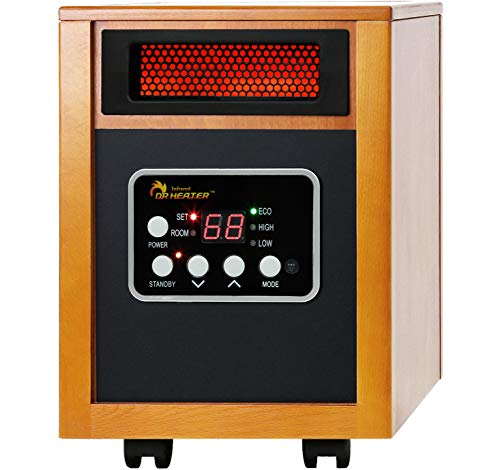
Dr Infrared DR-968The one listing in this category that publishes its amp draw and its noise level, which is exactly the arithmetic everyone else leaves you to do — 12.5 A and 39 dB, both stated.
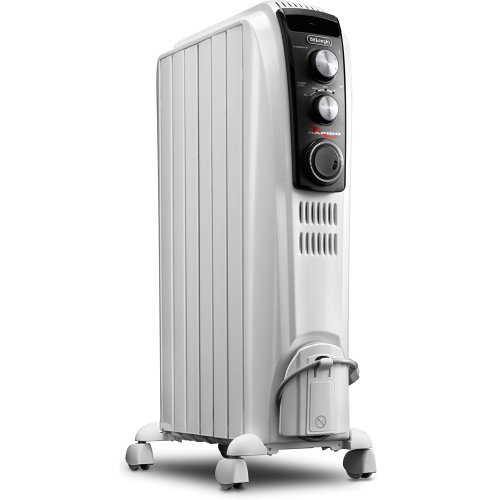
De'Longhi TRD40615TNo fan, so no noise and no moving dust — and the sealed oil keeps radiating after the element cuts out, which is why an oil-filled unit feels steadier than a ceramic one at the same wattage.
Wall-mounted, which removes the entire tip-over failure mode rather than mitigating it — and Wi-Fi scheduling means it can heat a bathroom before you get in it.
Rated power
1,500 W
Covers (computed)
150 sq ft
Draw (computed)
12.5 A at 120 V
Cost per hour
27.5¢
Coverage at 10 W/sq ft, average insulation, 8 ft ceiling = 5,118 BTU/h. Cost at 18.34¢/kWh; an eight-hour night at full output is $2.20. Exceeds the 12 A continuous limit of a 15 A circuit — check what else shares the breaker.
What works
On a wall it cannot be tipped, and it cannot be crowded by a curtain that moved
Scheduling from the app is the practical answer to bathroom and workshop use
The published 5,200 BTU/h figure matches 1,500 W exactly — no inflated claim
What does not
It is a mounting job, not an unbox-and-plug — and it needs an outlet where you mount it
Wi-Fi adds a failure mode a knob does not have
Wall-mounted radiant heat is directional; you feel it where it points
Published specification
Rated power
1,500 W at 120 V
Published output
5,200 BTU/h
Mounting
Wall-mounted
Control
Wi-Fi app, remote scheduling
Element
Infrared quartz
Heat type
Infrared quartz
Maker’s coverage claim
None published — the coverage figure above is ours
Safety listing
No listing mark published in the listing text; check the rating plate for the UL or ETL mark.
Who it is for
A bathroom, a small bedroom, a workshop corner — anywhere floor space is gone and a heater on the ground is a hazard.
What it is not for
Renters who cannot drill, and rooms where you want the heater to move with you.
The one listing in this category that publishes its amp draw and its noise level, which is exactly the arithmetic everyone else leaves you to do — 12.5 A and 39 dB, both stated.
Rated power
1,500 W
Covers (computed)
150 sq ft
Draw (computed)
12.5 A at 120 V
Cost per hour
27.5¢
Coverage at 10 W/sq ft, average insulation, 8 ft ceiling = 5,118 BTU/h. Cost at 18.34¢/kWh; an eight-hour night at full output is $2.20. Exceeds the 12 A continuous limit of a 15 A circuit — check what else shares the breaker.
What works
Publishes 12.5 A, which is the number that decides whether it fits your circuit
Publishes 39 dB, which is the number that decides whether it fits your bedroom
A wooden-cabinet infrared unit runs cooler on the outside than a bare panel
What does not
19 lb with wheels: this is furniture, not a portable you carry between rooms
12.5 A against a 15 A circuit's 12 A continuous limit — it does not legally fit, see the circuit-load guide
Dated cabinet styling that will not disappear into a modern room
Published specification
Rated power
1,500 W at 120 V
Current draw
12.5 A (published)
Noise
39 dB (published)
Element
Infrared quartz tube plus PTC
Thermostat
Electronic, 50–85°F
Other
12-hour auto-off timer, IR remote, caster wheels, 19 lb
Heat type
Infrared quartz
Maker’s coverage claim
None published — the coverage figure above is ours
Safety listing
No listing mark published in the listing text; check the cabinet's rating plate for the UL or ETL mark.
Who it is for
A reader who wants to compute the load rather than trust a claim: the published amp draw and decibel figure make it the easiest unit on this site to check.
What it is not for
A 15 A circuit shared with anything else, and not a small room where a 19 lb cabinet on wheels is in the way.
No fan, so no noise and no moving dust — and the sealed oil keeps radiating after the element cuts out, which is why an oil-filled unit feels steadier than a ceramic one at the same wattage.
Rated power
1,500 W
Covers (computed)
150 sq ft
Draw (computed)
12.5 A at 120 V
Cost per hour
27.5¢
Coverage at 10 W/sq ft, average insulation, 8 ft ceiling = 5,118 BTU/h. Cost at 18.34¢/kWh; an eight-hour night at full output is $2.20. Exceeds the 12 A continuous limit of a 15 A circuit — check what else shares the breaker.
What works
Genuinely silent: there is no fan to hear at 3 a.m.
The oil holds heat, so the room temperature swings less between thermostat cycles
Nothing blows air, so nothing stirs up dust in a bedroom
What does not
Slow. It takes 20–30 minutes to feel like it is doing anything
Heavy — the wheels are not a courtesy, they are a requirement
The surface gets genuinely hot; this is a radiator, not a cool-touch case
Published specification
Rated power
1,500 W at 120 V
Controls
Mechanical, with a programmable 24-hour timer
Fluid
Permanently sealed diathermic oil — never needs refilling
Maker's claim
Up to 75% more radiant surface area
Mobility
Front and rear handles, snap-on wheels
Heat type
Oil-filled
Maker’s coverage claim
None published — the coverage figure above is ours
Safety listing
No listing mark published in the listing text; verify the UL or ETL mark on the rating plate.
Who it is for
A bedroom, a nursery at a safe distance, or anywhere the fan noise of a ceramic heater is the actual problem you are trying to solve.
What it is not for
Fast heat, and not a room you only occupy for twenty minutes. It also should never be tucked beside a bed or curtain — hot surface, 3-foot rule.
Ranked on how each design handles the one genuinely hot part, not on heat output — every 1,500 W heater here produces identical heat, so safety is the only axis this page ranks on.
A unit that cannot be tipped over beats one with a tip-over switch, which is why a wall-mounted panel leads.
Published numbers rewarded. One pick publishes its current draw, its noise figure and its thermostat range; that is three more checkable specifications than this category usually offers.
The third pick is deliberately not infrared. If the hot element is the thing you do not want in the room, the honest recommendation is a type that does not have one.
And what we did not do: we have not tested these units, owned them, measured them or run them in a room. Everything above is compiled from published manufacturer specifications and live retail listings, with the electrical load, room coverage and running cost computed by us from the published wattage. The full method.
What we could not tell you
A safe distance in inches. ICNIRP publishes exposure limits, but they are occupational, dependent on exposure duration and source size, and expressed in irradiance rather than in feet from a consumer appliance. Nobody can convert that into "sit at least X inches away" without inventing the source's output, and we are not going to. The clearance figure we do publish — three feet from anything combustible — is a fire rule from the U.S. Fire Administration, and it is the one that matters in a house.
A grille temperature for any specific model. Not one maker in our registry publishes one. Where a listing says cool-touch we report the claim and whose claim it is; where it does not, we say that too.
Questions people actually ask
Are infrared heaters safe for your health?+
The radiation itself is thermal rather than ionizing: ICNIRP describes the harmful effects of infrared as thermal injury of tissues, and states that infrared is not thought to play a role in initiating skin cancer. The real risks are a hot element you can touch, a unit that can be tipped over, and a 12.5 A continuous electrical load — all manageable, none of them about radiation.
Do infrared heaters cause cancer?+
ICNIRP's published position is that infrared "is not thought to play a role in initiating skin cancer". What repeated moderate heat on one patch of skin can cause is a red-brown mottling — a cosmetic, local effect from habitually sitting against a heat source, not a malignancy.
Is it safe to sit in front of an infrared heater?+
Yes, at a normal distance, and your own discomfort is the limit to respect — ICNIRP notes that humans have inborn aversion responses to high heat and bright light, which is why domestic exposure stays far below the industrial exposures that cause harm. Do not sit within touching distance of a glowing element, and keep three feet between the heater and anything combustible.
Are infrared heaters safe for babies and pets?+
The element is the problem, not the radiation. An infrared quartz unit has the hottest reachable surface of any type on this site, so for a nursery or a household with animals the safer choices are a wall-mounted unit out of reach or a type with no glowing element at all. Our nursery and pet-safe roundups pick on exactly that basis.
Do infrared heaters produce carbon monoxide?+
No. An electric infrared heater has no fuel, no flame and no exhaust, so there is no pathway by which it could produce carbon monoxide. That is one of the few categorical answers in heater safety.
Which is safer, infrared or ceramic?+
They fail differently rather than one being safer. A ceramic PTC element self-limits its own temperature and is usually behind a cool-touch housing, but it has a fan intake that overheats when it blocks with dust. An infrared element runs hotter and is often closer to the surface, but fanless designs circulate nothing. Both are safe installed correctly; neither is safe on an extension cord.
Electric heaters have no combustion, so they make no carbon monoxide. Which heaters do, and why.
Written by Scooter M., an enthusiast — not a tester and not a certified anything. Every figure on this page is either published by the manufacturer, taken from a live retail listing, or computed from the published wattage using the formulas we publish. Found an error? Tell us and we will correct it, visibly and with a date on it.