It draws 12.5 amps. The circuit allows 12. This is the calculation almost no heater article performs, and it changes where you plug in.
By Scooter M. · Published August 31, 2026 · Last reviewed August 31, 2026
How this page is funded: we earn a commission if you buy through the links here, at no extra cost to you. Picks are chosen before links are attached, which is why every roundup names something to skip. Full disclosure.
A 1,500 W heater draws 12.5 amps at 120 V. A 15 A branch circuit supports 12 A of continuous load under the 125% sizing rule, so a 1,500 W heater technically exceeds it. It will usually run without tripping, but it should not share the circuit with anything else significant.
The arithmetic, in two steps
Step one — the draw. Amps equal watts divided by volts. 1,500 ÷ 120 = 12.5 A. That is a fixed property of the heater and it does not vary.
Step two — the allowance. Electrical code treats a load that operates for three hours or more as continuous, and requires the branch circuit conductors and the overcurrent device to be rated at not less than 125% of it (NFPA 70, Article 210.19(A)(1) and 210.20(A)). Dividing through: a continuous load may occupy at most 80% of the breaker rating.
Heater
Draw at 120 V
15 A circuit (12 A limit)
20 A circuit (16 A limit)
750 W
6.3 A
Fits
Fits
900 W
7.5 A
Fits
Fits
1,200 W
10.0 A
Fits
Fits
1,500 W
12.5 A
Over the limit
Fits
Maximum continuous
—
12 A = 1,440 W
16 A = 1,920 W
Draw computed as watts / 120 V. The continuous limit is 80% of the breaker rating, which follows from the NEC's requirement to size a circuit at 125% of a continuous load (NFPA 70, 210.19(A)(1) and 210.20(A)).
A space heater run for an evening is unambiguously a continuous load — it is the textbook example. So the honest conclusion is the one at the top of this page: 12.5 A does not fit within a 15 A circuit's 12 A continuous allowance. This arithmetic is also why almost every plug-in heater sold here is 1,500 W — the circuit sets the ceiling, so the entire category is clustered at one output and the shopping decision is about everything except the wattage.
So why does it work?
Because a breaker is a thermal-magnetic device, not a precise gate. A 15 A breaker does not trip at 15.0 A — it trips on a time-current curve, carrying a modest overload for a long time before opening. At 12.5 A it will not trip at all, ever.
The 80% rule is not about the breaker tripping. It is about sustained heat in the conductors, the terminations and the breaker itself over years of use. Continuous loads at the full breaker rating cause connections to warm, warm connections oxidize, oxidized connections have higher resistance, and higher resistance produces more heat. The failure this rule prevents is a slow one at a terminal screw, not a dramatic one.
How to find out what shares your circuit
1.Switch off one breaker at the panel and label it.
2.Walk the floor with a lamp or a socket tester and find every outlet and light that went dead. Those are all on that one circuit.
3.Repeat for the breakers serving the rooms you care about. It takes twenty minutes and it is information you will use for as long as you live there.
4.Then add up the continuous loads on any circuit you plan to put a heater on, and keep the total under 12 A on a 15 A breaker or 16 A on a 20 A breaker.
In most houses, the outlets in a single bedroom are on one circuit shared with an adjacent room or hallway. That is fine for a heater plus lamps and chargers. It is not fine for a heater plus a second heater, a window air conditioner, a microwave or a workshop tool.
Move the heater to a different circuit. Free, once you know which outlets are on which breaker. An outlet across a hallway is often on a different one.
Have a dedicated circuit run. An electrician's job, and the right answer if you are heating a room continuously all winter or running two heaters in the same space. If the space is a garage or a workshop, the circuit worth running is a two-pole 240 V one, because that is the only way past the 1,500 W ceiling — the same continuous-load arithmetic on this page is what sets its breaker at 30 A or 40 A.
Two things that are not fixes
Fitting a bigger breaker. The breaker protects the wire, not the appliance. Putting a 20 A breaker on 14-gauge wiring rated for 15 A removes the protection and leaves the wire to be the fuse. This is dangerous and it is a code violation.
Using an extension cord or a power strip to reach another outlet. A power strip does not change which circuit you are on, and a cord adds resistance and a connector exactly where a continuous 12.5 A load will find it. Why this is the wrong tool.
This page explains why the ceiling exists. If you have already hit it — the breaker is actually tripping — why your space heater keeps tripping the breaker works through the six causes in order of likelihood, only one of which means the heater is broken.
The 12 A allowance above comes from the code's definition of a continuous load — three hours or more — which means the length of the run is what decides whether this arithmetic applies to you at all. How long you can run a space heater works through that three-hour line, what 24/7 actually costs, and the parts that hours consume.
Picks that publish their current draw
Quick picks
Ranked for fit, not for hype. Coverage and current draw are computed from each unit’s published wattage. Tap a row for the full write-up, or go straight to the listing.
#
Product
Best for
Covers
Draw
Price
1
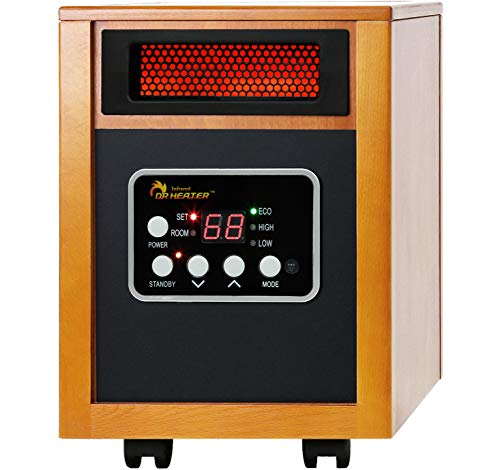
Dr Infrared DR-968The one listing in this category that publishes its amp draw and its noise level, which is exactly the arithmetic everyone else leaves you to do — 12.5 A and 39 dB, both stated.
Lasko 754201The 900 W low setting is the whole point: it is the rare listing that publishes both settings, so you can compute what the cheap mode actually costs instead of guessing.
The one listing in this category that publishes its amp draw and its noise level, which is exactly the arithmetic everyone else leaves you to do — 12.5 A and 39 dB, both stated.
Rated power
1,500 W
Covers (computed)
150 sq ft
Draw (computed)
12.5 A at 120 V
Cost per hour
27.5¢
Coverage at 10 W/sq ft, average insulation, 8 ft ceiling = 5,118 BTU/h. Cost at 18.34¢/kWh; an eight-hour night at full output is $2.20. Exceeds the 12 A continuous limit of a 15 A circuit — check what else shares the breaker.
What works
Publishes 12.5 A, which is the number that decides whether it fits your circuit
Publishes 39 dB, which is the number that decides whether it fits your bedroom
A wooden-cabinet infrared unit runs cooler on the outside than a bare panel
What does not
19 lb with wheels: this is furniture, not a portable you carry between rooms
12.5 A against a 15 A circuit's 12 A continuous limit — it does not legally fit, see the circuit-load guide
Dated cabinet styling that will not disappear into a modern room
Published specification
Rated power
1,500 W at 120 V
Current draw
12.5 A (published)
Noise
39 dB (published)
Element
Infrared quartz tube plus PTC
Thermostat
Electronic, 50–85°F
Other
12-hour auto-off timer, IR remote, caster wheels, 19 lb
Heat type
Infrared quartz
Maker’s coverage claim
None published — the coverage figure above is ours
Safety listing
No listing mark published in the listing text; check the cabinet's rating plate for the UL or ETL mark.
Who it is for
A reader who wants to compute the load rather than trust a claim: the published amp draw and decibel figure make it the easiest unit on this site to check.
What it is not for
A 15 A circuit shared with anything else, and not a small room where a 19 lb cabinet on wheels is in the way.
The 900 W low setting is the whole point: it is the rare listing that publishes both settings, so you can compute what the cheap mode actually costs instead of guessing.
Rated power
1,500 W / 900 W low
Covers (computed)
150 sq ft
Draw (computed)
12.5 A at 120 V
Cost per hour
27.5¢
Coverage at 10 W/sq ft, average insulation, 8 ft ceiling = 5,118 BTU/h. Cost at 18.34¢/kWh; an eight-hour night at full output is $2.20. Exceeds the 12 A continuous limit of a 15 A circuit — check what else shares the breaker.
What works
Both wattages are published, which is what makes an honest cost comparison possible
9 inches tall: it fits under a desk without being in the way
Manual top-mounted controls — nothing to relearn, nothing to lose the remote for
What does not
A dial thermostat with no numbers on it: you cannot set 68°F, only “about there”
No child lock, so the dial is reachable by anyone who can reach the unit
Fan noise is the price of a small ceramic unit moving 1,500 W of heat
ETL listed, per Lasko's published specification — one of the few in this roundup that names a mark rather than leaving it to the rating plate.
Who it is for
A desk, a small office, a dorm room — somewhere you want heat on a person rather than in a room.
What it is not for
A nursery, and not unattended use. It publishes a tip-over switch and overheat protection, but no child lock — and the USFA's advice to switch a heater off when you leave the room applies to every unit on this site, listed or not.
12.5 amps at 120 volts. The arithmetic is amps = watts ÷ volts, so 1,500 ÷ 120 = 12.5. At 240 V a 1,500 W load would draw 6.25 A, but plug-in heaters in the U.S. are 120 V appliances.
Can a 1500 watt heater run on a 15 amp circuit?+
It will run without tripping, but 12.5 A exceeds the 12 A continuous limit that the 125% sizing rule gives a 15 A circuit. Do not share that circuit with other significant loads, and prefer a lower setting or a dedicated circuit.
What size breaker do I need for a 1500 watt heater?+
A 20 A circuit gives a 16 A continuous allowance, which accommodates a 1,500 W heater with genuine headroom. Never fit a larger breaker to existing wiring — the breaker protects the wire, and the wire gauge sets the limit.
Why does my space heater trip the breaker?+
Almost always because something else substantial is on the same circuit. A 12.5 A heater plus a few amps of anything else exceeds 15 A. Find out which outlets share the breaker, and move one of the loads.
150 W warms a person; 600 W holds about 60 sq ft. The picks, the amps, and what each wattage honestly covers.
Written by Scooter M., an enthusiast — not a tester and not a certified anything. Every figure on this page is either published by the manufacturer, taken from a live retail listing, or computed from the published wattage using the formulas we publish. Found an error? Tell us and we will correct it, visibly and with a date on it.