This is where a single plug-in heater stops being a solution and becomes a supplement. 300 square feet wants 3,000 watts; an outlet gives you half.
By Scooter M. · Published September 21, 2026 · Last reviewed September 21, 2026
How this page is funded: we earn a commission if you buy through the links here, at no extra cost to you. Picks are chosen before links are attached, which is why every roundup names something to skip. Full disclosure.
A 300 sq ft room needs about 3,000 W at average insulation and an 8-foot ceiling. One plug-in heater delivers 1,500 W — exactly half. A single unit will not hold this room on its own in cold weather; it will run continuously and take the edge off.
The arithmetic, stated plainly
300 sq ft × 10 W = 3,000 W. One heater is 1,500 W. The shortfall is 50% — the largest of any room size on this site where people still expect a single heater to work.
Room size
Watts needed
BTU/h
Plug-in heaters
200 sq ft
2,000 W
6,824
2 (different circuits)
300 sq ft
3,000 W
10,236
2 (different circuits)
Computed as square feet x 10 W x insulation factor x (ceiling / 8 ft), for an average heated room — 10 W/sq ft, 8 ft ceiling. Heater count assumes the 1,500 W plug-in ceiling.
A 300 sq ft room is a large living room, a primary bedroom, a finished basement room or a studio apartment's main space: roughly 15 × 20 feet. It is also, not coincidentally, the coverage figure several manufacturers print on 1,500 W heaters — which is where this page earns its keep.
The four honest options
1. Two heaters, on two different circuits
Two 1,500 W units give you the 3,000 W the room actually wants. The constraint is electrical, not financial: two heaters draw 25 A between them, and no residential 15 or 20 A circuit will carry that. They must be on genuinely separate circuits, which in an older home or an apartment is less common than people assume — one circuit often serves several rooms.
If the room is large because it is open-plan but you occupy one end of it, radiant heat aimed at where you sit delivers comfort without trying to raise the air temperature of 300 square feet. This is the same reasoning that makes infrared the right answer in a garage, applied to a room that is merely large rather than uninsulated. The trade-off is that it warms what it can see. Convection vs radiant.
3. Treat it as a supplement to central heating
The most common realistic use at this size: the central system does the bulk and the space heater closes a gap in one cold room, so the thermostat for the whole house does not have to be raised. That is a legitimate and often economical strategy — and whether it saves money depends entirely on your fuel. Space heater vs central heat, worked through.
4. Accept the room is under-served and size expectations accordingly
One 1,500 W heater in a 300 sq ft room will make it noticeably more comfortable and will not make it warm on the coldest nights. That is a fine outcome if it is what you expected. It is a bad outcome if a box promised you 300 sq ft.
What it costs, and why it costs more than you would think
Wattage
Per hour
1 h
8 h
1,500 W
27.5¢
$0.28
$2.20
3,000 W
55.0¢
$0.55
$4.40
Computed at 18.34¢/kWh — the U.S. residential average for June 2026 (EIA, Electric Power Monthly, Table 5.6.A, released August 26, 2026). Your rate is on your own bill; substitute it and the arithmetic still holds. Figures assume full output for the whole period.
A single heater is 27.5 cents an hour; two are 55 cents. The figure people miss is that in an under-sized room the heater never cycles off — it never reaches the set point, so there is no duty-cycle discount. Where a correctly sized heater in a 100 sq ft room might run 60% of the time, one in a 300 sq ft room runs 100% of it. Budget the full-output number for every hour it is on.
This is the most recent month EIA has published. Residential rates move seasonally and vary enormously by state — from roughly a dime per kilowatt-hour in parts of the South to more than 40¢ in Hawaii — so treat it as a national reference point, not as your rate.
The circuit question, which decides option 1
Heater
Draw at 120 V
15 A circuit (12 A limit)
20 A circuit (16 A limit)
1,500 W
12.5 A
Over the limit
Fits
3,000 W
25.0 A
Over the limit
Over the limit
Maximum continuous
—
12 A = 1,440 W
16 A = 1,920 W
Draw computed as watts / 120 V. The continuous limit is 80% of the breaker rating, which follows from the NEC's requirement to size a circuit at 125% of a continuous load (NFPA 70, 210.19(A)(1) and 210.20(A)).
One heater at 12.5 A is already over the 12 A continuous allowance of a 15 A circuit. Two at 25 A is beyond any residential circuit. If the plan is two heaters, the plan is also two circuits — and confirming that is a five-minute job with the breaker panel and a lamp. The continuous-load rule.
Corrections
Drafty — multiply by 1.25. 300 sq ft becomes 3,750 W, which is two and a half heaters.
Unheated envelope — multiply by 1.5. 300 sq ft becomes 4,500 W, at which point you are into the garage conversation and hardwired 240 V equipment.
High or vaulted ceilings, common in the open-plan rooms that are 300 sq ft, add proportionally more air to heat.
What to buy
Picked for a room a single heater cannot hold: the largest honest convection output, a unit built to run continuously without complaint, a radiant option for heating people instead, and a silent radiator for a 300 sq ft bedroom.
Quick picks
Ranked for fit, not for hype. Coverage and current draw are computed from each unit’s published wattage. Tap a row for the full write-up, or go straight to the listing.
#
Product
Best for
Covers
Draw
Price
1
Dreo Solaris 718The rare heater whose published coverage claim survives the arithmetic: 1,500 W is a genuine 300 sq ft at 10 W/sq ft, and Dreo publishes that number rather than implying more.
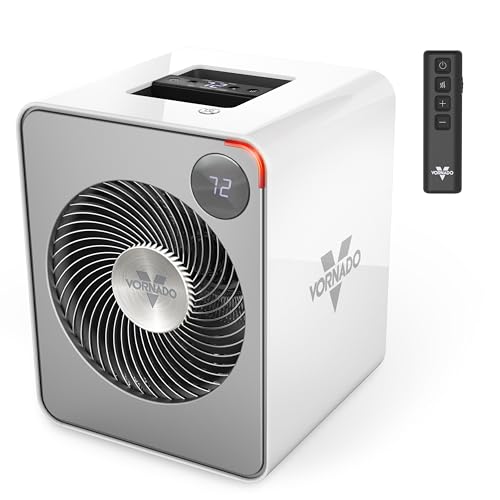
Vornado VMHi500The current top of Vornado's metal line: auto-climate control, two LED displays and a 1-12 hour timer in a cool-touch metal box, backed by five years.
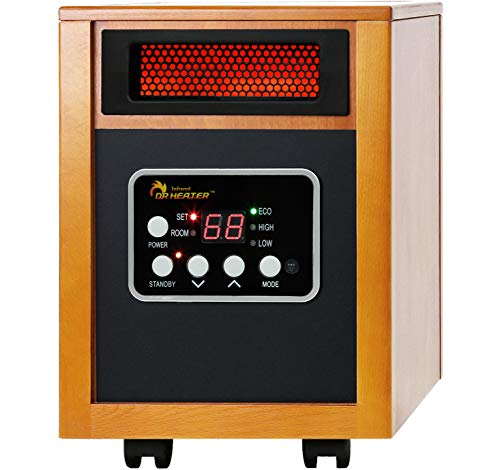
Dr Infrared DR-968The one listing in this category that publishes its amp draw and its noise level, which is exactly the arithmetic everyone else leaves you to do — 12.5 A and 39 dB, both stated.
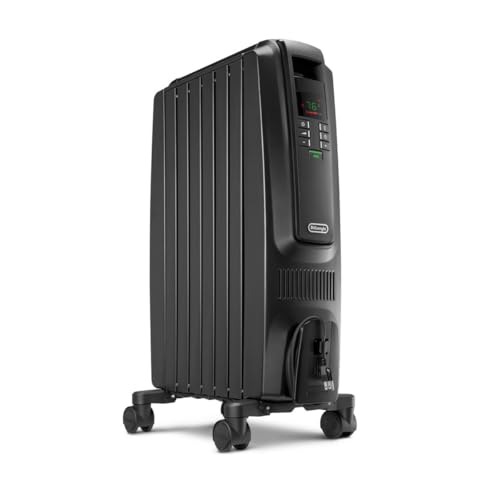
De'Longhi Dragon DigitalThe oil-filled radiator with a programmable timer, which is the version that matters overnight: it can bring a bedroom up before you wake and shut itself off, unattended, without you leaving it running all night.
The rare heater whose published coverage claim survives the arithmetic: 1,500 W is a genuine 300 sq ft at 10 W/sq ft, and Dreo publishes that number rather than implying more.
Rated power
1,500 W
Covers (computed)
150 sq ft
Draw (computed)
12.5 A at 120 V
Cost per hour
27.5¢
Coverage at 10 W/sq ft, average insulation, 8 ft ceiling = 5,118 BTU/h. Cost at 18.34¢/kWh; an eight-hour night at full output is $2.20. Exceeds the 12 A continuous limit of a 15 A circuit — check what else shares the breaker.
What works
A digital thermostat with numbers on it — you can set 68°F rather than guess at a dial
The published 300 sq ft claim matches the standard sizing rule instead of exceeding it
8 lb and 8 inches square: it moves room to room without a project
What does not
1,500 W is 1,500 W — nothing here heats faster than any other 1,500 W heater
Dreo does not publish a noise figure in decibels on the product page
Tall and narrow, which is a tipping profile: the tip-over cutoff matters more here
A living room, bedroom or den at or under 300 sq ft with average insulation and an 8-foot ceiling, where you want to set a temperature and stop thinking about it.
What it is not for
A garage, an uninsulated basement, or anything over about 300 sq ft. It is not under-powered — 1,500 W is the plug-in ceiling — the room is simply too big for one outlet.
The current top of Vornado's metal line: auto-climate control, two LED displays and a 1-12 hour timer in a cool-touch metal box, backed by five years.
Rated power
1,500 W
Covers (computed)
150 sq ft
Draw (computed)
12.5 A at 120 V
Cost per hour
27.5¢
Coverage at 10 W/sq ft, average insulation, 8 ft ceiling = 5,118 BTU/h. Cost at 18.34¢/kWh; an eight-hour night at full output is $2.20. Exceeds the 12 A continuous limit of a 15 A circuit — check what else shares the breaker.
What works
Auto-Climate Control adjusts output to hold a temperature rather than running flat out — the cycling behavior that genuinely lowers consumption
A 1–12 hour timer means it can stop on its own, which is the only reliable way an overnight heater saves money
Five years on a heater at this price is a costed commitment, not a marketing line
What does not
Vornado publishes no wattage and no coverage figure, so every sizing and cost number here is ours, computed from the retail-listed 1,500 W
No child lock is published — the same gap the rest of Vornado's range has, and it is disqualifying for a nursery
It is a fan heater in a metal box: moving air is the mechanism and you will hear it
Published specification
Rated power
1,500 W at 120 V (retail listings; Vornado publishes settings, not watts)
Heat settings
2, plus fan-only
Thermostat
Auto-Climate Control, digital
Timer
1–12 hours
Display
Two LED displays, for reading it from across the room
Housing
Cool-touch, powder-coated gloss metal cabinet with cord storage
Safety
Tip-over protection and a 2-stage auto shutoff
Warranty
5-year satisfaction guarantee
Heat type
Fan-forced
Maker’s coverage claim
None published — the coverage figure above is ours
Safety listing
Vornado publishes tip-over protection and a 2-stage auto shutoff but does not name a listing mark; check the rating plate.
Who it is for
A living room or bedroom where the heater is permanent and visible, and where a real thermostat, a timer and a cool metal shell are worth paying for over a plastic tower.
What it is not for
A nursery, because no child lock is published; and not silence, which means an oil-filled radiator instead.
The one listing in this category that publishes its amp draw and its noise level, which is exactly the arithmetic everyone else leaves you to do — 12.5 A and 39 dB, both stated.
Rated power
1,500 W
Covers (computed)
150 sq ft
Draw (computed)
12.5 A at 120 V
Cost per hour
27.5¢
Coverage at 10 W/sq ft, average insulation, 8 ft ceiling = 5,118 BTU/h. Cost at 18.34¢/kWh; an eight-hour night at full output is $2.20. Exceeds the 12 A continuous limit of a 15 A circuit — check what else shares the breaker.
What works
Publishes 12.5 A, which is the number that decides whether it fits your circuit
Publishes 39 dB, which is the number that decides whether it fits your bedroom
A wooden-cabinet infrared unit runs cooler on the outside than a bare panel
What does not
19 lb with wheels: this is furniture, not a portable you carry between rooms
12.5 A against a 15 A circuit's 12 A continuous limit — it does not legally fit, see the circuit-load guide
Dated cabinet styling that will not disappear into a modern room
Published specification
Rated power
1,500 W at 120 V
Current draw
12.5 A (published)
Noise
39 dB (published)
Element
Infrared quartz tube plus PTC
Thermostat
Electronic, 50–85°F
Other
12-hour auto-off timer, IR remote, caster wheels, 19 lb
Heat type
Infrared quartz
Maker’s coverage claim
None published — the coverage figure above is ours
Safety listing
No listing mark published in the listing text; check the cabinet's rating plate for the UL or ETL mark.
Who it is for
A reader who wants to compute the load rather than trust a claim: the published amp draw and decibel figure make it the easiest unit on this site to check.
What it is not for
A 15 A circuit shared with anything else, and not a small room where a 19 lb cabinet on wheels is in the way.
De'Longhi Dragon Digital Oil-Filled Radiator (TRD40615EBK)
The oil-filled radiator with a programmable timer, which is the version that matters overnight: it can bring a bedroom up before you wake and shut itself off, unattended, without you leaving it running all night.
Rated power
1,500 W
Covers (computed)
150 sq ft
Draw (computed)
12.5 A at 120 V
Cost per hour
27.5¢
Coverage at 10 W/sq ft, average insulation, 8 ft ceiling = 5,118 BTU/h. Cost at 18.34¢/kWh; an eight-hour night at full output is $2.20. Exceeds the 12 A continuous limit of a 15 A circuit — check what else shares the breaker.
What works
A programmable timer is the honest answer to “can I leave it on overnight” — you don't have to
Silent, like every oil-filled unit: no fan, no moving air
Digital control means you set a temperature, not a knob position
What does not
Costs more than the mechanical TRD40615T for identical heat output
Same slow warm-up as any oil-filled radiator
Heavy and bulky for its coverage — 26 inches of steel you will not be carrying upstairs
Published specification
Rated power
1,500 W at 120 V
Controls
Digital, with a 24-hour programmable timer
ECO function
Regulates power and temperature rather than running at full output
Dimensions
16" x 10" x 26"
Fluid
Permanently sealed diathermic oil
Safety
Child lock, thermal cut-off
Maker's coverage claim
None published — sold as a full-room heater
Heat type
Oil-filled
Maker’s coverage claim
None published — the coverage figure above is ours
Safety listing
No listing mark published in the listing text; verify the UL or ETL mark on the rating plate.
Who it is for
A bedroom where the heater needs to run on a schedule rather than all night, and where noise would wake you.
What it is not for
A room you need warm in five minutes, or a tight space where a hot 26-inch radiator cannot keep 3 feet of clearance.
Sized at 10 W per square foot with average insulation and an 8-foot ceiling, then the shortfall stated rather than hidden.
Units that tolerate continuous running preferred, because in a 300 sq ft room the thermostat will rarely get the chance to cycle them off.
A radiant option included deliberately, since heating the occupant is frequently the better answer at this size than heating the volume.
No coverage claim repeated without checking it — one pick here publishes 300 sq ft and our figure for it is 150.
And what we did not do: we have not tested these units, owned them, measured them or run them in a room. Everything above is compiled from published manufacturer specifications and live retail listings, with the electrical load, room coverage and running cost computed by us from the published wattage. The full method.
Questions people actually ask
What size space heater do I need for a 300 square foot room?+
About 3,000 W at 10 watts per square foot with average insulation and an 8-foot ceiling. One plug-in heater supplies 1,500 W, so a single unit covers half the demand — the options are two heaters on two circuits, radiant heat aimed at people, or using it as a supplement to central heating.
Will a 1500 watt heater heat a 300 sq ft room?+
Not on its own in cold weather. It supplies half the 3,000 W the room needs at the standard rule, so it will run continuously without reaching a set point and will take the edge off rather than making the room warm. Several heaters are nonetheless sold with a 300 sq ft claim on the box.
Can I use two space heaters in one room?+
Yes, but they must be on different circuits. Two 1,500 W heaters draw 25 A between them, well beyond any residential 15 or 20 A circuit. In older homes and apartments a single circuit often serves several rooms, so check the panel before buying the second one.
How much does it cost to heat a 300 sq ft room with a space heater?+
About 27.5 cents an hour for one 1,500 W heater, or 55 cents for two, at the U.S. average rate. Budget the full figure for every hour — in an under-sized room the heater never reaches its set point, so it never cycles off and there is no duty-cycle saving.
What size heater for a 15x20 room?+
A 15 × 20 room is 300 square feet and needs about 3,000 W. That is twice what one plug-in heater delivers, so plan for two units on separate circuits, radiant heat for the occupied end, or supplementary use alongside central heating.
Per-BTU arithmetic for gas, oil and electric — and the one condition that decides the answer.
Written by Scooter M., an enthusiast — not a tester and not a certified anything. Every figure on this page is either published by the manufacturer, taken from a live retail listing, or computed from the published wattage using the formulas we publish. Found an error? Tell us and we will correct it, visibly and with a date on it.