Recessed between the studs, wired in, nothing on the floor. These are fixed heaters — the class UL 1278 explicitly does not cover — and only one of them publishes a listing mark.
By Scooter M. · Published November 21, 2026 · Last reviewed November 21, 2026
How this page is funded: we earn a commission if you buy through the links here, at no extra cost to you. Picks are chosen before links are attached, which is why every roundup names something to skip. Full disclosure.
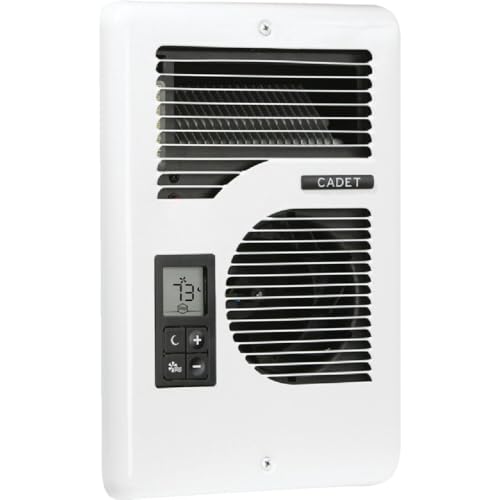
The pick is the Cadet Com-Pak CSC152TW: 1,500 W at 240 V, a built-in thermostat, three screws to install, and the only in-wall heater in this registry whose listing actually says "UL Listed Heater" — which, on a heater being wired permanently into a wall cavity, outranks every other specification. If you want belt-and-braces protection, the Stelpro Pulsair ARWF1502W is the only heater on this site with a resettable thermal cut-out *and* a backup thermal fuse behind it. If 1,500 W has never been enough for the room, the twin-element Com-Pak CSTC302TW is the only unit here that goes to 3,000 W — on a 20 A circuit, not a 15 A one.
An in-wall heater is not a wall-mounted heater, and the standard says so
This site already has a wall-mounted heater roundup, and it is a different product. Those units hang on the surface of a wall and plug into an outlet. These recess into the wall cavity and are wired in. The distinction is not just practical — it is where the safety standards divide:
UL 1278, "Movable and Wall-or Ceiling-Hung Electric Room Heaters" covers the plug-in panels. Its scope covers movable and wall- or ceiling-hung equipment, and explicitly excludes fixed and location-dedicated heaters.
UL 2021, "Fixed and Location-Dedicated Electric Room Heaters" is the standard for the units on this page. Its scope covers "fixed and location-dedicated electric room heating equipment rated 600 volts or less", and in turn excludes movable and wall- or ceiling-hung heaters.
UL 1042 covers baseboard equipment, fixed or portable — a third category again, and the subject of the baseboard roundup.
So "is it UL listed?" is three different questions depending on the form factor, and a mark earned under one standard says nothing about another. What we can tell you is which of these five publishes a mark at all: one does. Our page on UL versus ETL covers what either mark actually certifies.
The five units, side by side
Unit
Rated power
Current
Breaker
Our coverage
Maker's claim
Thermostat in the box
Listing mark published
Cadet Com-Pak CSC152TW
1,500 W / 240 V
6.25 A
15 A
150 sq ft
None published
Yes
Yes — "UL Listed Heater"
Stelpro Pulsair ARWF1502W
1,500 W / 240 V (750 W option)
6.25 A
15 A
150 sq ft
150 sq ft — agrees
No — wall thermostat required
No
Cadet Com-Pak Twin CSTC302TW
3,000 W / 240 V
12.50 A
20 A
300 sq ft
500 sq ft — we disagree
Yes, 40-85°F
No
Cadet Energy Plus CEC163TW
1,600 W / 240 V
6.67 A
15 A
160 sq ft
None published
Yes, digital
No
Stelpro Sonoma ASOS1502W
1,500 W / 240 V
6.25 A
15 A
150 sq ft
150 sq ft — agrees
Yes, electronic
No
Watts and volts are the makers' published figures. Current is watts ÷ volts; minimum circuit ampacity is that grossed up 25% under the continuous-load rule (NFPA 70, 210.19(A)(1) and 210.20(A)); the breaker is the smallest standard rating at or above it. "Our coverage" is watts ÷ 10 at this site's baseline sizing rule.
The column that should decide a lot of purchases is the second-to-last one. Two of these five arrive without a thermostat, and on the Pulsair the maker strongly recommends an electronic one — so its real cost is the heater plus a control plus the electrician's time to wire both. Comparing its sticker price against a complete unit is comparing two different purchases.
What recessing one actually involves
1.A stud bay deep enough. Stelpro publishes 2-3/8 inches minimum for the Pulsair; the Cadet units ship with a galvanized or powder-coated steel wall can that sets the hole size. An interior wall, because an exterior wall is where the insulation lives.
2.A dedicated 240 V two-pole branch circuit, sized from the table above. Four of these five fit a 15 A breaker; the 3,000 W twin needs 20 A.
3.A thermostat decision made before the wall closes, because a built-in kit and a wall thermostat are wired differently and only one of them is reachable afterwards.
4.An electrician. Every unit here says so in its own listing, and in most jurisdictions a new branch circuit is permit work. This is the part that makes an in-wall heater cost three times its sticker price, and it is also why it lasts twenty years.
5.Clearance checked against the furniture plan. A recessed heater blows warm air out at roughly ankle-to-knee height; a sofa pushed against it is both a dead heater and a hazard.
Running cost, which is the same as every other electric heater
Rated power
Output
Per hour
8 h/day for a month
Continuous for a month
750 W (Pulsair, configured low)
2,559 BTU/h
13.8¢
$33.01
$99.04
1,500 W
5,118 BTU/h
27.5¢
$66.02
$198.07
1,600 W
5,459 BTU/h
29.3¢
$70.43
$211.27
3,000 W
10,236 BTU/h
55.0¢
$132.05
$396.14
Computed at 18.34¢/kWh — the U.S. residential average for June 2026 (EIA, Electric Power Monthly, Table 5.6.A). BTU/h is watts x 3.412142.
There is no efficiency story here and anyone selling you one is wrong. The Cadet Energy Plus claims it "uses up to 30% less energy than a standard wall heater", and the mechanism is real but it is not conversion efficiency — every electric resistance heater turns essentially 100% of its input into heat. What that unit actually does is hold the room within a degree of the set-point and drop to a setback temperature on Night and Away, so it spends fewer watt-hours. That is the only lever that exists, and it is the same lever on the energy-efficient roundup.
The picks
Quick picks
Ranked for fit, not for hype. Coverage and current draw are computed from each unit’s published wattage. Tap a row for the full write-up, or go straight to the listing.
#
Product
Best for
Covers
Draw
Price
1
Cadet Com-Pak CSC152TWThe default in-wall heater, and the only one here whose listing actually says "UL Listed". A complete unit — heater, wall can, grille and thermostat — for less than half what the digital models cost, making the same 5,118 BTU/h.
Stelpro Pulsair 1500 WThe only heater in this registry with a thermal cut-out AND a backup thermal fuse behind it, and the only in-wall unit whose published coverage claim matches our own sizing arithmetic to the square foot.
Cadet Com-Pak Twin 3000 WTwo fan-forced heaters behind one grille, and the only in-wall unit here that breaks the 1,500-watt ceiling every plug-in heater on this site runs into. It is also the one whose coverage claim is furthest from the arithmetic.
Cadet Energy PlusThe in-wall heater for anyone who wants a number rather than a knob: a backlit digital thermostat holding the room within a degree, setback modes, a variable-speed fan and a lock on the temperature range. The energy claim is marketing; the controls are not.
Stelpro Sonoma 1500 WThe same 5,118 BTU/h as the cheapest unit here, with a built-in electronic thermostat, a five-year warranty and a façade designed not to look like a wall heater. You are paying for the controls and the face.
The default in-wall heater, and the only one here whose listing actually says "UL Listed". A complete unit — heater, wall can, grille and thermostat — for less than half what the digital models cost, making the same 5,118 BTU/h.
Rated power
1,500 W
Covers (computed)
150 sq ft
Draw (computed)
6.3 A at 240 V
Cost per hour
27.5¢
Coverage at 10 W/sq ft, average insulation, 8 ft ceiling = 5,118 BTU/h. Cost at 18.34¢/kWh; an eight-hour night at full output is $2.20. Hardwired 240 V: this is an electrician's installation, not a plug-in appliance.
What works
It publishes a UL listing. Of the five in-wall units here, this is the only one whose listing says so, which on a heater being wired into a wall cavity is the specification that matters most
Both published BTU figures are arithmetically correct, including the 208 V derating
A complete unit: heater assembly, wall can, grille and thermostat in one box, with nothing else to buy
6.25 A at 240 V fits the smallest two-pole breaker made, with room for a second heater on the same circuit in many cases
Three screws and a galvanized can — the simplest install in this group
What does not
It has a fan, and the fan is the part that fails. Every in-wall heater in this class is fan-forced; a baseboard or a mica panel has nothing to seize
The thermostat is a knob on the grille, not a number — fine, but not the digital set-point the dearer units give you
No published coverage figure and no published warranty in the listing text
Recessing it means cutting a hole in a wall. That is not reversible, and in a rental it is not yours to do
A wall heater blows warm air across a room at ankle height; it will never feel like the even radiant warmth of baseboard or mica
Published specification
Rated power
1,500 W at 240 V; 1,125 W at 208 V (both published)
Published output
5,120 / 3,840 BTU/h (the maker's figures; 1,500 W x 3.412142 = 5,118 and 1,125 W x 3.412142 = 3,839, so both check out)
Current draw
6.25 A at 240 V; 5.41 A at 208 V
Circuit it needs
7.8 A minimum circuit ampacity, so a 15 A two-pole 240 V breaker. Hardwired
Controls
Built-in adjustable thermostat, included
Safety
High-temperature safety shutoff; "UL Listed Heater" published in the listing
Install
Recess-mounted between studs with three screws; galvanized steel wall can; can be ceiling-mounted
Fan
Centrifugal
Size
14 in x 9.5 in x 5.25 in, 6.9 lb
Maker's coverage claim
None published. Our figure is 150 sq ft at 10 W per square foot, about 120 sq ft in a drafty room
Heat type
Fan-forced
Maker’s coverage claim
None published — the coverage figure above is ours
Safety listing
"UL Listed Heater" is published in the listing's own feature list — the only in-wall unit in this registry that publishes a listing mark. The listing does not name the standard; fixed, location-dedicated electric room heaters are covered by UL 2021.
Who it is for
A bathroom, hallway, small bedroom or finished basement of roughly 150 sq ft where the floor has to stay clear and an electrician is available.
What it is not for
A renter, a room over about 150 sq ft, or anyone who wants silence — the fan is audible by design.
The only heater in this registry with a thermal cut-out AND a backup thermal fuse behind it, and the only in-wall unit whose published coverage claim matches our own sizing arithmetic to the square foot.
Rated power
1,500 W / 750 W low
Covers (computed)
150 sq ft
Draw (computed)
6.3 A at 240 V
Cost per hour
27.5¢
Coverage at 10 W/sq ft, average insulation, 8 ft ceiling = 5,118 BTU/h. Cost at 18.34¢/kWh; an eight-hour night at full output is $2.20. Hardwired 240 V: this is an electrician's installation, not a plug-in appliance.
What works
A backup thermal fuse behind the resettable cut-out. Every other heater in this registry has one layer of overheat protection; this has two, and on a heater buried in a wall cavity that is the right place to spend the extra part
The 150 sq ft claim is 10 watts per square foot, which is the arithmetic rather than a marketing number
It can be configured to 750 W at install, so the same unit suits a 75 sq ft bathroom or a 150 sq ft bedroom
Four install positions, including surface-mount, which is the only way an in-wall heater reaches a wall too shallow to recess into
An 18-gauge grille, a published 75 CFM and a 5-year warranty — the specification sheet of a commercial product
What does not
No thermostat in the box, and the maker strongly recommends an electronic one, so the real price is higher than the sticker
No UL or ETL mark published on the listing or on Stelpro's own pages
The 750 W option is a wiring choice made once at install, not a setting you can change later from the wall
Fan-forced, so audible, and the fan remains the component most likely to end the heater's life
Hardwired and recessed: an electrician, and a hole in the wall
Published specification
Rated power
1,500 W at 240 V; 1,125 W at 208 V. Field-configurable at install to 750 W (563 W at 208 V)
Computed output
5,118 BTU/h at 1,500 W; 2,559 BTU/h on the 750 W configuration
Current draw
6.25 A at 240 V
Circuit it needs
7.8 A minimum circuit ampacity, so a 15 A two-pole 240 V breaker. Hardwired
Maker's coverage claim
150 sq ft — exactly 10 W per square foot, the rule this site sizes by
Fan
75 CFM, published
Element
Nichrome
Safety
Thermal protection with automatic reset, a backup thermal fuse behind it, and a pilot light
Thermostat
NOT included. A wall thermostat is required, or the RWFT1W single-pole / RWFT2 double-pole built-in kit as a separate purchase
Install
Four positions — recessed into a wall at least 2-3/8 in deep, or surface-mounted with the RWFSAW adapter, vertically or horizontally
No listing mark is published in the Amazon listing or on Stelpro's own pages. The listing does publish thermal protection with automatic reset plus a backup thermal fuse. Check the rating plate.
Who it is for
A bathroom, hallway or bedroom where you want the heater permanently out of the way, properly protected and sized honestly, and where the install is being done by someone who will fit a decent thermostat.
What it is not for
A renter, a buyer comparing sticker prices against complete units, or a room that needs more than 1,500 W.
Cadet Com-Pak Twin CSTC302TW In-Wall Electric Heater, 3000 W
Two fan-forced heaters behind one grille, and the only in-wall unit here that breaks the 1,500-watt ceiling every plug-in heater on this site runs into. It is also the one whose coverage claim is furthest from the arithmetic.
Rated power
3,000 W
Covers (computed)
300 sq ft
Draw (computed)
12.5 A at 240 V
Cost per hour
55.0¢
Coverage at 10 W/sq ft, average insulation, 8 ft ceiling = 10,236 BTU/h. Cost at 18.34¢/kWh; an eight-hour night at full output is $4.40. Hardwired 240 V: this is an electrician's installation, not a plug-in appliance.
What works
3,000 W in one unit, which is the only way to heat a 300 sq ft room from a single heater on this site — a plug-in heater stops at 1,500 W because a 120 V circuit does
The published BTU figure is exact, to the watt
A thermostat with a stated range (40-85°F) included in the box, which matters more on a heater you cannot reach past a grille
A manual-reset cut-out: it will not quietly restart after an overheat, which on a recessed heater is the behavior you want
What does not
The 500 sq ft claim is 6 watts per square foot. Our figure for 3,000 W is about 300 sq ft with average insulation and an 8-foot ceiling, and roughly 240 in a drafty room — a difference that will leave a buyer cold in a room they were told it suited
It needs a 20 A two-pole circuit, not the 15 A the rest of this group fits on, so the electrician's bill is larger
Horizontal interior-wall mounting only. Not approved vertically, not on a ceiling, not on an exterior wall
No listing mark published, unlike its own single-element sibling
Two fans in one box is two fans to fail, and a 55 cents-an-hour running cost at full output is the highest of any heater on this site short of the 240 V unit heaters
Published specification
Rated power
3,000 W at 240 V; 2,250 W at 208 V (both published)
Published output
About 10,236 BTU/h (the maker's figure; 3,000 W x 3.412142 = 10,236 — exact)
Current draw
12.5 A at 240 V; 10.82 A at 208 V
Circuit it needs
15.6 A minimum circuit ampacity, so a 20 A two-pole 240 V breaker — the only unit here that needs more than 15 A
Thermostat
Built-in, 40-85°F range, included
Safety
High-temperature safety shutoff with MANUAL reset
Install
Recesses between standard studs, hardwired, horizontal on an interior wall only — the listing says it is not approved for vertical or ceiling mounting
Construction
Powder-coated 20-gauge steel wall can, two heaters behind a single grille
Maker's coverage claim
"Up to 500 square feet", which is 6 W per square foot. At the 10 W per square foot this site sizes by, 3,000 W covers about 300 sq ft
Size
16.25 in x 12 in x 4 in, 11.5 lb
Warranty
2 years (listing). Assembled in the USA
Heat type
Fan-forced
Maker’s coverage claim
500 sq ft
Safety listing
No listing mark is published in the Amazon listing text. Its single-element sibling, the CSC152TW, does publish "UL Listed Heater". Check the rating plate.
Who it is for
A family room, basement, foyer or open entryway of roughly 300 sq ft where a single 1,500 W heater has never been enough and a 20 A two-pole circuit is available.
What it is not for
A 500 sq ft room. Also not a bedroom — this is a lot of fan-forced air for a small space, and the 40°F bottom of its thermostat range is a frost setting, not a comfort one.
Cadet Energy Plus CEC163TW In-Wall Electric Heater
The in-wall heater for anyone who wants a number rather than a knob: a backlit digital thermostat holding the room within a degree, setback modes, a variable-speed fan and a lock on the temperature range. The energy claim is marketing; the controls are not.
Rated power
1,600 W
Covers (computed)
160 sq ft
Draw (computed)
6.7 A at 240 V
Cost per hour
29.3¢
Coverage at 10 W/sq ft, average insulation, 8 ft ceiling = 5,459 BTU/h. Cost at 18.34¢/kWh; an eight-hour night at full output is $2.35. Hardwired 240 V: this is an electrician's installation, not a plug-in appliance.
What works
A digital thermostat that holds within a degree, which is the only lever that genuinely lowers an electric heater's bill: fewer watt-hours, not better watts
Night and Away setbacks, so the heater can be told to stop heating an empty room without anyone remembering to do it
It fits existing Com-Pak wall cans, so replacing an old Cadet wall heater needs no wall patching — a real saving on a retrofit
Tamperproof min/max locks, which is the feature that makes a wall heater survive a rental, an office or a child
A fan-only mode gives the hole in the wall a job in July
What does not
"Uses up to 30% less energy" needs reading carefully. Every electric resistance heater converts essentially 100% of its input to heat, so nothing here is more efficient than a $20 ceramic heater. The saving comes from holding the room closer to the set-point and from the setbacks — real, worth having, and not what the words imply
No listing mark published, on the most expensive in-wall unit here
No warranty is published in the listing, which is a strange omission at this price
The multi-volt sensor means the wattage depends on how it is wired — 1,000 W on a 120 V circuit is a third less heat than the headline figure, and the buyer may not be the person who chooses
Fan-forced, and roughly twice the price of the Com-Pak that makes almost the same heat
Published specification
Rated power
Multi-volt: 1,000 W at 120 V, 1,500 W at 208 V, 1,600 W at 240 V, selected automatically by the unit's power sensor (all published)
Published output
Up to 5,460 BTU/h (the maker's figure; 1,600 W x 3.412142 = 5,459)
Current draw
6.67 A at 240 V; 8.33 A if wired at 120 V
Circuit it needs
8.3 A minimum circuit ampacity at 240 V, so a 15 A two-pole breaker. Hardwired
Controls
Backlit digital display with push buttons, one-touch Night and Away setback modes, tamperproof minimum and maximum temperature locks
Fan
Variable-speed, with a fan-only mode for summer circulation
Safety
High-temperature safety shutoff
Install
Recessed and hardwired by an electrician. Ships as a complete unit and fits existing Cadet Com-Pak wall cans
Size
12 in x 9 in x 4 in, 7.4 lb
Maker's coverage claim
None published. Our figure is 160 sq ft at 1,600 W and 10 W per square foot
Warranty
Not published in the listing
Heat type
Fan-forced
Maker’s coverage claim
None published — the coverage figure above is ours
Safety listing
No listing mark is published in the Amazon listing text. Its simpler sibling, the CSC152TW, does publish "UL Listed Heater". Check the rating plate.
Who it is for
A bedroom, home office or rental unit of about 160 sq ft where the heater will be left to manage itself, and especially a retrofit into an existing Com-Pak can.
What it is not for
A buyer who reads "30% less energy" as 30% off the bill regardless of how it is used, or anyone replacing a working knob-controlled heater for that reason alone.
The same 5,118 BTU/h as the cheapest unit here, with a built-in electronic thermostat, a five-year warranty and a façade designed not to look like a wall heater. You are paying for the controls and the face.
Rated power
1,500 W
Covers (computed)
150 sq ft
Draw (computed)
6.3 A at 240 V
Cost per hour
27.5¢
Coverage at 10 W/sq ft, average insulation, 8 ft ceiling = 5,118 BTU/h. Cost at 18.34¢/kWh; an eight-hour night at full output is $2.20. Hardwired 240 V: this is an electrician's installation, not a plug-in appliance.
What works
A built-in electronic thermostat in the box — the control the cheap units leave as a knob and the dear Cadet charges for
The 150 sq ft claim is 10 watts per square foot, honest to the arithmetic
Five years, three on the electronics, published by the maker as well as the retailer
Slim enough at 9-1/16 inches wide to fit a narrow stud bay, and surface-mountable where recessing is impossible
What does not
It is roughly two and a half times the price of the Com-Pak and makes the same 5,118 BTU/h. Heat is watts; the premium buys the thermostat, the warranty and the appearance
No UL or ETL mark published on the listing or on Stelpro's own pages
"Style" is the stated differentiator, and a heater's appearance is the one specification this site cannot check for you
Fan-forced, so audible, with the same fan-failure risk as the rest of the class
Hardwired and recessed: electrician, hole, permanence
Published specification
Rated power
1,500 W at 240 V
Computed output
5,118 BTU/h (1,500 W x 3.412142)
Current draw
6.25 A at 240 V
Circuit it needs
7.8 A minimum circuit ampacity, so a 15 A two-pole 240 V breaker. Hardwired
Maker's coverage claim
150 sq ft — exactly 10 W per square foot, the rule this site sizes by
Thermostat
Built-in electronic thermostat, included
Element
Nichrome
Install
Recessed as standard, or surface-mounted with an adapter
Size
12-7/16 in high x 9-1/16 in wide, 6.2 lb
Warranty
5 years, 3 years on the electronic components
Made in
North America
Heat type
Fan-forced
Maker’s coverage claim
150 sq ft
Safety listing
No listing mark is published in the Amazon listing or on Stelpro's own pages. Check the rating plate.
Who it is for
A bedroom, bathroom or entryway of about 150 sq ft in a room where the heater is visible and a plain white grille would annoy you every day.
What it is not for
A basement, garage or utility space where nobody looks at the wall, and not a buyer who wants the most heat per dollar.
Fixed, recessed units only. A heater that hangs on a wall and plugs in is a different product under a different standard, and it has its own page. Everything here is wired in.
A published rated wattage at every voltage the unit supports, because these are sold into 120 V, 208 V and 240 V circuits and the output changes with each.
Whether a listing mark is published, stated per unit. On a heater that will be buried in a wall cavity for twenty years this is the specification we care most about, and only one of the five publishes one.
Whether the thermostat is in the box. Two of these need a wall thermostat bought separately, which is a real price difference that sticker comparisons hide.
Coverage claims checked against 10 watts per square foot and corrected where they do not survive it.
Current, minimum circuit ampacity and breaker computed for every unit, including the one that needs a 20 A two-pole circuit rather than the 15 A the rest fit on.
No installation or longevity claims of our own. We have not fitted these; what follows is published specification and arithmetic.
And what we did not do: we have not tested these units, owned them, measured them or run them in a room. Everything above is compiled from published manufacturer specifications and live retail listings, with the electrical load, room coverage and running cost computed by us from the published wattage. The full method.
What we’d skip, and why
Every roundup on this site names something to skip. It costs us nothing to publish and it is the fastest way to tell whether a buying guide was written for you or for its commission.
Assuming a 3,000 W unit drops into the same circuit as a 1,500 W one
The twin-element Com-Pak draws 12.5 A at 240 V, which under the continuous-load rule needs a circuit rated for 15.6 A — a 20 A two-pole breaker, not the 15 A every other unit on this page fits. If the electrician has quoted for a 15 A run, a late switch to the 3,000 W unit means new wire as well as a new breaker. Decide the wattage before anyone opens the wall.
A coverage claim of 500 sq ft on 3,000 watts
That is 6 watts per square foot. At the 10 W per square foot this site sizes by, 3,000 W holds about 300 sq ft with average insulation and an 8-foot ceiling, and roughly 240 in a drafty room — and a 500 sq ft space needs about 5,000 W, which is hardwired unit-heater territory. The claim is on an otherwise good heater, which is exactly why it is worth saying out loud.
An in-wall heater in a wall you cannot recess into
A recessed heater needs a stud bay of real depth — Stelpro publishes 2-3/8 inches minimum for the Pulsair — on an interior wall, and the twin Com-Pak is approved for horizontal mounting only, not vertical and not on a ceiling. Exterior walls hold insulation you do not want to remove, and a 2x4 wall with pipework in it is not a candidate. If the wall will not take it, the honest options are the surface-mount adapter Stelpro sells, a plug-in wall-hung panel, or baseboard.
Who should not buy one of these
Renters. Recessing a heater means cutting a hole in someone else's wall and adding a circuit to someone else's panel. The apartment roundup is built around what a renter can actually do.
Anyone who wants silence. Every unit on this page is fan-forced — that is how a heater the size of a shoebox moves 1,500 W of heat into a room. If noise is the problem you are solving, baseboard or a mica panel have no fan at all, and the quiet roundup ranks everything on published decibels.
Anyone who needs heat this week. An electrician, a permit and a wall opening is a two-to-six-week project in most places. A plug-in heater is the honest answer for this winter, and an in-wall unit is the answer for the next ten.
Questions people actually ask
Do I need an electrician to install an in-wall heater?+
Yes. Every unit on this page is hardwired into a dedicated branch circuit, most of them 240 V two-pole, and the listings say a qualified electrician should do the wiring. In most U.S. jurisdictions adding a new branch circuit is permit work. The heater itself is three screws; the circuit is the job.
What size breaker does an in-wall heater need?+
A 1,500 W unit at 240 V draws 6.25 A and needs a circuit rated for 7.8 A under the continuous-load rule, so the smallest standard breaker — 15 A, two-pole. A 1,600 W unit is 6.67 A and still fits 15 A. A 3,000 W twin-element unit draws 12.5 A, needs 15.6 A of circuit ampacity and therefore a 20 A two-pole breaker. Those are the two sizes you will see quoted.
Can you put an electric wall heater in a bathroom?+
In-wall fan-forced heaters are routinely specified for bathrooms — Stelpro names bathrooms for the Pulsair, and the Cadet Com-Pak is sold with a bathroom thermostat variant. What governs it is local code and the heater's own instructions, including GFCI requirements and how far the unit must sit from a tub or shower. That is a question for the electrician doing the install, not for a product listing.
In-wall or baseboard: which is better?+
In-wall if floor space and wall length are scarce, or if you want the heat up and out into the room quickly: a fan moves 1,500 W into a space far faster than a convecting element. Baseboard if you want silence and even, low-intensity warmth, and have four or five feet of clear wall to give it. In-wall has a fan to fail; baseboard has nothing to fail but takes longer and demands clearance.
Are in-wall electric heaters efficient?+
They convert essentially 100% of the electricity they draw into heat, the same as every other electric resistance heater, so no model is more efficient than another at the same wattage. Where they differ is control: a digital thermostat holding the room within a degree, with setback modes for night and away, genuinely lowers the bill by lowering the hours. Claims of 30% energy savings describe that, not the element.
Can I replace an old wall heater without patching the wall?+
Sometimes, and it is worth checking before you shop. Cadet's Energy Plus is sold on exactly this: it ships as a complete unit that fits existing Cadet Com-Pak wall cans, so an older Com-Pak can be upgraded with no new hole. If your existing can is another maker's, measure it before assuming anything fits.
How many square feet will an in-wall heater heat?+
About 10 watts per square foot with average insulation and an 8-foot ceiling: 1,500 W holds roughly 150 sq ft, 1,600 W about 160, and 3,000 W about 300. Take about 20% off for a drafty room or a lot of glass. Two of the makers here publish exactly those figures; one claims 500 sq ft for a 3,000 W unit, which is 6 watts per square foot and is not a figure we can support.
5,000 to 7,500 W, hardwired. The draw, the breaker each one needs, and four units whose manuals we read.
Written by Scooter M., an enthusiast — not a tester and not a certified anything. Every figure on this page is either published by the manufacturer, taken from a live retail listing, or computed from the published wattage using the formulas we publish. Found an error? Tell us and we will correct it, visibly and with a date on it.