The type that heats you rather than the room — which makes it excellent in exactly the places every other heater struggles, and useless in a couple of places they do not.
By Scooter M. · Published August 31, 2026 · Last reviewed August 31, 2026
How this page is funded: we earn a commission if you buy through the links here, at no extra cost to you. Picks are chosen before links are attached, which is why every roundup names something to skip. Full disclosure.
An infrared heater emits radiant heat from a hot quartz element. The infrared passes through air with little absorption and warms whatever solid surface it hits — you, the floor, the furniture. The effect is immediate but directional, and it works in drafty spaces where warmed air would simply be carried away.
How it works
Current heats a quartz tube to a high temperature, and hot objects radiate. At those temperatures most of the emission is in the infrared band, which air is largely transparent to. So the energy travels across the room without warming much on the way, and is absorbed by the first solid thing it meets.
That absorbed energy warms your skin, your clothing, the floor and the furniture. Those surfaces then release heat into the air slowly, so a room does eventually warm — but as a second-order effect rather than the mechanism.
Where it is genuinely better than anything else
Garages and workshops. You cannot win against that much cold air behind an uninsulated door, so do not try — heat the person at the bench. The garage arithmetic.
Basements. Same reasoning: the corrected sizing puts air heating out of reach, and radiant does not care.
High or vaulted ceilings. Warm air rises into the part of the room nobody occupies. Radiant heat goes where it is pointed.
Spaces with a door that keeps opening. Every opening flushes out convected heat and does nothing to radiant.
Covered porches and patios. The classic radiant application — heating people in a space with no envelope at all.
The problems, stated plainly
Shadowing. Radiant heat does not bend around obstacles. Sit with your back to the heater and your front is cold. Put a table between you and it and your legs get nothing. In a room with several people this is genuinely awkward — one person is warm and another, three feet away behind a chair, is not.
No persistence in the air. Switch it off and the warmth stops almost immediately. Surfaces stay warm briefly; the air was never heated to begin with.
Very hot elements. A quartz tube glows and runs far hotter than a ceramic element. Enclosed cabinet designs and wall-mounted panels manage this; bare-element units do not, and the three-foot clearance rule is at its most literal with them. If the question behind your reading is the health one rather than the fire one, are infrared heaters safe answers it with what ICNIRP actually publishes.
Fans, in most cabinet units. The popular wooden-cabinet infrared heaters include a blower to spread the radiant output into the room, which makes them hybrids — and audible. If you want silent infrared, that means a fanless wall panel.
Three units picked on this basis — including the rare one that publishes both its current draw and a decibel figure — are on best infrared space heaters. If you are cross-shopping infrared against a silent radiator rather than against ceramic, infrared vs oil-filled sets the two side by side.
Cabinet, panel or bare element?
Form
Radiant?
Fan?
Best use
Cabinet infrared (wooden or metal case)
Yes, plus convection
Usually
Living rooms, basements, workshops
Wall-mounted infrared panel
Yes
Usually not
Bathrooms, small bedrooms, tight spaces
Bare quartz element (tower or dish)
Yes, strongly
No
Patios, garages, spot heating
Outdoor patio heater
Yes
No
Unenclosed spaces
Cabinet designs are hybrids: they radiate and also blow warmed air, which is why they suit indoor rooms better than a bare element does.
Infrared picks
Quick picks
Ranked for fit, not for hype. Coverage and current draw are computed from each unit’s published wattage. Tap a row for the full write-up, or go straight to the listing.
#
Product
Best for
Covers
Draw
Price
1
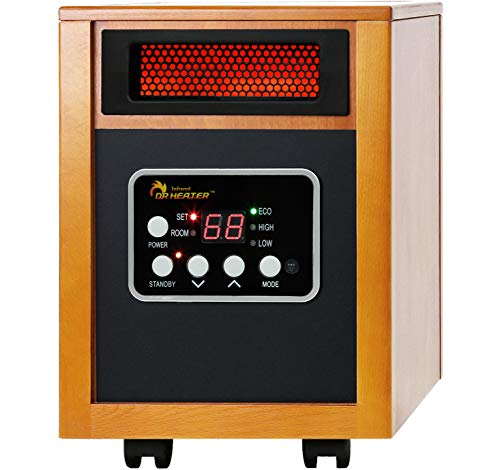
Dr Infrared DR-968The one listing in this category that publishes its amp draw and its noise level, which is exactly the arithmetic everyone else leaves you to do — 12.5 A and 39 dB, both stated.
Heat Storm HS-1500-PHXWall-mounted, which removes the entire tip-over failure mode rather than mitigating it — and Wi-Fi scheduling means it can heat a bathroom before you get in it.
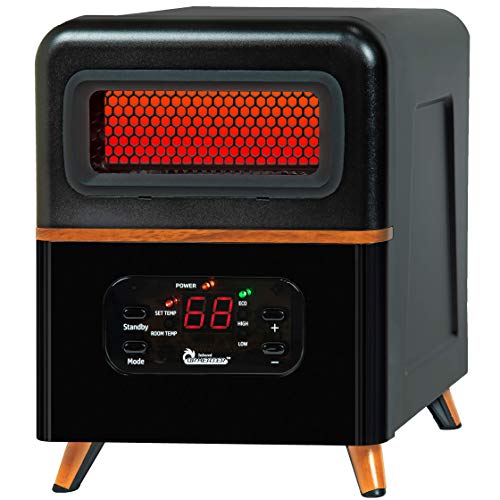
Dr Infrared DR-978A hybrid: infrared for the person in front of it and a blower to push convected heat into the rest of the room, which is a genuine answer to radiant heating's shadowing problem.
The one listing in this category that publishes its amp draw and its noise level, which is exactly the arithmetic everyone else leaves you to do — 12.5 A and 39 dB, both stated.
Rated power
1,500 W
Covers (computed)
150 sq ft
Draw (computed)
12.5 A at 120 V
Cost per hour
27.5¢
Coverage at 10 W/sq ft, average insulation, 8 ft ceiling = 5,118 BTU/h. Cost at 18.34¢/kWh; an eight-hour night at full output is $2.20. Exceeds the 12 A continuous limit of a 15 A circuit — check what else shares the breaker.
What works
Publishes 12.5 A, which is the number that decides whether it fits your circuit
Publishes 39 dB, which is the number that decides whether it fits your bedroom
A wooden-cabinet infrared unit runs cooler on the outside than a bare panel
What does not
19 lb with wheels: this is furniture, not a portable you carry between rooms
12.5 A against a 15 A circuit's 12 A continuous limit — it does not legally fit, see the circuit-load guide
Dated cabinet styling that will not disappear into a modern room
Published specification
Rated power
1,500 W at 120 V
Current draw
12.5 A (published)
Noise
39 dB (published)
Element
Infrared quartz tube plus PTC
Thermostat
Electronic, 50–85°F
Other
12-hour auto-off timer, IR remote, caster wheels, 19 lb
Heat type
Infrared quartz
Maker’s coverage claim
None published — the coverage figure above is ours
Safety listing
No listing mark published in the listing text; check the cabinet's rating plate for the UL or ETL mark.
Who it is for
A reader who wants to compute the load rather than trust a claim: the published amp draw and decibel figure make it the easiest unit on this site to check.
What it is not for
A 15 A circuit shared with anything else, and not a small room where a 19 lb cabinet on wheels is in the way.
Wall-mounted, which removes the entire tip-over failure mode rather than mitigating it — and Wi-Fi scheduling means it can heat a bathroom before you get in it.
Rated power
1,500 W
Covers (computed)
150 sq ft
Draw (computed)
12.5 A at 120 V
Cost per hour
27.5¢
Coverage at 10 W/sq ft, average insulation, 8 ft ceiling = 5,118 BTU/h. Cost at 18.34¢/kWh; an eight-hour night at full output is $2.20. Exceeds the 12 A continuous limit of a 15 A circuit — check what else shares the breaker.
What works
On a wall it cannot be tipped, and it cannot be crowded by a curtain that moved
Scheduling from the app is the practical answer to bathroom and workshop use
The published 5,200 BTU/h figure matches 1,500 W exactly — no inflated claim
What does not
It is a mounting job, not an unbox-and-plug — and it needs an outlet where you mount it
Wi-Fi adds a failure mode a knob does not have
Wall-mounted radiant heat is directional; you feel it where it points
Published specification
Rated power
1,500 W at 120 V
Published output
5,200 BTU/h
Mounting
Wall-mounted
Control
Wi-Fi app, remote scheduling
Element
Infrared quartz
Heat type
Infrared quartz
Maker’s coverage claim
None published — the coverage figure above is ours
Safety listing
No listing mark published in the listing text; check the rating plate for the UL or ETL mark.
Who it is for
A bathroom, a small bedroom, a workshop corner — anywhere floor space is gone and a heater on the ground is a hazard.
What it is not for
Renters who cannot drill, and rooms where you want the heater to move with you.
Dr. Infrared Heater DR-978 Dual Heating Hybrid Space Heater
A hybrid: infrared for the person in front of it and a blower to push convected heat into the rest of the room, which is a genuine answer to radiant heating's shadowing problem.
Rated power
1,500 W
Covers (computed)
150 sq ft
Draw (computed)
12.5 A at 120 V
Cost per hour
27.5¢
Coverage at 10 W/sq ft, average insulation, 8 ft ceiling = 5,118 BTU/h. Cost at 18.34¢/kWh; an eight-hour night at full output is $2.20. Exceeds the 12 A continuous limit of a 15 A circuit — check what else shares the breaker.
What works
Addresses the one real weakness of pure radiant heat — everything outside the cone stays cold
Remote control, so the unit does not have to be within reach to be adjusted
Cabinet construction keeps the very hot quartz element behind a housing
What does not
The blower means it is not a silent heater, and no decibel figure is published for this model
Still 1,500 W: the hybrid design changes distribution, never total output
No published coverage figure, so sizing is entirely on you
Published specification
Rated power
1,500 W at 120 V
Element
Dual heating — infrared quartz plus convection
Control
Remote
Maker's coverage claim
None published
Heat type
Infrared quartz
Maker’s coverage claim
None published — the coverage figure above is ours
Safety listing
No listing mark published in the listing text; check the cabinet's rating plate for the UL or ETL mark.
Who it is for
A living room or basement where you want immediate radiant warmth on the sofa and the rest of the room to catch up rather than stay cold.
What it is not for
A bedroom where noise matters, and any space where the published specification list needs to be complete — this one is thinner than its DR-968 sibling.
It heats a quartz element to a high temperature, which radiates infrared. The infrared passes through air with little absorption and warms the first solid surfaces it reaches — people, floors and furniture — which then warm the air slowly.
Are infrared heaters cheaper to run?+
Not per kilowatt-hour; all electric heaters are about 100% efficient. They can consume less because you may be comfortable at a lower setting, since the heat goes to you rather than to the room's air.
Are infrared heaters good for large rooms?+
They are good at making an area of a large room comfortable, which is often what you actually want. They do not raise a large room's air temperature any more than a convection heater of the same wattage would.
Do infrared heaters dry out the air?+
No more than any other heater. Raising air temperature lowers relative humidity at constant moisture content, and that happens with every heating method. Infrared arguably does it less, because it heats the air less.
The radiation is thermal, not ionizing. The hot element and the tipping cabinet are the risks that are real.
Written by Scooter M., an enthusiast — not a tester and not a certified anything. Every figure on this page is either published by the manufacturer, taken from a live retail listing, or computed from the published wattage using the formulas we publish. Found an error? Tell us and we will correct it, visibly and with a date on it.