The air genuinely feels drier and the heater genuinely did not dry it. Both things are true, and the distinction is the whole answer.
By Scooter M. · Published September 24, 2026 · Last reviewed September 24, 2026
How this page is funded: we earn a commission if you buy through the links here, at no extra cost to you. Picks are chosen before links are attached, which is why every roundup names something to skip. Full disclosure.
No. An electric space heater has no mechanism that removes water from a room — the water in your air before you switch it on is still there afterwards. What changes is relative humidity: warm air can hold more water vapor, so the same water becomes a smaller percentage of what the air could hold, and the room feels drier.
The distinction that answers the whole question
Two different things are both called humidity, and separating them resolves this completely. The National Weather Service defines them like this.
Absolute humidity is, in the NWS's words, *"a measure of the actual amount of water vapor (moisture) in the air, regardless of the air's temperature."* It is a quantity of water. A heater does not change it.
Relative humidity measures that vapor *"RELATIVE to the temperature of the air … the actual amount of water vapor in the air compared to the total amount of vapor that can exist in the air at its current temperature."* It is a percentage of a capacity, and the capacity moves with temperature.
This is not a technicality and it is not us telling you the dryness is imaginary. A room at 25% relative humidity is genuinely dry to live in — your skin, your throat and your wooden furniture are responding to something real. The point is narrower and more useful: the heater is not what to fix.
So what actually dries out a house in winter
The chain starts outside. Cold air holds very little water vapor in absolute terms — that is the same NWS principle running in the other direction. In winter, the air outdoors is cold and therefore carries very little water, full stop.
That air gets into your house continuously, through every gap, vent, door and imperfect window seal. Once inside it warms to room temperature, and its capacity to hold water climbs while the amount of water it brought with it stays the same. The result is low relative humidity indoors, and the colder it is outside the more pronounced it gets.
Your heating system is what makes the house habitable, not what makes it dry. Central heating does this exactly as much as a space heater does — the mechanism is temperature, and any source of heat produces it. A house heated by a heat pump, a furnace or a wood stove has the same winter dryness problem for the same reason. How space heaters compare with central heat on cost.
The one thing a heater genuinely does to your air
There is a real air-quality difference between heater types, and it is not moisture — it is dust.
A fan-forced or ceramic heater is, mechanically, a fan. It pulls room air through an intake and pushes it back out, and in doing so it lifts whatever was settled on the floor and circulates it. People with dust sensitivities, allergies or asthma notice this within a day of putting a fan heater in a small room, and they are not imagining that either.
Fanless designs do not do this. An oil-filled radiator, a mica panel and a radiant panel all heat by radiation and natural convection, with no moving parts and no forced airflow. If the complaint that brought you here is really about dusty or irritating air rather than dry air, that is the distinction worth buying on — and it is the reason every pick below is fanless.
Type
Removes moisture?
Moves dust?
Ceramic / fan-forced
No
Yes — it is a fan
Infrared with a blower
No
Yes, while the blower runs
Oil-filled radiator
No
No — no fan, no moving parts
Micathermic panel
No
No
Radiant panel
No
No
What each type does to the air in the room. Note that the moisture column is identical for all of them.
What the humidity should actually be
If you are going to act on this, act on a number rather than a feeling. The EPA states that *"indoor relative humidity (RH) should be kept below 60 percent -- ideally between 30 percent and 50 percent, if possible."*
That range is not only about comfort. Below it, static, dry skin and cracking in wood and instruments become common. Above it, condensation and mold become the problem instead — which is why the EPA's guidance is framed as a ceiling with a preferred band rather than "more is better".
What to do about it
1.Measure first with a hygrometer, and check it in the room you actually sit in rather than the hallway.
2.If it is genuinely low, add water, do not remove heat. A humidifier is the tool that changes absolute humidity; it is the only thing in this article that does. Size it to the room rather than the house.
3.If the complaint is irritation rather than dryness, change the heater type. A fanless heater stops circulating dust, and that is a change a humidifier cannot make.
4.Do not turn the heater down to fix humidity. It would work, in the sense that a colder room has a higher relative humidity at the same water content — and you would be cold. That is not a fix, it is a trade.
5.Do not put water on or near the heater. Bowls of water on a radiator are a very old suggestion and a bad one around an electrical appliance; the three-foot clearance rule does not have an exception for humidification.
Fanless heaters, if dust is the real issue
Picked purely on the mechanism that matters here: no fan, so no forced circulation of whatever is on the floor. All four heat by radiation and natural convection, and all four are also silent for the same reason.
Quick picks
Ranked for fit, not for hype. Coverage and current draw are computed from each unit’s published wattage. Tap a row for the full write-up, or go straight to the listing.
#
Product
Best for
Covers
Draw
Price
1
De'Longhi HMP1500A micathermic panel is a radiator that gave up its bulk: it radiates like oil-filled and warms up like ceramic, and it is about three inches deep so it can live against a wall.
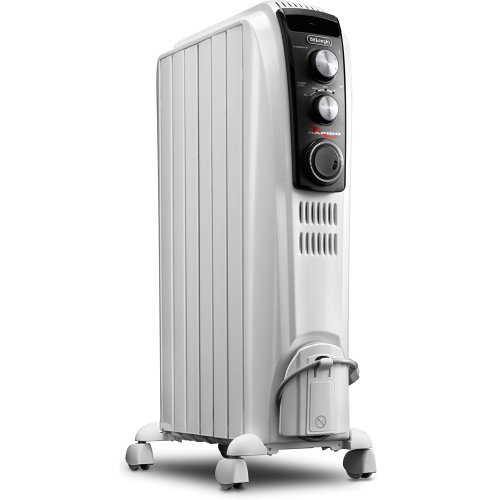
De'Longhi TRD40615TNo fan, so no noise and no moving dust — and the sealed oil keeps radiating after the element cuts out, which is why an oil-filled unit feels steadier than a ceramic one at the same wattage.
Pelonis PSHO07JR4AGBThe digital Pelonis: every one of its three wattages is published, the thermostat sets to the degree, and it is the only oil-filled radiator here with a child lock.
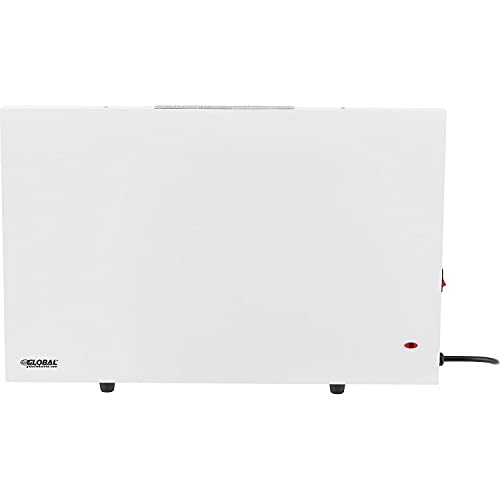
Global Industrial panelFunctionally the same 170 W under-desk panel as the QMark, with the one control the QMark lacks — an adjustable thermostat, so it cycles instead of running until you remember it.
A micathermic panel is a radiator that gave up its bulk: it radiates like oil-filled and warms up like ceramic, and it is about three inches deep so it can live against a wall.
Rated power
1,500 W / 750 W low
Covers (computed)
150 sq ft
Draw (computed)
12.5 A at 120 V
Cost per hour
27.5¢
Coverage at 10 W/sq ft, average insulation, 8 ft ceiling = 5,118 BTU/h. Cost at 18.34¢/kWh; an eight-hour night at full output is $2.20. Exceeds the 12 A continuous limit of a 15 A circuit — check what else shares the breaker.
What works
No fan, so no noise and nothing blown around a room
Warms up far faster than an oil-filled radiator of the same wattage
Wall-mountable, which gets it out of the floor space it would otherwise eat
What does not
The panel surface is hot to the touch — this is not a cool-touch design
No published coverage figure
Radiant heat is directional: stand behind it and you will not feel much
No fan, so no noise and no moving dust — and the sealed oil keeps radiating after the element cuts out, which is why an oil-filled unit feels steadier than a ceramic one at the same wattage.
Rated power
1,500 W
Covers (computed)
150 sq ft
Draw (computed)
12.5 A at 120 V
Cost per hour
27.5¢
Coverage at 10 W/sq ft, average insulation, 8 ft ceiling = 5,118 BTU/h. Cost at 18.34¢/kWh; an eight-hour night at full output is $2.20. Exceeds the 12 A continuous limit of a 15 A circuit — check what else shares the breaker.
What works
Genuinely silent: there is no fan to hear at 3 a.m.
The oil holds heat, so the room temperature swings less between thermostat cycles
Nothing blows air, so nothing stirs up dust in a bedroom
What does not
Slow. It takes 20–30 minutes to feel like it is doing anything
Heavy — the wheels are not a courtesy, they are a requirement
The surface gets genuinely hot; this is a radiator, not a cool-touch case
Published specification
Rated power
1,500 W at 120 V
Controls
Mechanical, with a programmable 24-hour timer
Fluid
Permanently sealed diathermic oil — never needs refilling
Maker's claim
Up to 75% more radiant surface area
Mobility
Front and rear handles, snap-on wheels
Heat type
Oil-filled
Maker’s coverage claim
None published — the coverage figure above is ours
Safety listing
No listing mark published in the listing text; verify the UL or ETL mark on the rating plate.
Who it is for
A bedroom, a nursery at a safe distance, or anywhere the fan noise of a ceramic heater is the actual problem you are trying to solve.
What it is not for
Fast heat, and not a room you only occupy for twenty minutes. It also should never be tucked beside a bed or curtain — hot surface, 3-foot rule.
3 · A radiator with a child lock and a real set-point
Pelonis PSHO07JR4AGB Oil-Filled Radiator
The digital Pelonis: every one of its three wattages is published, the thermostat sets to the degree, and it is the only oil-filled radiator here with a child lock.
Rated power
1,500 W / 600 W low
Covers (computed)
150 sq ft
Draw (computed)
12.5 A at 120 V
Cost per hour
27.5¢
Coverage at 10 W/sq ft, average insulation, 8 ft ceiling = 5,118 BTU/h. Cost at 18.34¢/kWh; an eight-hour night at full output is $2.20. Exceeds the 12 A continuous limit of a 15 A circuit — check what else shares the breaker.
What works
All three wattages are published — 600, 900 and 1,500 W — so the cost of every setting can be computed rather than guessed at, which is not true of most radiators at this price
A thermostat that sets to the degree from 41 to 95°F, on a type that usually ships with an unmarked dial
The only oil-filled radiator in our registry with a published child lock, which is what makes a silent heater usable in a room with a toddler
What does not
Pelonis publishes 255 sq ft of coverage; our 10 W/sq ft rule puts 1,500 W at 150 sq ft. The claim is roughly 1.7 times ours and the wattage is the ceiling either way
No UL or ETL mark is named, which is the one thing we would still want stated given everything else it publishes
The “ECO mode saves up to 40%” figure is a best case, not a guarantee — savings come from running fewer hours at full output, not from the mode being more efficient
Published specification
Rated power
600 W / 900 W / 1,500 W at 120 V (all three published)
Thermostat
41–95°F in 1°F increments
Modes
ECO, Sleep and Memory
Timer
24 hours
Controls
Touch panel plus remote
Construction
108 “Volcano” thermal vents
Maker's noise claim
“<5 dB” — fanless; see the note on the comparison page
Safety
Tip-over protection, overheat auto shut-off, child lock, V0 flame-retardant housing
Heat type
Oil-filled
Maker’s coverage claim
255 sq ft
Safety listing
Pelonis publishes a V0 flame-retardant housing, tip-over protection, overheat auto shut-off and a child lock, but does not name a UL or ETL mark. Check the rating plate.
Who it is for
A bedroom, nursery or study where silence is the requirement, someone else in the house should not be able to change the settings, and you want to set an actual temperature and a shut-off time.
What it is not for
Fast heat, or a room much over 150 sq ft on our arithmetic. It is a radiator: it warms slowly and steadily, and that is the design rather than a fault.
Global Industrial Under-Desk Radiant Panel Heater with Adjustable Thermostat
Functionally the same 170 W under-desk panel as the QMark, with the one control the QMark lacks — an adjustable thermostat, so it cycles instead of running until you remember it.
Rated power
170 W
Covers (computed)
17 sq ft
Draw (computed)
1.4 A at 120 V
Cost per hour
3.1¢
Coverage at 10 W/sq ft, average insulation, 8 ft ceiling = 580 BTU/h. Cost at 18.34¢/kWh; an eight-hour night at full output is $0.25. Fits a 15 A circuit as a continuous load.
What works
An adjustable thermostat, which is the single thing the QMark panel does not have
Same 170 W and the same 1.4 A class of draw — negligible against a desk circuit
Radiant panel format suits the enclosed footwell rather than fighting it
What does not
Near-identical to the QMark panel in size and output — you are choosing a control, not a different heater
No published listing mark in the listing text
Still a personal heater: it does nothing for the room, and it should not be bought expecting otherwise
Published specification
Rated power
170 W at 120 V
Controls
Adjustable thermostat
Dimensions
22-7/16" W x 14-14/16" H
Mounting
Floor mount, compact under-desk design
Finish
White
Heat type
Radiant panel
Maker’s coverage claim
None published — the coverage figure above is ours
Safety listing
No listing mark published in the listing text; check the rating plate for the UL or ETL mark.
Who it is for
The same desk-bound reader as the QMark, who would rather the panel cycled on a thermostat than stayed on until switched off.
What it is not for
Anyone wanting a room warm. It is a leg warmer with a thermostat, and that is the correct expectation to have of it.
Picked on one mechanism: no fan. Moisture is identical across every heater type, so the only air-quality difference a heater can make is whether it circulates dust — and that is decided by whether it has a blower.
Silence came along for free, because the same absence of moving parts that stops dust circulation is what makes these types quiet.
A published low wattage preferred where it exists, since a fanless heater that can idle at a lower setting spends less time at full output in a room it is holding steady.
No humidity claim credited to any heater. Nothing in this registry adds or removes water from a room, and no pick is ranked as though it does.
And what we did not do: we have not tested these units, owned them, measured them or run them in a room. Everything above is compiled from published manufacturer specifications and live retail listings, with the electrical load, room coverage and running cost computed by us from the published wattage. The full method.
What we could not tell you
A worked example with numbers. Articles on this subject routinely give a specific conversion — warm this air from one temperature to another and the relative humidity lands on exactly that percentage. We have deliberately not written one. The NWS page we are citing states the principle clearly but publishes no worked conversion, and any figure we produced would rest on psychrometric assumptions we chose ourselves. So the principle is here and sourced, and the arithmetic is not — for the same reason we do not repeat coverage claims we cannot check.
Whether you personally need a humidifier. That depends on a reading from your room, which we do not have. The EPA's 30-50% band is the target; a hygrometer is how you find out where you are in relation to it.
Questions people actually ask
Do space heaters dry out the air?+
No. An electric heater has no mechanism for removing water from a room — the absolute humidity is unchanged. What drops is relative humidity, because warm air can hold more water vapor, so the same amount of water becomes a lower percentage of the air's capacity. The room feels drier and the heater did not dry it.
Why does my room feel so dry when the heater is on?+
Because cold outdoor air carries very little water, and it is entering your house continuously. When it warms up indoors its capacity to hold moisture rises while the water it brought stays the same, so relative humidity falls. Any heat source does this — central heating, a heat pump and a space heater all produce the same effect.
Which type of space heater does not dry out the air?+
All of them are identical on moisture — none removes water. If the real complaint is irritated airways rather than dryness, the distinction that matters is dust: fan-forced and ceramic heaters circulate settled dust, while oil-filled radiators, mica panels and radiant panels have no fan and do not.
What humidity should my house be in winter?+
The EPA says indoor relative humidity should be kept below 60 percent and ideally between 30 and 50 percent. Below that band you get static, dry skin and cracking in wood; above it, condensation and mold become the bigger problem.
Should I use a humidifier with a space heater?+
Only if a hygrometer says the room is below about 30% relative humidity. A humidifier is the only device in this discussion that changes the actual amount of water in the air, so it is the right tool when the reading is genuinely low — and unnecessary when it is not.
Do space heaters cause dry skin or a dry throat?+
Indirectly, in the same way any heating does. The low relative humidity that comes with warming cold winter air is what dries skin and throats, and the heater is the source of the warmth rather than the source of the dryness. Raising the room's humidity addresses it; switching heater types does not.
Heating the air versus heating the things in it — the distinction under every other comparison.
Written by Scooter M., an enthusiast — not a tester and not a certified anything. Every figure on this page is either published by the manufacturer, taken from a live retail listing, or computed from the published wattage using the formulas we publish. Found an error? Tell us and we will correct it, visibly and with a date on it.