Not without supplying the power yourself, and the arithmetic of supplying it is brutal. Here is what a generator and a battery each have to be rated for, and the one class of heater that survives the division.
By Scooter M. · Published October 17, 2026 · Last reviewed October 17, 2026
How this page is funded: we earn a commission if you buy through the links here, at no extra cost to you. Picks are chosen before links are attached, which is why every roundup names something to skip. Full disclosure.
No. Every heater on this site is electric, so when the grid stops, it stops. Running one anyway needs 1,500 W of continuous output from a generator, or a battery holding about 12 kWh to cover an eight-hour night — which is why the only space heater that makes sense off-grid is a 150 W radiant panel pointed at a person.
The question underneath the question
Nobody searching this is confused about whether an electric appliance needs electricity. The real question is what it would take to run one anyway, and that resolves into two numbers that are easy to confuse and do completely different jobs.
Watts are a rate — how fast the heater consumes energy, and therefore what the power source has to deliver at any instant. This is the number that decides whether the heater starts at all.
Watt-hours are a quantity — how much energy is in the tank or the battery, and therefore how long it lasts. This is the number that decides whether the heater is still running at 3 a.m.
A 1,500 W heater fails the first test against most battery equipment and the second test against all of it. Both arithmetics are below, and neither is complicated — which is the point, because this is a decision people make in a hurry with a flashlight in their teeth.
What a generator has to be rated for
A 1,500 W heater needs 1,500 W continuously, for as long as it runs. Generators are advertised on a bigger number than the one that matters here, so the specification to read is the rated or running figure rather than the headline.
Generac's own explanation of its ratings is the clearest statement of this: starting watts are "the extra watts a generator can provide momentarily to turn on an appliance", and the advertised wattage is "the maximum total electricity, measured in watts, that a portable generator can provide" across all of its outlets together. Its GP8000E example is rated at 8,000 continuous watts and up to 10,000 starting watts — two numbers, one machine.
The second limit is per-outlet rather than per-machine, and it is volts times amps. Generac puts a 120 V, 20 A duplex outlet at 2,400 watts and warns that "if a user exceeds 2,400 watts, this outlet will be overloaded, and the breaker will trip". A 1,500 W heater is 12.5 A, so it fits that outlet with room to spare — the constraint is the machine's continuous total, shared with the refrigerator, the furnace blower and the phone chargers.
Heater
Draw at 120 V
15 A circuit (12 A limit)
20 A circuit (16 A limit)
750 W
6.3 A
Fits
Fits
900 W
7.5 A
Fits
Fits
1,200 W
10.0 A
Fits
Fits
1,500 W
12.5 A
Over the limit
Fits
Maximum continuous
—
12 A = 1,440 W
16 A = 1,920 W
Draw computed as watts / 120 V. The continuous limit is 80% of the breaker rating, which follows from the NEC's requirement to size a circuit at 125% of a continuous load (NFPA 70, 210.19(A)(1) and 210.20(A)).
What a battery has to hold
A portable power station is sold on two numbers and you need both. Capacity in watt-hours is how much energy is in the box. AC output in watts is how fast it can hand that energy over, and it is a hard ceiling set by the inverter inside.
The output ceiling comes first, and it is where most of these attempts end. A station whose continuous AC rating is below 1,500 W will not run a 1,500 W heater at all, no matter how much capacity it has — it will either refuse or shut down on overload within seconds. Read the continuous AC figure on the spec sheet, not the surge figure beside it, for the same reason as the generator above.
If the heater does start, capacity sets the clock, and the division is unforgiving. Here is every combination worth knowing, with our 10% allowance for inverter losses applied so the figures are the ones you would actually see:
Heater draw
500 Wh station
1,000 Wh station
2,000 Wh station
150 W radiant panel
3 h
6 h
12 h
170 W radiant panel
2 h 40 m
5 h 20 m
10 h 35 m
750 W (a published low setting)
36 m
1 h 12 m
2 h 24 m
1,500 W room heater
18 m
36 m
1 h 12 m
Hours = capacity × 0.9 ÷ the heater's draw. The 0.9 is our allowance for inverter losses and is an assumption, stated so you can change it; everything else is division. A battery sitting in a cold room will do worse than its rating, not better.
The bottom row is the one to sit with. A 1,500 W heater on a station the size of a car battery is about half an hour of warmth, and then you own a dead battery and a cold room. To cover a single eight-hour night at full output you need 12 kWh — a whole-home battery wall, not a box with a handle, and considerably more than most houses would use to keep the lights on for a day.
Run the same arithmetic on the top row and the picture inverts. A 150 W panel wants 1.2 kWh for an eight-hour night, which a mid-sized station covers with margin. The heater did not get better; the job got smaller.
So stop heating the room and heat the person
This is the same conclusion the desk heater arithmetic reaches from the opposite direction, and in an outage it is not a preference but the only option that divides. At 150 W you cannot move the air temperature of a room — 150 W is about 15 sq ft at our sizing rule, which is a doormat. What 150 W of radiant panel can do is put warmth directly onto the legs of one person sitting still, which is what you actually want at hour six of an outage.
The cost side is almost beside the point here, but it is worth seeing: the two panels below draw 2.8 and 3.1 cents an hour at our published rate, against 27.5 cents for a 1,500 W heater. On the grid that is a modest saving. On a battery it is the difference between an evening and twenty minutes.
This is the most recent month EIA has published. Residential rates move seasonally and vary enormously by state — from roughly a dime per kilowatt-hour in parts of the South to more than 40¢ in Hawaii — so treat it as a national reference point, not as your rate.
The three heaters a battery can actually carry
Picked on draw, which is the only specification that matters when the power source is the constraint. Two are 150-170 W personal panels with no fan and no moving parts at all. The third is here because it publishes a genuine 750 W step, which is the lowest setting on any room-sized heater in our registry — and because a mica panel, having no blower, is the room heater least bothered by being run off an inverter.
Quick picks
Ranked for fit, not for hype. Coverage and current draw are computed from each unit’s published wattage. Tap a row for the full write-up, or go straight to the listing.
#
Product
Best for
Covers
Draw
Price
1
Cozy Legs CLA 150 W radiant panel that does one job — warm the legs in a footwell — and is the only heater in this registry whose maker publishes a zero-clearance safety listing on its own page.
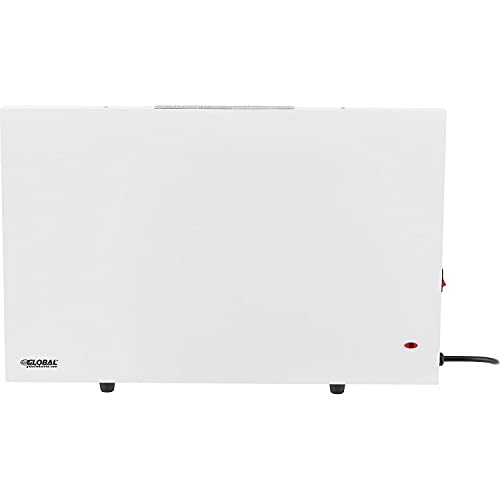
Global Industrial panelFunctionally the same 170 W under-desk panel as the QMark, with the one control the QMark lacks — an adjustable thermostat, so it cycles instead of running until you remember it.
De'Longhi HMP1500A micathermic panel is a radiator that gave up its bulk: it radiates like oil-filled and warms up like ceramic, and it is about three inches deep so it can live against a wall.
A 150 W radiant panel that does one job — warm the legs in a footwell — and is the only heater in this registry whose maker publishes a zero-clearance safety listing on its own page.
Rated power
150 W
Covers (computed)
15 sq ft
Draw (computed)
1.3 A at 120 V
Cost per hour
2.8¢
Coverage at 10 W/sq ft, average insulation, 8 ft ceiling = 512 BTU/h. Cost at 18.34¢/kWh; an eight-hour night at full output is $0.22. Fits a 15 A circuit as a continuous load.
What works
150 W is 1.25 A — about a tenth of a 1,500 W room heater, so it will not trouble a desk circuit already carrying a computer and two monitors
Silent by construction: a radiant panel has no fan and no moving parts at all
The maker publishes an ETL zero-clearance listing — a rarity in this registry, and the reason the panel can sit flat against a desk modesty board or a wall
What does not
No set-point. The thermostat is built in and no range is published, so there is nothing to dial and no timer — it runs until the in-cord switch goes off
Cozy Products publishes no coverage figure, no warranty terms and no panel dimensions on the product page, so none of the three can be checked
150 W warms your legs and nothing else. It is not a small room heater and it will not raise the air temperature of an office
Published specification
Rated power
150 W at 120 V, 60 Hz (Cozy Products' published figures)
Current draw
1.25 A (150 ÷ 120) — our figure. Cozy Products' page prints 1.3 A, which is the same draw rounded
Element
Radiant panel — no fan, no moving parts
Thermostat
Built-in; Cozy Products publishes no set-point range, so there is no temperature to choose
Controls
An in-cord roller switch
Size
Cozy Products publishes the shipping box at 25 x 20 x 2 inches and the weight at 8 lb, but not the panel's own dimensions — so we do not print a panel size
Surface temperature
Approximately 130°F (Cozy Products' published figure)
Safety
ETL Certified Zero-Clearance — no clearance required, which the maker states on its own page
Heat type
Radiant panel
Maker’s coverage claim
None published — the coverage figure above is ours
Safety listing
Cozy Products publishes an ETL Certified Zero-Clearance rating on its own product page, which is why the panel may sit against a wall or other combustible surface.
Who it is for
A footwell where the complaint is cold legs, the circuit is already busy, and you want the lowest-draw honest answer rather than a 1,500 W heater in a small box.
What it is not for
Heating a room, or anywhere you need the heater to switch itself off. Without a timer or a set-point it is on until you switch it off at the cord, which makes the [unattended-heater guidance](/safety/overnight) matter more, not less.
Global Industrial Under-Desk Radiant Panel Heater with Adjustable Thermostat
Functionally the same 170 W under-desk panel as the QMark, with the one control the QMark lacks — an adjustable thermostat, so it cycles instead of running until you remember it.
Rated power
170 W
Covers (computed)
17 sq ft
Draw (computed)
1.4 A at 120 V
Cost per hour
3.1¢
Coverage at 10 W/sq ft, average insulation, 8 ft ceiling = 580 BTU/h. Cost at 18.34¢/kWh; an eight-hour night at full output is $0.25. Fits a 15 A circuit as a continuous load.
What works
An adjustable thermostat, which is the single thing the QMark panel does not have
Same 170 W and the same 1.4 A class of draw — negligible against a desk circuit
Radiant panel format suits the enclosed footwell rather than fighting it
What does not
Near-identical to the QMark panel in size and output — you are choosing a control, not a different heater
No published listing mark in the listing text
Still a personal heater: it does nothing for the room, and it should not be bought expecting otherwise
Published specification
Rated power
170 W at 120 V
Controls
Adjustable thermostat
Dimensions
22-7/16" W x 14-14/16" H
Mounting
Floor mount, compact under-desk design
Finish
White
Heat type
Radiant panel
Maker’s coverage claim
None published — the coverage figure above is ours
Safety listing
No listing mark published in the listing text; check the rating plate for the UL or ETL mark.
Who it is for
The same desk-bound reader as the QMark, who would rather the panel cycled on a thermostat than stayed on until switched off.
What it is not for
Anyone wanting a room warm. It is a leg warmer with a thermostat, and that is the correct expectation to have of it.
A micathermic panel is a radiator that gave up its bulk: it radiates like oil-filled and warms up like ceramic, and it is about three inches deep so it can live against a wall.
Rated power
1,500 W / 750 W low
Covers (computed)
150 sq ft
Draw (computed)
12.5 A at 120 V
Cost per hour
27.5¢
Coverage at 10 W/sq ft, average insulation, 8 ft ceiling = 5,118 BTU/h. Cost at 18.34¢/kWh; an eight-hour night at full output is $2.20. Exceeds the 12 A continuous limit of a 15 A circuit — check what else shares the breaker.
What works
No fan, so no noise and nothing blown around a room
Warms up far faster than an oil-filled radiator of the same wattage
Wall-mountable, which gets it out of the floor space it would otherwise eat
What does not
The panel surface is hot to the touch — this is not a cool-touch design
No published coverage figure
Radiant heat is directional: stand behind it and you will not feel much
Ranked on draw, not on heat. When the power source is the constraint, the only specification that decides whether a heater is usable is how many watts it pulls — so these are the three lowest-draw units in our registry that are still purchasable.
A published low setting counts as a second, usable operating point, because on a battery the difference between 1,500 W and 750 W is the difference between forty minutes and ninety.
Fanless designs preferred. A radiant panel and a mica panel have no motor at all, which means nothing in them cares about the waveform an inverter produces.
No power station, generator or battery is a pick here. We cover space heaters; we are not going to attach a buy link to equipment we do not research.
And what we did not do: we have not tested these units, owned them, measured them or run them in a room. Everything above is compiled from published manufacturer specifications and live retail listings, with the electrical load, room coverage and running cost computed by us from the published wattage. The full method.
What we are not going to suggest
Search this topic and the results fill up with propane and kerosene heaters sold as "indoor safe". We do not cover combustion heaters, we are not going to attach a buy link to one, and the federal guidance on improvising heat indoors is unambiguous. FEMA's Ready.gov says plainly: "Do not use a gas stove or oven to heat your home" because "it increases your risk of carbon monoxide poisoning", and that "generators, camp stoves or charcoal grills should always be used outdoors and at least 20 feet away from windows".
Ready.gov's other instruction is the one nobody wants to read and the one that is actually correct when it is genuinely cold: "Go to a community location with power if heat or cold is extreme", and "check with local officials about heating and cooling locations open near you". A 150 W panel and a duvet is a reasonable answer to a chilly evening. It is not an answer to a multi-day winter outage, and we are not going to pretend a space heater is.
One adjacent case deserves naming because the search overlaps: if what worries you about an outage is pipes, that is freeze protection rather than comfort heating — and it has the same dependency. A thermostatic heater holding a crawl space above freezing is as dead as everything else when the power goes, which is why the real freeze-protection measures in an outage are draining, insulating and dripping rather than plugging anything in.
Questions people actually ask
Will a space heater work in a power outage?+
No. Every portable space heater sold in the US is electric, so it stops when the grid does. It will work from a generator or a battery, but only if that source can supply its full rated wattage continuously — 1,500 W for most of them.
What size generator do I need to run a space heater?+
One whose rated or running output exceeds the heater's wattage, plus whatever else you are powering. For a 1,500 W heater that means at least 1,500 W of continuous capacity, and the surge or starting figure is irrelevant because a resistance element draws no inrush current. Run it outdoors only, at least 20 feet from the house.
Can a portable power station run a space heater?+
Only if its continuous AC output rating is at or above the heater's draw, and then not for long. A 1,000 Wh station runs a 1,500 W heater for roughly 36 minutes after inverter losses. The same station runs a 150 W radiant panel for about six hours.
How many watt-hours does a space heater use overnight?+
A 1,500 W heater running eight hours consumes 12 kWh — 12,000 watt-hours. A 750 W setting halves that to 6 kWh, and a 150 W radiant panel uses 1.2 kWh. Those are the figures to size any battery against.
Is it safe to run a generator in the garage with the door open?+
No. CPSC states that opening doors or windows will not provide enough ventilation to prevent lethal carbon monoxide buildup, and about 85 people a year die in the US from CO poisoning caused by portable generators. Outdoors only, at least 20 feet from the building, with the exhaust pointed away from it.
What is the lowest-wattage space heater that actually does something?+
A 150 W radiant panel, which is enough to warm one person's legs in a footwell and nothing more. Nothing below about 600 W will change a room's air temperature, and 600 W only holds about 60 sq ft at 10 watts per square foot.
Holding 40°F unattended for months is not room heating. Ranked on set-point, moisture rating and the fan.
Written by Scooter M., an enthusiast — not a tester and not a certified anything. Every figure on this page is either published by the manufacturer, taken from a live retail listing, or computed from the published wattage using the formulas we publish. Found an error? Tell us and we will correct it, visibly and with a date on it.