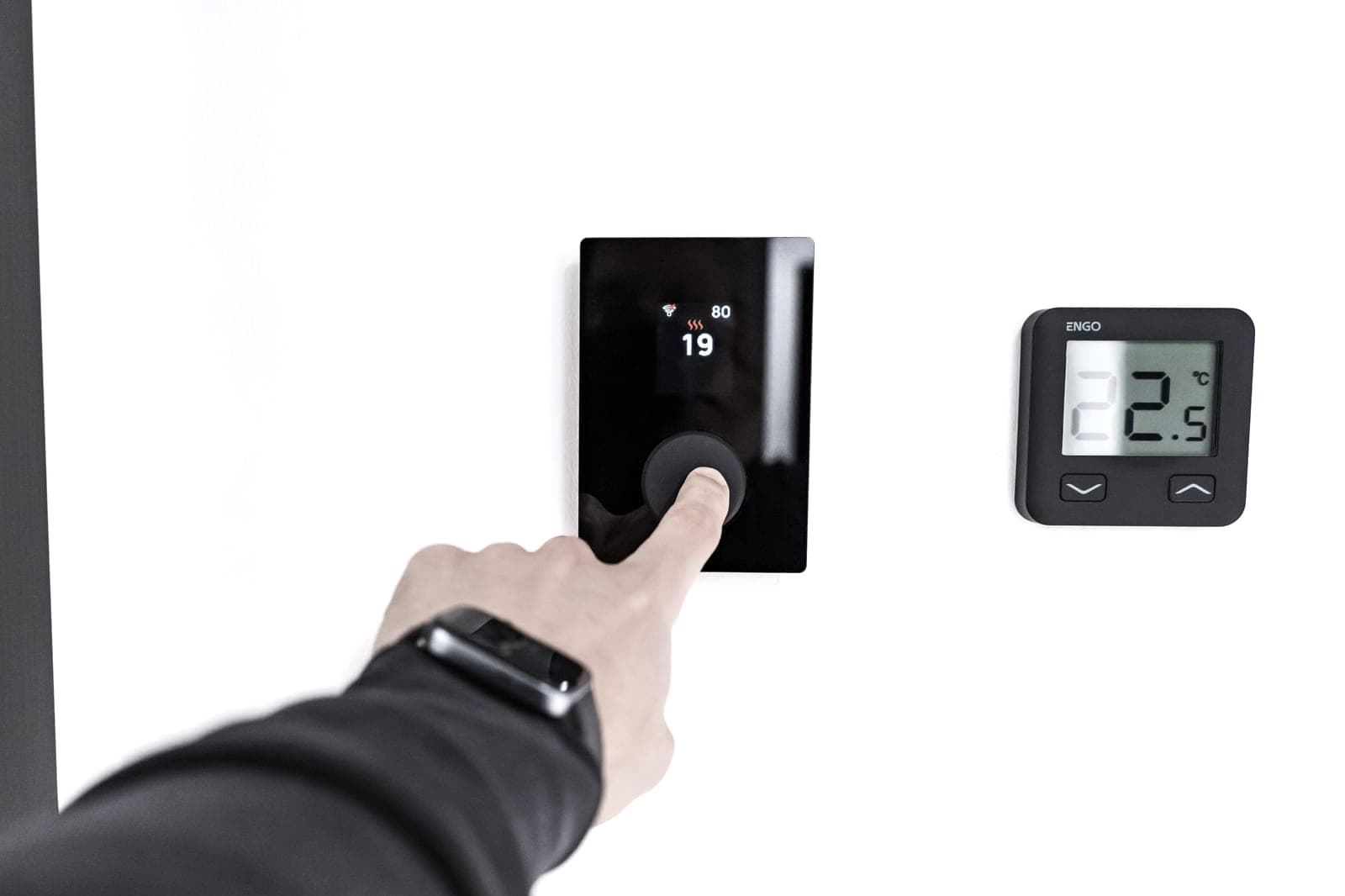
Mounted on a wall, it cannot be tipped, crowded or reached — which removes four failure modes by geometry rather than by electronics.
By Scooter M. · Published August 31, 2026 · Last reviewed August 31, 2026
How this page is funded: we earn a commission if you buy through the links here, at no extra cost to you. Picks are chosen before links are attached, which is why every roundup names something to skip. Full disclosure.
The Heat Storm HS-1500-PHX-WIFI is a 1,500 W wall-mounted infrared heater with Wi-Fi app control and scheduling, publishing 5,200 BTU/h of output. Mounting removes the tip-over, floor-clutter and child-reach failure modes entirely.
The BTU claim, checked
The listing publishes 5,200 BTU/h. The conversion is 1 W = 3.412142 BTU/h, so 1,500 W is 5,118 BTU/h. The published figure is 1.6% above the exact conversion — a rounding, not a claim.
That sounds like a small thing and it is not. This category is full of listings advertising 1,500 W heaters at 8,000 or 10,000 BTU/h, which is arithmetically impossible: there is nowhere for the extra energy to come from. A published figure that matches the conversion is a signal about the whole listing. The conversion table.
Wall-mounted, which removes the entire tip-over failure mode rather than mitigating it — and Wi-Fi scheduling means it can heat a bathroom before you get in it.
Rated power
1,500 W
Covers (computed)
150 sq ft
Draw (computed)
12.5 A at 120 V
Cost per hour
27.5¢
Coverage at 10 W/sq ft, average insulation, 8 ft ceiling = 5,118 BTU/h. Cost at 18.34¢/kWh; an eight-hour night at full output is $2.20. Exceeds the 12 A continuous limit of a 15 A circuit — check what else shares the breaker.
What works
On a wall it cannot be tipped, and it cannot be crowded by a curtain that moved
Scheduling from the app is the practical answer to bathroom and workshop use
The published 5,200 BTU/h figure matches 1,500 W exactly — no inflated claim
What does not
It is a mounting job, not an unbox-and-plug — and it needs an outlet where you mount it
Wi-Fi adds a failure mode a knob does not have
Wall-mounted radiant heat is directional; you feel it where it points
Published specification
Rated power
1,500 W at 120 V
Published output
5,200 BTU/h
Mounting
Wall-mounted
Control
Wi-Fi app, remote scheduling
Element
Infrared quartz
Heat type
Infrared quartz
Maker’s coverage claim
None published — the coverage figure above is ours
Safety listing
No listing mark published in the listing text; check the rating plate for the UL or ETL mark.
Who it is for
A bathroom, a small bedroom, a workshop corner — anywhere floor space is gone and a heater on the ground is a hazard.
What it is not for
Renters who cannot drill, and rooms where you want the heater to move with you.
It cannot be crowded at floor level. No laundry pile, no curtain pooling against it, no box pushed up to it in a basement.
Its cord does not cross a floor. No trip hazard, nothing run under a rug, no reason to reach for an extension cord.
It is out of reach of a crawling child or a pet. Which is why it is in the nursery roundup despite being an infrared unit with a hot element.
The three-foot clearance rule still applies — above and in front of it, which on a wall is usually easy to satisfy and easy to forget to check.
Running cost, and what scheduling is worth
Wattage
Per hour
1 h
2 h
4 h
8 h
1,500 W
27.5¢
$0.28
$0.55
$1.10
$2.20
Computed at 18.34¢/kWh — the U.S. residential average for June 2026 (EIA, Electric Power Monthly, Table 5.6.A, released August 26, 2026). Your rate is on your own bill; substitute it and the arithmetic still holds. Figures assume full output for the whole period.
App scheduling is the feature that makes those short-duration rows realistic rather than theoretical. A bathroom heater scheduled for twenty minutes before you get up costs about nine cents and means you never leave it running “just in case”. That is a much larger saving than anything about the element, and it is the pattern this site keeps arriving at.
What it is not for
Renters who cannot drill, which is a real constraint and not a small population. Anyone who wants the heater to follow them — mounting is permanent by definition. And it needs an outlet where you mount it, which is the practical detail that derails most of these installations: check for one before you buy, not after.
It is also radiant, so the shadowing caveat applies: you feel it where it points, and a wall-mounted unit points at one part of the room.
The Wi-Fi is the part worth weighing against the alternatives, because scheduling is the only connected feature that lowers a bill. Best smart and Wi-Fi space heaters sets this unit against the two Dreo wall heaters and explains why so little of that category publishes a model number.
Questions people actually ask
How many BTU is the Heat Storm HS-1500-PHX-WIFI?+
The listing publishes 5,200 BTU/h. The exact conversion from 1,500 W is 5,118 BTU/h, so the published figure is a rounding rather than an inflated claim.
Is a wall-mounted heater safer than a portable one?+
It removes several failure modes by geometry: it cannot be tipped over, cannot be crowded at floor level, does not need a cord across the floor, and is out of a child's reach. The three-foot clearance rule still applies.
Does the Heat Storm HS-1500-PHX need an electrician?+
No — it plugs into a standard outlet. It does need mounting to a wall and an outlet at the mounting position, which is the detail worth checking before buying.
Can you schedule the Heat Storm HS-1500-PHX-WIFI?+
Yes, through its Wi-Fi app. Scheduling is the practical answer to running a heater only when it is needed, which matters more for the bill than any element technology.
WH719S sweeps, WH517S publishes 28 dB and IP24. Both schedule from the app; neither names a listing mark.
Written by Scooter M., an enthusiast — not a tester and not a certified anything. Every figure on this page is either published by the manufacturer, taken from a live retail listing, or computed from the published wattage using the formulas we publish. Found an error? Tell us and we will correct it, visibly and with a date on it.