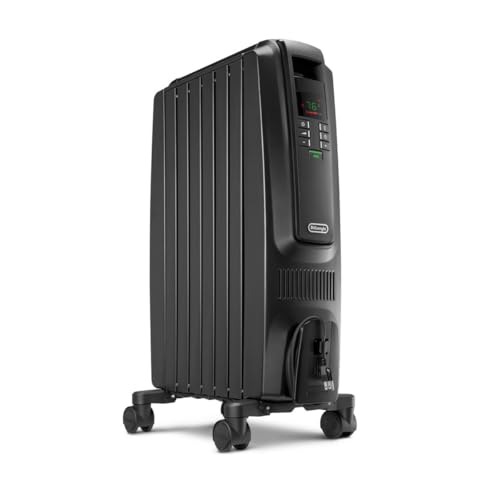
A silent 1,500 W oil-filled radiator with a child lock, which is rarer in this registry than it sounds. The heat is identical to its cheaper sibling's, and De'Longhi's own page tells you where it stops working.
By Scooter M. · Published October 17, 2026 · Last reviewed October 17, 2026
How this page is funded: we earn a commission if you buy through the links here, at no extra cost to you. Picks are chosen before links are attached, which is why every roundup names something to skip. Full disclosure.
The Dragon Digital is a 1,500 W oil-filled radiator with a 24-hour programmable timer, an ECO mode and a published child lock — and it is one of only three heaters among the 29 purchasable units in our registry whose maker publishes a child lock at all. It makes exactly the same heat as the mechanical TRD40615T, at the same cost per hour. The premium over that model buys the lock, the ECO mode and a digital panel — not more warmth.
Who it is for, in one line each
Best for a bedroom with a toddler in the house — silent, fanless, and the controls lock.
Best for running on a schedule rather than overnight: the 24-hour programmable timer is the honest alternative to leaving a heater on all night.
Not for fast heat. It is an oil-filled radiator; it takes twenty to thirty minutes to feel like it is doing anything, and that is the design.
Not for a large or drafty room. De'Longhi's own page says this product "is only suitable for well insulated spaces or occasional use".
Not for anyone choosing on price alone — the mechanical sibling delivers identical heat for less money.
The specification, and what it computes to
Top pick · Overnight, on a schedule
De'Longhi Dragon Digital Oil-Filled Radiator (TRD40615EBK)
The oil-filled radiator with a programmable timer, which is the version that matters overnight: it can bring a bedroom up before you wake and shut itself off, unattended, without you leaving it running all night.
Rated power
1,500 W
Covers (computed)
150 sq ft
Draw (computed)
12.5 A at 120 V
Cost per hour
27.5¢
Coverage at 10 W/sq ft, average insulation, 8 ft ceiling = 5,118 BTU/h. Cost at 18.34¢/kWh; an eight-hour night at full output is $2.20. Exceeds the 12 A continuous limit of a 15 A circuit — check what else shares the breaker.
What works
A programmable timer is the honest answer to “can I leave it on overnight” — you don't have to
Silent, like every oil-filled unit: no fan, no moving air
Digital control means you set a temperature, not a knob position
What does not
Costs more than the mechanical TRD40615T for identical heat output
Same slow warm-up as any oil-filled radiator
Heavy and bulky for its coverage — 26 inches of steel you will not be carrying upstairs
Published specification
Rated power
1,500 W at 120 V
Controls
Digital, with a 24-hour programmable timer
ECO function
Regulates power and temperature rather than running at full output
Dimensions
16" x 10" x 26"
Fluid
Permanently sealed diathermic oil
Safety
Child lock, thermal cut-off
Maker's coverage claim
None published — sold as a full-room heater
Heat type
Oil-filled
Maker’s coverage claim
None published — the coverage figure above is ours
Safety listing
No listing mark published in the listing text; verify the UL or ETL mark on the rating plate.
Who it is for
A bedroom where the heater needs to run on a schedule rather than all night, and where noise would wake you.
What it is not for
A room you need warm in five minutes, or a tight space where a hot 26-inch radiator cannot keep 3 feet of clearance.
Published figures from De'Longhi's TRD40615EBK page and the Amazon listing. Our column is watts ÷ volts for current, watts × 3.412142 for output, watts ÷ 10 for coverage at our baseline sizing rule, and the site rate for cost.
The sentence on De'Longhi's own page worth the whole review
The practical reading is that this radiator is a bedroom, study or nursery appliance, and that if the room you have in mind is a 300 sq ft living room with a cold wall, the correct answer is on the large-rooms page and it starts with the sizing arithmetic rather than a product.
The child lock, and why three out of twenty-nine matters
De'Longhi publishes that the unit "offers the security of a child lock, thermal cut-off, and other built-in safety elements". Across the 29 purchasable heaters we track, exactly three publish a child lock: this one, the Dreo Solaris 718 and the Lasko Ellipse CT18950. Everything else either publishes none or leaves the question to the photographs.
That scarcity is the single strongest argument for this model over its mechanical sibling, and it is worth being precise about what a lock does and does not do. It stops a child changing the settings. It does not make the surface cool — an oil-filled radiator is hot to the touch by design, because the steel is the radiating surface — and it does not change the three-foot clearance rule or the USFA's advice to switch a heater off when you leave the room. For a room where a toddler can reach the controls, the lock is the specification to filter on; for a room where a toddler can reach the *radiator*, the answer is a wall-mounted unit instead.
What the ECO mode actually does
De'Longhi describes it as saving "energy by automatically adjusting heat and power settings for the most comfortable and economical warmth". In plain terms it regulates the element's duty cycle rather than running flat out — which is a real saving in hours, not a change in efficiency. Every electric resistance heater converts essentially all of its electricity to heat, so no heater is cheaper to run than another at the same wattage; what ECO does is spend fewer watt-hours.
One consequence worth knowing before it alarms you: a radiator in ECO mode spends a large part of the evening with the element off, coasting on the heat already in the oil. That is the mode working, and it is one of the behaviors on the "my heater has stopped heating" page that turns out not to be a fault.
Digital against mechanical: the actual decision
Dragon Digital (TRD40615EBK)
TRD40615T
Price position
The pricier of the two
The cheaper of the two
Heat output
5,118 BTU/h
5,118 BTU/h
Cost per hour
27.5¢
27.5¢
Controls
Digital panel, LED display
Mechanical
Timer
24-hour programmable
24-hour programmable
ECO mode
Yes
No
Child lock
Yes
No
Set-point in degrees
Not published
Not published
Certification mark
None published
None published
Price positions as checked on 2026-10-17; both buy links show the live figure. Both units are 1,500 W, both are silent, both use permanently sealed diathermic oil, and neither publishes a coverage figure or a certification mark.
Read that table and the decision is unusually clean. Both have the timer — which is the feature people assume they are paying the premium for, and they are not. What the premium actually buys is the child lock, the ECO mode and a panel with numbers on it instead of a knob. If a child can reach the controls, that premium is well spent. If not, the mechanical model is the same heat, the same silence and the same running cost for less money, and we would buy that one.
Neither publishes a thermostat set-point range, which is the gap both De'Longhi units share and the reason neither leads our thermostat roundup. A digital display that shows the room temperature is not the same thing as a dial you can set to 68°F, and only 7 of the 29 heaters we track publish the range at all.
Three things De'Longhi's page does not get right
1.The warranty contradicts itself. The product page's order panel says "2-Year included warranty" while a site-wide banner on the same page advertises "Industry Leading 3 Year Warranty Included". We cannot tell you which applies to this SKU, so we publish both and the discrepancy.
2.The model number drifts. The page is served as the TRD40615EBK-6A and its own copy describes "the 1500-watt TRD40615EL De'Longhi radiant heater". The Amazon listing says TRD40615EBK. They appear to be the same radiator in different finishes, but if you are matching a part or a manual, check the plate.
3."With TOS" is never defined. It appears in De'Longhi's own page title and nowhere in the specification. It most likely means a tip-over switch, which would matter on a 26-inch radiator on castors — and because the maker does not say, we do not count a tip-over switch on this unit. Our product entry lists the child lock and thermal cut-off that De'Longhi does publish, and nothing more.
The circuit, which is the same for every unit here
At 1,500 W and 120 V this radiator draws 12.5 A — against the 12 A a 15 A branch circuit is allowed to carry continuously. One radiator per circuit, nothing else significant sharing it, and nothing on an extension cord or a power strip.
Heater
Draw at 120 V
15 A circuit (12 A limit)
20 A circuit (16 A limit)
750 W
6.3 A
Fits
Fits
900 W
7.5 A
Fits
Fits
1,200 W
10.0 A
Fits
Fits
1,500 W
12.5 A
Over the limit
Fits
Maximum continuous
—
12 A = 1,440 W
16 A = 1,920 W
Draw computed as watts / 120 V. The continuous limit is 80% of the breaker rating, which follows from the NEC's requirement to size a circuit at 125% of a continuous load (NFPA 70, 210.19(A)(1) and 210.20(A)).
This matters more on a radiator than on a ceramic heater for an unglamorous reason: a radiator is the heater most likely to be pushed behind furniture and left alone for a whole winter, which is exactly the installation where a bad cord connection has time to fail. Why extension cords fail with heaters.
Questions people actually ask
Is the De'Longhi Dragon Digital worth the extra over the TRD40615T?+
Only if you need the child lock. Both are 1,500 W, both are silent, both publish a 24-hour programmable timer, and both cost about 27.5 cents an hour to run. The premium buys a published child lock, an ECO mode and a digital panel — not more heat, and not a timer the cheaper model lacks.
How much does the Dragon Digital cost to run?+
About 27.5 cents an hour at full output, $2.20 for an eight-hour night and about $66 a month at eight hours a day, computed at 18.34 cents per kilowatt-hour. The ECO mode lowers that by reducing hours at full output rather than by being more efficient — all electric resistance heaters are essentially 100% efficient.
What size room will the Dragon Digital heat?+
About 150 sq ft at 10 watts per square foot with average insulation and an 8-foot ceiling — our figure, because De'Longhi publishes no coverage claim. De'Longhi does publish a caveat worth reading: the product "is only suitable for well insulated spaces or occasional use".
Does the De'Longhi Dragon Digital have a child lock?+
Yes — De'Longhi publishes a child lock and a thermal cut-off. It is one of only three heaters among the 29 purchasable units we track whose maker publishes a child lock, which is the strongest reason to pick it over the mechanical model.
Does it need refilling with oil?+
No. The diathermic oil is permanently sealed at the factory and is a heat-transfer medium rather than a fuel — De'Longhi's own wording is that the reservoir "never needs refilling". A radiator that appears to need oil has a leak and should be replaced, not topped up.
Does the Dragon Digital have a tip-over switch?+
De'Longhi does not say. Its own page title includes "with TOS", which most likely means a tip-over switch, but the specification never defines the abbreviation — so we do not count one. What it does publish is a child lock and a thermal cut-off.
How long does it take to warm a room?+
Twenty to thirty minutes before it feels like it is doing anything, like every oil-filled radiator — the element has to heat the oil and the oil has to heat the steel before the steel heats the room. The compensation is that it keeps radiating after the element cuts out, so the room drifts rather than dropping.
Thermostat satisfied, fan-only mode, a tripped overheat cutoff, an unseated tip-over switch — in that order.
Written by Scooter M., an enthusiast — not a tester and not a certified anything. Every figure on this page is either published by the manufacturer, taken from a live retail listing, or computed from the published wattage using the formulas we publish. Found an error? Tell us and we will correct it, visibly and with a date on it.