Or running for four minutes and stopping, or never seeming to come on at all. Four causes cover nearly all of it, and two of them are the heater working exactly as designed.
By Scooter M. · Published October 17, 2026 · Last reviewed October 17, 2026
How this page is funded: we earn a commission if you buy through the links here, at no extra cost to you. Picks are chosen before links are attached, which is why every roundup names something to skip. Full disclosure.
Four causes cover almost all of it, and the first two are not faults: the thermostat is satisfied because the room is already at the dial's setting, or the unit is in fan-only mode. The other two are a tripped overheat cutoff — usually a dust-blocked intake — and a tip-over switch that has not seated on carpet or an uneven floor. Check them in that order before you spend anything.
The four checks, in order of likelihood
1.Turn the thermostat to maximum. If the element comes on, the thermostat was satisfied and nothing is broken.
2.Look at the mode switch. Fan-only is a setting on most ceramic heaters and it blows room-temperature air by design.
3.Switch off, unplug, and let it cool for fifteen minutes with the intake clear. If it then runs and later stops again, the overheat cutoff is doing its job and something is blocking airflow.
4.Put it on a hard, level floor and press down. A tip-over switch that has not seated holds the element off while everything else looks normal.
If all four pass and the fan runs but the air stays cold, you are into a failed element or a failed thermostat, and that is a replacement rather than a repair — the four signs to replace covers where that line is.
1. The thermostat is satisfied, and the dial is not telling you
This is the most common cause by a distance, and it is a disclosure problem rather than a fault. A heater whose thermostat is an unmarked dial gives you no way to know what temperature you asked for. If the room has drifted above that setting — because the sun came out, because the central heating cycled on, because you turned the dial down last night — the element stays off while the fan may well keep running. Cold air, working heater.
Only 7 of the 29 purchasable heaters we track publish a thermostat range in degrees at all. On the other 22 there is no number anywhere on the machine, so "is it broken" and "is it satisfied" look identical from the outside. Turning the dial to maximum for sixty seconds is the test that separates them, and it costs nothing.
2. It is in fan-only mode
Almost every ceramic heater here ships with a fan-only setting, and on a mechanical unit it sits one click away from the heat settings. The BLACK+DECKER BHDC201's published control is a four-position switch — off, fan, low, high; the Lasko 754201 publishes two heat settings plus fan-only; even the hardwired 7,500 W Comfort Zone garage unit has a fan-only mode so it can be used as a summer blower.
A heater in fan-only mode is a desk fan. In winter the air it moves feels actively cold, which is why this reads as a fault rather than a misread switch. Check the switch position and the indicator before anything else mechanical.
3. The overheat cutoff has tripped
Every heater in our registry publishes an overheat cutoff — it is the one safety feature that is genuinely universal here. It is a thermal device: when the air leaving the unit gets hotter than it should, it opens, and it stays open until the heater cools. How the cutoffs work covers the mechanism.
The signature is unmistakable once you know it: the heater runs for a few minutes, stops, and repeats. That cycle is not a thermostat — a thermostat cycles on room temperature and the intervals wander. A cutoff cycles on the heater's own temperature and the intervals are short and similar. The causes, in order of how often they turn out to be the answer:
A dust-loaded intake grille. The single most common one, and the reason the short maintenance list is mostly "vacuum the grille".
Carpet pile or a rug blocking the underside of a unit that draws air from below.
Pushed too close to a wall, a sofa back or a curtain — which is also the three-foot clearance rule being broken, so the cutoff is preventing something worse than inconvenience.
A towel, a cushion or a coat on or against the cabinet. Same mechanism, faster onset.
4. The tip-over switch has not seated
A tip-over switch is usually a weighted plunger in the base that has to be pressed in by the heater's own weight on a flat surface. On a thick carpet, on an uneven floorboard, or on a unit standing on one corner of a rug edge, it may not seat — and the heater then behaves as though it has been knocked over, which is to say it refuses to heat.
The fix is to put it on something hard and level, which is where a heater belongs anyway. The diagnostic is to lift it slightly and set it down firmly on a bare floor; if the element lights, that was the whole story.
Three behaviors that look like faults and are not
Cold air at switch-on, or after switch-off
Some heaters deliberately run the fan before and after the element. Marley publishes this on the Fahrenheat range as an automatic fan delay: the fan runs only once the element is warm, and keeps running until it has cooled — which exists precisely to stop the unit blowing cold air and to extend component life. A few seconds of cool air at the start and a minute of cooling air at the end is a feature with a name.
A timer that did what you set it to do
A heater that stopped after exactly eight hours did not fail. The Honeywell HCE220B publishes a 2, 4 or 8 hour auto-off timer; the Dr Infrared DR-968 publishes a 12-hour auto-off; the Comfort Zone garage unit publishes a 12-hour timer with auto shut-off; several radiators here carry 24-hour programmable timers. If the stop time is suspiciously round, check the timer before the element.
It is heating. The room is bigger than the heater
This is the complaint that arrives as "it blows cold" and turns out to be "it never gets warm". A 1,500 W heater covers about 150 sq ft at 10 watts per square foot with average insulation and an 8-foot ceiling. Multiply by 1.25 for a drafty room and 1.5 for a space outside the heated envelope, and the honest coverage falls fast:
Room size
Watts needed
BTU/h
Plug-in heaters
150 sq ft
1,500 W
5,118
1
200 sq ft
2,000 W
6,824
2 (different circuits)
300 sq ft
3,000 W
10,236
2 (different circuits)
400 sq ft
4,000 W
13,649
3 (different circuits)
Computed as square feet x 10 W x insulation factor x (ceiling / 8 ft), for an average heated room — 10 W/sq ft, 8 ft ceiling. Heater count assumes the 1,500 W plug-in ceiling.
In a 300 sq ft living room a single 1,500 W heater is supplying half of what the room needs, and the air leaving it is genuinely not very warm by the time it has mixed with the rest of the room. Nothing is broken. The sizing rule and its two corrections is the page for that, and the sizing calculator does the arithmetic for your room.
The symptom-to-cause table
What it is doing
Most likely cause
What to do
Fan runs, air is cold, no heat at all
Fan-only mode, or the thermostat is satisfied
Check the mode switch; turn the thermostat to maximum for a minute
Runs 3-10 minutes, stops, restarts, repeats
Overheat cutoff on restricted airflow
Unplug, cool 15 minutes, vacuum the grille, restore 3 ft clearance
Nothing happens at all, no fan either
Tip-over switch unseated, tripped breaker, or a dead outlet
Set it on a hard level floor; test the outlet with a lamp; check the breaker
Stopped after a round number of hours
The auto-off timer fired
Read the timer setting; most are 2, 4, 8, 12 or 24 hours
Cold for the first few seconds, or for a minute after switch-off
Published fan delay — by design
Nothing. This is the heater protecting its own components
Ordered by how often each cause turns out to be the answer. Nothing here requires opening the unit — if the fix needs the case off, the honest answer is a new heater.
When to stop diagnosing and replace it
A portable heater is an element, a thermostat, usually a fan, and a cord. There is no filter to change, nothing to lubricate and no service network, which means the repair-or-replace question resolves almost always to replace. The arithmetic is blunt: a 1,500 W heater costs about 27.5 cents an hour to run and about $66 a month at eight hours a day, and several of the picks below cost less than a single month of running. The four signs to replace rather than persist is the page that draws that line.
If you are replacing, the specification that prevents a repeat of this entire page is a thermostat with numbers on it — and, if the complaint was cold air from a blower, a type that has no blower at all.
Quick picks
Ranked for fit, not for hype. Coverage and current draw are computed from each unit’s published wattage. Tap a row for the full write-up, or go straight to the listing.
#
Product
Best for
Covers
Draw
Price
1
Dreo Solaris 718The rare heater whose published coverage claim survives the arithmetic: 1,500 W is a genuine 300 sq ft at 10 W/sq ft, and Dreo publishes that number rather than implying more.
Pelonis PSHO06MR6ASBThe digital Pelonis: all three of its wattages are published, the thermostat sets to the degree between 41 and 95°F, and it rolls on its own wheels.
A radiator with a real set-point and a 24-hour timer
Honeywell HCE220BA shoebox-sized ceramic heater that publishes four preset temperatures and a 2/4/8-hour auto-off — specificity almost nothing else this size offers.
A thermostat with numbers on it, on a small heater
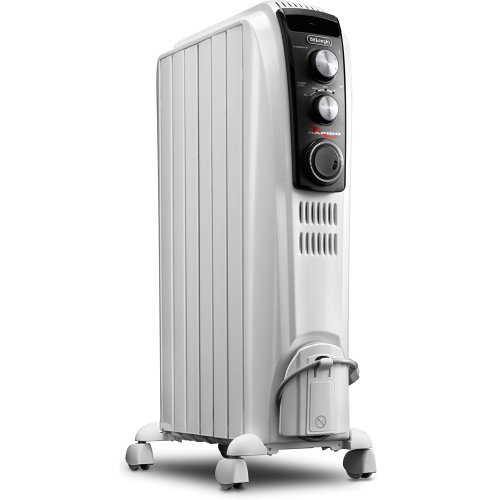
De'Longhi TRD40615TNo fan, so no noise and no moving dust — and the sealed oil keeps radiating after the element cuts out, which is why an oil-filled unit feels steadier than a ceramic one at the same wattage.
The rare heater whose published coverage claim survives the arithmetic: 1,500 W is a genuine 300 sq ft at 10 W/sq ft, and Dreo publishes that number rather than implying more.
Rated power
1,500 W
Covers (computed)
150 sq ft
Draw (computed)
12.5 A at 120 V
Cost per hour
27.5¢
Coverage at 10 W/sq ft, average insulation, 8 ft ceiling = 5,118 BTU/h. Cost at 18.34¢/kWh; an eight-hour night at full output is $2.20. Exceeds the 12 A continuous limit of a 15 A circuit — check what else shares the breaker.
What works
A digital thermostat with numbers on it — you can set 68°F rather than guess at a dial
The published 300 sq ft claim matches the standard sizing rule instead of exceeding it
8 lb and 8 inches square: it moves room to room without a project
What does not
1,500 W is 1,500 W — nothing here heats faster than any other 1,500 W heater
Dreo does not publish a noise figure in decibels on the product page
Tall and narrow, which is a tipping profile: the tip-over cutoff matters more here
A living room, bedroom or den at or under 300 sq ft with average insulation and an 8-foot ceiling, where you want to set a temperature and stop thinking about it.
What it is not for
A garage, an uninsulated basement, or anything over about 300 sq ft. It is not under-powered — 1,500 W is the plug-in ceiling — the room is simply too big for one outlet.
2 · A radiator with a real set-point and a 24-hour timer
Pelonis PSHO06MR6ASB Oil-Filled Radiator
The digital Pelonis: all three of its wattages are published, the thermostat sets to the degree between 41 and 95°F, and it rolls on its own wheels.
Rated power
1,500 W / 600 W low
Covers (computed)
150 sq ft
Draw (computed)
12.5 A at 120 V
Cost per hour
27.5¢
Coverage at 10 W/sq ft, average insulation, 8 ft ceiling = 5,118 BTU/h. Cost at 18.34¢/kWh; an eight-hour night at full output is $2.20. Exceeds the 12 A continuous limit of a 15 A circuit — check what else shares the breaker.
What works
All three wattages are published — 600, 900 and 1,500 W — so the cost of every setting can be computed rather than guessed at, which is not true of most radiators at this price
A thermostat that sets to the degree from 41 to 95°F, on a type that usually ships with an unmarked dial
A 24-hour timer and an LED touchscreen with a remote, so the set-point and the shut-off can both be chosen rather than approximated
What does not
Pelonis publishes no coverage figure for this model, so there is no maker claim to check our 150 sq ft against — the 1,500 W ceiling is the only number either of us can stand behind
No UL or ETL mark is named, which is the one thing we would still want stated given everything else it publishes
No child lock is published — the model it replaces named one, and this one does not, which matters if the point was a heater a toddler cannot reset
Published specification
Rated power
600 W / 900 W / 1,500 W at 120 V (all three published)
Thermostat
41–95°F in 1°F increments
Modes
Energy-saving ECO mode
Timer
24 hours
Controls
LED touchscreen plus remote
Construction
Upgraded M-shaped fins; Pelonis publishes no fin count
Maker's noise claim
“Fan-free design ensures ultra-quiet performance” — no decibel figure is published
Portability
Universal wheels and handles
Safety
Tip-over protection, overheat protection and V0 flame-retardant materials
Heat type
Oil-filled
Maker’s coverage claim
None published — the coverage figure above is ours
Safety listing
Pelonis publishes V0 flame-retardant materials, tip-over protection and overheat protection, but does not name a UL or ETL mark and does not state a child lock. Check the rating plate.
Who it is for
A bedroom, nursery or study where silence is the requirement and you want to set an actual temperature and a shut-off time rather than a dial position.
What it is not for
Fast heat, or a room much over 150 sq ft on our arithmetic. It is a radiator: it warms slowly and steadily, and that is the design rather than a fault.
3 · A thermostat with numbers on it, on a small heater
Honeywell HCE220B UberHeat Plus Ceramic Heater
A shoebox-sized ceramic heater that publishes four preset temperatures and a 2/4/8-hour auto-off — specificity almost nothing else this size offers.
Rated power
1,500 W
Covers (computed)
150 sq ft
Draw (computed)
12.5 A at 120 V
Cost per hour
27.5¢
Coverage at 10 W/sq ft, average insulation, 8 ft ceiling = 5,118 BTU/h. Cost at 18.34¢/kWh; an eight-hour night at full output is $2.20. Exceeds the 12 A continuous limit of a 15 A circuit — check what else shares the breaker.
What works
Four preset temperatures rather than an unmarked dial — on a heater this small and this cheap, being able to ask for 70°F is unusual
Two independent overheat mechanisms are published — a high-temperature sensor and a thermal cut-off fuse — plus a tip-over switch
A 2/4/8-hour auto-off means it can stop by itself, which is what actually reduces the bill
What does not
No UL or ETL mark published by Honeywell, which is the one thing we would want stated at this size and price
Four presets is not the same as a full range: if you want 68°F you are choosing between 65 and 70
2.8 lb and shoebox-sized means it is a personal heater, not a room heater, whatever the 1,500 W suggests
Published specification
Rated power
1,500 W maximum at 120 V
Heat settings
2 (high and low)
Thermostat
Four preset comfort levels — 65°, 70°, 75° and 80°F
Auto-off timer
2, 4 or 8 hours
Safety
Tip-over switch; 2x overheat protection (high-temperature sensor plus a thermal cut-off fuse); cool-touch housing
Size
8.5" x 4.5" x 8.86", 2.8 lb
Warranty
3-year limited
Heat type
Ceramic (PTC)
Maker’s coverage claim
None published — the coverage figure above is ours
Safety listing
Honeywell does not publish a UL or ETL mark for this model; it does publish two independent overheat mechanisms. Check the rating plate.
Who it is for
A small office, a bedside table or a desk, where the heater needs to hold roughly a known temperature and switch itself off after a few hours.
What it is not for
A large or drafty room, and not a nursery — no child lock is published and the presets are reachable by anyone who can reach the unit.
No fan, so no noise and no moving dust — and the sealed oil keeps radiating after the element cuts out, which is why an oil-filled unit feels steadier than a ceramic one at the same wattage.
Rated power
1,500 W
Covers (computed)
150 sq ft
Draw (computed)
12.5 A at 120 V
Cost per hour
27.5¢
Coverage at 10 W/sq ft, average insulation, 8 ft ceiling = 5,118 BTU/h. Cost at 18.34¢/kWh; an eight-hour night at full output is $2.20. Exceeds the 12 A continuous limit of a 15 A circuit — check what else shares the breaker.
What works
Genuinely silent: there is no fan to hear at 3 a.m.
The oil holds heat, so the room temperature swings less between thermostat cycles
Nothing blows air, so nothing stirs up dust in a bedroom
What does not
Slow. It takes 20–30 minutes to feel like it is doing anything
Heavy — the wheels are not a courtesy, they are a requirement
The surface gets genuinely hot; this is a radiator, not a cool-touch case
Published specification
Rated power
1,500 W at 120 V
Controls
Mechanical, with a programmable 24-hour timer
Fluid
Permanently sealed diathermic oil — never needs refilling
Maker's claim
Up to 75% more radiant surface area
Mobility
Front and rear handles, snap-on wheels
Heat type
Oil-filled
Maker’s coverage claim
None published — the coverage figure above is ours
Safety listing
No listing mark published in the listing text; verify the UL or ETL mark on the rating plate.
Who it is for
A bedroom, a nursery at a safe distance, or anywhere the fan noise of a ceramic heater is the actual problem you are trying to solve.
What it is not for
Fast heat, and not a room you only occupy for twenty minutes. It also should never be tucked beside a bed or curtain — hot surface, 3-foot rule.
Picked on whether the heater lets you diagnose it, which is this page's whole subject: a set-point in degrees, published wattages and a published timer interval turn "it keeps stopping" into a number you can check.
A published thermostat range counts heavily — only 7 of the 29 purchasable heaters we track publish one, and on a dial-only unit you can never tell a satisfied thermostat from a dead element.
One pick has no fan at all, because a heater with no blower cannot blow cold air. If the symptom that brought you here is the complaint you want to never have again, that is the structural fix.
No pick here is recommended as more reliable. We have not run these units and warranty length is a proxy for what a maker expects to pay out on, not a measurement.
And what we did not do: we have not tested these units, owned them, measured them or run them in a room. Everything above is compiled from published manufacturer specifications and live retail listings, with the electrical load, room coverage and running cost computed by us from the published wattage. The full method.
What we could not tell you
A reset procedure for your model. Overheat cutoffs differ: most are automatic and reset themselves once the unit has cooled, some need the power cycled, and a few have a physical reset. The owner's manual for your model is the only place that answer lives, and inventing a generic one would be worse than useless on an appliance whose cutoff is a safety device.
A failure-rate ranking by brand. We have not run these heaters and nobody publishes service-life data, so there is no honest way to tell you which brand stops working first. What is published is warranty length, and how little of it exists is its own finding.
Questions people actually ask
Why is my space heater blowing cold air?+
Most often because the thermostat is satisfied — the room is already above the dial's setting, so the element is off while the fan still runs — or because the unit is in fan-only mode. Turn the thermostat to maximum for a minute and check the mode switch before assuming a fault.
Why does my space heater keep shutting off after a few minutes?+
That short, repeating cycle is the overheat cutoff, not the thermostat. It means airflow is restricted: a dust-loaded intake grille, carpet under the base, or the heater pushed against a wall or sofa. Unplug it, let it cool for fifteen minutes, vacuum the grille and restore three feet of clearance.
How do I reset a space heater's overheat protection?+
Switch it off, unplug it, and let it cool for about fifteen minutes with the intake clear — most cutoffs reset themselves at that point. Check your model's manual, because a few require a power cycle or have a physical reset button, and the cutoff is a safety device rather than a nuisance to defeat.
Do space heaters turn off automatically?+
Most will, for three different reasons that get confused: the thermostat cycles the element off when the room reaches temperature, the overheat and tip-over cutoffs shut it down on a fault, and many models have an auto-off timer of 2 to 24 hours. Only the middle one indicates a problem.
Is it bad if my space heater keeps cycling on and off?+
Not if the intervals wander with the room temperature — that is a thermostat working, and a digital one in ECO mode will do it constantly. It is a problem if the cycle is short and regular, because that is the overheat cutoff reporting blocked airflow.
My heater works but the room is still cold. Is it faulty?+
Probably not. A 1,500 W heater covers roughly 150 sq ft with average insulation and an 8-foot ceiling, 120 sq ft in a drafty room and 100 sq ft in a space outside the heated envelope. In anything larger it is a supplement to central heat rather than a replacement, and no plug-in heater can exceed 1,500 W.
The only feature that actually cuts the bill, because it is the only one that turns the heater off.
Written by Scooter M., an enthusiast — not a tester and not a certified anything. Every figure on this page is either published by the manufacturer, taken from a live retail listing, or computed from the published wattage using the formulas we publish. Found an error? Tell us and we will correct it, visibly and with a date on it.