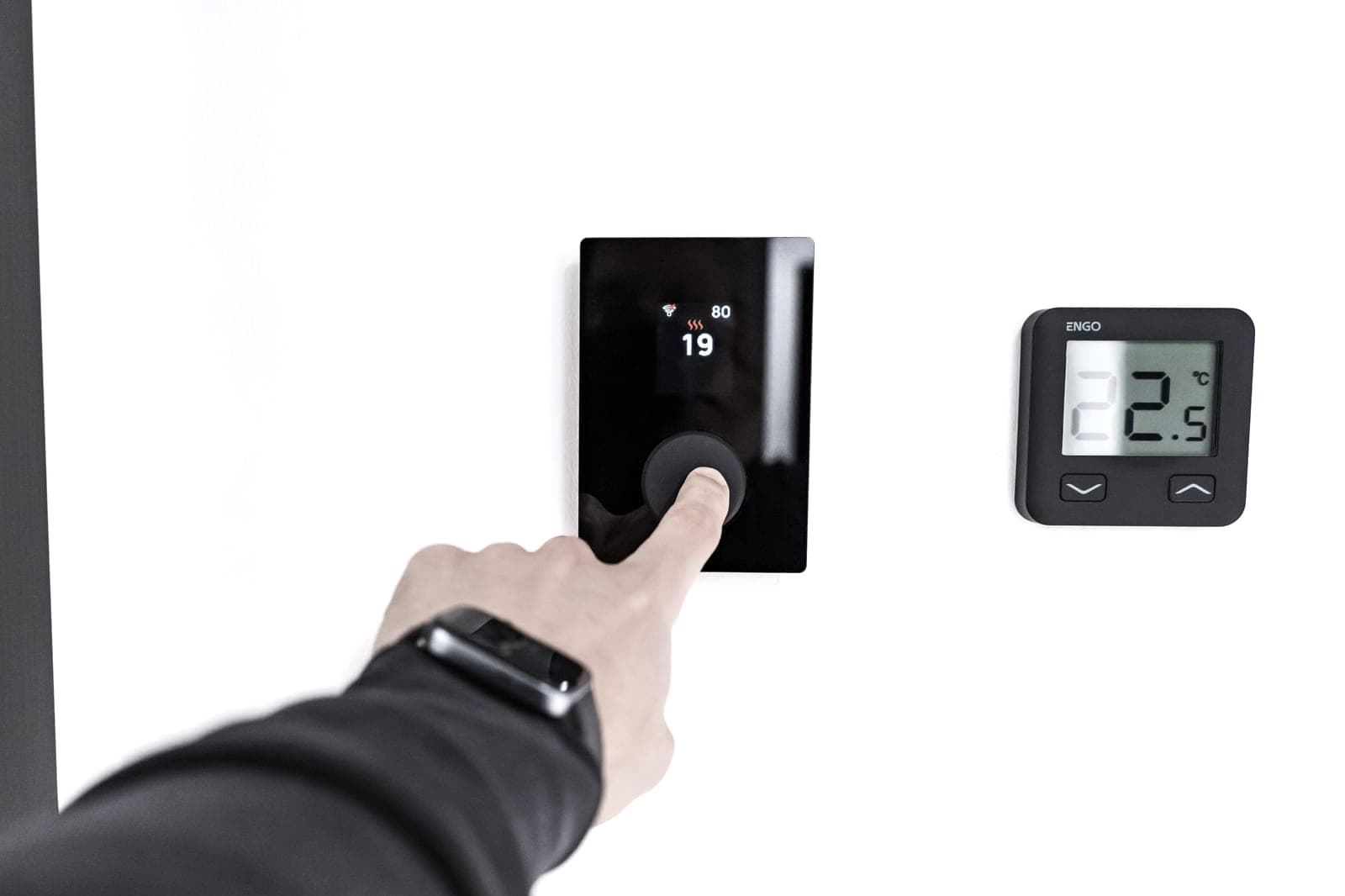
A wall-mounted heater cannot be tipped over, cannot be crowded by objects on the floor, needs no cord across a room and sits out of a child's or pet's reach. Plug-in panels handle small rooms and bathrooms; a hardwired 240 V unit is the only option that genuinely heats a garage.
Most of the safety conversation in this category is about electronics bolted on to mitigate a hazard — a tip-over switch to catch a heater that has fallen, a thermal cutoff to catch one that is smothered. Mounting is different in kind: it removes the hazards rather than detecting them.
- It cannot be tipped. The most likely mechanical failure in the category simply does not exist. What a tip-over switch is for.
- It cannot be crowded at floor level. No laundry pile, no curtain pooling against it, no box shoved up to it in a basement — the arrangement behind the leading contributing factor in heating fires.
- Its cord does not cross a floor. Nothing to trip over, nothing run under a rug, no reason to reach for an extension cord.
- It is out of reach. A crawling child or a cat cannot get to it, which is why a mounted unit appears in the nursery roundup despite running a hot element.
What mounting does not remove is clearance. Three feet still applies — above it and in front of it, which on a wall is usually easy to satisfy and easy to forget to check. A shelf 18 inches above a wall heater is exactly the arrangement the rule exists to prevent.
| Plug-in wall panel | Hardwired 240 V unit |
|---|
| Typical output | 1,500 W | 2,500–5,000 W |
| Covers (average room) | About 150 sq ft | About 500 sq ft |
| Supply | Standard 120 V outlet | Dedicated 240 V circuit |
| Installation | Mount it, plug it in | Electrician, hardwired |
| Suits | Bathroom, small bedroom, study, RV | Garage, workshop, outbuilding |
| Renter-friendly | Only if you can drill | No |
Coverage at 10 W/sq ft, average insulation, 8-ft ceiling; the 240 V figure reflects a published 500 sq ft claim for a 5,000 W unit.
The decision is almost entirely made by the space. If it is a room inside the heated envelope, a plug-in panel is right and the whole job is a drill and an outlet. If it is a garage, a shop or an outbuilding, no plug-in heater of any mounting style will do it — the sizing arithmetic puts that space at 6,000–9,000 W and a wall outlet delivers 1,500.
| Wattage | Per hour | 1 h | 4 h | 8 h |
|---|
| 1,500 W | 27.5¢ | $0.28 | $1.10 | $2.20 |
| 5,000 W | 91.7¢ | $0.92 | $3.67 | $7.34 |
Computed at 18.34¢/kWh — the U.S. residential average for June 2026 (EIA, Electric Power Monthly, Table 5.6.A, released August 26, 2026). Your rate is on your own bill; substitute it and the arithmetic still holds. Figures assume full output for the whole period.
Note the 5,000 W row before you assume the hardwired unit is the sensible upgrade: it costs more than three times as much per hour, because it is doing more than three times as much work. That is not inefficiency — it is the price of actually heating a garage rather than warming a bench.
One pattern worth knowing before you shop: nearly every heater in this category that offers genuine Wi-Fi and app scheduling is also a wall unit, which is why best smart and Wi-Fi space heaters overlaps this page so heavily. If connectivity is what you are actually after rather than the mounting, start there instead.
Quick picks
Ranked for fit, not for hype. Coverage and current draw are computed from each unit’s published wattage. Tap a row for the full write-up, or go straight to the listing.
| # | Product | Best for | Covers | Draw | Price |
|---|
| 1 | Heat Storm HS-1500-PHXWall-mounted, which removes the entire tip-over failure mode rather than mitigating it — and Wi-Fi scheduling means it can heat a bathroom before you get in it. | Getting the heater off the floor | 150 sq ft | 12.5 A | $149.99 · Check on Amazon |
| 2 | De'Longhi HMP1500A micathermic panel is a radiator that gave up its bulk: it radiates like oil-filled and warms up like ceramic, and it is about three inches deep so it can live against a wall. | A slim profile against a wall | 150 sq ft | 12.5 A | $129.95 · Check on Amazon |
| 3 | Fahrenheat FUH54The honest answer to garage heating: 5,000 W on a 240 V circuit is 3.3 times what any outlet can deliver, which is why plug-in heaters never work out there. | A garage that actually gets warm | 500 sq ft | 20.8 A | $686.00 · Check on Amazon |
Coverage computed at 10 W/sq ft, average insulation, 8 ft ceiling. Draw computed as watts ÷ volts. Neither figure is a manufacturer claim.
#ad · how this site is funded · price as of October 21, 2026
Top pick · Getting the heater off the floor
Heat Storm HS-1500-PHX-WIFI Wall-Mounted Infrared Heater
Wall-mounted, which removes the entire tip-over failure mode rather than mitigating it — and Wi-Fi scheduling means it can heat a bathroom before you get in it.
- Rated power
- 1,500 W
- Covers (computed)
- 150 sq ft
- Draw (computed)
- 12.5 A at 120 V
- Cost per hour
- 27.5¢
Coverage at 10 W/sq ft, average insulation, 8 ft ceiling = 5,118 BTU/h. Cost at 18.34¢/kWh; an eight-hour night at full output is $2.20. Exceeds the 12 A continuous limit of a 15 A circuit — check what else shares the breaker.
What works
- On a wall it cannot be tipped, and it cannot be crowded by a curtain that moved
- Scheduling from the app is the practical answer to bathroom and workshop use
- The published 5,200 BTU/h figure matches 1,500 W exactly — no inflated claim
What does not
- It is a mounting job, not an unbox-and-plug — and it needs an outlet where you mount it
- Wi-Fi adds a failure mode a knob does not have
- Wall-mounted radiant heat is directional; you feel it where it points
| Published specification |
|---|
| Rated power | 1,500 W at 120 V |
| Published output | 5,200 BTU/h |
| Mounting | Wall-mounted |
| Control | Wi-Fi app, remote scheduling |
| Element | Infrared quartz |
| Heat type | Infrared quartz |
| Maker’s coverage claim | None published — the coverage figure above is ours |
| Safety listing | No listing mark published in the listing text; check the rating plate for the UL or ETL mark. |
Who it is for
A bathroom, a small bedroom, a workshop corner — anywhere floor space is gone and a heater on the ground is a hazard.
What it is not for
Renters who cannot drill, and rooms where you want the heater to move with you.
2 · A slim profile against a wall
De'Longhi HMP1500 Mica Panel Heater
A micathermic panel is a radiator that gave up its bulk: it radiates like oil-filled and warms up like ceramic, and it is about three inches deep so it can live against a wall.
- Rated power
- 1,500 W / 750 W low
- Covers (computed)
- 150 sq ft
- Draw (computed)
- 12.5 A at 120 V
- Cost per hour
- 27.5¢
Coverage at 10 W/sq ft, average insulation, 8 ft ceiling = 5,118 BTU/h. Cost at 18.34¢/kWh; an eight-hour night at full output is $2.20. Exceeds the 12 A continuous limit of a 15 A circuit — check what else shares the breaker.
What works
- No fan, so no noise and nothing blown around a room
- Warms up far faster than an oil-filled radiator of the same wattage
- Wall-mountable, which gets it out of the floor space it would otherwise eat
What does not
- The panel surface is hot to the touch — this is not a cool-touch design
- No published coverage figure
- Radiant heat is directional: stand behind it and you will not feel much
| Published specification |
|---|
| Rated power | 1,500 W high / 750 W low, at 120 V |
| Element | Mica panel — radiant plus convection, no fan |
| Mounting | Freestanding or wall-mountable |
| Controls | Adjustable thermostat, two heat settings |
| Frost mode | Standby setting holding the room above 41°F |
| Safety | Thermal shut-off, internal tip-over switch, standby setting |
| Heat type | Micathermic |
| Maker’s coverage claim | None published — the coverage figure above is ours |
| Safety listing | No listing mark published in the listing text; verify the UL or ETL mark on the rating plate. |
Who it is for
A room where floor space is tight and fan noise is unwelcome — a small bedroom, a study, a hallway landing.
What it is not for
A nursery or a household with toddlers, unless it is wall-mounted well out of reach. A hot panel at knee height is a burn, not a fire.
3 · A garage that actually gets warm
Fahrenheat FUH54 Ceiling-Mounted Garage Unit Heater
The honest answer to garage heating: 5,000 W on a 240 V circuit is 3.3 times what any outlet can deliver, which is why plug-in heaters never work out there.
- Rated power
- 5,000 W
- Covers (computed)
- 500 sq ft
- Draw (computed)
- 20.8 A at 240 V
- Cost per hour
- 91.7¢
Coverage at 10 W/sq ft, average insulation, 8 ft ceiling = 17,061 BTU/h. Cost at 18.34¢/kWh; an eight-hour night at full output is $7.34. Hardwired 240 V: this is an electrician's installation, not a plug-in appliance.
What works
- Actually sized for a two-car garage, which no 1,500 W plug-in heater is
- Ceiling-mounted, so it is not in the way and cannot be knocked over
- Published coverage, wattage, amps and BTU — all four numbers are on the listing
What does not
- Needs a dedicated 240 V circuit and an electrician: this is a wiring job, not a purchase
- 20.8 A of draw needs a circuit rated for 26.1 A once the continuous-load rule is applied — a real allocation on a panel that may not have room for it
- Overkill and unusable indoors — there is no 240 V outlet in your living room
| Published specification |
|---|
| Rated power | 5,000 W at 240 V (also configurable at 2,500 W) |
| Current draw | 20.8 A at 240 V (5,000 ÷ 240) |
| Minimum circuit ampacity | 26.1 A — 125% of the draw under the NEC continuous-load rule; sets the breaker |
| Published output | 17,065 BTU/h |
| Maker's coverage claim | 500 sq ft |
| Installation | Hardwired, ceiling- or wall-mounted. Not a plug-in appliance |
| Heat type | Fan-forced |
| Maker’s coverage claim | 500 sq ft |
| Safety listing | No listing mark published in the listing text; a hardwired 240 V unit must be installed to NEC and its rating plate checked by whoever wires it. |
Who it is for
A garage, workshop or outbuilding you want genuinely warm, where you have panel capacity and are willing to pay an electrician.
What it is not for
Anyone looking for a plug-in solution. If you want to plug it in, this is not the product and no product is — read the garage roundup first.
Every roundup on this site names something to skip. It costs us nothing to publish and it is the fastest way to tell whether a buying guide was written for you or for its commission.
Mounting a heater where there is no outlet, and solving it with an extension cord
This is the single most common way a wall-mount installation goes wrong. You pick the ideal wall, drill it, hang the unit — and then discover the nearest outlet is eight feet away. A 1,500 W heater draws 12.5 A continuously, which is more than most household cords are rated for and which puts two extra connectors into a permanently loaded circuit, hidden behind furniture where nobody will notice one warming. Why the connectors, not the cord, are the failure point. Check for an outlet at the mounting position before you buy, not after.
A 120 V wall panel for a garage or shop, expecting it to heat the space
Mounting changes the hazards, not the physics. A plug-in wall panel is still 1,500 W, which is still about 100 sq ft in an unheated envelope. A two-car garage needs 6,000–9,000 W. If the goal is a warm garage rather than a warm workbench, the honest answer is a hardwired 240 V unit and an electrician — the full garage arithmetic.
- 1.Find the outlet first. Mount within the unit's own cord reach, with no extension. This kills more wall-heater plans than anything else.
- 2.Check what is above. Three feet of clearance above the unit, and nothing that will be put on a shelf there later.
- 3.Check the wall. Follow the manufacturer's fixing instructions for the wall type; a heater is heavier than a picture and lives on the wall for years.
- 4.Check the circuit. A mounted heater is still a 12.5 A continuous load. If it shares a breaker with a bathroom or a home office, work out the total before it becomes a nuisance trip.
- 5.Renting? Ask first. Mounting is a permanent alteration, and the alternative — a floor unit with a tip-over cutoff — is a legitimate second choice.
- Genuinely wall-mountable, per the manufacturer — not “can lean against a wall”. Mounting hardware or a published wall-mount design is the entry requirement.
- Plug-in and hardwired kept separate and labeled, because one is a purchase and the other is an electrician.
- Outlet position treated as a real constraint, since it is the detail that derails most of these installations.
- Published wattage, so the room can be sized — the sizing rule does not change just because the heater is on a wall.
And what we did not do: we have not tested these units, owned them, measured them or run them in a room. Everything above is compiled from published manufacturer specifications and live retail listings, with the electrical load, room coverage and running cost computed by us from the published wattage. The full method.