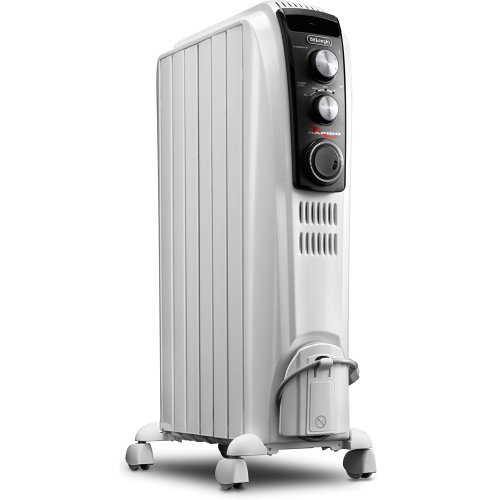
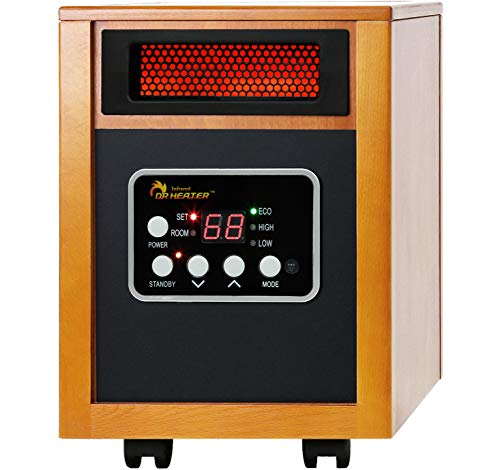
One heats the air in the room, the other heats the things in it. This is the distinction underneath every other heater comparison on this site.
By Scooter M. · Published August 31, 2026 · Last reviewed August 31, 2026
How this page is funded: we earn a commission if you buy through the links here, at no extra cost to you. Picks are chosen before links are attached, which is why every roundup names something to skip. Full disclosure.
Convection heaters warm the air, which then warms you — even coverage, slower to arrive, and it disperses when you open a door. Radiant heaters emit infrared that warms people and surfaces directly — instant, directional, and unaffected by drafts.
The mechanism
Convection is heat transfer through a moving fluid, and in a room the fluid is air. A convection heater warms the air touching it; that air becomes less dense, rises, and is replaced by cooler air. A fan-forced heater does the same thing deliberately and faster. Either way, the room's air becomes the reservoir, and you are warmed by being in it.
Radiation is heat transfer by electromagnetic waves, and it needs no medium at all. Infrared passes through air almost untouched and is absorbed by the first solid surface it reaches. You feel it on your skin the instant you are in its path, and you stop feeling it the instant you step out.
The everyday demonstration is standing in winter sunlight through a window: the air is cold, the room is cold, and your face is warm. Nothing heated the air. That is radiant transfer, and it is what an infrared heater does deliberately.
Which heaters are which
Type
Mechanism
Fan?
Ceramic (PTC) tower
Convection, fan-forced
Yes
Fan-forced / vortex
Convection, fan-forced
Yes
Oil-filled radiator
Mostly convection, some radiant
No
Micathermic panel
Roughly half radiant, half convection
No
Infrared quartz panel
Radiant
No
Infrared cabinet heater
Radiant plus fan-forced convection
Usually
Most real products are hybrids to some degree; the column describes the dominant mechanism.
Where each one wins, and why
Convection wins in an enclosed room you want uniformly warm. A bedroom, a study, a closed living room. Because it heats a reservoir of air, the whole space comes up together and stays up while the room stays closed.
Radiant wins where the air is a losing battle. A garage, a workshop, a basement, a covered porch, a room with a vaulted ceiling, a space with a door that keeps opening. In all of those, warmed air escapes or rises out of reach, and heating the person directly sidesteps the problem entirely.
The four practical differences
1.Speed. Radiant is immediate; convection takes ten to thirty minutes depending on the design.
2.Persistence. Convection leaves a warm room behind for a while. Radiant leaves warm surfaces but a cold room, so it feels colder faster once switched off.
3.Draftiness. An open door destroys convected heat and barely affects radiant. In a space with a lot of air exchange, radiant is the only thing that works.
4.Coverage. Convection fills a room. Radiant covers a cone. Sitting behind a radiant heater is being outside its coverage entirely.
Picks from both mechanisms
Quick picks
Ranked for fit, not for hype. Coverage and current draw are computed from each unit’s published wattage. Tap a row for the full write-up, or go straight to the listing.
#
Product
Best for
Covers
Draw
Price
1
De'Longhi TRD40615TNo fan, so no noise and no moving dust — and the sealed oil keeps radiating after the element cuts out, which is why an oil-filled unit feels steadier than a ceramic one at the same wattage.
Dr Infrared DR-968The one listing in this category that publishes its amp draw and its noise level, which is exactly the arithmetic everyone else leaves you to do — 12.5 A and 39 dB, both stated.
Dreo Solaris 718The rare heater whose published coverage claim survives the arithmetic: 1,500 W is a genuine 300 sq ft at 10 W/sq ft, and Dreo publishes that number rather than implying more.
No fan, so no noise and no moving dust — and the sealed oil keeps radiating after the element cuts out, which is why an oil-filled unit feels steadier than a ceramic one at the same wattage.
Rated power
1,500 W
Covers (computed)
150 sq ft
Draw (computed)
12.5 A at 120 V
Cost per hour
27.5¢
Coverage at 10 W/sq ft, average insulation, 8 ft ceiling = 5,118 BTU/h. Cost at 18.34¢/kWh; an eight-hour night at full output is $2.20. Exceeds the 12 A continuous limit of a 15 A circuit — check what else shares the breaker.
What works
Genuinely silent: there is no fan to hear at 3 a.m.
The oil holds heat, so the room temperature swings less between thermostat cycles
Nothing blows air, so nothing stirs up dust in a bedroom
What does not
Slow. It takes 20–30 minutes to feel like it is doing anything
Heavy — the wheels are not a courtesy, they are a requirement
The surface gets genuinely hot; this is a radiator, not a cool-touch case
Published specification
Rated power
1,500 W at 120 V
Controls
Mechanical, with a programmable 24-hour timer
Fluid
Permanently sealed diathermic oil — never needs refilling
Maker's claim
Up to 75% more radiant surface area
Mobility
Front and rear handles, snap-on wheels
Heat type
Oil-filled
Maker’s coverage claim
None published — the coverage figure above is ours
Safety listing
No listing mark published in the listing text; verify the UL or ETL mark on the rating plate.
Who it is for
A bedroom, a nursery at a safe distance, or anywhere the fan noise of a ceramic heater is the actual problem you are trying to solve.
What it is not for
Fast heat, and not a room you only occupy for twenty minutes. It also should never be tucked beside a bed or curtain — hot surface, 3-foot rule.
The one listing in this category that publishes its amp draw and its noise level, which is exactly the arithmetic everyone else leaves you to do — 12.5 A and 39 dB, both stated.
Rated power
1,500 W
Covers (computed)
150 sq ft
Draw (computed)
12.5 A at 120 V
Cost per hour
27.5¢
Coverage at 10 W/sq ft, average insulation, 8 ft ceiling = 5,118 BTU/h. Cost at 18.34¢/kWh; an eight-hour night at full output is $2.20. Exceeds the 12 A continuous limit of a 15 A circuit — check what else shares the breaker.
What works
Publishes 12.5 A, which is the number that decides whether it fits your circuit
Publishes 39 dB, which is the number that decides whether it fits your bedroom
A wooden-cabinet infrared unit runs cooler on the outside than a bare panel
What does not
19 lb with wheels: this is furniture, not a portable you carry between rooms
12.5 A against a 15 A circuit's 12 A continuous limit — it does not legally fit, see the circuit-load guide
Dated cabinet styling that will not disappear into a modern room
Published specification
Rated power
1,500 W at 120 V
Current draw
12.5 A (published)
Noise
39 dB (published)
Element
Infrared quartz tube plus PTC
Thermostat
Electronic, 50–85°F
Other
12-hour auto-off timer, IR remote, caster wheels, 19 lb
Heat type
Infrared quartz
Maker’s coverage claim
None published — the coverage figure above is ours
Safety listing
No listing mark published in the listing text; check the cabinet's rating plate for the UL or ETL mark.
Who it is for
A reader who wants to compute the load rather than trust a claim: the published amp draw and decibel figure make it the easiest unit on this site to check.
What it is not for
A 15 A circuit shared with anything else, and not a small room where a 19 lb cabinet on wheels is in the way.
The rare heater whose published coverage claim survives the arithmetic: 1,500 W is a genuine 300 sq ft at 10 W/sq ft, and Dreo publishes that number rather than implying more.
Rated power
1,500 W
Covers (computed)
150 sq ft
Draw (computed)
12.5 A at 120 V
Cost per hour
27.5¢
Coverage at 10 W/sq ft, average insulation, 8 ft ceiling = 5,118 BTU/h. Cost at 18.34¢/kWh; an eight-hour night at full output is $2.20. Exceeds the 12 A continuous limit of a 15 A circuit — check what else shares the breaker.
What works
A digital thermostat with numbers on it — you can set 68°F rather than guess at a dial
The published 300 sq ft claim matches the standard sizing rule instead of exceeding it
8 lb and 8 inches square: it moves room to room without a project
What does not
1,500 W is 1,500 W — nothing here heats faster than any other 1,500 W heater
Dreo does not publish a noise figure in decibels on the product page
Tall and narrow, which is a tipping profile: the tip-over cutoff matters more here
A living room, bedroom or den at or under 300 sq ft with average insulation and an 8-foot ceiling, where you want to set a temperature and stop thinking about it.
What it is not for
A garage, an uninsulated basement, or anything over about 300 sq ft. It is not under-powered — 1,500 W is the plug-in ceiling — the room is simply too big for one outlet.
What is the difference between convection and radiant heat?+
Convection warms the air, which then warms you — even but slower, and lost when a door opens. Radiant emits infrared that warms people and surfaces directly — instant and directional, and unaffected by air movement.
Is radiant heat better than convection?+
In drafty, large or high-ceilinged spaces, yes, because heating the air there is a losing battle. In an enclosed room you want uniformly warm, convection is better.
Which is more efficient, convection or radiant?+
Both are about 100% efficient at converting electricity to heat. Radiant can require less energy for the same perceived comfort because it warms you without raising the whole room's air temperature.
Do radiant heaters work in drafty rooms?+
Yes, better than convection heaters do. Infrared warms the surfaces it reaches regardless of air movement, whereas convected warm air is carried away by a draft before it reaches you.
No heater removes water from a room. Warming air lowers relative humidity — the feeling is real, the cause is not the heater.
Written by Scooter M., an enthusiast — not a tester and not a certified anything. Every figure on this page is either published by the manufacturer, taken from a live retail listing, or computed from the published wattage using the formulas we publish. Found an error? Tell us and we will correct it, visibly and with a date on it.