They cost the same per hour and produce the same heat. The difference is where that heat goes — and which one you want is decided entirely by the room.
By Scooter M. · Published August 31, 2026 · Last reviewed August 31, 2026
How this page is funded: we earn a commission if you buy through the links here, at no extra cost to you. Picks are chosen before links are attached, which is why every roundup names something to skip. Full disclosure.
Ceramic heaters warm the air and circulate it with a fan, so the whole room comes up evenly over ten to twenty minutes. Infrared heaters emit radiant heat that warms you and nearby surfaces almost instantly, but only where they point. Both cost the same per hour at the same wattage.
How each one works
Ceramic (PTC). Current passes through a ceramic element with a positive temperature coefficient — its resistance rises as it heats, which naturally limits its own temperature. A fan draws room air across it and pushes the warmed air out. You are heating the air, and the air is heating you.
Infrared quartz. Current heats a quartz tube, which emits in the infrared band. Infrared passes through air without warming it much and is absorbed by the first solid thing it hits — you, the floor, the furniture. Those surfaces then warm the air around them slowly. It is the same mechanism by which sunlight through a window warms your face on a cold day while the room stays cold.
The comparison
Ceramic (PTC)
Infrared quartz
Heats
The air, then you
You and surfaces directly
Time to feel it
10–20 minutes for the room
Seconds, if it is pointing at you
Directional?
No — the fan distributes it
Yes, strongly
Noise
Fan noise, typically 45–55 dB
Silent if fanless; many cabinet units have blowers
Best room shape
Enclosed, normal ceiling
Large, drafty, high-ceilinged, or open
Persistence after switch-off
Short — warm air disperses
None — but surfaces stay warm
Moves dust
Yes, it is a fan
No, if fanless
Efficiency
~100%
~100%
Cost per hour at 1,500 W
27.5¢
27.5¢
Cost computed at 18.34¢/kWh (EIA, June 2026). The identical bottom two rows are the point.
The verdict, by room
Bedroom: ceramic, or neither. You want the whole room even and you want it silent, which argues for an oil-filled radiator over both. Between these two, ceramic — infrared pointing at a bed heats one side of a sleeping person.
Living room you occupy for an evening: ceramic. You move around, and even air temperature is what you want.
Garage or workshop: infrared, clearly. You cannot win against that much cold air, so heat the person at the bench. The garage arithmetic.
Home office at a desk: either, with a nod to infrared if you sit still — it makes you comfortable without raising the room. Office picks.
Basement: infrared. Same reasoning as the garage — the sizing correction makes air heating an uphill fight.
A room with a very high or vaulted ceiling: infrared. Warm air rises out of reach; radiant heat does not.
The practical differences nobody mentions
Dust and allergies. A ceramic heater is a fan, and a fan in a room moves whatever is on the floor into the air. People with dust sensitivities notice this within a day. Fanless designs — infrared panels, oil-filled radiators, mica panels — do not do it.
Shadowing. Radiant heat does not go around things. Sit with your back to an infrared heater and your front is cold. Put a coffee table between you and it and your legs are cold. This is obvious in retrospect and surprising in practice.
Surface temperature. Quartz elements run extremely hot and glow. Cabinet-style infrared units enclose that behind a grille and a housing; bare-element units do not. The three-foot clearance rule is not negotiable with either, but it is especially not with an exposed element.
Picks for both sides
Quick picks
Ranked for fit, not for hype. Coverage and current draw are computed from each unit’s published wattage. Tap a row for the full write-up, or go straight to the listing.
#
Product
Best for
Covers
Draw
Price
1
Dreo Solaris 718The rare heater whose published coverage claim survives the arithmetic: 1,500 W is a genuine 300 sq ft at 10 W/sq ft, and Dreo publishes that number rather than implying more.
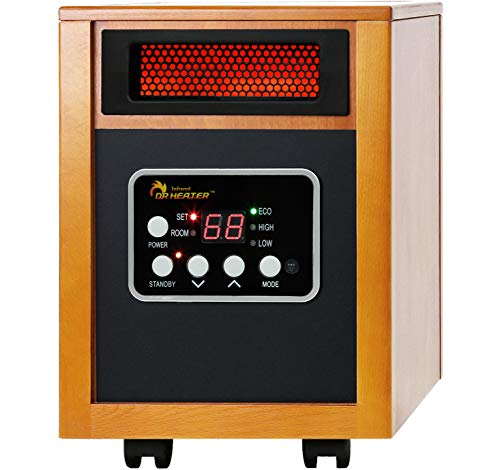
Dr Infrared DR-968The one listing in this category that publishes its amp draw and its noise level, which is exactly the arithmetic everyone else leaves you to do — 12.5 A and 39 dB, both stated.
Lasko 5586A long-running 1,500 W tower with a digital thermostat, an 8-hour timer and a remote — the cheap end of the category without the missing-safety-feature problem the cheap end usually has.
Heat Storm HS-1500-PHXWall-mounted, which removes the entire tip-over failure mode rather than mitigating it — and Wi-Fi scheduling means it can heat a bathroom before you get in it.
The rare heater whose published coverage claim survives the arithmetic: 1,500 W is a genuine 300 sq ft at 10 W/sq ft, and Dreo publishes that number rather than implying more.
Rated power
1,500 W
Covers (computed)
150 sq ft
Draw (computed)
12.5 A at 120 V
Cost per hour
27.5¢
Coverage at 10 W/sq ft, average insulation, 8 ft ceiling = 5,118 BTU/h. Cost at 18.34¢/kWh; an eight-hour night at full output is $2.20. Exceeds the 12 A continuous limit of a 15 A circuit — check what else shares the breaker.
What works
A digital thermostat with numbers on it — you can set 68°F rather than guess at a dial
The published 300 sq ft claim matches the standard sizing rule instead of exceeding it
8 lb and 8 inches square: it moves room to room without a project
What does not
1,500 W is 1,500 W — nothing here heats faster than any other 1,500 W heater
Dreo does not publish a noise figure in decibels on the product page
Tall and narrow, which is a tipping profile: the tip-over cutoff matters more here
A living room, bedroom or den at or under 300 sq ft with average insulation and an 8-foot ceiling, where you want to set a temperature and stop thinking about it.
What it is not for
A garage, an uninsulated basement, or anything over about 300 sq ft. It is not under-powered — 1,500 W is the plug-in ceiling — the room is simply too big for one outlet.
The one listing in this category that publishes its amp draw and its noise level, which is exactly the arithmetic everyone else leaves you to do — 12.5 A and 39 dB, both stated.
Rated power
1,500 W
Covers (computed)
150 sq ft
Draw (computed)
12.5 A at 120 V
Cost per hour
27.5¢
Coverage at 10 W/sq ft, average insulation, 8 ft ceiling = 5,118 BTU/h. Cost at 18.34¢/kWh; an eight-hour night at full output is $2.20. Exceeds the 12 A continuous limit of a 15 A circuit — check what else shares the breaker.
What works
Publishes 12.5 A, which is the number that decides whether it fits your circuit
Publishes 39 dB, which is the number that decides whether it fits your bedroom
A wooden-cabinet infrared unit runs cooler on the outside than a bare panel
What does not
19 lb with wheels: this is furniture, not a portable you carry between rooms
12.5 A against a 15 A circuit's 12 A continuous limit — it does not legally fit, see the circuit-load guide
Dated cabinet styling that will not disappear into a modern room
Published specification
Rated power
1,500 W at 120 V
Current draw
12.5 A (published)
Noise
39 dB (published)
Element
Infrared quartz tube plus PTC
Thermostat
Electronic, 50–85°F
Other
12-hour auto-off timer, IR remote, caster wheels, 19 lb
Heat type
Infrared quartz
Maker’s coverage claim
None published — the coverage figure above is ours
Safety listing
No listing mark published in the listing text; check the cabinet's rating plate for the UL or ETL mark.
Who it is for
A reader who wants to compute the load rather than trust a claim: the published amp draw and decibel figure make it the easiest unit on this site to check.
What it is not for
A 15 A circuit shared with anything else, and not a small room where a 19 lb cabinet on wheels is in the way.
Lasko 5586 Oscillating Digital Ceramic Tower Heater (29 in)
A long-running 1,500 W tower with a digital thermostat, an 8-hour timer and a remote — the cheap end of the category without the missing-safety-feature problem the cheap end usually has.
Rated power
1,500 W
Covers (computed)
150 sq ft
Draw (computed)
12.5 A at 120 V
Cost per hour
27.5¢
Coverage at 10 W/sq ft, average insulation, 8 ft ceiling = 5,118 BTU/h. Cost at 18.34¢/kWh; an eight-hour night at full output is $2.20. Exceeds the 12 A continuous limit of a 15 A circuit — check what else shares the breaker.
What works
Digital thermostat and a timer at the price most units charge for a two-position knob
Oscillation moves the air rather than roasting whatever is directly in front of it
A model that has been on sale long enough for its failure modes to be well known
What does not
“For large rooms” is a marketing phrase, not a number — Lasko publishes no coverage figure
No child lock, which matters if the reason you are shopping is a nursery
Plastic housing and a light chassis: it will tip if a dog leans on it
Published specification
Rated power
1,500 W at 120 V
Maker's coverage claim
None published — listed as “for large rooms”
Controls
Digital thermostat, remote, 8-hour auto-off timer
Height
29"
Safety
Cool-touch housing, overheat protection
Heat type
Ceramic (PTC)
Maker’s coverage claim
None published — the coverage figure above is ours
Safety listing
Lasko does not publish a listing mark on the Amazon listing text; check the unit's own rating plate for the UL or ETL mark before you use it.
Who it is for
Someone heating one main room who wants a thermostat and a timer and is not willing to pay a premium for a metal cabinet.
What it is not for
A room with a toddler or a curious pet. Without a child lock, the controls are one press away from full output at floor height.
Wall-mounted, which removes the entire tip-over failure mode rather than mitigating it — and Wi-Fi scheduling means it can heat a bathroom before you get in it.
Rated power
1,500 W
Covers (computed)
150 sq ft
Draw (computed)
12.5 A at 120 V
Cost per hour
27.5¢
Coverage at 10 W/sq ft, average insulation, 8 ft ceiling = 5,118 BTU/h. Cost at 18.34¢/kWh; an eight-hour night at full output is $2.20. Exceeds the 12 A continuous limit of a 15 A circuit — check what else shares the breaker.
What works
On a wall it cannot be tipped, and it cannot be crowded by a curtain that moved
Scheduling from the app is the practical answer to bathroom and workshop use
The published 5,200 BTU/h figure matches 1,500 W exactly — no inflated claim
What does not
It is a mounting job, not an unbox-and-plug — and it needs an outlet where you mount it
Wi-Fi adds a failure mode a knob does not have
Wall-mounted radiant heat is directional; you feel it where it points
Published specification
Rated power
1,500 W at 120 V
Published output
5,200 BTU/h
Mounting
Wall-mounted
Control
Wi-Fi app, remote scheduling
Element
Infrared quartz
Heat type
Infrared quartz
Maker’s coverage claim
None published — the coverage figure above is ours
Safety listing
No listing mark published in the listing text; check the rating plate for the UL or ETL mark.
Who it is for
A bathroom, a small bedroom, a workshop corner — anywhere floor space is gone and a heater on the ground is a hazard.
What it is not for
Renters who cannot drill, and rooms where you want the heater to move with you.
Neither in general. Infrared warms you and nearby surfaces almost instantly and suits large, drafty or high-ceilinged spaces. Ceramic warms the air evenly and suits enclosed rooms. At the same wattage they cost the same to run.
Do infrared heaters use less electricity than ceramic?+
Not per hour. Both are about 100% efficient, so 1,500 W is 1,500 W. Infrared can result in lower consumption because you may be comfortable at a lower setting without raising the room's air temperature.
Which heats a room faster, ceramic or infrared?+
Infrared makes you feel warm faster — within seconds if it points at you. Ceramic raises the room's actual air temperature faster, because a fan distributing warm air heats the volume more effectively than radiant heat does.
Are infrared heaters safe indoors?+
Yes, with the same rules as any heater: three feet of clearance, direct wall plug, tip-over and overheat cutoffs. Quartz elements run very hot, so enclosed cabinet designs and wall-mounted panels are preferable where children or pets are around.
Heats you, not the air — which is why it wins in drafty rooms and loses behind the sofa.
Written by Scooter M., an enthusiast — not a tester and not a certified anything. Every figure on this page is either published by the manufacturer, taken from a live retail listing, or computed from the published wattage using the formulas we publish. Found an error? Tell us and we will correct it, visibly and with a date on it.