A 150 sq ft room needs about 1,500 W at average insulation and an 8-foot ceiling — precisely one plug-in heater at full output. If the room is drafty or the ceiling is above 8 feet, the honest requirement is 1,900–2,100 W and one heater will run continuously.
150 sq ft × 10 W = 1,500 W. That is a 10 × 15, a 12 × 12.5, or a generously sized bedroom. It is also, exactly, the output of a single U.S. plug-in heater — which is a coincidence of the standard 15 A circuit rather than a design, but a useful one.
| Room size | Watts needed | BTU/h | Plug-in heaters |
|---|
| 150 sq ft | 1,500 W | 5,118 | 1 |
Computed as square feet x 10 W x insulation factor x (ceiling / 8 ft), for an average heated room — 10 W/sq ft, 8 ft ceiling. Heater count assumes the 1,500 W plug-in ceiling.
Being exactly at capacity has a specific consequence: you have no margin. On a mild evening the heater will reach the setpoint and cycle happily. On the coldest night of the year, in a room with an exterior wall and a window, it will run continuously and hold the room a few degrees below where you set it. That is not a fault; it is the room being at the edge of what one outlet can do.
| Room condition (150 sq ft) | Watts needed | One heater is... |
|---|
| Well insulated, 8 ft ceiling | 1,200 W | Comfortable, will cycle |
| Average, 8 ft ceiling | 1,500 W | Exactly enough, no margin |
| Average, 9 ft ceiling | 1,688 W | Slightly short — runs continuously |
| Drafty or single-glazed, 8 ft | 1,875 W | Short by a quarter |
| Drafty, 9 ft ceiling | 2,109 W | Short by 40% — consider two |
watts = 150 × 10 × insulation factor × (ceiling ÷ 8). Computed from the site formula.
The bottom two rows are where people get frustrated, and it is worth naming the symptom so it is recognizable: a heater running at full output all evening, the room reaching 65°F when you asked for 70°F, and the bill arriving as if it had done what you wanted. Sealing the draft is cheaper than the second heater.
| Wattage | Per hour | 4 h | 8 h | 12 h |
|---|
| 1,200 W | 22.0¢ | $0.88 | $1.76 | $2.64 |
| 1,500 W | 27.5¢ | $1.10 | $2.20 | $3.30 |
Computed at 18.34¢/kWh — the U.S. residential average for June 2026 (EIA, Electric Power Monthly, Table 5.6.A, released August 26, 2026). Your rate is on your own bill; substitute it and the arithmetic still holds. Figures assume full output for the whole period.
Worth noting: a well-insulated 150 sq ft room only needs 1,200 W, and running a 1,500 W heater on a 1,200 W-equivalent setting saves 20% of every hour. This is the room size where a low setting is not a compromise — it is the correct setting for most of the winter.
Quick picks
Ranked for fit, not for hype. Coverage and current draw are computed from each unit’s published wattage. Tap a row for the full write-up, or go straight to the listing.
| # | Product | Best for | Covers | Draw | Price |
|---|
| 1 | LaskoNo photo Lasko Ellipse CD12950The short answer to “which small heater has a child lock”: a tabletop unit that publishes a tip-over switch, a child lock and an auto-eco mode rather than leaving you to guess. | A desk, a nursery, a small bedroom | 150 sq ft | 12.5 A | Check price on Amazon |
| 2 | Honeywell HCE220BA shoebox-sized ceramic heater that publishes four preset temperatures and a 2/4/8-hour auto-off — specificity almost nothing else this size offers. | A thermostat with numbers on it, on a small heater | 150 sq ft | 12.5 A | $59.99 · Check on Amazon |
| 3 | De'Longhi TRD40615TNo fan, so no noise and no moving dust — and the sealed oil keeps radiating after the element cuts out, which is why an oil-filled unit feels steadier than a ceramic one at the same wattage. | Silence, and a bedroom | 150 sq ft | 12.5 A | $159.95 · Check on Amazon |
Coverage computed at 10 W/sq ft, average insulation, 8 ft ceiling. Draw computed as watts ÷ volts. Neither figure is a manufacturer claim.
#ad · how this site is funded · price as of October 18, 2026
LaskoNo photo
Top pick · A desk, a nursery, a small bedroom
Lasko Ellipse CD12950 Tabletop Ceramic Heater
The short answer to “which small heater has a child lock”: a tabletop unit that publishes a tip-over switch, a child lock and an auto-eco mode rather than leaving you to guess.
- Rated power
- 1,500 W
- Covers (computed)
- 150 sq ft
- Draw (computed)
- 12.5 A at 120 V
- Cost per hour
- 27.5¢
Coverage at 10 W/sq ft, average insulation, 8 ft ceiling = 5,118 BTU/h. Cost at 18.34¢/kWh; an eight-hour night at full output is $2.20. Exceeds the 12 A continuous limit of a 15 A circuit — check what else shares the breaker.
What works
- Child lock and tip-over switch are both published, not inferred from a photo
- Tabletop height gets the outlet cord off the floor, which is where cords get stepped on
- AutoECO cycles rather than running flat out, which is the only real way a heater saves money
What does not
- Still 1,500 W: on a desk it will heat the room, not just you, and cost accordingly
- No published coverage figure
- Tabletop placement means it needs 3 feet of clear space on a surface that usually has none
| Published specification |
|---|
| Rated power | 1,500 W at 120 V |
| Maker's coverage claim | None published |
| Controls | Digital display, thermostat, AutoECO mode, remote |
| Oscillation | Wide oscillation |
| Safety | Tip-over switch, child lock |
| Heat type | Ceramic (PTC) |
| Maker’s coverage claim | None published — the coverage figure above is ours |
| Safety listing | No listing mark is published in the Amazon listing text; verify the UL or ETL mark on the rating plate. |
Who it is for
A small room — a nursery, a home office, a bedroom under about 150 sq ft — where the controls need to be lockable.
What it is not for
An open-plan living room. A tabletop unit oscillating across a desk is not going to move 1,500 W of heat around 400 sq ft.
2 · A thermostat with numbers on it, on a small heater
Honeywell HCE220B UberHeat Plus Ceramic Heater
A shoebox-sized ceramic heater that publishes four preset temperatures and a 2/4/8-hour auto-off — specificity almost nothing else this size offers.
- Rated power
- 1,500 W
- Covers (computed)
- 150 sq ft
- Draw (computed)
- 12.5 A at 120 V
- Cost per hour
- 27.5¢
Coverage at 10 W/sq ft, average insulation, 8 ft ceiling = 5,118 BTU/h. Cost at 18.34¢/kWh; an eight-hour night at full output is $2.20. Exceeds the 12 A continuous limit of a 15 A circuit — check what else shares the breaker.
What works
- Four preset temperatures rather than an unmarked dial — on a heater this small and this cheap, being able to ask for 70°F is unusual
- Two independent overheat mechanisms are published — a high-temperature sensor and a thermal cut-off fuse — plus a tip-over switch
- A 2/4/8-hour auto-off means it can stop by itself, which is what actually reduces the bill
What does not
- No UL or ETL mark published by Honeywell, which is the one thing we would want stated at this size and price
- Four presets is not the same as a full range: if you want 68°F you are choosing between 65 and 70
- 2.8 lb and shoebox-sized means it is a personal heater, not a room heater, whatever the 1,500 W suggests
| Published specification |
|---|
| Rated power | 1,500 W maximum at 120 V |
| Heat settings | 2 (high and low) |
| Thermostat | Four preset comfort levels — 65°, 70°, 75° and 80°F |
| Auto-off timer | 2, 4 or 8 hours |
| Safety | Tip-over switch; 2x overheat protection (high-temperature sensor plus a thermal cut-off fuse); cool-touch housing |
| Size | 8.5" x 4.5" x 8.86", 2.8 lb |
| Warranty | 3-year limited |
| Heat type | Ceramic (PTC) |
| Maker’s coverage claim | None published — the coverage figure above is ours |
| Safety listing | Honeywell does not publish a UL or ETL mark for this model; it does publish two independent overheat mechanisms. Check the rating plate. |
Who it is for
A small office, a bedside table or a desk, where the heater needs to hold roughly a known temperature and switch itself off after a few hours.
What it is not for
A large or drafty room, and not a nursery — no child lock is published and the presets are reachable by anyone who can reach the unit.
Sources for this entry
- Amazon listing — published model HCE220B, variable heat settings and auto-off timer
- Honeywell Store — UberHeat Plus HCE220 specification (1,500 W maximum, 2 heat settings, 65/70/75/80°F presets, 2/4/8-hour auto-off, tip-over switch, 2x overheat protection, cool-touch housing, 8.5 x 4.5 x 8.86 in, 2.8 lb, 3-year limited warranty)
3 · Silence, and a bedroom
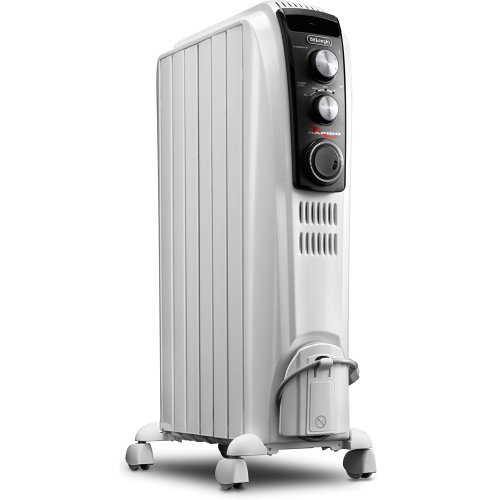
De'Longhi TRD40615T Oil-Filled Radiator Heater
No fan, so no noise and no moving dust — and the sealed oil keeps radiating after the element cuts out, which is why an oil-filled unit feels steadier than a ceramic one at the same wattage.
- Rated power
- 1,500 W
- Covers (computed)
- 150 sq ft
- Draw (computed)
- 12.5 A at 120 V
- Cost per hour
- 27.5¢
Coverage at 10 W/sq ft, average insulation, 8 ft ceiling = 5,118 BTU/h. Cost at 18.34¢/kWh; an eight-hour night at full output is $2.20. Exceeds the 12 A continuous limit of a 15 A circuit — check what else shares the breaker.
What works
- Genuinely silent: there is no fan to hear at 3 a.m.
- The oil holds heat, so the room temperature swings less between thermostat cycles
- Nothing blows air, so nothing stirs up dust in a bedroom
What does not
- Slow. It takes 20–30 minutes to feel like it is doing anything
- Heavy — the wheels are not a courtesy, they are a requirement
- The surface gets genuinely hot; this is a radiator, not a cool-touch case
| Published specification |
|---|
| Rated power | 1,500 W at 120 V |
| Controls | Mechanical, with a programmable 24-hour timer |
| Fluid | Permanently sealed diathermic oil — never needs refilling |
| Maker's claim | Up to 75% more radiant surface area |
| Mobility | Front and rear handles, snap-on wheels |
| Heat type | Oil-filled |
| Maker’s coverage claim | None published — the coverage figure above is ours |
| Safety listing | No listing mark published in the listing text; verify the UL or ETL mark on the rating plate. |
Who it is for
A bedroom, a nursery at a safe distance, or anywhere the fan noise of a ceramic heater is the actual problem you are trying to solve.
What it is not for
Fast heat, and not a room you only occupy for twenty minutes. It also should never be tucked beside a bed or curtain — hot surface, 3-foot rule.
At 1,500 W the heater draws 12.5 A, which is above the 12 A continuous allowance of a 15 A branch circuit. In a bedroom carrying only lamps and a phone charger that is a technicality most people never notice; in a room that also runs a desktop computer or a window air conditioner it is not. The full arithmetic is here.