The honest answer is that the official guidance says no, and the data behind that guidance is worth reading rather than being told about.
By Scooter M. · Published August 31, 2026 · Last reviewed August 31, 2026
How this page is funded: we earn a commission if you buy through the links here, at no extra cost to you. Picks are chosen before links are attached, which is why every roundup names something to skip. Full disclosure.
The U.S. Fire Administration's guidance is to turn space heaters off when you leave the room or go to bed. Unattended equipment is a named contributing factor in its portable heater fire data. The practical alternative is a heater with a programmable timer that warms the room and then shuts itself off.
What the guidance actually says
The USFA publishes three heating-safety rules for households, and they are short enough to quote in full: keep anything that can burn at least 3 feet from all heat sources; turn space heaters off when leaving the room or going to bed; and have heating equipment and chimneys cleaned and inspected each year by a professional.
That middle rule is the one this page is about, and it is unambiguous. It is not “be careful overnight” or “use a modern heater overnight” — it is turn it off.
Why unattended running specifically
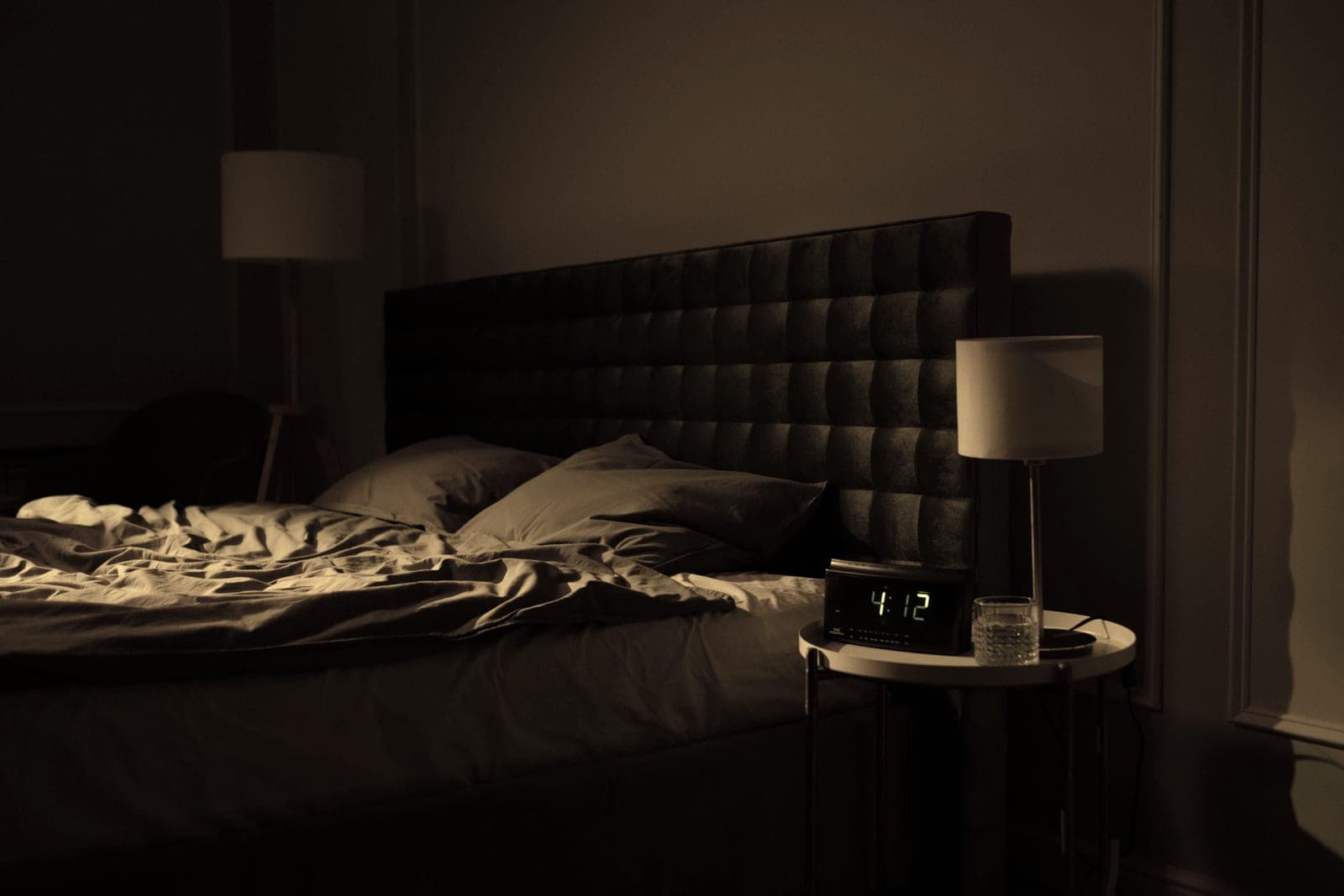
The risk is not that a heater is more likely to fail at night. It is that if something does go wrong at 3 a.m., nobody notices for an hour. Every one of the realistic failure modes — a blanket that slid onto the grille, a curtain that moved, a heater knocked over by a cat, a cord warming under a rug — is trivially recoverable if a person is awake in the room and consequential if nobody is.
The federal data reflects that asymmetry. The U.S. Fire Administration's portable heater report records an annual average of 1,100 portable heater fires in residential buildings, causing 65 deaths, 150 injuries and $51 million in property loss (2017–2019). Set that against its heating-fires report, which records 34,200 heating fires and 165 deaths a year: portable heaters are about 3% of the fires and about 39% of the deaths. That arithmetic is ours, from the two published annual averages, and the full working is here.
What to do instead — the timer answer
The reason people run heaters overnight is not recklessness, it is that the bedroom is cold at 11 p.m. and the guidance offers no alternative. There is one, and it is a purchase rather than a sacrifice: a heater with a programmable timer.
Set it to run for the two hours around bedtime and shut off. The room reaches temperature while you are falling asleep, the thermal mass of the room and the bedding carries you through the coldest hours, and there is no appliance running unattended at 3 a.m. In a reasonably insulated bedroom this genuinely works, and it costs less: two hours of a 1,500 W heater is about 55 cents against $2.20 for eight.
Approach
Cost per night at 1,500 W
Unattended hours
Run all night (8 h)
$2.20
8
Timer, 2 h at bedtime
$0.55
0
Timer, 2 h at bedtime + 1 h pre-wake
$0.83
1
Wall-mounted, scheduled, 3 h split
$0.83
1, out of reach
Computed at 18.34¢/kWh (EIA, June 2026), full output. The unattended-hours column is the one that matters.
If you are going to do it anyway
People will, and pretending otherwise helps nobody. So: the things that most reduce the risk of an overnight run, in order.
This page is about running a heater unattended. If your question is really about duration — whether the appliance itself minds being on for twelve hours, or what 24/7 costs — that is a different question with a different answer, and it is on how long you can run a space heater.
1.Three feet of clearance, verified with the lights on. Not “about right” — actually measured, from the duvet, the curtains and anything on the floor.
3.A unit with a published tip-over cutoff and overheat protection.What each one prevents.
4.A working smoke alarm in the room. The USFA's heating-fire data records smoke alarms present in only 54% of nonconfined residential heating fires — the single largest gap in that dataset.
5.A wall-mounted heater if the room is small. It cannot be tipped, crowded or reached, which removes most of the list above by geometry — the mounted options.
6.Not on carpet, not against furniture, not behind a door that swings.
Picks that make the timer answer possible
Quick picks
Ranked for fit, not for hype. Coverage and current draw are computed from each unit’s published wattage. Tap a row for the full write-up, or go straight to the listing.
#
Product
Best for
Covers
Draw
Price
1
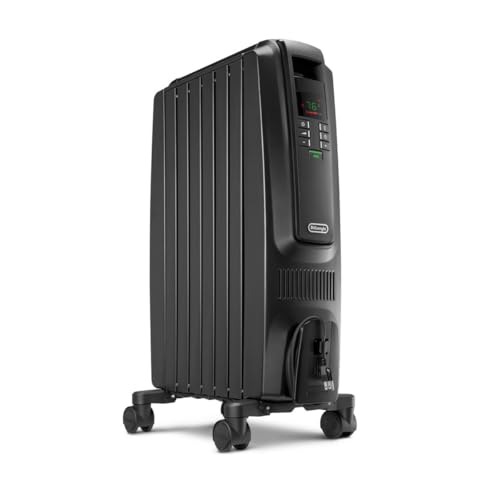
De'Longhi Dragon DigitalThe oil-filled radiator with a programmable timer, which is the version that matters overnight: it can bring a bedroom up before you wake and shut itself off, unattended, without you leaving it running all night.
Heat Storm HS-1500-PHXWall-mounted, which removes the entire tip-over failure mode rather than mitigating it — and Wi-Fi scheduling means it can heat a bathroom before you get in it.
Vornado VH200Circulates the room's air instead of aiming a hot jet at your shins — the difference you feel is uniformity, not output, because the output is the same 1,500 W as everything else.
De'Longhi Dragon Digital Oil-Filled Radiator (TRD40615EBK)
The oil-filled radiator with a programmable timer, which is the version that matters overnight: it can bring a bedroom up before you wake and shut itself off, unattended, without you leaving it running all night.
Rated power
1,500 W
Covers (computed)
150 sq ft
Draw (computed)
12.5 A at 120 V
Cost per hour
27.5¢
Coverage at 10 W/sq ft, average insulation, 8 ft ceiling = 5,118 BTU/h. Cost at 18.34¢/kWh; an eight-hour night at full output is $2.20. Exceeds the 12 A continuous limit of a 15 A circuit — check what else shares the breaker.
What works
A programmable timer is the honest answer to “can I leave it on overnight” — you don't have to
Silent, like every oil-filled unit: no fan, no moving air
Digital control means you set a temperature, not a knob position
What does not
Costs more than the mechanical TRD40615T for identical heat output
Same slow warm-up as any oil-filled radiator
Heavy and bulky for its coverage — 26 inches of steel you will not be carrying upstairs
Published specification
Rated power
1,500 W at 120 V
Controls
Digital, with a 24-hour programmable timer
ECO function
Regulates power and temperature rather than running at full output
Dimensions
16" x 10" x 26"
Fluid
Permanently sealed diathermic oil
Safety
Child lock, thermal cut-off
Maker's coverage claim
None published — sold as a full-room heater
Heat type
Oil-filled
Maker’s coverage claim
None published — the coverage figure above is ours
Safety listing
No listing mark published in the listing text; verify the UL or ETL mark on the rating plate.
Who it is for
A bedroom where the heater needs to run on a schedule rather than all night, and where noise would wake you.
What it is not for
A room you need warm in five minutes, or a tight space where a hot 26-inch radiator cannot keep 3 feet of clearance.
Wall-mounted, which removes the entire tip-over failure mode rather than mitigating it — and Wi-Fi scheduling means it can heat a bathroom before you get in it.
Rated power
1,500 W
Covers (computed)
150 sq ft
Draw (computed)
12.5 A at 120 V
Cost per hour
27.5¢
Coverage at 10 W/sq ft, average insulation, 8 ft ceiling = 5,118 BTU/h. Cost at 18.34¢/kWh; an eight-hour night at full output is $2.20. Exceeds the 12 A continuous limit of a 15 A circuit — check what else shares the breaker.
What works
On a wall it cannot be tipped, and it cannot be crowded by a curtain that moved
Scheduling from the app is the practical answer to bathroom and workshop use
The published 5,200 BTU/h figure matches 1,500 W exactly — no inflated claim
What does not
It is a mounting job, not an unbox-and-plug — and it needs an outlet where you mount it
Wi-Fi adds a failure mode a knob does not have
Wall-mounted radiant heat is directional; you feel it where it points
Published specification
Rated power
1,500 W at 120 V
Published output
5,200 BTU/h
Mounting
Wall-mounted
Control
Wi-Fi app, remote scheduling
Element
Infrared quartz
Heat type
Infrared quartz
Maker’s coverage claim
None published — the coverage figure above is ours
Safety listing
No listing mark published in the listing text; check the rating plate for the UL or ETL mark.
Who it is for
A bathroom, a small bedroom, a workshop corner — anywhere floor space is gone and a heater on the ground is a hazard.
What it is not for
Renters who cannot drill, and rooms where you want the heater to move with you.
Circulates the room's air instead of aiming a hot jet at your shins — the difference you feel is uniformity, not output, because the output is the same 1,500 W as everything else.
Rated power
1,500 W
Covers (computed)
150 sq ft
Draw (computed)
12.5 A at 120 V
Cost per hour
27.5¢
Coverage at 10 W/sq ft, average insulation, 8 ft ceiling = 5,118 BTU/h. Cost at 18.34¢/kWh; an eight-hour night at full output is $2.20. Exceeds the 12 A continuous limit of a 15 A circuit — check what else shares the breaker.
What works
Cool-touch case: the outside does not become the hazard the inside is
A 5-year warranty on a $75 heater is an unusual amount of skin in the game
Whole-room circulation means fewer cold corners at the same wattage
What does not
A control knob, not a digital thermostat — you cannot set a number
Vornado's own page does not publish wattage, coverage or a decibel figure
It is a fan. Air movement you can hear is how the design works, not a defect
Published specification
Rated power
1,500 W at 120 V (retail listings; Vornado publishes settings, not watts)
Heat settings
3
Thermostat
Thermostatic control knob
Safety
Tip-over switch, automatic safety shut-off, cool-touch case
Warranty
5-year limited
Heat type
Fan-forced
Maker’s coverage claim
None published — the coverage figure above is ours
Safety listing
Vornado's product page publishes an “Automatic Safety Shut-off System” and a tip-over switch but does not name a listing mark; check the rating plate.
Who it is for
A bedroom or living room where the complaint is “one end is warm and the other isn't”, rather than “it never gets warm”.
What it is not for
Silent operation, and not a garage. A moving-air heater in an uninsulated space is heating the outdoors with extra steps.
The U.S. Fire Administration advises turning space heaters off when you go to bed, because unattended running is a named contributing factor in portable heater fires. A programmable timer that warms the room and then shuts off is the practical alternative.
Is it safe to sleep with a space heater on?+
It is safer than running one in an empty room, since you are present — but the guidance is still to turn it off. If you do run one, keep three feet of clearance, plug it directly into the wall, and use a unit with tip-over and overheat cutoffs.
Which space heater is safest to leave on overnight?+
One with a programmable timer, so it does not stay on. Beyond that, a wall-mounted unit is the safest form factor because it cannot be tipped, crowded at floor level or reached by a child or pet.
How much does it cost to run a space heater all night?+
About $2.20 for eight hours at 1,500 W and 18.34¢/kWh, at full output. A two-hour timed run at bedtime is about 55 cents and leaves nothing running unattended.
No time limit on the appliance. The three real limits are the circuit, the bill, and the unattended-use advice.
Written by Scooter M., an enthusiast — not a tester and not a certified anything. Every figure on this page is either published by the manufacturer, taken from a live retail listing, or computed from the published wattage using the formulas we publish. Found an error? Tell us and we will correct it, visibly and with a date on it.