The hard part is not the size of the room. It is that you are motionless in it for four hours and it probably has no fourth wall.
By Scooter M. · Published October 3, 2026 · Last reviewed October 3, 2026
How this page is funded: we earn a commission if you buy through the links here, at no extra cost to you. Picks are chosen before links are attached, which is why every roundup names something to skip. Full disclosure.
A living room needs a heater chosen for stillness and silence rather than speed: you sit motionless for hours, so steady radiant warmth and a real thermostat beat fast output, and fan noise competes with the television. If the room is open to a hall or stairwell, size it to the connected space, not the floor plan.
Three things make this room different
You are not moving. Sitting still is the coldest thing you do indoors — no muscle activity, reduced circulation to hands and feet, and four unbroken hours of it. That is why a living room often feels cold at a temperature that is perfectly comfortable in a kitchen, and why steady radiant warmth from a surface beats a hot air jet that warms you when it sweeps past and leaves you when it does not.
The room is probably not a room. Bedrooms have four walls and a door. Living rooms open to halls, stairwells, dining areas and kitchens, and that makes the sizing rule much less useful than it looks — a stairwell in particular is a chimney for the warm air you just paid for. This is the single biggest reason living-room heater purchases disappoint, and it is a sizing error rather than a product one.
The floor is busy. Rugs, cables, a coffee table, a dog that leans on warm things, a child who is interested in anything with a light on it. Three feet of clearance in every direction is harder to find here than in any other room in the house, and the hardware that handles that — a published tip-over switch, a child lock, a cool-touch housing — matters more than it does on a desk.
Sizing, and the open-plan correction
Start with the arithmetic, then adjust it honestly. Average insulation and an 8-foot ceiling at 10 W per square foot:
Room size
Watts needed
BTU/h
Plug-in heaters
200 sq ft
2,000 W
6,824
2 (different circuits)
250 sq ft
2,500 W
8,530
2 (different circuits)
300 sq ft
3,000 W
10,236
2 (different circuits)
400 sq ft
4,000 W
13,649
3 (different circuits)
Computed as square feet x 10 W x insulation factor x (ceiling / 8 ft), for an average heated room — 10 W/sq ft, 8 ft ceiling. Heater count assumes the 1,500 W plug-in ceiling.
A 250 sq ft living room wants about 2,500 W, which is already past what any single outlet delivers. That is the crux: most living rooms are bigger than one 1,500 W heater can heat, and the correct conclusion is not to buy a bigger heater but to change what you are asking it to do. A plug-in heater in a living room is a supplement that makes the seating area comfortable while the central heat does the room, or it is a way to keep the room usable with the thermostat turned down. It is not a furnace replacement. The full sizing rule, including the multipliers.
What it costs for an evening
A living room heater runs in long, predictable blocks — an evening at a time — which makes it one of the easier costs on this site to plan around.
Wattage
Per hour
2 h
4 h
6 h
900 W
16.5¢
$0.33
$0.66
$0.99
1,500 W
27.5¢
$0.55
$1.10
$1.65
Computed at 18.34¢/kWh — the U.S. residential average for June 2026 (EIA, Electric Power Monthly, Table 5.6.A, released August 26, 2026). Your rate is on your own bill; substitute it and the arithmetic still holds. Figures assume full output for the whole period.
Four hours at full output is about $1.10, call it $33 a month for every evening of a winter. That is a real number and it is also the number to compare against turning the whole house up: if a heater in the room you are actually in lets you drop the central thermostat, it frequently wins. Space heater vs central heat, worked through properly.
This is the most recent month EIA has published. Residential rates move seasonally and vary enormously by state — from roughly a dime per kilowatt-hour in parts of the South to more than 40¢ in Hawaii — so treat it as a national reference point, not as your rate.
The picks
Quick picks
Ranked for fit, not for hype. Coverage and current draw are computed from each unit’s published wattage. Tap a row for the full write-up, or go straight to the listing.
#
Product
Best for
Covers
Draw
Price
1
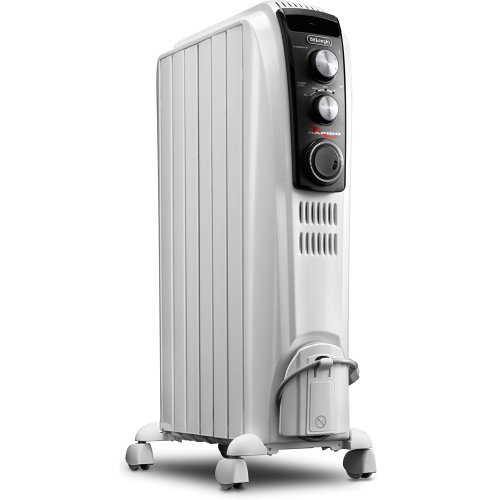
De'Longhi TRD40615TNo fan, so no noise and no moving dust — and the sealed oil keeps radiating after the element cuts out, which is why an oil-filled unit feels steadier than a ceramic one at the same wattage.
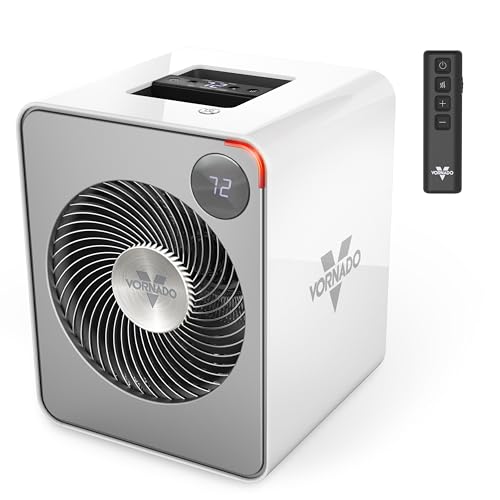
Vornado VMHi500The current top of Vornado's metal line: auto-climate control, two LED displays and a 1-12 hour timer in a cool-touch metal box, backed by five years.
Dreo Solaris 718The rare heater whose published coverage claim survives the arithmetic: 1,500 W is a genuine 300 sq ft at 10 W/sq ft, and Dreo publishes that number rather than implying more.
Pelonis PSHO07JR4AGBThe digital Pelonis: every one of its three wattages is published, the thermostat sets to the degree, and it is the only oil-filled radiator here with a child lock.
No fan, so no noise and no moving dust — and the sealed oil keeps radiating after the element cuts out, which is why an oil-filled unit feels steadier than a ceramic one at the same wattage.
Rated power
1,500 W
Covers (computed)
150 sq ft
Draw (computed)
12.5 A at 120 V
Cost per hour
27.5¢
Coverage at 10 W/sq ft, average insulation, 8 ft ceiling = 5,118 BTU/h. Cost at 18.34¢/kWh; an eight-hour night at full output is $2.20. Exceeds the 12 A continuous limit of a 15 A circuit — check what else shares the breaker.
What works
Genuinely silent: there is no fan to hear at 3 a.m.
The oil holds heat, so the room temperature swings less between thermostat cycles
Nothing blows air, so nothing stirs up dust in a bedroom
What does not
Slow. It takes 20–30 minutes to feel like it is doing anything
Heavy — the wheels are not a courtesy, they are a requirement
The surface gets genuinely hot; this is a radiator, not a cool-touch case
Published specification
Rated power
1,500 W at 120 V
Controls
Mechanical, with a programmable 24-hour timer
Fluid
Permanently sealed diathermic oil — never needs refilling
Maker's claim
Up to 75% more radiant surface area
Mobility
Front and rear handles, snap-on wheels
Heat type
Oil-filled
Maker’s coverage claim
None published — the coverage figure above is ours
Safety listing
No listing mark published in the listing text; verify the UL or ETL mark on the rating plate.
Who it is for
A bedroom, a nursery at a safe distance, or anywhere the fan noise of a ceramic heater is the actual problem you are trying to solve.
What it is not for
Fast heat, and not a room you only occupy for twenty minutes. It also should never be tucked beside a bed or curtain — hot surface, 3-foot rule.
The current top of Vornado's metal line: auto-climate control, two LED displays and a 1-12 hour timer in a cool-touch metal box, backed by five years.
Rated power
1,500 W
Covers (computed)
150 sq ft
Draw (computed)
12.5 A at 120 V
Cost per hour
27.5¢
Coverage at 10 W/sq ft, average insulation, 8 ft ceiling = 5,118 BTU/h. Cost at 18.34¢/kWh; an eight-hour night at full output is $2.20. Exceeds the 12 A continuous limit of a 15 A circuit — check what else shares the breaker.
What works
Auto-Climate Control adjusts output to hold a temperature rather than running flat out — the cycling behavior that genuinely lowers consumption
A 1–12 hour timer means it can stop on its own, which is the only reliable way an overnight heater saves money
Five years on a heater at this price is a costed commitment, not a marketing line
What does not
Vornado publishes no wattage and no coverage figure, so every sizing and cost number here is ours, computed from the retail-listed 1,500 W
No child lock is published — the same gap the rest of Vornado's range has, and it is disqualifying for a nursery
It is a fan heater in a metal box: moving air is the mechanism and you will hear it
Published specification
Rated power
1,500 W at 120 V (retail listings; Vornado publishes settings, not watts)
Heat settings
2, plus fan-only
Thermostat
Auto-Climate Control, digital
Timer
1–12 hours
Display
Two LED displays, for reading it from across the room
Housing
Cool-touch, powder-coated gloss metal cabinet with cord storage
Safety
Tip-over protection and a 2-stage auto shutoff
Warranty
5-year satisfaction guarantee
Heat type
Fan-forced
Maker’s coverage claim
None published — the coverage figure above is ours
Safety listing
Vornado publishes tip-over protection and a 2-stage auto shutoff but does not name a listing mark; check the rating plate.
Who it is for
A living room or bedroom where the heater is permanent and visible, and where a real thermostat, a timer and a cool metal shell are worth paying for over a plastic tower.
What it is not for
A nursery, because no child lock is published; and not silence, which means an oil-filled radiator instead.
The rare heater whose published coverage claim survives the arithmetic: 1,500 W is a genuine 300 sq ft at 10 W/sq ft, and Dreo publishes that number rather than implying more.
Rated power
1,500 W
Covers (computed)
150 sq ft
Draw (computed)
12.5 A at 120 V
Cost per hour
27.5¢
Coverage at 10 W/sq ft, average insulation, 8 ft ceiling = 5,118 BTU/h. Cost at 18.34¢/kWh; an eight-hour night at full output is $2.20. Exceeds the 12 A continuous limit of a 15 A circuit — check what else shares the breaker.
What works
A digital thermostat with numbers on it — you can set 68°F rather than guess at a dial
The published 300 sq ft claim matches the standard sizing rule instead of exceeding it
8 lb and 8 inches square: it moves room to room without a project
What does not
1,500 W is 1,500 W — nothing here heats faster than any other 1,500 W heater
Dreo does not publish a noise figure in decibels on the product page
Tall and narrow, which is a tipping profile: the tip-over cutoff matters more here
A living room, bedroom or den at or under 300 sq ft with average insulation and an 8-foot ceiling, where you want to set a temperature and stop thinking about it.
What it is not for
A garage, an uninsulated basement, or anything over about 300 sq ft. It is not under-powered — 1,500 W is the plug-in ceiling — the room is simply too big for one outlet.
4 · A radiator with a child lock and a real set-point
Pelonis PSHO07JR4AGB Oil-Filled Radiator
The digital Pelonis: every one of its three wattages is published, the thermostat sets to the degree, and it is the only oil-filled radiator here with a child lock.
Rated power
1,500 W / 600 W low
Covers (computed)
150 sq ft
Draw (computed)
12.5 A at 120 V
Cost per hour
27.5¢
Coverage at 10 W/sq ft, average insulation, 8 ft ceiling = 5,118 BTU/h. Cost at 18.34¢/kWh; an eight-hour night at full output is $2.20. Exceeds the 12 A continuous limit of a 15 A circuit — check what else shares the breaker.
What works
All three wattages are published — 600, 900 and 1,500 W — so the cost of every setting can be computed rather than guessed at, which is not true of most radiators at this price
A thermostat that sets to the degree from 41 to 95°F, on a type that usually ships with an unmarked dial
The only oil-filled radiator in our registry with a published child lock, which is what makes a silent heater usable in a room with a toddler
What does not
Pelonis publishes 255 sq ft of coverage; our 10 W/sq ft rule puts 1,500 W at 150 sq ft. The claim is roughly 1.7 times ours and the wattage is the ceiling either way
No UL or ETL mark is named, which is the one thing we would still want stated given everything else it publishes
The “ECO mode saves up to 40%” figure is a best case, not a guarantee — savings come from running fewer hours at full output, not from the mode being more efficient
Published specification
Rated power
600 W / 900 W / 1,500 W at 120 V (all three published)
Thermostat
41–95°F in 1°F increments
Modes
ECO, Sleep and Memory
Timer
24 hours
Controls
Touch panel plus remote
Construction
108 “Volcano” thermal vents
Maker's noise claim
“<5 dB” — fanless; see the note on the comparison page
Safety
Tip-over protection, overheat auto shut-off, child lock, V0 flame-retardant housing
Heat type
Oil-filled
Maker’s coverage claim
255 sq ft
Safety listing
Pelonis publishes a V0 flame-retardant housing, tip-over protection, overheat auto shut-off and a child lock, but does not name a UL or ETL mark. Check the rating plate.
Who it is for
A bedroom, nursery or study where silence is the requirement, someone else in the house should not be able to change the settings, and you want to set an actual temperature and a shut-off time.
What it is not for
Fast heat, or a room much over 150 sq ft on our arithmetic. It is a radiator: it warms slowly and steadily, and that is the design rather than a fault.
Chosen for a body that is not moving. Sitting still for hours is the coldest thing you can do in a room, so steady radiant warmth and a thermostat that holds a temperature beat fast output.
Noise weighted heavily, because this is the room with the television and the conversation in it. A fan you tolerate in a workshop is a fan you resent at 8 p.m.
Open-plan reality applied to the sizing, not the floor area of the room on the plan. A living room open to a hall, stairwell or kitchen is a larger thermal space than its own dimensions suggest.
Floor-level hazards taken seriously. This is the room with the rug, the toddler, the dog and the power strip, so published tip-over and child-lock hardware counts for more here than in an office.
And what we did not do: we have not tested these units, owned them, measured them or run them in a room. Everything above is compiled from published manufacturer specifications and live retail listings, with the electrical load, room coverage and running cost computed by us from the published wattage. The full method.
What we’d skip, and why
Every roundup on this site names something to skip. It costs us nothing to publish and it is the fastest way to tell whether a buying guide was written for you or for its commission.
A heater sized to the room's floor area when the room is open-plan
The 10 W per square foot rule assumes a room with four walls and a door. A living room open to a hallway, a stairwell or a kitchen is thermally continuous with all of them, and warm air leaves upward through a stairwell faster than anywhere else in the house. Measuring your 240 sq ft living room and buying 2,400 W of heater produces a disappointed review of a heater that was sized correctly for a room you do not have. If the space is open, size it to the whole connected volume or accept that you are heating the seating area rather than the room.
An oscillating tower on a deep-pile rug with a toddler in the house
We recommend oscillating towers often and they are fine in most rooms. A living room is where the three risk factors stack: a tall narrow shape with a high center of gravity, a soft surface that makes tipping easier and then insulates whatever tipped, and small people at exactly the right height to pull it over. The hazard is not that carpet ignites under a working heater — it does not — it is the sequence that starts with tipping. If this is your living room, take the published tip-over switch and child lock over the taller tower.
A note on where this page ends
If your living room is genuinely large and genuinely closed — a real 400 sq ft room with a door — then square footage is the binding constraint rather than stillness or noise, and the large-rooms roundup is the better page for you. If the problem is specifically that the room is cold because it is over a crawl space or has three exterior walls, the drafty-room multiplier matters more than any pick here. This page is for the common case: a normal living room, an evening at a time, a person sitting still in it.
Questions people actually ask
What size space heater do I need for a living room?+
At 10 W per square foot, a 250 sq ft living room wants about 2,500 W — more than a single outlet can supply. Most living rooms are therefore bigger than one plug-in heater can heat, so the realistic goal is warming the seating area while central heat runs cooler, not heating the whole room from an outlet.
Is an oil-filled radiator or a ceramic heater better for a living room?+
An oil-filled radiator, usually. It is silent, which matters in the room with the television, and the sealed oil keeps radiating after the element cuts out, so the temperature swings less. A ceramic fan heater warms the room faster but you hear it, and in a room where you are sitting still the steadier heat is the more comfortable one.
Will a space heater heat an open-plan living room?+
Not the whole space. An open-plan area is thermally continuous with every room it connects to, and a stairwell actively carries warm air away. The approach that works is heating the zone you sit in rather than the floor area on the plan, and turning the central thermostat down to pay for it.
Where should I put a space heater in a living room?+
On a hard floor, near the seating, with three feet of clearance in every direction and no rug, cable or furniture inside that. Keep it off a deep-pile rug if you can — carpet does not ignite under an upright working heater, but it makes tipping easier and then insulates whatever tipped.
How much does it cost to run a space heater in the living room every evening?+
About $1.10 for four hours at 1,500 W, at our published rate of 18.34 cents per kWh — roughly $33 a month for every evening of a winter. A published 900 W setting takes four hours to about 66 cents.
Three feet on every side, hard floor where possible — and the features that decide what happens if it tips.
Written by Scooter M., an enthusiast — not a tester and not a certified anything. Every figure on this page is either published by the manufacturer, taken from a live retail listing, or computed from the published wattage using the formulas we publish. Found an error? Tell us and we will correct it, visibly and with a date on it.