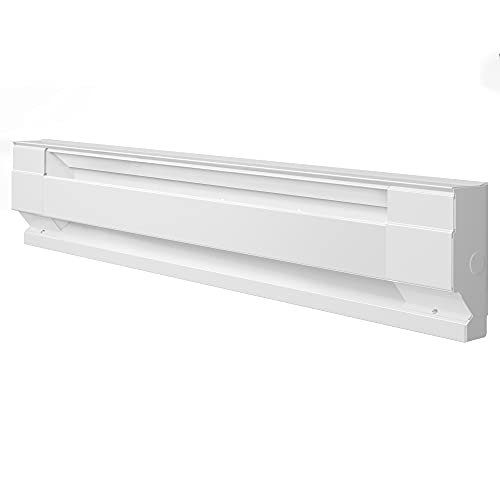
Long, silent, low-intensity heat along the floor — and a different safety standard from everything else on this site. Two of these plug in; three need an electrician.
By Scooter M. · Published November 21, 2026 · Last reviewed November 21, 2026
How this page is funded: we earn a commission if you buy through the links here, at no extra cost to you. Picks are chosen before links are attached, which is why every roundup names something to skip. Full disclosure.
If you do not want an electrician, the pick is the Cadet 4P1500W portable baseboard: 1,500 W on a standard 120 V outlet, a dial thermostat on the heater, a tip-over switch, and a published BTU figure that survives a calculator. If the heater is being wired in, the pick is the Stelpro Brava AB51252W — 1,250 W at 240 V, a lifetime element warranty, and the only published coverage claim in this entire registry that lands exactly where our own sizing arithmetic puts it (125 sq ft). The cheapest honest way into hardwired heat is the 750 W Cadet 3F750W.
First, the thing nobody tells you: baseboard is a different safety standard
Everywhere else on this site, when we talk about a safety listing on a space heater, the standard behind it is UL 1278, "Movable and Wall-or Ceiling-Hung Electric Room Heaters". Its own scope clause says it covers "movable and wall- or ceiling-hung electric room-heating equipment rated 600 volts or less" — and then, in the next clause, that it does not cover "fixed heaters, location-dedicated heaters, baseboard heaters, duct heaters".
Baseboard equipment has its own standard: UL 1042, "Electric Baseboard Heating Equipment", whose scope covers "portable and fixed electric baseboard heating equipment rated at 600 volts or less" and which classifies baseboard units as fixed or portable by their dimensions. So a baseboard heater is not an unlisted space heater — it is a listed product under a different number, and "is it UL 1278 listed?" is the wrong question to ask about one.
Plug-in or hardwired: this is the decision, and it is not close
Plug-in portable
Hardwired
Voltage
120 V
240 V (or 208 V in some buildings), occasionally 120 V
Who installs it
You, out of the box
A licensed electrician
Current at 1,500 W
12.50 A
6.25 A at 240 V
Circuit needed at 1,500 W
20 A — 15.6 A minimum ampacity
15 A two-pole — 7.8 A minimum ampacity
Thermostat
On the heater, included
Usually a separate purchase: wall or built-in kit
Tip-over switch
Yes — it can fall over
No, and it does not need one
Can you take it with you
Yes
No
Typical wattage ceiling
1,500 W, because a 120 V circuit stops there
Several units on one circuit
The two halves of the category. Current is watts ÷ volts; minimum circuit ampacity is that figure grossed up 25% under the continuous-load rule (NFPA 70, 210.19(A)(1) and 210.20(A)); the breaker is the smallest standard rating at or above it.
Read the current column twice. The same 1,500 watts of heat draws half the current at 240 V that it draws at 120 V, which is the entire engineering reason hardwired baseboard exists and the reason a plug-in baseboard is limited to one room's worth of heat. It is also why the hardwired units here are *less* powerful on paper and still the better answer for a room you intend to keep heating for years: 1,250 W on a 15 A two-pole circuit has headroom, and 1,500 W on a 15 A 120 V circuit does not.
The sizing and cost arithmetic, for every wattage in this category
Rated power
Current
Min. circuit
Breaker
Output
Covers
Per hour
Month at 8 h/day
563 W at 208 V
2.71 A
3.4 A
15 A
1,921 BTU/h
56 sq ft
10.3¢
$24.78
750 W at 240 V
3.13 A
3.9 A
15 A
2,559 BTU/h
75 sq ft
13.8¢
$33.01
938 W at 208 V
4.51 A
5.6 A
15 A
3,201 BTU/h
94 sq ft
17.2¢
$41.29
1,000 W at 120 V
8.33 A
10.4 A
15 A
3,412 BTU/h
100 sq ft
18.3¢
$44.02
1,250 W at 240 V
5.21 A
6.5 A
15 A
4,265 BTU/h
125 sq ft
22.9¢
$55.02
1,500 W at 120 V
12.50 A
15.6 A
20 A
5,118 BTU/h
150 sq ft
27.5¢
$66.02
1,500 W at 240 V
6.25 A
7.8 A
15 A
5,118 BTU/h
150 sq ft
27.5¢
$66.02
Coverage is watts ÷ 10 at this site's baseline rule: average insulation, 8-foot ceiling. Cost is computed at 18.34¢/kWh — the U.S. residential average for June 2026 (EIA, Electric Power Monthly, Table 5.6.A). BTU/h is watts x 3.412142.
Note that the two 1,500 W rows cost exactly the same to run. Voltage changes the current, not the energy: 1.5 kW for an hour is 1.5 kWh whether it arrives at 120 or 240 volts, and anyone telling you 240 V baseboard is cheaper to run is confusing amps with kilowatt-hours. What 240 V genuinely buys is circuit headroom, thinner wire for the same heat, and the ability to put two heaters on one breaker.
The other number worth staring at is the monthly one. Holding one 150 sq ft room with 1,500 W of baseboard for eight hours a day is about $66 a month at the national average rate — which is why baseboard's reputation as expensive heat is half-deserved. It is not the heater, it is the hours: baseboard is designed to run continuously at low output, and continuous is where electric resistance heat gets costly. How space heaters compare with central heat does the whole-house version of that sum, and the baseboard comparison is the page for anyone deciding between baseboard and a portable heater on cost alone.
The picks
Quick picks
Ranked for fit, not for hype. Coverage and current draw are computed from each unit’s published wattage. Tap a row for the full write-up, or go straight to the listing.
#
Product
Best for
Covers
Draw
Price
1
Cadet 4P1500WThe only way to buy the baseboard form factor without wiring anything: 1,500 W on a standard 120 V outlet, a dial thermostat on the heater itself, and a tip-over switch that a hardwired baseboard does not have because it cannot fall over.
Stelpro Brava 1250 WThe only product in this registry whose published coverage claim lands exactly where our own sizing rule puts it: 1,250 W, 125 sq ft, 10 watts per square foot. Everything else about it — the element, the warranty, the one-piece cabinet — is what a hardwired baseboard should be.
Cadet 3F750WThree feet of baseboard, 750 watts, and two published BTU figures that both survive a calculator. It is the small-room answer in this category and the least amount of money anyone can spend on a fixed heater.
Comfort Zone CZ600A 30-inch metal baseboard heater for the price of a cheap ceramic one, with a published 750 W low step and a manual that contradicts its own retail listing about how hot the body gets. We believe the manual.
Cadet 4F1000-1WThe compromise unit: hardwired baseboard heat on the 120 V circuit most houses already have, at the price of twice the current and a coverage claim we cannot support.
The only way to buy the baseboard form factor without wiring anything: 1,500 W on a standard 120 V outlet, a dial thermostat on the heater itself, and a tip-over switch that a hardwired baseboard does not have because it cannot fall over.
Rated power
1,500 W
Covers (computed)
150 sq ft
Draw (computed)
12.5 A at 120 V
Cost per hour
27.5¢
Coverage at 10 W/sq ft, average insulation, 8 ft ceiling = 5,118 BTU/h. Cost at 18.34¢/kWh; an eight-hour night at full output is $2.20. Exceeds the 12 A continuous limit of a 15 A circuit — check what else shares the breaker.
What works
No electrician and no permit — this is the only baseboard heater here you can own by taking it out of a box
A tip-over switch, which no hardwired baseboard carries and which matters because this one can be knocked over
The BTU figure on the listing is arithmetically correct, which is rarer in this category than it should be
Steel-sheathed element with aluminum fins and a 2-year warranty, in a form factor that is mostly sold with no warranty statement at all
What does not
12.5 A on 120 V is the whole problem with a 1,500 W plug-in baseboard. The continuous-load rule puts it on a 20 A circuit, and on the 15 A circuit it will probably be plugged into it exceeds the 12 A continuous allowance
It costs several times what a 1,500 W ceramic heater costs and makes exactly the same 5,118 BTU/h, because every electric resistance heater converts essentially all of its input to heat. You are buying the shape, the silence and the thermostat, not more heat
49 inches long: it wants a clear run of wall, which is the opposite of what a portable heater usually promises
The listing publishes no coverage figure, no low setting and no listing mark, so our sizing number is the only one either of us can check
Published specification
Rated power
1,500 W at 120 V
Published output
5,120 BTU/h (the maker's figure; 1,500 W x 3.412142 = 5,118, so it checks out)
Current draw
12.5 A at 120 V
Circuit it needs
15.6 A minimum circuit ampacity under the continuous-load rule, which is a 20 A branch circuit — not the 15 A circuit most bedrooms are on
Install
Plug-in. 6-foot grounded cord, no hardwiring, no wall cutting
Controls
Built-in dial thermostat with an off position. No timer, no remote, no set-point numbers
Safety
Tip-over switch and a high-temperature safety shutoff, both named in the listing
Length
49 in, 10.1 lb, with built-in handles
Warranty
2 years (listing)
Made in
USA (listing)
Maker's coverage claim
None published. Our figure is 150 sq ft at 10 W per square foot, or about 120 sq ft in a drafty room
Heat type
Electric baseboard
Maker’s coverage claim
None published — the coverage figure above is ours
Safety listing
No listing mark is published in the Amazon listing text, and Cadet's own product pages returned no readable specification to us. One distributor's spec field reads "cUL/UL Listed", which is a retailer's claim rather than the maker's. Check the rating plate.
Who it is for
A renter or anyone who wants baseboard heat's silence and even warmth in a bedroom or study without wiring work — and who has, or can free up, a 20 A outlet.
What it is not for
A 15 A circuit shared with anything else, a bathroom, or a household where a 49-inch heater at floor level is in a toddler's path. Also not the cheap way to heat one room; a ceramic heater is a tenth of the price for the same watts.
The only product in this registry whose published coverage claim lands exactly where our own sizing rule puts it: 1,250 W, 125 sq ft, 10 watts per square foot. Everything else about it — the element, the warranty, the one-piece cabinet — is what a hardwired baseboard should be.
Rated power
1,250 W
Covers (computed)
125 sq ft
Draw (computed)
5.2 A at 240 V
Cost per hour
22.9¢
Coverage at 10 W/sq ft, average insulation, 8 ft ceiling = 4,265 BTU/h. Cost at 18.34¢/kWh; an eight-hour night at full output is $1.83. Hardwired 240 V: this is an electrician's installation, not a plug-in appliance.
What works
The coverage claim is honest to the watt — 1,250 W for 125 sq ft is the arithmetic, not a marketing number, and no other maker here does that
A lifetime element warranty for the original owner, published by the maker as well as the retailer
A one-piece cabinet, which the maker says is what stops the ticking and popping two-piece baseboards make as they heat and cool. That is the complaint people actually have about baseboard heat
Universal wiring at both ends, pre-punched holes and cable clamps included, so the electrician's visit is short
5.21 A at 240 V fits a 15 A two-pole circuit with room to spare
What does not
It is hardwired and it needs an electrician. There is no plug, no cord and no legal way to add one
The thermostat is a separate purchase, which is easy to miss when comparing its price against a plug-in heater that includes one
No UL or ETL mark is published on the listing or on Stelpro's own page — unusual for a product that will be wired into a wall
60 inches is five feet of wall, and baseboard wants furniture kept off it
1,250 W is less heat than a 1,500 W plug-in heater, which surprises people who assume hardwired means more powerful
Published specification
Rated power
1,250 W at 240 V; 938 W at 208 V (both published)
Computed output
4,265 BTU/h at 240 V (1,250 W x 3.412142)
Current draw
5.21 A at 240 V; 4.51 A at 208 V
Circuit it needs
6.5 A minimum circuit ampacity, so a 15 A two-pole 240 V breaker. Hardwired — there is no plug
Maker's coverage claim
125 sq ft — which is exactly 10 W per square foot, the rule this site sizes by
Thermostat
NOT included. A wall thermostat or the SIBT1W / SIBT2W / SIBTE12F built-in kit is a separate purchase
Construction
One-piece steel cabinet with a single tubular stainless-steel sheathed element and aluminum fins; 22-gauge casing the maker rates to support 165 lb at its center
Safety
Full-length thermal protection with automatic reset; overheat cut-out if airflow is blocked
Length
60 in, 10 lb
Warranty
Five years, three years on electronic components, lifetime on the heating element for the original owner (published on Stelpro's own page and on the listing)
Made in
North America (maker)
Heat type
Electric baseboard
Maker’s coverage claim
125 sq ft
Safety listing
No listing mark is published in the Amazon listing or on Stelpro's own AB-series page. The maker does publish full-length thermal protection with automatic reset. Check the rating plate.
Who it is for
A bedroom, condo, home office or finished basement where the heat should be silent, permanent and out of the way, and where an electrician is already coming or the circuit already exists.
What it is not for
A renter, a room with no 240 V circuit, or anyone who wants heat this week. Also not a large or badly insulated room: 125 sq ft is the claim and we agree with it.
Cadet F Series 3F750W 36-inch Electric Baseboard Heater
Three feet of baseboard, 750 watts, and two published BTU figures that both survive a calculator. It is the small-room answer in this category and the least amount of money anyone can spend on a fixed heater.
Rated power
750 W
Covers (computed)
75 sq ft
Draw (computed)
3.1 A at 240 V
Cost per hour
13.8¢
Coverage at 10 W/sq ft, average insulation, 8 ft ceiling = 2,559 BTU/h. Cost at 18.34¢/kWh; an eight-hour night at full output is $1.10. Hardwired 240 V: this is an electrician's installation, not a plug-in appliance.
What works
Both published BTU figures are arithmetically correct, including the 208 V derating most listings do not bother to state at all
750 W is the right size for a small room, and it is the only sub-1,000 W fixed heater here — a 1,500 W unit in a 75 sq ft bedroom will short-cycle and overshoot
A limited lifetime warranty on a heater that costs less than a tank of fuel
3.13 A leaves a 15 A two-pole circuit almost empty, so it can share one with a second length of baseboard in most cases
What does not
No thermostat. On its own this heater has no control of any kind — it is an element in a case, and the thermostat decides whether it is pleasant or not
No published coverage figure and no published listing mark, so the only sizing number on this page is ours
750 W will not warm a cold room quickly. It is a hold-the-temperature heater, which is what baseboard is for and not what most buyers expect
36 inches of wall has to stay clear of furniture, curtains and rugs
Published specification
Rated power
750 W at 240 V; 563 W at 208 V (both published)
Published output
2,560 / 1,925 BTU/h (the maker's figures; 750 W x 3.412142 = 2,559 and 563 W x 3.412142 = 1,921, so both check out)
Current draw
3.13 A at 240 V; 2.71 A at 208 V
Circuit it needs
3.9 A minimum circuit ampacity, so a 15 A two-pole 240 V breaker. Hardwired
Thermostat
NOT included. Cadet's BTF2W built-in thermostat or a wall thermostat is a separate purchase
Install
Universal wiring with pre-punched knockouts, feed from either end
Length
36.3 in, 5 lb
Warranty
Limited lifetime (listing)
Maker's coverage claim
None published. Our figure is 75 sq ft at 10 W per square foot, or about 60 sq ft in a drafty room
Heat type
Electric baseboard
Maker’s coverage claim
None published — the coverage figure above is ours
Safety listing
No listing mark is published in the Amazon listing text, and Cadet's own product pages returned no readable specification to us. Check the rating plate.
Who it is for
A small bedroom, bathroom, landing or home office of roughly 75 sq ft on a 240 V circuit, paired with a decent wall thermostat.
What it is not for
A living room, a basement or any space over about 100 sq ft, and not a buyer who expects the heater to arrive with controls.
A 30-inch metal baseboard heater for the price of a cheap ceramic one, with a published 750 W low step and a manual that contradicts its own retail listing about how hot the body gets. We believe the manual.
Rated power
1,500 W / 750 W low
Covers (computed)
150 sq ft
Draw (computed)
12.5 A at 120 V
Cost per hour
27.5¢
Coverage at 10 W/sq ft, average insulation, 8 ft ceiling = 5,118 BTU/h. Cost at 18.34¢/kWh; an eight-hour night at full output is $2.20. Exceeds the 12 A continuous limit of a 15 A circuit — check what else shares the breaker.
What works
A published 750 W low step, which is the setting this heater should live on — 13.8 cents an hour against 27.5
Both safety devices are described in the manual, including how to reset each one, which is more than most listings at this price manage
The manual publishes its own current draw and frequency (12.5 A, 120 V, 60 Hz) and warns against sharing the circuit — the honest version of a specification most makers leave out
Metal body and a 30-inch footprint: the smallest baseboard-shaped heater here
What does not
The listing and the manual disagree about the body temperature. The retail bullet claims a "stay-cool body"; the manual says "Do not touch body of heater when in use... to avoid burns, do not let bare skin touch hot surfaces." Both cannot be true, and the manual is the document that ships with the heater
The manual rules out the rooms people buy baseboard heaters for most: "not intended for use in a bathroom, laundry area, or similar locations"
12.5 A on high is a 20 A circuit, and the manual's own instruction not to share the circuit makes that explicit
No extension cords, no leaving it unattended, and no listing mark published anywhere — three constraints that come straight from its own documentation
Twelve months of warranty, against five years and a lifetime element on the hardwired units here
Published specification
Rated power
High 1,500 W / Low 750 W, both published in the owner's manual
Published output
5,120 BTU/h on high (manual; 1,500 W x 3.412142 = 5,118)
Current draw
12.5 A at 120 V, 60 Hz — the manual's own figure
Circuit it needs
15.6 A minimum circuit ampacity on high, so a 20 A branch circuit. The manual says not to plug it into a circuit servicing other electrical needs
Controls
Power dial (off / low / high), adjustable thermostat knob, power indicator light
Safety
Automatic overheat cut-out, reset by unplugging for 10 minutes; tip-over switch that resets when the heater is stood upright
Body
"Sturdy metal body" (manual). The manual also says the body is hot in use
Size
30.4 in long, 4.8 lb
Warranty
Twelve months against defects in material and workmanship (manual)
Maker's coverage claim
None in the manual. Our figure is 150 sq ft on high at 10 W per square foot
Heat type
Electric baseboard
Maker’s coverage claim
None published — the coverage figure above is ours
Safety listing
No UL or ETL mark appears anywhere in the owner's manual or the listing. The manual does describe an automatic overheat protection device and a tip-over switch. Check the rating plate.
Who it is for
A dry bedroom, study or hobby room where you want to see whether you like long, silent, low-intensity heat before paying an electrician for the real thing.
What it is not for
A bathroom or laundry room — its own manual says so. Not a nursery either: the manual's burn warning settles that.
Cadet 4F1000-1W Convection Baseboard Heater, 1000 W 120 V
The compromise unit: hardwired baseboard heat on the 120 V circuit most houses already have, at the price of twice the current and a coverage claim we cannot support.
Rated power
1,000 W
Covers (computed)
100 sq ft
Draw (computed)
8.3 A at 120 V
Cost per hour
18.3¢
Coverage at 10 W/sq ft, average insulation, 8 ft ceiling = 3,412 BTU/h. Cost at 18.34¢/kWh; an eight-hour night at full output is $1.47. Fits a 15 A circuit as a continuous load.
What works
It runs on 120 V, which is the only reason to choose it — no new two-pole circuit, no panel work beyond a dedicated run
1,000 W is a sensible size for a 100 sq ft room, and the fanless convection is silent
Four feet of element spreads the same heat over more surface than a compact heater, which is why baseboard feels gentler
What does not
The 175 sq ft claim is 5.7 watts per square foot and we do not believe it. Our figure for 1,000 W is about 100 sq ft with average insulation and an 8-foot ceiling, and roughly 80 in a drafty room
8.33 A at 120 V is twice the current the same heat costs at 240 V, and it is 10.4 A of minimum circuit ampacity on a 15 A circuit — which is most of it
No published warranty, no published listing mark and no published thermostat, so three of the things that normally separate a fixed heater from a cheap one are simply unstated
Hardwired, so it still needs an electrician even though it does not need a new voltage
Published specification
Rated power
1,000 W at 120 V
Computed output
3,412 BTU/h (1,000 W x 3.412142)
Current draw
8.33 A at 120 V — roughly double what the same wattage draws at 240 V
Circuit it needs
10.4 A minimum circuit ampacity, so a 15 A breaker, and it is most of that circuit
Maker's coverage claim
175 sq ft, which works out at 5.7 W per square foot. At the 10 W per square foot this site sizes by, 1,000 W covers about 100 sq ft
Thermostat
Not stated in the listing. Assume a separate wall thermostat
Install
Hardwired, wall-mounted; no fan
Length
48 in (4 ft)
Warranty
Not published in the listing
Heat type
Electric baseboard
Maker’s coverage claim
175 sq ft
Safety listing
No listing mark is published in the Amazon listing text, and Cadet's own product pages returned no readable specification to us. Check the rating plate.
Who it is for
A roughly 100 sq ft room in a house with no 240 V capacity to spare, where silent permanent heat is worth a dedicated 120 V circuit.
What it is not for
A 175 sq ft room, whatever the listing says. Also not a shared circuit — at 8.33 A continuous it has to be the only thing on the run.
Split by install first, ranked second. Whether a heater plugs in or has to be wired changes who can buy it more than any specification does, so the plug-in units and the hardwired units are judged separately and both are on the page.
A published rated wattage at a stated voltage. A 240 V baseboard's output depends on whether the circuit is 208 V or 240 V, and a maker that publishes only one figure has published half a specification.
Coverage claims checked against 10 watts per square foot. Two makers here land exactly on it, one claims 5.7 W/sq ft, and saying which is which is the most useful thing this page does.
Current, minimum circuit ampacity and breaker size computed for every unit, because a 1,500 W baseboard on 120 V needs a 20 A circuit and the listings do not say so.
The safety standard stated, not assumed. Baseboard equipment is covered by UL 1042, not the UL 1278 that covers the portable heaters elsewhere on this site, and we say which units publish a mark at all.
No testing claims. We have not installed any of these. Every figure below is the maker's published number or arithmetic you can repeat.
And what we did not do: we have not tested these units, owned them, measured them or run them in a room. Everything above is compiled from published manufacturer specifications and live retail listings, with the electrical load, room coverage and running cost computed by us from the published wattage. The full method.
What we’d skip, and why
Every roundup on this site names something to skip. It costs us nothing to publish and it is the fastest way to tell whether a buying guide was written for you or for its commission.
A 1,500 W plug-in baseboard on a shared 15 A circuit
This is the single most common way to buy a plug-in baseboard heater wrongly. 1,500 W at 120 V draws 12.5 A, and the continuous-load rule puts it on a circuit rated for 15.6 A — a 20 A breaker. On the 15 A circuit most bedrooms are wired with, the continuous allowance is 12 A and the heater is already over it before you plug in a lamp. The Comfort Zone's own manual says it plainly: "do not plug the heater into a circuit that is servicing other electrical needs." If you cannot give it a circuit of its own, buy the 750 W or 1,000 W unit instead, or run it on low.
Any baseboard sold on a coverage claim under about 8 watts per square foot
The 1,000 W Cadet on this page claims 175 sq ft, which works out at 5.7 W per square foot; the 3,000 W in-wall unit from the same maker claims 500 sq ft, which is 6 W. At the 10 W per square foot this site sizes by, those rooms need 1,750 W and 5,000 W. A low watts-per-square-foot claim is not a more efficient heater — there is no such thing — it is a bigger room being promised to a smaller element, and the buyer finds out in January.
Hydronic baseboard, this season, because you mostly cannot buy it
Liquid-filled baseboard — Cadet's SoftHeat line, Fahrenheat's FHP1500T — is the premium version of this form factor, and genuinely better in one respect: the mineral oil holds heat after the thermostat cuts out and the surface runs cooler, which Cadet's own spec sheet sells as "lowest surface temperatures available, perfect for homes with kids and pets". We would recommend it. When we checked in November 2026 the portable hydronic units had no live offer, so there is nothing to link to and we will not send you to a dead listing. Worth re-checking if cool surfaces are the reason you are reading this.
What baseboard heat does well, honestly
Silence. There is no fan, nothing to seize and nothing to whine. If the complaint about your current heater is noise, baseboard and mica panels are the two form factors that solve it outright, and baseboard is the one you can leave permanently installed.
Even, low-intensity warmth. The same watts spread along three to five feet of finned element run at a much lower surface temperature than a compact heater, so there is no hot jet of air and no scorched-dust smell when it starts up. That is also why it feels slow: it is warming the room rather than aiming at you.
Nothing on the floor and nothing to trip over. A hardwired baseboard has no cord, which removes the single most common fire-risk failure on this whole site — a heater plugged into an extension cord or power strip. It is the one category where that hazard simply does not exist.
And what it will not fix
It will not heat a cold room quickly. Baseboard is a hold-the-temperature heater; the finned element and the low surface temperature are both working against fast recovery. If you want a room warm in ten minutes, a fan heater is the honest answer and the ceramic roundup is the page.
It will not let you put the sofa back. Baseboard needs clear air in front of it to convect at all — Cadet's own technical sheet asks for at least 12 inches in front and clearance from anything hanging above, like drapes. A baseboard heater behind a bookcase is a fire risk and a heater that does not work.
It will not come with a thermostat, if it is hardwired. All three hardwired units here are sold as elements; the control is a separate purchase, and it is the component that decides whether the room is comfortable or oscillating between too warm and too cold. Budget for an electronic wall thermostat, not the cheapest mechanical one.
It will not be cheaper to run than any other electric heater. Watts are watts. What lowers a bill is a thermostat that holds the room closer to the set-point and fewer hours of operation — the same two levers as everywhere else on this site, laid out in full on the energy-efficient roundup.
Questions people actually ask
Are electric baseboard heaters expensive to run?+
They cost exactly what any other electric heater of the same wattage costs: a 1,500 W baseboard is 27.5 cents an hour and about $66 a month at eight hours a day, computed at 18.34¢/kWh. The reputation comes from how they are used, not what they are — baseboard is designed to run continuously at low output, and continuous running is what makes electric resistance heat expensive. A 750 W unit holding a small room is 13.8 cents an hour.
Does an electric baseboard heater need its own circuit?+
A hardwired one does: it is a dedicated 240 V two-pole branch circuit, and a 1,250 W unit needs a circuit rated for 6.5 A, which means the smallest breaker made. A 1,500 W plug-in baseboard on 120 V draws 12.5 A and needs a 20 A circuit under the continuous-load rule — more than the 12 A continuous allowance on the 15 A circuit most rooms are wired with. Comfort Zone's own manual tells you not to share the circuit, and that is the right instruction.
Can I put furniture in front of a baseboard heater?+
No. Baseboard works by convection, which needs air to enter at the bottom and leave at the top, and blocking it both stops the heat and creates a fire risk. Cadet's technical guidance asks for at least 12 inches of clearance in front and clearance from anything hanging above it, such as curtains. The U.S. Fire Administration's three-foot rule for combustibles applies to the front face as well.
Is 120 V or 240 V baseboard better?+
240 V, if you have the choice. The same heat draws half the current, which means a smaller breaker, thinner wire and the option of putting two heaters on one circuit — a 1,500 W unit is 6.25 A at 240 V against 12.5 A at 120 V. It costs the same per hour to run either way, because kilowatt-hours do not care about voltage. Choose 120 V only when a 240 V circuit is not available and you do not want to pay for one.
Can you buy a baseboard heater that just plugs in?+
Yes, and two of the five on this page do. A portable baseboard is a 120 V unit with a grounded cord, a thermostat dial on the heater and a tip-over switch — the trade-offs are the 12.5 A current draw, a 20 A circuit requirement at 1,500 W, and a much higher price per watt than a plug-in ceramic heater. The thing you are buying is the shape and the silence, not more heat.
How many feet of baseboard heater do I need?+
Size by watts first, then by length. At about 10 watts per square foot with average insulation and an 8-foot ceiling, a 100 sq ft bedroom wants about 1,000 W and a 150 sq ft room about 1,500 W; in a drafty room add roughly 20%. Most baseboard runs produce 250 W per foot, so 1,000 W is about four feet. Our room calculator does it with your own dimensions and insulation.
Are electric baseboard heaters safe to leave on?+
They are the form factor with no cord to overheat and nothing to knock over, which removes two of the most common failure modes. The remaining risks are a blocked element and combustibles too close — curtains above it, furniture in front, anything stored on it. Every unit here publishes an overheat cut-out, and the hardwired ones publish full-length thermal protection, but a cut-out is a backstop and clearance is the actual protection.
Do baseboard heaters use UL 1278 like other space heaters?+
No, and this catches people out. UL 1278 covers movable and wall- or ceiling-hung room heaters, and its scope clause explicitly excludes baseboard heaters. Electric baseboard equipment is covered by UL 1042, which covers both portable and fixed baseboard units and sorts them by dimension. Either way, the mark that matters is the one printed on the heater's own rating plate.
Silent by design, not by adjective — the fanless types, plus the one unit that publishes a dB figure.
Written by Scooter M., an enthusiast — not a tester and not a certified anything. Every figure on this page is either published by the manufacturer, taken from a live retail listing, or computed from the published wattage using the formulas we publish. Found an error? Tell us and we will correct it, visibly and with a date on it.