Two published numbers make this the easiest unit on the site to check — and one of them tells you it does not fit a 15 amp circuit.
By Scooter M. · Published August 31, 2026 · Last reviewed August 31, 2026
How this page is funded: we earn a commission if you buy through the links here, at no extra cost to you. Picks are chosen before links are attached, which is why every roundup names something to skip. Full disclosure.
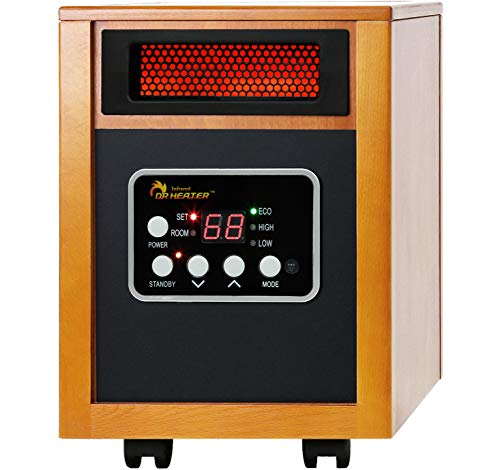
The Dr Infrared Heater DR-968 is a 1,500 W dual-element unit — infrared quartz plus PTC — in a cabinet with caster wheels. It publishes a 12.5 A current draw, a 39 dB noise level, a 50–85°F electronic thermostat and a 12-hour auto-off timer.
Two numbers almost nobody publishes
Most heater listings publish a wattage, a room-size claim and a list of adjectives. This one publishes 12.5 A and 39 dB, and both are load-bearing.
The amp figure is the one that decides whether you can plug it in where you want to. 12.5 A matches exactly what 1,500 W ÷ 120 V predicts, which is itself worth something — it means the listing's numbers are internally consistent rather than aspirational.
The decibel figure is the one that decides whether it can live in a bedroom. For scale, a quiet library is around 40 dB. A published 39 dB is at the threshold where a heater becomes background rather than an event, and it is the only reason a fan-forced unit appears in our quiet roundup at all.
The specification and computed figures
Top pick · The published numbers
Dr Infrared Heater DR-968 Portable Space Heater
The one listing in this category that publishes its amp draw and its noise level, which is exactly the arithmetic everyone else leaves you to do — 12.5 A and 39 dB, both stated.
Rated power
1,500 W
Covers (computed)
150 sq ft
Draw (computed)
12.5 A at 120 V
Cost per hour
27.5¢
Coverage at 10 W/sq ft, average insulation, 8 ft ceiling = 5,118 BTU/h. Cost at 18.34¢/kWh; an eight-hour night at full output is $2.20. Exceeds the 12 A continuous limit of a 15 A circuit — check what else shares the breaker.
What works
Publishes 12.5 A, which is the number that decides whether it fits your circuit
Publishes 39 dB, which is the number that decides whether it fits your bedroom
A wooden-cabinet infrared unit runs cooler on the outside than a bare panel
What does not
19 lb with wheels: this is furniture, not a portable you carry between rooms
12.5 A against a 15 A circuit's 12 A continuous limit — it does not legally fit, see the circuit-load guide
Dated cabinet styling that will not disappear into a modern room
Published specification
Rated power
1,500 W at 120 V
Current draw
12.5 A (published)
Noise
39 dB (published)
Element
Infrared quartz tube plus PTC
Thermostat
Electronic, 50–85°F
Other
12-hour auto-off timer, IR remote, caster wheels, 19 lb
Heat type
Infrared quartz
Maker’s coverage claim
None published — the coverage figure above is ours
Safety listing
No listing mark published in the listing text; check the cabinet's rating plate for the UL or ETL mark.
Who it is for
A reader who wants to compute the load rather than trust a claim: the published amp draw and decibel figure make it the easiest unit on this site to check.
What it is not for
A 15 A circuit shared with anything else, and not a small room where a 19 lb cabinet on wheels is in the way.
The circuit problem, which its own spec sheet reveals
Here is the awkward consequence of publishing an honest amp figure: 12.5 A exceeds the 12 A continuous allowance of a 15 A branch circuit. Electrical code sizes a circuit at 125% of a continuous load, which caps continuous draw at 80% of the breaker rating.
Heater
Draw at 120 V
15 A circuit (12 A limit)
20 A circuit (16 A limit)
1,500 W
12.5 A
Over the limit
Fits
Maximum continuous
—
12 A = 1,440 W
16 A = 1,920 W
Draw computed as watts / 120 V. The continuous limit is 80% of the breaker rating, which follows from the NEC's requirement to size a circuit at 125% of a continuous load (NFPA 70, 210.19(A)(1) and 210.20(A)).
This is not a criticism of this heater — every 1,500 W heater on this site draws the same 12.5 A. It is a criticism of the rest of the category for not printing it. Buy this unit and you know to check the circuit; buy one that publishes only a wattage and you probably will not. The full arithmetic.
Running cost
Wattage
Per hour
1 h
4 h
8 h
1,500 W
27.5¢
$0.28
$1.10
$2.20
Computed at 18.34¢/kWh — the U.S. residential average for June 2026 (EIA, Electric Power Monthly, Table 5.6.A, released August 26, 2026). Your rate is on your own bill; substitute it and the arithmetic still holds. Figures assume full output for the whole period.
The dual element
It combines an infrared quartz tube with a PTC ceramic element and a blower. In mechanism terms that makes it a hybrid: radiant heat directly onto whoever is in front of it, plus convected warm air for the rest of the room. It is a genuine answer to radiant heating's shadowing problem — the person outside the cone is not left cold.
What it is not for
Small rooms, in the practical sense: 19 lb on caster wheels is furniture, and it will not tuck under a desk or beside a nightstand. A shared 15 A circuit, per the arithmetic above. And a modern interior, if that matters to you — the wooden cabinet styling is distinctive and it does not disappear into a room.
Questions people actually ask
How many amps does the Dr Infrared DR-968 draw?+
12.5 amps, published by the manufacturer and matching the computed figure of 1,500 W ÷ 120 V. That exceeds the 12 A continuous limit of a 15 A branch circuit, so it should not share a circuit with other significant loads.
How loud is the Dr Infrared DR-968?+
39 dB, published. For scale, a quiet library is around 40 dB. It is one of the very few heater listings in the category that states a decibel figure at all.
Is the Dr Infrared DR-968 good for a bedroom?+
At a published 39 dB it is quiet enough for many people, and it has a 12-hour timer. It is also 19 lb on wheels, which is a lot of object for a small bedroom, and its 12.5 A draw needs a circuit with headroom.
What is dual heating on the DR-968?+
It combines an infrared quartz tube with a PTC ceramic element and a blower — radiant heat onto whoever is in front of it plus convected warm air for the rest of the room.
Ceramic heats the air, infrared heats you. Same cost, different rooms — the verdict per use case.
Written by Scooter M., an enthusiast — not a tester and not a certified anything. Every figure on this page is either published by the manufacturer, taken from a live retail listing, or computed from the published wattage using the formulas we publish. Found an error? Tell us and we will correct it, visibly and with a date on it.