Six causes, ordered by how often they are the answer. Only one of them means the heater is broken.
By Scooter M. · Published September 13, 2026 · Last reviewed September 13, 2026
How this page is funded: we earn a commission if you buy through the links here, at no extra cost to you. Picks are chosen before links are attached, which is why every roundup names something to skip. Full disclosure.
A space heater trips a breaker because the circuit is carrying more current than the breaker allows — usually the heater's 12.5 A plus whatever else is plugged into the same circuit. Move the heater to a circuit of its own, or run it at a lower wattage. A genuinely faulty heater is the rarest cause.
Start with the arithmetic, because it explains five of the six
A 1,500 W heater draws 12.5 amps at 120 V. A 15 A breaker allows 12 A of continuous load — that is the 80% figure that comes out of the NEC's 125% sizing rule for loads running three hours or more. So a full-output space heater is already slightly over the continuous allowance of a standard household circuit before anything else is plugged in.
Heater
Draw at 120 V
15 A circuit (12 A limit)
20 A circuit (16 A limit)
750 W
6.3 A
Fits
Fits
900 W
7.5 A
Fits
Fits
1,200 W
10.0 A
Fits
Fits
1,500 W
12.5 A
Over the limit
Fits
Maximum continuous
—
12 A = 1,440 W
16 A = 1,920 W
Draw computed as watts / 120 V. The continuous limit is 80% of the breaker rating, which follows from the NEC's requirement to size a circuit at 125% of a continuous load (NFPA 70, 210.19(A)(1) and 210.20(A)).
This is not a defect in your heater and it is not unique to the brand you bought. It is the arithmetic of every 1,500 W plug-in heater sold in the United States, and it is worked through completely on a 1,500 watt heater on a 15 amp circuit. What that page explains is *why the ceiling exists*. This page is about what to do when you have hit it.
The six causes, in order of how often they are the answer
1. Something else is on the same circuit
This is the answer most of the time. A breaker protects a circuit, not a room, and a single 15 A circuit in an older house routinely serves a bedroom, a hallway and part of another room. Your heater at 12.5 A plus a 700 W microwave at 5.8 A is 18.3 A on a 15 A breaker, and the breaker is doing precisely its job.
How to confirm it: switch the breaker off and walk the house noting what died. People are almost always surprised by the answer. Then run the heater with everything else on that list unplugged.
2. The heater is on an extension cord or power strip
A 12.5 A continuous load on a household extension cord is the single most dangerous thing in this list, and it can present as nuisance tripping before it presents as anything worse. Many power strips also contain their own overcurrent protection, which will trip at a lower threshold than the breaker. Plug the heater directly into a wall outlet — always, without exception. Why extension cords fail with space heaters covers the mechanism.
3. It is an AFCI or GFCI breaker, not an overload
If the tripping device is an arc-fault (AFCI) or ground-fault (GFCI) breaker or outlet — bedrooms and bathrooms respectively, in modern construction — then it may not be tripping on current at all. These devices watch for electrical signatures rather than load, and a heater's thermostat switching a large resistive load on and off can occasionally look like one.
How to tell: an overload trip happens after the heater has been running a while and has a distinct “too much load” pattern; a GFCI trip is typically immediate and repeatable. A GFCI that trips the instant a particular heater is switched on, every single time, is telling you something real about that heater and it should be retired.
4. The circuit is a 15 A circuit and you assumed it was 20 A
Look at the number on the breaker handle. A 20 A circuit allows 16 A continuous, which comfortably accommodates a 1,500 W heater and leaves headroom. A 15 A circuit allows 12 A and does not. Kitchens and garages often have 20 A circuits; bedrooms usually do not. This single check resolves a surprising number of cases and costs nothing.
5. Two heaters
Two 1,500 W heaters draw 25 A between them. If they are on the same circuit — and in an apartment or an older house they very often are, even in different rooms — no breaker in a residential panel will carry that. This is worth stating because the instinct when one heater is not keeping up is to add another, which reliably produces the tripping the person was not previously having.
6. The heater is actually faulty
Last, because it is genuinely last. A heater with a failing element, a damaged cord or a degraded internal connection can draw more than its rating or fault to ground. The signature is a heater that trips a circuit you have proven is otherwise empty, or one that trips immediately and repeatably on any circuit you try. If it also smells, stop there — see what a burning smell from a space heater means.
The fix that works without an electrician: use fewer watts
If moving the heater to its own circuit is not possible — and in a rental it frequently is not — the reliable remedy is to stop asking for 1,500 W. A heater with a published low setting lets you do that deliberately rather than by guesswork.
Setting
Draw
Share of a 15 A continuous allowance
Cost per hour
1,500 W
12.5 A
104% — over on its own
27.5¢
900 W
7.5 A
63%
16.5¢
750 W
6.3 A
52%
13.8¢
170 W (under-desk panel)
1.4 A
12%
3.1¢
Current draw at 120 V, against a 15 A circuit's 12 A continuous allowance.
Note what that table also shows: the lower setting is cheaper in exactly the proportion you would expect, because every electric heater costs the same per watt. Dropping to 900 W solves the breaker problem and cuts the bill by 40% at the same time. What it costs you is heating capacity — 900 W covers about 90 sq ft at our sizing rule rather than 150.
This is the most recent month EIA has published. Residential rates move seasonally and vary enormously by state — from roughly a dime per kilowatt-hour in parts of the South to more than 40¢ in Hawaii — so treat it as a national reference point, not as your rate.
Heaters that make this easy
Four units that either publish a genuine low wattage or draw so little that the question disappears. Each pick card shows the computed draw and circuit fit for both settings.
Quick picks
Ranked for fit, not for hype. Coverage and current draw are computed from each unit’s published wattage. Tap a row for the full write-up, or go straight to the listing.
#
Product
Best for
Covers
Draw
Price
1
BLACK+DECKER BHDC201The cheapest heater here that publishes its low wattage, which is the only way to know what the economical setting actually costs instead of guessing at it.
Lasko 754201The 900 W low setting is the whole point: it is the rare listing that publishes both settings, so you can compute what the cheap mode actually costs instead of guessing.
De'Longhi HMP1500A micathermic panel is a radiator that gave up its bulk: it radiates like oil-filled and warms up like ceramic, and it is about three inches deep so it can live against a wall.
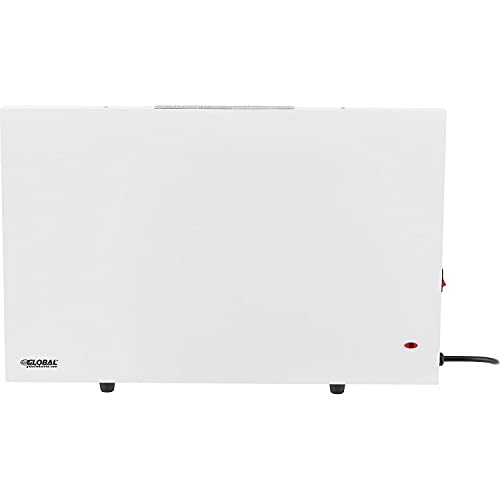
Global Industrial panelFunctionally the same 170 W under-desk panel as the QMark, with the one control the QMark lacks — an adjustable thermostat, so it cycles instead of running until you remember it.
Top pick · A published 750 W low setting for under $25
BLACK+DECKER BHDC201 Personal Ceramic Heater
The cheapest heater here that publishes its low wattage, which is the only way to know what the economical setting actually costs instead of guessing at it.
Rated power
1,500 W / 750 W low
Covers (computed)
150 sq ft
Draw (computed)
12.5 A at 120 V
Cost per hour
27.5¢
Coverage at 10 W/sq ft, average insulation, 8 ft ceiling = 5,118 BTU/h. Cost at 18.34¢/kWh; an eight-hour night at full output is $2.20. Exceeds the 12 A continuous limit of a 15 A circuit — check what else shares the breaker.
What works
Publishes 750 W as well as 1,500 W — at this price that is genuinely unusual, and it halves the running cost when you do not need full output
A four-position mechanical switch has almost nothing in it to fail
Both cutoffs published, which is not a given at the bottom of the market
What does not
No published listing mark, so the rating plate is the only place to confirm UL or ETL
A dial thermostat with no numbers — you can set “warmer”, not 68°F
Personal-sized: this heats the person at the desk, not the room around them
Published specification
Rated power
1,500 W high / 750 W low, at 120 V
Controls
Four-position switch — off, fan, low, high
Thermostat
Adjustable
Other modes
Fan-only
Safety
Overheat protection and tip-over auto shut-off
Heat type
Ceramic (PTC)
Maker’s coverage claim
None published — the coverage figure above is ours
Safety listing
No listing mark is published in the listing text; check the rating plate for UL or ETL.
Who it is for
A desk, a home office or a small bedroom where the 750 W setting will do most of the work and the 1,500 W setting is there for the cold snap.
What it is not for
A large or drafty room. At 750 W it covers about 75 sq ft at our sizing rule, and at 1,500 W it is still a personal heater in a small cabinet.
The 900 W low setting is the whole point: it is the rare listing that publishes both settings, so you can compute what the cheap mode actually costs instead of guessing.
Rated power
1,500 W / 900 W low
Covers (computed)
150 sq ft
Draw (computed)
12.5 A at 120 V
Cost per hour
27.5¢
Coverage at 10 W/sq ft, average insulation, 8 ft ceiling = 5,118 BTU/h. Cost at 18.34¢/kWh; an eight-hour night at full output is $2.20. Exceeds the 12 A continuous limit of a 15 A circuit — check what else shares the breaker.
What works
Both wattages are published, which is what makes an honest cost comparison possible
9 inches tall: it fits under a desk without being in the way
Manual top-mounted controls — nothing to relearn, nothing to lose the remote for
What does not
A dial thermostat with no numbers on it: you cannot set 68°F, only “about there”
No child lock, so the dial is reachable by anyone who can reach the unit
Fan noise is the price of a small ceramic unit moving 1,500 W of heat
ETL listed, per Lasko's published specification — one of the few in this roundup that names a mark rather than leaving it to the rating plate.
Who it is for
A desk, a small office, a dorm room — somewhere you want heat on a person rather than in a room.
What it is not for
A nursery, and not unattended use. It publishes a tip-over switch and overheat protection, but no child lock — and the USFA's advice to switch a heater off when you leave the room applies to every unit on this site, listed or not.
A micathermic panel is a radiator that gave up its bulk: it radiates like oil-filled and warms up like ceramic, and it is about three inches deep so it can live against a wall.
Rated power
1,500 W / 750 W low
Covers (computed)
150 sq ft
Draw (computed)
12.5 A at 120 V
Cost per hour
27.5¢
Coverage at 10 W/sq ft, average insulation, 8 ft ceiling = 5,118 BTU/h. Cost at 18.34¢/kWh; an eight-hour night at full output is $2.20. Exceeds the 12 A continuous limit of a 15 A circuit — check what else shares the breaker.
What works
No fan, so no noise and nothing blown around a room
Warms up far faster than an oil-filled radiator of the same wattage
Wall-mountable, which gets it out of the floor space it would otherwise eat
What does not
The panel surface is hot to the touch — this is not a cool-touch design
No published coverage figure
Radiant heat is directional: stand behind it and you will not feel much
Global Industrial Under-Desk Radiant Panel Heater with Adjustable Thermostat
Functionally the same 170 W under-desk panel as the QMark, with the one control the QMark lacks — an adjustable thermostat, so it cycles instead of running until you remember it.
Rated power
170 W
Covers (computed)
17 sq ft
Draw (computed)
1.4 A at 120 V
Cost per hour
3.1¢
Coverage at 10 W/sq ft, average insulation, 8 ft ceiling = 580 BTU/h. Cost at 18.34¢/kWh; an eight-hour night at full output is $0.25. Fits a 15 A circuit as a continuous load.
What works
An adjustable thermostat, which is the single thing the QMark panel does not have
Same 170 W and the same 1.4 A class of draw — negligible against a desk circuit
Radiant panel format suits the enclosed footwell rather than fighting it
What does not
Near-identical to the QMark panel in size and output — you are choosing a control, not a different heater
No published listing mark in the listing text
Still a personal heater: it does nothing for the room, and it should not be bought expecting otherwise
Published specification
Rated power
170 W at 120 V
Controls
Adjustable thermostat
Dimensions
22-7/16" W x 14-14/16" H
Mounting
Floor mount, compact under-desk design
Finish
White
Heat type
Radiant panel
Maker’s coverage claim
None published — the coverage figure above is ours
Safety listing
No listing mark published in the listing text; check the rating plate for the UL or ETL mark.
Who it is for
The same desk-bound reader as the QMark, who would rather the panel cycled on a thermostat than stayed on until switched off.
What it is not for
Anyone wanting a room warm. It is a leg warmer with a thermostat, and that is the correct expectation to have of it.
The breaker trips with nothing else on the circuit and the heater works fine elsewhere — that points at the circuit, not the heater.
The breaker is warm to the touch, or the panel smells hot. Stop and call someone today.
An outlet is discolored, scorched, or loose enough that a plug droops in it. A loose connection heats up and is a fire mechanism independent of the breaker.
You are considering adding a dedicated circuit for a heater — a reasonable thing to want in a home office, and straightforward work for an electrician.
The breaker will not reset, or resets and trips instantly with everything unplugged.
None of the above is something to work around with a different heater. A circuit that trips empty has a fault in it, and the heater was only the thing that revealed it.
If the heater runs but misbehaves in some other way — cutting out after a few minutes, blowing cold, or smelling wrong — that is a different ladder. Space heater maintenance has the symptom table, and the short answer is usually that the inlet is blocked rather than that anything has broken.
Questions people actually ask
Why does my space heater trip the breaker?+
Almost always because the circuit is carrying more than the breaker allows. A 1,500 W heater draws 12.5 A on its own, against a 15 A circuit's 12 A continuous allowance, so anything else on that circuit pushes it over. A faulty heater is the least likely explanation.
Can I put a bigger breaker in to stop my heater tripping it?+
No, and this is dangerous. The breaker is sized to protect the wire in the wall, not the appliance. A 15 A circuit is typically wired in 14-gauge conductor that is not rated for 20 A, so fitting a 20 A breaker leaves undersized wire unprotected against an overload.
What wattage space heater will not trip a 15 amp breaker?+
Anything at or below about 1,400 W has a theoretical chance, but for genuine headroom on a shared circuit use 900 W (7.5 A) or less. A 900 W setting occupies 63% of the 12 A continuous allowance and leaves room for lighting and electronics on the same circuit.
Why does my heater trip a GFCI outlet immediately?+
A GFCI watches for current leaking to ground rather than for overload, so an immediate, repeatable trip is a different signal from an overload. If one specific heater trips a GFCI every time it is switched on, that heater should be taken out of service rather than moved to a non-GFCI outlet.
Can two space heaters run on the same circuit?+
Not at full output. Two 1,500 W heaters draw 25 A between them, well beyond any residential 15 or 20 A circuit. Two heaters are only workable if they are on genuinely separate circuits, which in an apartment or older house is less common than people assume.
Four things worth doing, none of which is opening the cabinet — and the four signs it is finished.
Written by Scooter M., an enthusiast — not a tester and not a certified anything. Every figure on this page is either published by the manufacturer, taken from a live retail listing, or computed from the published wattage using the formulas we publish. Found an error? Tell us and we will correct it, visibly and with a date on it.