Both are electric resistance at 100%, so this comparison is not about cost per unit of heat. It is about how much of the house you are heating and how well you can control it.
By Scooter M. · Published August 31, 2026 · Last reviewed August 31, 2026
How this page is funded: we earn a commission if you buy through the links here, at no extra cost to you. Picks are chosen before links are attached, which is why every roundup names something to skip. Full disclosure.
Electric baseboard and a plug-in space heater are both resistance heating at essentially 100% efficiency, so a kilowatt-hour buys identical heat from either. The differences are wattage, thermostat quality and how much space each is heating.
Same physics, so start somewhere else
Electric baseboard is a resistance element in a finned enclosure that heats by natural convection, hardwired to a 240 V circuit and controlled by a wall or integral thermostat. A plug-in space heater is a resistance element in a portable box on a 120 V circuit. Both convert essentially all their electricity into heat.
That makes this an unusually clean comparison, because a large part of the usual argument disappears: neither is more efficient, and a kilowatt-hour costs whatever your utility charges regardless of which appliance drew it.
Where they actually differ
Electric baseboard
Plug-in space heater
Efficiency
~100%
~100%
Typical rating
750–2,000 W per run, often several runs
1,500 W maximum
Supply
240 V hardwired, dedicated circuit
120 V wall outlet
Control
Wall or integral thermostat, per zone
Whatever the unit has
Noise
Silent (no fan); occasional ticking
Silent to ~50 dB, depending on type
Portability
None
Total
Coverage
Sized and installed for the room
About 150 sq ft
Cost per delivered kWh
Identical
Identical
Both are electric resistance heating; the cost-per-heat row is the point.
The wattage difference is the real one
A baseboard installation is sized for the room, and because it is on a 240 V circuit it is not bound by the 1,500 W plug-in ceiling. A 200 sq ft room might have a 2,000 W baseboard run — which is the wattage the room actually needs and which no plug-in heater can supply.
So in a room with adequate baseboard, adding a space heater does not add capability. It adds a second, smaller, less well-controlled heat source drawing from a different circuit. The times it is genuinely useful are when the baseboard is under-sized, when its thermostat is inaccurate, or when you want fast heat in one corner without bringing the whole room up.
Control is where a space heater can genuinely win
Older baseboard thermostats are frequently a bimetallic dial with no numbers, mounted on a wall, with a swing of several degrees. A modern space heater with a digital thermostat set in 1°F increments genuinely holds a temperature better than that — and since overshoot is the biggest avoidable cost in resistance heating, better control is a real saving even at identical efficiency.
The cleaner fix, if the room has baseboard, is usually to replace the baseboard thermostat with a modern electronic one rather than to add an appliance. That is a small electrical job, not a heating project, and it improves the whole room's control rather than one corner of it.
Picks that pair well with under-performing baseboard
Quick picks
Ranked for fit, not for hype. Coverage and current draw are computed from each unit’s published wattage. Tap a row for the full write-up, or go straight to the listing.
#
Product
Best for
Covers
Draw
Price
1
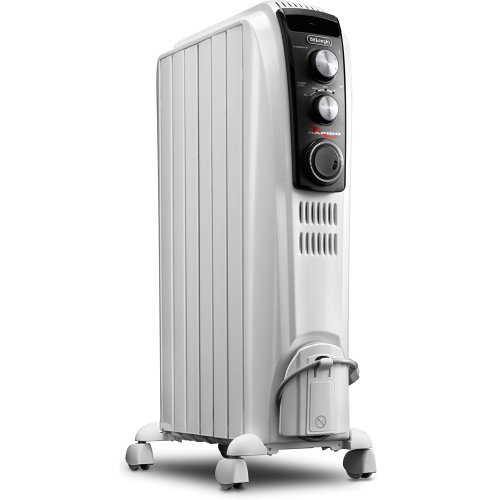
De'Longhi TRD40615TNo fan, so no noise and no moving dust — and the sealed oil keeps radiating after the element cuts out, which is why an oil-filled unit feels steadier than a ceramic one at the same wattage.
Dreo Solaris 718The rare heater whose published coverage claim survives the arithmetic: 1,500 W is a genuine 300 sq ft at 10 W/sq ft, and Dreo publishes that number rather than implying more.
No fan, so no noise and no moving dust — and the sealed oil keeps radiating after the element cuts out, which is why an oil-filled unit feels steadier than a ceramic one at the same wattage.
Rated power
1,500 W
Covers (computed)
150 sq ft
Draw (computed)
12.5 A at 120 V
Cost per hour
27.5¢
Coverage at 10 W/sq ft, average insulation, 8 ft ceiling = 5,118 BTU/h. Cost at 18.34¢/kWh; an eight-hour night at full output is $2.20. Exceeds the 12 A continuous limit of a 15 A circuit — check what else shares the breaker.
What works
Genuinely silent: there is no fan to hear at 3 a.m.
The oil holds heat, so the room temperature swings less between thermostat cycles
Nothing blows air, so nothing stirs up dust in a bedroom
What does not
Slow. It takes 20–30 minutes to feel like it is doing anything
Heavy — the wheels are not a courtesy, they are a requirement
The surface gets genuinely hot; this is a radiator, not a cool-touch case
Published specification
Rated power
1,500 W at 120 V
Controls
Mechanical, with a programmable 24-hour timer
Fluid
Permanently sealed diathermic oil — never needs refilling
Maker's claim
Up to 75% more radiant surface area
Mobility
Front and rear handles, snap-on wheels
Heat type
Oil-filled
Maker’s coverage claim
None published — the coverage figure above is ours
Safety listing
No listing mark published in the listing text; verify the UL or ETL mark on the rating plate.
Who it is for
A bedroom, a nursery at a safe distance, or anywhere the fan noise of a ceramic heater is the actual problem you are trying to solve.
What it is not for
Fast heat, and not a room you only occupy for twenty minutes. It also should never be tucked beside a bed or curtain — hot surface, 3-foot rule.
The rare heater whose published coverage claim survives the arithmetic: 1,500 W is a genuine 300 sq ft at 10 W/sq ft, and Dreo publishes that number rather than implying more.
Rated power
1,500 W
Covers (computed)
150 sq ft
Draw (computed)
12.5 A at 120 V
Cost per hour
27.5¢
Coverage at 10 W/sq ft, average insulation, 8 ft ceiling = 5,118 BTU/h. Cost at 18.34¢/kWh; an eight-hour night at full output is $2.20. Exceeds the 12 A continuous limit of a 15 A circuit — check what else shares the breaker.
What works
A digital thermostat with numbers on it — you can set 68°F rather than guess at a dial
The published 300 sq ft claim matches the standard sizing rule instead of exceeding it
8 lb and 8 inches square: it moves room to room without a project
What does not
1,500 W is 1,500 W — nothing here heats faster than any other 1,500 W heater
Dreo does not publish a noise figure in decibels on the product page
Tall and narrow, which is a tipping profile: the tip-over cutoff matters more here
A living room, bedroom or den at or under 300 sq ft with average insulation and an 8-foot ceiling, where you want to set a temperature and stop thinking about it.
What it is not for
A garage, an uninsulated basement, or anything over about 300 sq ft. It is not under-powered — 1,500 W is the plug-in ceiling — the room is simply too big for one outlet.
Per unit of heat, no — both are electric resistance at essentially 100% efficiency, so a kilowatt-hour delivers the same heat from either. Which costs less in practice depends on how much space each is heating and how accurately it is controlled.
Can a space heater replace baseboard heat?+
Only in a room small enough for 1,500 W. Baseboard runs on 240 V and is often rated at 2,000 W or more for a single room, which no plug-in heater can match.
Should I use a space heater instead of turning on baseboard heat?+
If it lets you heat one room instead of several, yes. If the baseboard is already only heating that one room, you are just swapping one resistance heater for a smaller one with a possibly better thermostat.
Why is my baseboard heat so expensive?+
Because electric resistance heating costs about 5.4 cents per thousand BTU at the U.S. average rate, several times what natural gas costs, and baseboard often heats a whole house that way. The wattage is the cost; the appliance is not the problem.
200 sq ft wants 2,000 W and an outlet gives 1,500. The gap, and four ways to close it.
Written by Scooter M., an enthusiast — not a tester and not a certified anything. Every figure on this page is either published by the manufacturer, taken from a live retail listing, or computed from the published wattage using the formulas we publish. Found an error? Tell us and we will correct it, visibly and with a date on it.