The three-foot rule is not about the air. It is about what the heater lands on, and what happens in the seconds after it does.
By Scooter M. · Published September 21, 2026 · Last reviewed September 21, 2026
How this page is funded: we earn a commission if you buy through the links here, at no extra cost to you. Picks are chosen before links are attached, which is why every roundup names something to skip. Full disclosure.
Keep three feet clear on every side of a space heater, including above it, and keep it on a hard level floor rather than carpet where you can. Carpet is a problem because it lets a heater tip and then insulates whatever it lands on — not because the pile ignites at normal operating temperature.
Three feet, from the U.S. Fire Administration
The figure is not a manufacturer's suggestion. The U.S. Fire Administration's guidance for portable heaters is a three-foot clearance from anything that can burn — bedding, curtains, upholstery, paper, laundry, clothing on a drying rack — plus switching the heater off when you leave the room or go to bed.
Three feet sounds generous until you measure a real room. A heater at the foot of a bed is usually closer than that to the duvet. One beside an armchair is within three feet of the upholstery. One under a desk is within three feet of everything. The rule is not difficult to follow, it is just difficult to follow *accidentally* — it has to be a decision when you place the heater.
Why the rule exists, which is not what people assume
Most people read the clearance rule as being about hot air scorching nearby fabric. That is part of it, but the larger part is the failure case: a heater that is knocked over, covered, or has its intake blocked.
A heater lying face-down on a rug, or with a towel draped over its intake, is not in a slightly worse version of its normal state — it is in a fundamentally different one, where the heat it produces has nowhere to go. Clearance is the margin that keeps an ordinary accident from becoming that. The federal figures behind this: an annual average of 1,100 portable-heater fires in residential buildings, 65 deaths, 150 injuries and $51 million in property loss for 2017-2019. The full statistics, with sources.
The carpet question, answered properly
"Can I put a space heater on carpet" is one of the most-asked questions in this category and it usually gets a one-word answer in both directions. The honest answer has three parts.
1.Carpet does not ignite from an upright, working heater. A modern heater's base and cabinet are designed to sit on a floor, and a listed unit has been tested with that in mind. If the heater is upright, functioning and clear, the pile underneath it is not the risk.
2.Carpet makes tipping far more likely. It is soft, uneven, and it catches feet and castors. A tall tower on a deep pile is markedly less stable than the same tower on wood or tile — and tipping is the actual hazard.
3.Carpet is what makes a tipped heater dangerous. This is the part that gets left out. A heater face-down on a hard floor is against a surface that conducts heat away and does not burn. Face-down on carpet, it is against a material that insulates, traps the heat and is itself combustible. The carpet does not start the problem; it is what turns the problem into a fire.
The clearance checklist, by direction
Direction
What gets missed
In front (the outlet)
The obvious one, and the one people actually respect. Keep bedding, curtains and upholstery out of the plume.
Behind (the intake)
The most commonly blocked side and the one that trips the overheat cutoff. A heater pushed back against a wall or a sofa is starving its own intake. If yours cuts out after a few minutes, this is almost always why — see maintenance.
Above
Shelves, a desk underside, a windowsill with curtains above it. Heat rises, and a heater under a shelf is heating the shelf.
Underneath
Rugs, carpet pile, laundry, extension cords. A cord running under a heater is the worst version of this — see why extension cords fail.
The walkway around it
Not a burn risk, a tipping risk. If the heater is where someone walks at night, it is in the wrong place regardless of clearance.
Three feet is the baseline in every direction. These are the specific things people forget.
Placement by room
Bedroom. The single highest-stakes room, because bedding is combustible and the occupant is asleep. Keep it well away from the bed, on a hard surface if at all possible, and prefer a unit with a timer so it stops on its own. Bedroom picks.
Nursery or a room with a toddler. Clearance plus a child lock plus a tip-over switch. A heater at floor level in a room with a small child is reachable by definition. What that room requires.
Under a desk. The one place where the three-foot rule is essentially impossible with a room heater — which is the argument for a 170 W under-desk panel instead of a 1,500 W unit in an enclosed footwell. Desk and under-desk heaters.
Around animals. A dog that leans on furniture will lean on a heater, and a cat will sit on anything warm. Cool-touch housings and tip-over cutoffs matter more here than anywhere. Pet-safe picks.
The shapes that survive a knock
Clearance is about the heater's surroundings. Stability is about the heater, and it is worth choosing for — the picks below are ordered by how well they handle being in a real room rather than an ideal one.
A tall, light tower is the least forgiving shape and needs its tip-over switch most. A low, heavy cabinet or an oil-filled radiator is hard to knock over at all. A wall-mounted panel or an under-desk panel removes the question entirely: nothing on the floor cannot fall over, and an inch-thick panel drawing 170 W is not doing to a carpet what a 1,500 W tower would.
Quick picks
Ranked for fit, not for hype. Coverage and current draw are computed from each unit’s published wattage. Tap a row for the full write-up, or go straight to the listing.
#
Product
Best for
Covers
Draw
Price
1
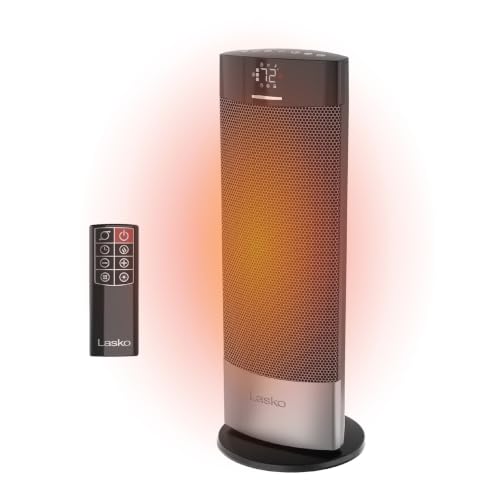
Lasko Ellipse CT18950The short Ellipse tower is the one that publishes the two things the taller Laskos do not: a tip-over switch and a child lock, on top of a digital display and wide oscillation.
The only tower here with both cutoffs and a child lock
Dreo Solaris 718The rare heater whose published coverage claim survives the arithmetic: 1,500 W is a genuine 300 sq ft at 10 W/sq ft, and Dreo publishes that number rather than implying more.
De'Longhi HMP1500A micathermic panel is a radiator that gave up its bulk: it radiates like oil-filled and warms up like ceramic, and it is about three inches deep so it can live against a wall.
Global Industrial panelFunctionally the same 170 W under-desk panel as the QMark, with the one control the QMark lacks — an adjustable thermostat, so it cycles instead of running until you remember it.
The short Ellipse tower is the one that publishes the two things the taller Laskos do not: a tip-over switch and a child lock, on top of a digital display and wide oscillation.
Rated power
1,500 W
Covers (computed)
150 sq ft
Draw (computed)
12.5 A at 120 V
Cost per hour
27.5¢
Coverage at 10 W/sq ft, average insulation, 8 ft ceiling = 5,118 BTU/h. Cost at 18.34¢/kWh; an eight-hour night at full output is $2.20. Exceeds the 12 A continuous limit of a 15 A circuit — check what else shares the breaker.
What works
A published tip-over switch AND a published child lock — no other tower in this registry publishes both, and they are exactly what a tall heater in a family room needs
An 18-inch tower has a lower center of gravity than the 23- and 30-inch units it competes with
Digital display, thermostat, remote and a timer at a price close to the simpler towers
What does not
Lasko's own product page for this model was unreachable when we checked, so every figure here is from the retail listing rather than the manufacturer
The wattage of the three heat modes is not published, so only the 1,500 W maximum can be costed
No coverage claim and no listing mark named — at 1,500 W our own figure is 150 sq ft either way
Published specification
Rated power
1,500 W at 120 V
Heat modes
Three, plus two fan settings; the per-mode wattage is not published
Controls
Digital display, thermostat, remote, timer
Oscillation
Wide oscillation
Height
18"
Safety
Tip-over switch and child lock, both published in the listing
Heat type
Ceramic (PTC)
Maker’s coverage claim
None published — the coverage figure above is ours
Safety listing
The listing publishes a tip-over switch and a child lock but names no UL or ETL mark. Lasko's own product page for this model could not be reached, so check the rating plate on the unit.
Who it is for
A living room, family room or home office where children or animals move past the heater and a tip-over switch plus a child lock are worth more than an extra five inches of tower.
What it is not for
Anyone who needs to compute the cost of a low setting, or who wants the manufacturer's own specification sheet before buying — for this model it was not reachable.
The rare heater whose published coverage claim survives the arithmetic: 1,500 W is a genuine 300 sq ft at 10 W/sq ft, and Dreo publishes that number rather than implying more.
Rated power
1,500 W
Covers (computed)
150 sq ft
Draw (computed)
12.5 A at 120 V
Cost per hour
27.5¢
Coverage at 10 W/sq ft, average insulation, 8 ft ceiling = 5,118 BTU/h. Cost at 18.34¢/kWh; an eight-hour night at full output is $2.20. Exceeds the 12 A continuous limit of a 15 A circuit — check what else shares the breaker.
What works
A digital thermostat with numbers on it — you can set 68°F rather than guess at a dial
The published 300 sq ft claim matches the standard sizing rule instead of exceeding it
8 lb and 8 inches square: it moves room to room without a project
What does not
1,500 W is 1,500 W — nothing here heats faster than any other 1,500 W heater
Dreo does not publish a noise figure in decibels on the product page
Tall and narrow, which is a tipping profile: the tip-over cutoff matters more here
A living room, bedroom or den at or under 300 sq ft with average insulation and an 8-foot ceiling, where you want to set a temperature and stop thinking about it.
What it is not for
A garage, an uninsulated basement, or anything over about 300 sq ft. It is not under-powered — 1,500 W is the plug-in ceiling — the room is simply too big for one outlet.
A micathermic panel is a radiator that gave up its bulk: it radiates like oil-filled and warms up like ceramic, and it is about three inches deep so it can live against a wall.
Rated power
1,500 W / 750 W low
Covers (computed)
150 sq ft
Draw (computed)
12.5 A at 120 V
Cost per hour
27.5¢
Coverage at 10 W/sq ft, average insulation, 8 ft ceiling = 5,118 BTU/h. Cost at 18.34¢/kWh; an eight-hour night at full output is $2.20. Exceeds the 12 A continuous limit of a 15 A circuit — check what else shares the breaker.
What works
No fan, so no noise and nothing blown around a room
Warms up far faster than an oil-filled radiator of the same wattage
Wall-mountable, which gets it out of the floor space it would otherwise eat
What does not
The panel surface is hot to the touch — this is not a cool-touch design
No published coverage figure
Radiant heat is directional: stand behind it and you will not feel much
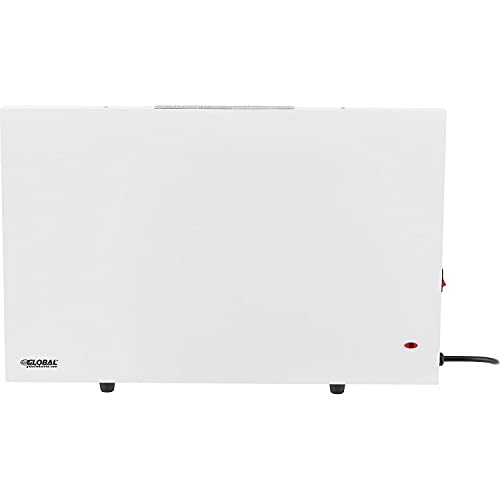
Global Industrial Under-Desk Radiant Panel Heater with Adjustable Thermostat
Functionally the same 170 W under-desk panel as the QMark, with the one control the QMark lacks — an adjustable thermostat, so it cycles instead of running until you remember it.
Rated power
170 W
Covers (computed)
17 sq ft
Draw (computed)
1.4 A at 120 V
Cost per hour
3.1¢
Coverage at 10 W/sq ft, average insulation, 8 ft ceiling = 580 BTU/h. Cost at 18.34¢/kWh; an eight-hour night at full output is $0.25. Fits a 15 A circuit as a continuous load.
What works
An adjustable thermostat, which is the single thing the QMark panel does not have
Same 170 W and the same 1.4 A class of draw — negligible against a desk circuit
Radiant panel format suits the enclosed footwell rather than fighting it
What does not
Near-identical to the QMark panel in size and output — you are choosing a control, not a different heater
No published listing mark in the listing text
Still a personal heater: it does nothing for the room, and it should not be bought expecting otherwise
Published specification
Rated power
170 W at 120 V
Controls
Adjustable thermostat
Dimensions
22-7/16" W x 14-14/16" H
Mounting
Floor mount, compact under-desk design
Finish
White
Heat type
Radiant panel
Maker’s coverage claim
None published — the coverage figure above is ours
Safety listing
No listing mark published in the listing text; check the rating plate for the UL or ETL mark.
Who it is for
The same desk-bound reader as the QMark, who would rather the panel cycled on a thermostat than stayed on until switched off.
What it is not for
Anyone wanting a room warm. It is a leg warmer with a thermostat, and that is the correct expectation to have of it.
Placement is one of three things that have to be right, and it is the easiest. The other two are the circuit — a 1,500 W heater draws 12.5 A continuously, which is over a 15 A circuit's allowance on its own (the arithmetic) — and the connection, which means the wall outlet directly and never an extension cord or a power strip.
A perfectly placed heater on an overloaded circuit is still a problem, and a perfectly placed heater on a damaged cord is a worse one. Clearance is necessary and it is not sufficient.
Questions people actually ask
Can you put a space heater on carpet?+
Generally yes, if it is upright, working and clear — carpet does not ignite from a functioning heater. The real issue is that carpet makes tipping more likely and makes a tipped heater far more dangerous, because it insulates and traps the heat. On carpet, prefer a unit with a published tip-over switch and a low, heavy shape, or stand it on a hard mat.
How far should a space heater be from furniture?+
Three feet, in every direction including above, per U.S. Fire Administration guidance. That applies to anything that can burn: upholstery, bedding, curtains, paper, laundry and clothing. The side most often forgotten is the intake at the back, which is also what trips the overheat cutoff when blocked.
Why does my space heater shut off when it is near a wall?+
Because its intake is blocked. Most heaters draw air in at the back, and a unit pushed against a wall or a sofa starves itself and trips the overheat cutoff. Pull it out, give it clearance on every side, and vacuum the intake grille — that fixes the large majority of cases.
Is it safe to put a space heater on a rug?+
Treat a rug like carpet: the risk is tipping and what happens afterwards, not the rug igniting under a working heater. A hard, non-combustible surface is better. If a rug is unavoidable, choose a low, heavy heater with a published tip-over switch rather than a tall tower.
Can a space heater be under a desk?+
Not a room heater — a footwell makes three feet of clearance impossible and blocks the intake, which is exactly what trips the thermal cutoff. An under-desk radiant panel at about 170 W is the product class designed for that space, and it draws about a tenth of the current.
How much clearance does a space heater need above it?+
The same three feet. Heat rises, so shelves, the underside of a desk and windowsills with curtains above them are all within the rule. A heater tucked under a shelf is heating the shelf continuously, which is the same failure mode as a blocked intake.
A desk does not need a room heater. 170 W of radiant panel against 1,500 W — the arithmetic and the picks.
Written by Scooter M., an enthusiast — not a tester and not a certified anything. Every figure on this page is either published by the manufacturer, taken from a live retail listing, or computed from the published wattage using the formulas we publish. Found an error? Tell us and we will correct it, visibly and with a date on it.