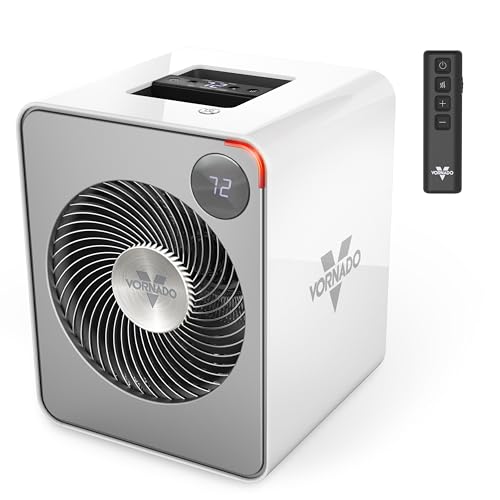
A cool-touch metal cabinet that holds a temperature and stops on its own. The catch is how little Vornado will tell you in numbers.
By Scooter M. · Published September 14, 2026 · Last reviewed September 14, 2026
How this page is funded: we earn a commission if you buy through the links here, at no extra cost to you. Picks are chosen before links are attached, which is why every roundup names something to skip. Full disclosure.
The Vornado VMHi500 is a metal-cabinet heater with two heat settings plus fan-only, Auto-Climate Control, a remote, a 1-12 hour timer, two LED displays, tip-over protection and a 2-stage auto shutoff, backed by a five-year guarantee. Vornado publishes no wattage; retail listings put it at 1,500 W.
What Vornado publishes — and what it does not
Vornado is unusual in this category, and not in a good way: its product pages describe behavior rather than specifications. For the VMHi500 its own page gives you two heat settings plus fan-only, Auto-Climate Control, a remote, a 1-12 hour timer, two LED displays, a cool-touch powder-coated metal cabinet with cord storage, tip-over protection, a 2-stage auto shutoff and a five-year satisfaction guarantee.
What it does not give you is a wattage, a coverage figure in square feet, or a named safety listing. Those three absences matter, because they are exactly the numbers a buyer needs to size the heater, cost it and satisfy a lease that requires a listed appliance.
The specification and the computed figures
Top pick · A metal cabinet that stops on its own
Vornado VMHi500 Whole Room Metal Heater
The current top of Vornado's metal line: auto-climate control, two LED displays and a 1-12 hour timer in a cool-touch metal box, backed by five years.
Rated power
1,500 W
Covers (computed)
150 sq ft
Draw (computed)
12.5 A at 120 V
Cost per hour
27.5¢
Coverage at 10 W/sq ft, average insulation, 8 ft ceiling = 5,118 BTU/h. Cost at 18.34¢/kWh; an eight-hour night at full output is $2.20. Exceeds the 12 A continuous limit of a 15 A circuit — check what else shares the breaker.
What works
Auto-Climate Control adjusts output to hold a temperature rather than running flat out — the cycling behavior that genuinely lowers consumption
A 1–12 hour timer means it can stop on its own, which is the only reliable way an overnight heater saves money
Five years on a heater at this price is a costed commitment, not a marketing line
What does not
Vornado publishes no wattage and no coverage figure, so every sizing and cost number here is ours, computed from the retail-listed 1,500 W
No child lock is published — the same gap the rest of Vornado's range has, and it is disqualifying for a nursery
It is a fan heater in a metal box: moving air is the mechanism and you will hear it
Published specification
Rated power
1,500 W at 120 V (retail listings; Vornado publishes settings, not watts)
Heat settings
2, plus fan-only
Thermostat
Auto-Climate Control, digital
Timer
1–12 hours
Display
Two LED displays, for reading it from across the room
Housing
Cool-touch, powder-coated gloss metal cabinet with cord storage
Safety
Tip-over protection and a 2-stage auto shutoff
Warranty
5-year satisfaction guarantee
Heat type
Fan-forced
Maker’s coverage claim
None published — the coverage figure above is ours
Safety listing
Vornado publishes tip-over protection and a 2-stage auto shutoff but does not name a listing mark; check the rating plate.
Who it is for
A living room or bedroom where the heater is permanent and visible, and where a real thermostat, a timer and a cool metal shell are worth paying for over a plastic tower.
What it is not for
A nursery, because no child lock is published; and not silence, which means an oil-filled radiator instead.
Auto-Climate Control is the reason to buy this over a cheaper Vornado
The VMHi300, one step down the same line, has a mechanical dial. This one has Auto-Climate Control and two LED displays, and that difference is worth more than it sounds — not because it produces more heat, but because it decides how many hours the element actually runs.
A heater that holds a set temperature cycles off when the room reaches it. A heater with an unmarked dial gets turned up until it is warm and left there. Across an eight-hour evening the second one runs a great deal longer, and since every electric heater costs the same per hour at the same wattage, running hours are the only variable there is. The full argument is on the thermostat roundup.
Wattage
Per hour
1 h
4 h
8 h
1,500 W
27.5¢
$0.28
$1.10
$2.20
Computed at 18.34¢/kWh — the U.S. residential average for June 2026 (EIA, Electric Power Monthly, Table 5.6.A, released August 26, 2026). Your rate is on your own bill; substitute it and the arithmetic still holds. Figures assume full output for the whole period.
At full output this is 27.5 cents an hour — the same as every other 1,500 W heater on this site, and the same as the plastic tower that costs half as much. The metal cabinet, the displays and the guarantee are what you are paying for. Cycling is what gets the bill down.
This is the most recent month EIA has published. Residential rates move seasonally and vary enormously by state — from roughly a dime per kilowatt-hour in parts of the South to more than 40¢ in Hawaii — so treat it as a national reference point, not as your rate.
What the metal cabinet actually buys
Powder-coated metal, published as cool-touch, with cord storage. Metal does not become brittle the way heater-grade plastic does after a few seasons of thermal cycling, and a cool-touch metal shell is a genuine engineering result rather than a marketing line — most metal heaters are emphatically not cool to the touch.
The five-year satisfaction guarantee is the strongest signal here. A warranty is the one claim a manufacturer cannot make cheaply: it is a costed commitment. Five years on a heater in this price bracket says more about expected build quality than any spec sheet would.
How big a room, and the answer Vornado will not give you
Room size
Watts needed
BTU/h
Plug-in heaters
150 sq ft
1,500 W
5,118
1
200 sq ft
2,000 W
6,824
2 (different circuits)
300 sq ft
3,000 W
10,236
2 (different circuits)
Computed as square feet x 10 W x insulation factor x (ceiling / 8 ft), for an average heated room — 10 W/sq ft, 8 ft ceiling. Heater count assumes the 1,500 W plug-in ceiling.
At our standard 10 watts per square foot with average insulation and an 8-foot ceiling, 1,500 W covers about 150 sq ft. Vornado publishes no coverage claim of its own for this model, so if you see one attached to it on a retailer's filter, that number did not come from Vornado. Use the wattage.
Vortex circulation is a distribution claim, not an output one, and the distinction decides whether this heater fixes your problem. If the complaint is *“one end of the room is warm and the other is cold,”* circulation is the fix. If the complaint is *“the room never gets warm,”* it changes nothing — the room is bigger than 1,500 W can hold, and the sizing calculator will say by how much.
The circuit question
Heater
Draw at 120 V
15 A circuit (12 A limit)
20 A circuit (16 A limit)
1,500 W
12.5 A
Over the limit
Fits
Maximum continuous
—
12 A = 1,440 W
16 A = 1,920 W
Draw computed as watts / 120 V. The continuous limit is 80% of the breaker rating, which follows from the NEC's requirement to size a circuit at 125% of a continuous load (NFPA 70, 210.19(A)(1) and 210.20(A)).
12.5 A against a 15 A circuit's 12 A continuous allowance — over the limit on its own, exactly like every other 1,500 W heater. One per circuit, nothing else significant sharing it, and never on an extension cord. The arithmetic in full.
How these were picked
Specifications taken from Vornado's own product page, with the wattage from retail listings because Vornado does not publish one.
Coverage, draw and running cost computed by us from that retail-listed wattage — and flagged as ours, not Vornado's.
Vortex circulation assessed as a distribution claim, not an output one.
We have not run this heater.
And what we did not do: we have not tested these units, owned them, measured them or run them in a room. Everything above is compiled from published manufacturer specifications and live retail listings, with the electrical load, room coverage and running cost computed by us from the published wattage. The full method.
Questions people actually ask
How many watts is the Vornado VMHi500?+
Vornado does not publish a wattage for it. Retail listings put it at 1,500 W, which is the ceiling for any U.S. plug-in heater and is consistent with the rest of the range. Every current and cost figure we compute for this unit rests on that retail figure rather than a manufacturer one.
What is the difference between the Vornado VMHi500 and the VMHi300?+
Control, mainly. The VMHi300 has a mechanical dial; the VMHi500 has Auto-Climate Control, two LED displays, a remote and a 1-12 hour timer. Both are cool-touch metal cabinets with vortex circulation and a five-year guarantee, and both produce the same heat at the same cost per hour.
What size room does the Vornado VMHi500 heat?+
About 150 sq ft at the standard 10 watts per square foot, assuming average insulation and an 8-foot ceiling. That figure is ours — Vornado publishes no coverage claim for this model. Vortex circulation spreads that heat more evenly but does not create more of it.
Is the Vornado VMHi500 UL or ETL listed?+
Vornado does not name a listing mark on its product page. It does publish tip-over protection and a 2-stage auto shutoff. Check the rating plate on the unit before buying if your lease or insurer requires a listed heater.
Does the Vornado VMHi500 have a child lock?+
None is published. That is the main reason we do not recommend it for a nursery, despite the cool-touch cabinet and both cutoffs being exactly what that room otherwise wants.
Cool-touch, tip-over cutoff and a 5-year warranty — plus a maker that publishes settings, not specs.
Written by Scooter M., an enthusiast — not a tester and not a certified anything. Every figure on this page is either published by the manufacturer, taken from a live retail listing, or computed from the published wattage using the formulas we publish. Found an error? Tell us and we will correct it, visibly and with a date on it.