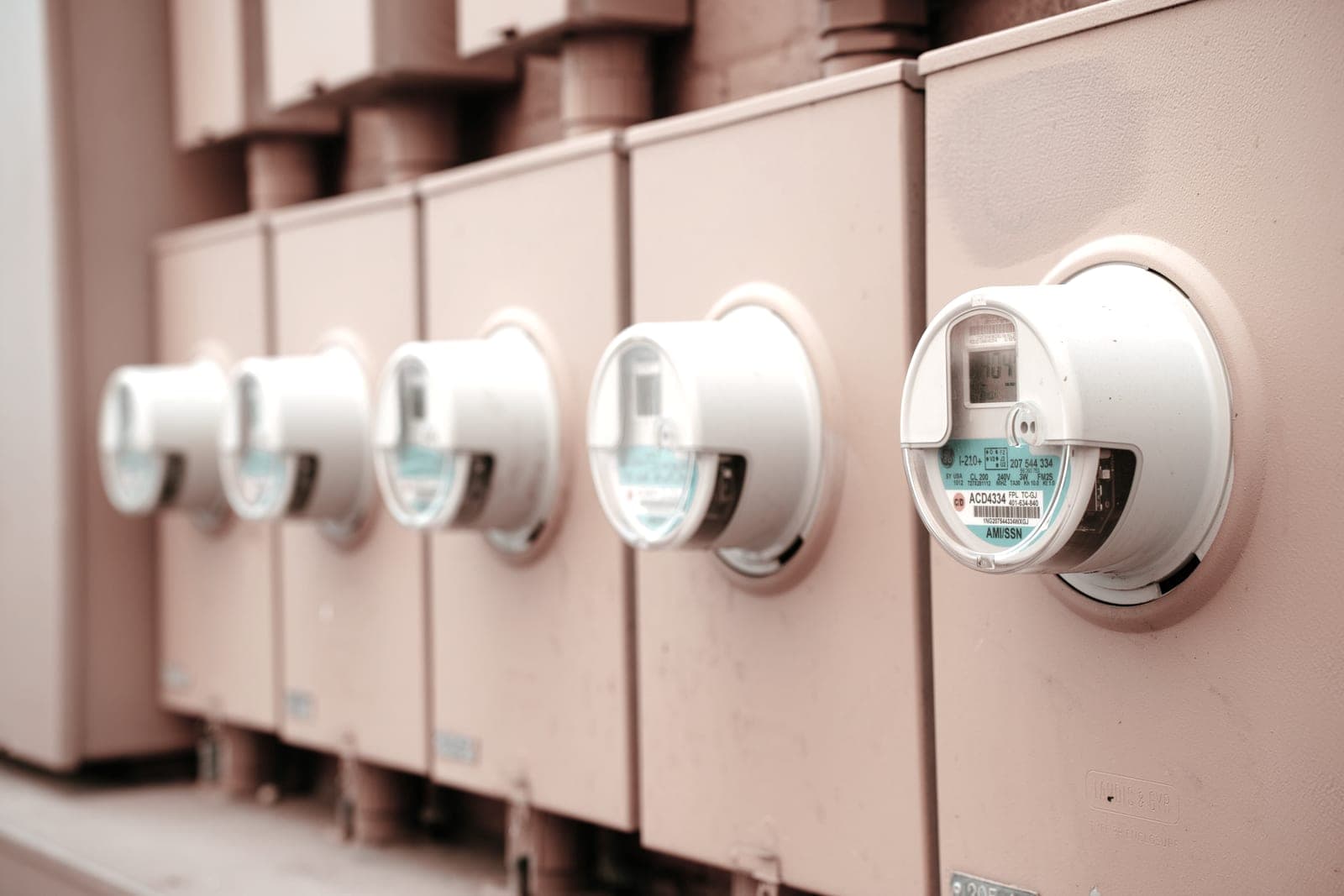
Almost every plug-in heater in America is 1,500 watts, and the reason is not the heater. It is the outlet.
By Scooter M. · Published August 31, 2026 · Last reviewed August 31, 2026
How this page is funded: we earn a commission if you buy through the links here, at no extra cost to you. Picks are chosen before links are attached, which is why every roundup names something to skip. Full disclosure.
Most plug-in space heaters draw 1,500 watts on high, with a low setting of 750 to 900 watts. 1,500 W is the effective ceiling because a 120 V, 15 A branch circuit supports 12 A of continuous load, which is 1,440 W.
The ceiling, and where it comes from
A standard U.S. wall outlet is fed by a 120 V branch circuit protected at 15 A, or sometimes 20 A. Electrical code treats a load that runs for three hours or more as continuous, and requires the branch circuit and its overcurrent device to be rated at not less than 125% of that continuous load (NFPA 70, Article 210.19(A)(1) and 210.20(A)).
Turn that around: a continuous load may not exceed 80% of the breaker rating. On a 15 A circuit that is 12 A, and 12 A × 120 V = 1,440 W. On a 20 A circuit it is 16 A, or 1,920 W.
So 1,500 W is the number the industry settled on: it is the largest round figure that a 15 A outlet will physically deliver without tripping, and it is slightly above the continuous allowance — which is a wrinkle almost nobody publishes and which we work through here.
What each wattage means in practice
Watts
Amps at 120 V
Covers (average room)
Cost per hour
500 W
4.2 A
50 sq ft
9.2¢
750 W
6.3 A
75 sq ft
13.8¢
900 W
7.5 A
90 sq ft
16.5¢
1,000 W
8.3 A
100 sq ft
18.3¢
1,200 W
10.0 A
120 sq ft
22.0¢
1,500 W
12.5 A
150 sq ft
27.5¢
Amps = W ÷ 120. Coverage at 10 W/sq ft, average insulation, 8-ft ceiling. Cost at 18.34¢/kWh (EIA, June 2026).
That table is the whole of this site in one place: the wattage decides the amps, the amps decide the circuit, the wattage decides the coverage, and the wattage decides the cost. Everything else is packaging.
Choosing a setting rather than a product
The low setting is under-used, and the reason is a misconception: people assume a heater on low takes proportionally longer to heat the room and therefore costs the same overall. In a room the heater can actually hold, that is not what happens. Once the room is at temperature, both settings are just cycling — and on low it cycles at a lower power, so it costs less per hour of running.
The rule of thumb: match the setting to the room's requirement, not to the heater's maximum. A 100 sq ft office needs about 1,000 W, so a 900 W low setting will hold it once it is warm. Use high to get there, then drop to low.
Wattage
8 h/day
750 W
$33.01
900 W
$39.61
1,500 W
$66.02
Computed at 18.34¢/kWh — the U.S. residential average for June 2026 (EIA, Electric Power Monthly, Table 5.6.A, released August 26, 2026). Your rate is on your own bill; substitute it and the arithmetic still holds. Monthly figures are 30-day months at full output; a thermostat that cycles will reduce them.
What about “watt equivalent” claims?
Some listings advertise a heater as “equivalent to 1,500 W” while rating it lower. What that generally means is that the unit is radiant and points at you, so it feels comparable at close range. That can be genuinely true as a comfort claim — but it is not equivalent output, and it will not hold a room the way the wattage it is compared to would. Read the rated wattage on the specification, size the room from that, and treat the comparison as marketing.
Picks that publish both settings
Quick picks
Ranked for fit, not for hype. Coverage and current draw are computed from each unit’s published wattage. Tap a row for the full write-up, or go straight to the listing.
#
Product
Best for
Covers
Draw
Price
1
Lasko 754201The 900 W low setting is the whole point: it is the rare listing that publishes both settings, so you can compute what the cheap mode actually costs instead of guessing.
Honeywell HCE220BA shoebox-sized ceramic heater that publishes four preset temperatures and a 2/4/8-hour auto-off — specificity almost nothing else this size offers.
A thermostat with numbers on it, on a small heater
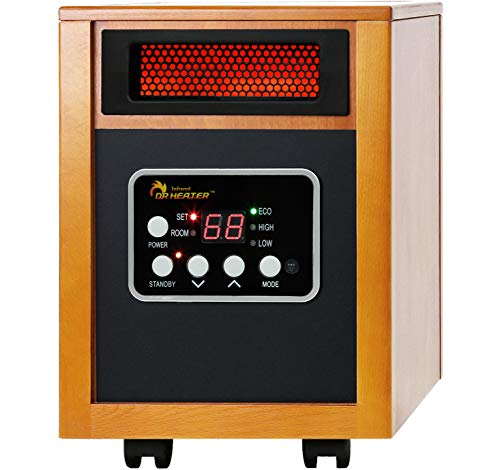
Dr Infrared DR-968The one listing in this category that publishes its amp draw and its noise level, which is exactly the arithmetic everyone else leaves you to do — 12.5 A and 39 dB, both stated.
The 900 W low setting is the whole point: it is the rare listing that publishes both settings, so you can compute what the cheap mode actually costs instead of guessing.
Rated power
1,500 W / 900 W low
Covers (computed)
150 sq ft
Draw (computed)
12.5 A at 120 V
Cost per hour
27.5¢
Coverage at 10 W/sq ft, average insulation, 8 ft ceiling = 5,118 BTU/h. Cost at 18.34¢/kWh; an eight-hour night at full output is $2.20. Exceeds the 12 A continuous limit of a 15 A circuit — check what else shares the breaker.
What works
Both wattages are published, which is what makes an honest cost comparison possible
9 inches tall: it fits under a desk without being in the way
Manual top-mounted controls — nothing to relearn, nothing to lose the remote for
What does not
A dial thermostat with no numbers on it: you cannot set 68°F, only “about there”
No child lock, so the dial is reachable by anyone who can reach the unit
Fan noise is the price of a small ceramic unit moving 1,500 W of heat
ETL listed, per Lasko's published specification — one of the few in this roundup that names a mark rather than leaving it to the rating plate.
Who it is for
A desk, a small office, a dorm room — somewhere you want heat on a person rather than in a room.
What it is not for
A nursery, and not unattended use. It publishes a tip-over switch and overheat protection, but no child lock — and the USFA's advice to switch a heater off when you leave the room applies to every unit on this site, listed or not.
2 · A thermostat with numbers on it, on a small heater
Honeywell HCE220B UberHeat Plus Ceramic Heater
A shoebox-sized ceramic heater that publishes four preset temperatures and a 2/4/8-hour auto-off — specificity almost nothing else this size offers.
Rated power
1,500 W
Covers (computed)
150 sq ft
Draw (computed)
12.5 A at 120 V
Cost per hour
27.5¢
Coverage at 10 W/sq ft, average insulation, 8 ft ceiling = 5,118 BTU/h. Cost at 18.34¢/kWh; an eight-hour night at full output is $2.20. Exceeds the 12 A continuous limit of a 15 A circuit — check what else shares the breaker.
What works
Four preset temperatures rather than an unmarked dial — on a heater this small and this cheap, being able to ask for 70°F is unusual
Two independent overheat mechanisms are published — a high-temperature sensor and a thermal cut-off fuse — plus a tip-over switch
A 2/4/8-hour auto-off means it can stop by itself, which is what actually reduces the bill
What does not
No UL or ETL mark published by Honeywell, which is the one thing we would want stated at this size and price
Four presets is not the same as a full range: if you want 68°F you are choosing between 65 and 70
2.8 lb and shoebox-sized means it is a personal heater, not a room heater, whatever the 1,500 W suggests
Published specification
Rated power
1,500 W maximum at 120 V
Heat settings
2 (high and low)
Thermostat
Four preset comfort levels — 65°, 70°, 75° and 80°F
Auto-off timer
2, 4 or 8 hours
Safety
Tip-over switch; 2x overheat protection (high-temperature sensor plus a thermal cut-off fuse); cool-touch housing
Size
8.5" x 4.5" x 8.86", 2.8 lb
Warranty
3-year limited
Heat type
Ceramic (PTC)
Maker’s coverage claim
None published — the coverage figure above is ours
Safety listing
Honeywell does not publish a UL or ETL mark for this model; it does publish two independent overheat mechanisms. Check the rating plate.
Who it is for
A small office, a bedside table or a desk, where the heater needs to hold roughly a known temperature and switch itself off after a few hours.
What it is not for
A large or drafty room, and not a nursery — no child lock is published and the presets are reachable by anyone who can reach the unit.
The one listing in this category that publishes its amp draw and its noise level, which is exactly the arithmetic everyone else leaves you to do — 12.5 A and 39 dB, both stated.
Rated power
1,500 W
Covers (computed)
150 sq ft
Draw (computed)
12.5 A at 120 V
Cost per hour
27.5¢
Coverage at 10 W/sq ft, average insulation, 8 ft ceiling = 5,118 BTU/h. Cost at 18.34¢/kWh; an eight-hour night at full output is $2.20. Exceeds the 12 A continuous limit of a 15 A circuit — check what else shares the breaker.
What works
Publishes 12.5 A, which is the number that decides whether it fits your circuit
Publishes 39 dB, which is the number that decides whether it fits your bedroom
A wooden-cabinet infrared unit runs cooler on the outside than a bare panel
What does not
19 lb with wheels: this is furniture, not a portable you carry between rooms
12.5 A against a 15 A circuit's 12 A continuous limit — it does not legally fit, see the circuit-load guide
Dated cabinet styling that will not disappear into a modern room
Published specification
Rated power
1,500 W at 120 V
Current draw
12.5 A (published)
Noise
39 dB (published)
Element
Infrared quartz tube plus PTC
Thermostat
Electronic, 50–85°F
Other
12-hour auto-off timer, IR remote, caster wheels, 19 lb
Heat type
Infrared quartz
Maker’s coverage claim
None published — the coverage figure above is ours
Safety listing
No listing mark published in the listing text; check the cabinet's rating plate for the UL or ETL mark.
Who it is for
A reader who wants to compute the load rather than trust a claim: the published amp draw and decibel figure make it the easiest unit on this site to check.
What it is not for
A 15 A circuit shared with anything else, and not a small room where a 19 lb cabinet on wheels is in the way.
Most plug-in heaters use 1,500 W on high and 750–900 W on low. Personal and desk heaters range from 200 to 800 W. Hardwired 240 V unit heaters run from 2,500 to 7,500 W.
Why are all space heaters 1500 watts?+
Because a 120 V, 15 A branch circuit supports 12 A of continuous load, or 1,440 W. 1,500 W is the largest practical output a standard U.S. outlet can deliver, so it became the industry ceiling.
How many amps does a 1500 watt heater draw?+
12.5 amps at 120 V — the arithmetic is 1,500 ÷ 120. That is above the 12 A continuous limit of a 15 A circuit, which is why it should not share a circuit with other significant loads.
Is a 750 watt heater enough?+
For about 75 sq ft at average insulation — a small bedroom, a bathroom, a desk area. It is also a good holding setting for a 100 sq ft room once a 1,500 W unit has brought it up to temperature.
Every heater here is electric, so the outage stops it. What a generator and a battery each have to be rated for.
Written by Scooter M., an enthusiast — not a tester and not a certified anything. Every figure on this page is either published by the manufacturer, taken from a live retail listing, or computed from the published wattage using the formulas we publish. Found an error? Tell us and we will correct it, visibly and with a date on it.