There are four things worth doing and none of them involves opening the cabinet. Here they are, plus how to tell a dirty heater from a finished one.
By Scooter M. · Published September 15, 2026 · Last reviewed September 15, 2026
How this page is funded: we earn a commission if you buy through the links here, at no extra cost to you. Picks are chosen before links are attached, which is why every roundup names something to skip. Full disclosure.
There are four maintenance jobs on a portable heater: vacuum the inlet and outlet grilles, check the cord and plug for damage or heat, confirm three feet of clearance, and look at the outlet it plugs into. Nothing inside the cabinet is user-serviceable. Do the first one at the start of every season.
Most maintenance advice for these is padding
Search this topic and you will find long lists — lubricate this, calibrate that, replace the filter, descale, book an annual service. Almost none of it applies to a portable electric heater. There is no filter on most of them, nothing to lubricate, nothing to calibrate and no service network. The machine is an element, a thermostat, usually a fan, and a cord.
That is good news: it means the real list is short enough to actually do. It also means that when a heater stops behaving, the honest answer is usually *replace it* rather than *repair it* — and this page is mostly about telling those two situations apart.
The four things worth doing
1. Vacuum the grilles — start of every season
This is the only one that is genuinely routine. Dust settles on a cold element all summer and burns off the first time it runs, which is where the alarming first-run smell comes from. Unplug the heater, let it cool completely, and go over the inlet and outlet grilles with a vacuum brush attachment. Do it in September rather than at 11 p.m. on the first cold night. What the burning smell means, and when it is not dust.
2. Look at the cord and the plug
A heater cord carries 12.5 A continuously at 1,500 W, which is more than almost anything else you own. Run the whole length through your fingers: any stiffness, flattening, nicks, or a section that has been under a rug or a chair leg is a reason to retire the unit. At the plug end, look for discoloration on the pins and feel whether the plug body is warm after an hour of running. Warm is not normal.
3. Confirm the clearance, again
Three feet on all sides, which is the U.S. Fire Administration's figure. This is on the list not because it degrades but because rooms change — a chair gets moved in November, a stack of boxes appears in December, curtains get closed differently. The clearance you checked when you bought it is not necessarily the clearance it has now.
4. Check the outlet, not just the heater
The outlet wears too, and it is the half of the connection nobody inspects. Does the plug hold firmly, or does it droop? Is the faceplate warm? Is there any brown or yellow staining around the slots? A loose contact generates heat inside the wall where you cannot see it, and no amount of heater maintenance fixes it. If the outlet is suspect, that is an electrician's job, and a new heater plugged into the same socket reproduces the fault exactly.
How to clean one properly
1.Unplug it at the wall and let it cool completely. Not “mostly cool” — the element and the surrounding metal hold heat for a while after the fan stops.
2.Vacuum the inlet grille with a brush attachment. The inlet is where the dust actually accumulates, because that is the side pulling room air in. On a tower this is usually the back; on a cabinet unit it may be the side or the bottom.
3.Vacuum the outlet grille as well, gently. Do not push anything through the slots — no cotton buds, no compressed-air straws, nothing that can bend a fin or touch the element.
4.Wipe the exterior with a dry or barely damp cloth. No solvents, no sprays, and nothing wet anywhere near the grilles or the controls.
5.Run it for twenty minutes with a window open, so any remaining dust burns off while the room is ventilated rather than while you are trying to sleep.
An oil-filled radiator is the easy case — no fan, no inlet, so it is a wipe-down and a look at the cord. It is also the type least likely to fail, for the same reason: fewer moving parts than anything else here.
It stopped working — what it probably is
Four symptoms cover most of it, and the first two are usually not the heater at all.
Symptom
Most likely cause
Where to look
Nothing happens at all
The breaker, or the outlet — not the heater. Test the heater on a different circuit before concluding anything.
Overheat cutoff doing its job, almost always because the inlet is blocked by dust, furniture or a rug. Clean it and give it clearance.
The cleaning steps above
Blows cold, or cold then warm
The thermostat is satisfied — the sensor sits inside the heater, near its own outlet, so a unit in a corner warms itself before the room. Give it space on all sides.
Start at the top. The cheapest explanations are also the most common ones.
Notice the pattern: three of the four are environmental rather than mechanical. A heater that cuts out is usually a heater that cannot breathe, and a heater that does nothing is usually a circuit problem. Both are worth ruling out before spending money.
How long they last, and what actually kills them
No manufacturer publishes a service life for a portable heater, and we are not going to invent one. What can be said honestly is what fails, and in what order.
The fan, first and most often. It is the only part with a bearing and it runs for hundreds of hours a season. Fan noise changing character — a new rattle, a whine, a grinding start — is the earliest honest warning most of these give you.
The thermostat, second. Mechanical bimetallic thermostats drift, so a heater that used to cycle sensibly starts overshooting or short-cycling. Digital units tend to fail outright rather than drift.
The cord and plug, third — and this is the failure that matters, because it is the one with fire consequences rather than comfort consequences. It is also the one you can inspect.
The element, rarely. A resistance element that has been treated reasonably tends to outlast the things around it. Fanless types — oil-filled radiators, mica panels — are therefore the longest-lived designs on this site, because they have removed the part that usually goes first.
Wattage
Per hour
1 h
8 h
1,500 W
27.5¢
$0.28
$2.20
Computed at 18.34¢/kWh — the U.S. residential average for June 2026 (EIA, Electric Power Monthly, Table 5.6.A, released August 26, 2026). Your rate is on your own bill; substitute it and the arithmetic still holds. Figures assume full output for the whole period.
This is the most recent month EIA has published. Residential rates move seasonally and vary enormously by state — from roughly a dime per kilowatt-hour in parts of the South to more than 40¢ in Hawaii — so treat it as a national reference point, not as your rate.
What the makers will actually commit to
Here is the finding that surprised us while writing this page. We checked every product in our registry for a published warranty, because if nobody publishes a service life then the warranty is the only durability number a manufacturer will put its name to.
Of the 22 currently-purchasable heaters in our registry, exactly 5 publish a warranty at all. The other 17 publish none — not a short one, none. That is not an accusation of poor build quality; plenty of unwarranted goods last for years. It is a statement about how much of this market expects to be held to anything.
Heater
Published warranty
Type
Vornado VMHi500
5-year satisfaction guarantee
Fan-forced, metal cabinet
Vornado VMHi300
5-year satisfaction guarantee
Fan-forced, metal cabinet
Lasko 755320
3 years
Ceramic tower
Lasko 754201
3 years
Ceramic, tabletop
Honeywell HCE220B
3-year limited
Ceramic, compact
Every purchasable heater in our registry that publishes a warranty, longest first. The other 17 publish nothing.
A warranty is the one claim a company cannot make cheaply — it is a costed commitment rather than a line of copy. That is why it is the ranking criterion for the picks below, and why two Vornados lead them.
The four signs to replace rather than persist
1.Any damage to the cord or plug. Stiffness, nicks, flattening, discoloration on the pins, a plug that is warm or loose. This is not a judgment call and it is not repairable at home.
2.A smell that is not first-of-season dust — hot plastic, anything acrid, anything fishy. Dust burn-off fades within half an hour and does not come back; a fault persists or worsens.
3.A tip-over or overheat cutoff that no longer works. Tilt it while running (carefully, on a clear floor) and it should cut out. If it does not, the feature you are relying on has failed silently and the heater is finished.
4.Scorch marks, melted plastic, or a cabinet that is hot somewhere it did not used to be. Anything visibly heat-damaged has already told you what is happening inside.
Those four are worth taking literally because of what is behind them. U.S. Fire Administration data for 2017–2019 records an annual average of 1,100 portable heater fires in residential buildings, 65 deaths, 150 injuries and $51 million in property loss — a small share of heating fires overall, but a strikingly large share of the deaths. The full figures, with sources.
If it is finished: what to replace it with
Ranked by published warranty, because that is the only durability figure any of these makers commits to. Each pick card shows the computed coverage, current draw and running cost alongside the published specification.
Quick picks
Ranked for fit, not for hype. Coverage and current draw are computed from each unit’s published wattage. Tap a row for the full write-up, or go straight to the listing.
#
Product
Best for
Covers
Draw
Price
1
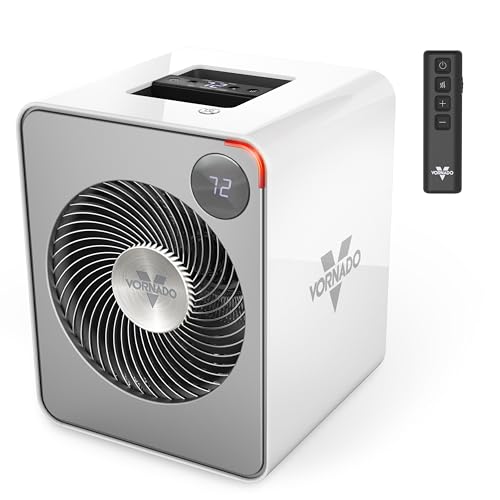
Vornado VMHi500The current top of Vornado's metal line: auto-climate control, two LED displays and a 1-12 hour timer in a cool-touch metal box, backed by five years.
Vornado VMHi300The in-stock Vornado: a powder-coated metal cabinet, vortex circulation and a five-year guarantee, with mechanical dials instead of a screen.
Lasko 755320A 23-inch digital tower with a thermostat, an 8-hour timer and a remote — and the only heater here whose published coverage figure lands exactly where our own sizing rule puts it.
The maker's coverage claim that matches the arithmetic
Honeywell HCE220BA shoebox-sized ceramic heater that publishes four preset temperatures and a 2/4/8-hour auto-off — specificity almost nothing else this size offers.
A thermostat with numbers on it, on a small heater
The current top of Vornado's metal line: auto-climate control, two LED displays and a 1-12 hour timer in a cool-touch metal box, backed by five years.
Rated power
1,500 W
Covers (computed)
150 sq ft
Draw (computed)
12.5 A at 120 V
Cost per hour
27.5¢
Coverage at 10 W/sq ft, average insulation, 8 ft ceiling = 5,118 BTU/h. Cost at 18.34¢/kWh; an eight-hour night at full output is $2.20. Exceeds the 12 A continuous limit of a 15 A circuit — check what else shares the breaker.
What works
Auto-Climate Control adjusts output to hold a temperature rather than running flat out — the cycling behavior that genuinely lowers consumption
A 1–12 hour timer means it can stop on its own, which is the only reliable way an overnight heater saves money
Five years on a heater at this price is a costed commitment, not a marketing line
What does not
Vornado publishes no wattage and no coverage figure, so every sizing and cost number here is ours, computed from the retail-listed 1,500 W
No child lock is published — the same gap the rest of Vornado's range has, and it is disqualifying for a nursery
It is a fan heater in a metal box: moving air is the mechanism and you will hear it
Published specification
Rated power
1,500 W at 120 V (retail listings; Vornado publishes settings, not watts)
Heat settings
2, plus fan-only
Thermostat
Auto-Climate Control, digital
Timer
1–12 hours
Display
Two LED displays, for reading it from across the room
Housing
Cool-touch, powder-coated gloss metal cabinet with cord storage
Safety
Tip-over protection and a 2-stage auto shutoff
Warranty
5-year satisfaction guarantee
Heat type
Fan-forced
Maker’s coverage claim
None published — the coverage figure above is ours
Safety listing
Vornado publishes tip-over protection and a 2-stage auto shutoff but does not name a listing mark; check the rating plate.
Who it is for
A living room or bedroom where the heater is permanent and visible, and where a real thermostat, a timer and a cool metal shell are worth paying for over a plastic tower.
What it is not for
A nursery, because no child lock is published; and not silence, which means an oil-filled radiator instead.
The in-stock Vornado: a powder-coated metal cabinet, vortex circulation and a five-year guarantee, with mechanical dials instead of a screen.
Rated power
1,500 W
Covers (computed)
150 sq ft
Draw (computed)
12.5 A at 120 V
Cost per hour
27.5¢
Coverage at 10 W/sq ft, average insulation, 8 ft ceiling = 5,118 BTU/h. Cost at 18.34¢/kWh; an eight-hour night at full output is $2.20. Exceeds the 12 A continuous limit of a 15 A circuit — check what else shares the breaker.
What works
A five-year guarantee on a heater at this price is an unusual amount of skin in the game
Cool-touch metal cabinet with a metal inlet grille — fingers and dust stay away from the element
Vortex circulation evens out a room rather than aiming a hot jet at whatever is in front of it
What does not
Vornado publishes no wattage and no coverage figure, so every sizing and cost number on this page is ours, computed from the retail-listed 1,500 W
Mechanical dials: you can set “warmer”, not a temperature
It is a fan heater. Moving air is how the design works and you will hear it
Published specification
Rated power
1,500 W at 120 V (retail listings; Vornado publishes settings, not watts)
Heat settings
2, plus fan-only
Thermostat
Adjustable, mechanical
Housing
Cool-touch powder-coated metal cabinet with a metal inlet grille
None published — the coverage figure above is ours
Safety listing
Vornado publishes an automatic safety shut-off system and tip-over protection but does not name a listing mark; check the rating plate.
Who it is for
A living room or bedroom where the complaint is that one end is warm and the other is not, and where a metal cabinet and a long warranty are worth the price over a plastic tower.
What it is not for
Silent operation, or anyone who wants to dial in a number. For a set temperature look at a digital unit; for silence look at an oil-filled radiator.
3 · The maker's coverage claim that matches the arithmetic
Lasko 755320 Oscillating Digital Ceramic Tower Heater (23 in)
A 23-inch digital tower with a thermostat, an 8-hour timer and a remote — and the only heater here whose published coverage figure lands exactly where our own sizing rule puts it.
Rated power
1,500 W / 900 W low
Covers (computed)
150 sq ft
Draw (computed)
12.5 A at 120 V
Cost per hour
27.5¢
Coverage at 10 W/sq ft, average insulation, 8 ft ceiling = 5,118 BTU/h. Cost at 18.34¢/kWh; an eight-hour night at full output is $2.20. Exceeds the 12 A continuous limit of a 15 A circuit — check what else shares the breaker.
What works
Lasko publishes 150 sq ft, and 1,500 W at 10 W per square foot is 150 sq ft — the claim and the arithmetic agree exactly, which almost never happens
A published 900 W low setting, so the economical mode has a computable cost
Digital thermostat, 8-hour timer and a remote at a price where a two-position knob is the norm
What does not
No child lock published, which rules it out of a nursery on this site's criteria
Tall, narrow and 7 lb — that is a tipping profile, and there is no published tip-over cutoff in Lasko's specification
Oscillation and a fan mean it is audible; the silent types are elsewhere in this roundup
Published specification
Rated power
900 W to 1,500 W (Lasko's published range)
Heat settings
Two
Thermostat
Adjustable, with a digital display
Oscillation
Yes
Timer
8 hours
Remote
Included, with onboard storage
Size
23" H x 7.25" D x 7.00" W, 7.29 lb
Safety
Cool-touch housing, automatic overheat protection
Warranty
3 years
Heat type
Ceramic (PTC)
Maker’s coverage claim
150 sq ft
Safety listing
ETL listed, stated on Lasko's own product page.
Who it is for
A home office, family room or bedroom at or under 150 sq ft where you want a real thermostat and a timer without paying for a metal cabinet.
What it is not for
A nursery, or a room where a curious pet or toddler can reach it. No child lock and no published tip-over switch is the wrong combination at floor height.
4 · A thermostat with numbers on it, on a small heater
Honeywell HCE220B UberHeat Plus Ceramic Heater
A shoebox-sized ceramic heater that publishes four preset temperatures and a 2/4/8-hour auto-off — specificity almost nothing else this size offers.
Rated power
1,500 W
Covers (computed)
150 sq ft
Draw (computed)
12.5 A at 120 V
Cost per hour
27.5¢
Coverage at 10 W/sq ft, average insulation, 8 ft ceiling = 5,118 BTU/h. Cost at 18.34¢/kWh; an eight-hour night at full output is $2.20. Exceeds the 12 A continuous limit of a 15 A circuit — check what else shares the breaker.
What works
Four preset temperatures rather than an unmarked dial — on a heater this small and this cheap, being able to ask for 70°F is unusual
Two independent overheat mechanisms are published — a high-temperature sensor and a thermal cut-off fuse — plus a tip-over switch
A 2/4/8-hour auto-off means it can stop by itself, which is what actually reduces the bill
What does not
No UL or ETL mark published by Honeywell, which is the one thing we would want stated at this size and price
Four presets is not the same as a full range: if you want 68°F you are choosing between 65 and 70
2.8 lb and shoebox-sized means it is a personal heater, not a room heater, whatever the 1,500 W suggests
Published specification
Rated power
1,500 W maximum at 120 V
Heat settings
2 (high and low)
Thermostat
Four preset comfort levels — 65°, 70°, 75° and 80°F
Auto-off timer
2, 4 or 8 hours
Safety
Tip-over switch; 2x overheat protection (high-temperature sensor plus a thermal cut-off fuse); cool-touch housing
Size
8.5" x 4.5" x 8.86", 2.8 lb
Warranty
3-year limited
Heat type
Ceramic (PTC)
Maker’s coverage claim
None published — the coverage figure above is ours
Safety listing
Honeywell does not publish a UL or ETL mark for this model; it does publish two independent overheat mechanisms. Check the rating plate.
Who it is for
A small office, a bedside table or a desk, where the heater needs to hold roughly a known temperature and switch itself off after a few hours.
What it is not for
A large or drafty room, and not a nursery — no child lock is published and the presets are reachable by anyone who can reach the unit.
Replacement picks are ranked by published warranty length, because nothing else is published. No maker states a service life or a mean time between failures, so the warranty is the only number any of them will commit to in writing.
Only currently-purchasable units that actually publish a warranty are listed. That was a much shorter list than expected — see the table below.
A published safety listing is treated as a tiebreaker, since a heater you intend to keep for a decade is one you want listed.
Nothing here is a durability test. We have not run these units for years, or at all. Warranty length is a proxy for what a manufacturer expects to pay out on, not a measurement.
And what we did not do: we have not tested these units, owned them, measured them or run them in a room. Everything above is compiled from published manufacturer specifications and live retail listings, with the electrical load, room coverage and running cost computed by us from the published wattage. The full method.
What is not worth your money
“Space heater maintenance kits.” There is nothing in a portable heater to maintain with a kit. A vacuum brush attachment is the tool.
Annual servicing. No service network exists for portable electric heaters, and the labor on any shop that offered it would exceed the price of a new unit several times over.
Compressed air blown into the grilles. It drives dust deeper into the cabinet and onto the element rather than removing it. Vacuum pulls; air pushes.
Covers and cases for storage. A closed cabinet or a cardboard box is fine. What matters is that it is stored dry, not sealed.
Storage itself is genuinely simple: unplug, cool, vacuum, coil the cord loosely rather than wrapping it tightly around the body — tight wrapping is a real cause of cord damage at the strain relief — and keep it somewhere dry. A garage floor is not somewhere dry.
Questions people actually ask
How long do space heaters last?+
No manufacturer publishes a service life, so anyone quoting a specific number of years is guessing. What is publishable is what fails first: the fan, then the thermostat, then the cord. Fanless designs — oil-filled radiators and mica panels — remove the part that usually goes first. The longest warranty published by any purchasable heater in our registry is five years.
How do you clean a space heater?+
Unplug it, let it cool completely, then vacuum the inlet and outlet grilles with a brush attachment and wipe the exterior with a dry or barely damp cloth. Do not open the cabinet, do not push anything through the slots, and do not use compressed air — it drives dust onto the element instead of removing it.
Why does my space heater turn off after a few minutes?+
Almost always the overheat cutoff doing its job because the inlet is blocked — by dust, by furniture pushed too close, or by the unit sitting on a rug. Clean the grilles and give it three feet of clearance on all sides. If it still cuts out on a clear floor with clean grilles, the heater is finished.
Is it worth repairing a space heater?+
Almost never. There is nothing user-serviceable inside, no service network exists, and a 1,500 W heater costs about $66 a month to run at eight hours a day — several times what a replacement costs. The electricity dwarfs the appliance, and the failure modes have fire consequences rather than merely inconvenient ones.
When should you replace a space heater?+
Four signs: any damage to the cord or plug; a smell that is not first-of-season dust burn-off; a tip-over or overheat cutoff that no longer trips; or any visible scorching, melting or new hot spot on the cabinet. Each of those is a replace, not a repair.
How often should you clean a space heater?+
Once at the start of every heating season is enough for most households, plus a look at the grilles mid-season if you have pets or a lot of carpet. The dust that matters accumulates on the element over the months the heater sits unused.
No time limit on the appliance. The three real limits are the circuit, the bill, and the unattended-use advice.
Written by Scooter M., an enthusiast — not a tester and not a certified anything. Every figure on this page is either published by the manufacturer, taken from a live retail listing, or computed from the published wattage using the formulas we publish. Found an error? Tell us and we will correct it, visibly and with a date on it.