The type you buy for silence — and the one whose marketing claims need the most arithmetic applied to them.
By Scooter M. · Published September 13, 2026 · Last reviewed September 13, 2026
How this page is funded: we earn a commission if you buy through the links here, at no extra cost to you. Picks are chosen before links are attached, which is why every roundup names something to skip. Full disclosure.
Buy an oil-filled radiator for silence, not for savings. It has no fan, which makes it the quietest electric heater you can buy and the only sensible choice for a bedroom. At equal wattage it costs exactly the same to run as any other electric heater — 27.5 cents an hour at 1,500 W and the U.S. average rate.
What you are actually buying
An oil-filled radiator is a sealed steel body filled with diathermic oil and an electric element sitting in it. The element heats the oil, the oil heats the steel, and the steel heats the room by convection and a little radiation. Nothing moves. There is no fan, no impeller and no air being pushed anywhere, which is why the type is silent and why it is the one people buy for bedrooms.
The oil is not fuel and it is not consumed. It is a heat-transfer medium, permanently sealed at the factory, and it never needs topping up. If a listing suggests otherwise, treat everything else on that listing with suspicion.
The thermal-mass argument, with the arithmetic attached
The strongest genuine claim for this type is that it keeps giving off heat after the element switches off, so the room stays comfortable through the thermostat's off-cycle instead of swinging. That is true, and it is the real reason an oil-filled radiator feels steadier than a fan heater. It is also much smaller than the marketing suggests.
Here is the honest version. The oil and steel in a typical radiator store a modest amount of energy — enough to keep radiating meaningfully for on the order of ten to twenty minutes after cut-off, tapering the whole time. That smooths the temperature curve. What it does not do is heat your room for free: every joule that comes out of the oil went into it from the wall first, at the same 18.34 cents per kilowatt-hour as everything else. Residual heat is a comfort feature, not an efficiency feature. Any listing presenting it as a way to cut your bill has crossed from description into fiction.
What it costs to run
Because wattage is the only input that matters, the cost table for an oil-filled radiator is the cost table for every heater on this site. At the rate below, here is what the settings you will actually use come to.
Wattage
Per hour
1 h
4 h
8 h
600 W
11.0¢
$0.11
$0.44
$0.88
900 W
16.5¢
$0.17
$0.66
$1.32
1,500 W
27.5¢
$0.28
$1.10
$2.20
Computed at 18.34¢/kWh — the U.S. residential average for June 2026 (EIA, Electric Power Monthly, Table 5.6.A, released August 26, 2026). Your rate is on your own bill; substitute it and the arithmetic still holds. Figures assume full output for the whole period.
The reason the low settings matter so much is visible in that table: a radiator idling at 600 W costs well under half what it costs at full output. This is precisely why a maker publishing its per-setting wattages is worth paying for — two of our four picks do not publish theirs, and on those two the only cost figure anyone can honestly compute is the 1,500 W maximum.
This is the most recent month EIA has published. Residential rates move seasonally and vary enormously by state — from roughly a dime per kilowatt-hour in parts of the South to more than 40¢ in Hawaii — so treat it as a national reference point, not as your rate.
How big a room, honestly
The sizing rule on this site is 10 watts per square foot for an average-insulation room with an 8-foot ceiling, which puts a 1,500 W radiator at 150 square feet. Multiply by 1.25 for a drafty room and 1.5 for an unheated one. None of the four picks below publishes a coverage claim of its own, so every coverage figure attached to them on this page is ours and is computed, not quoted.
Room size
Watts needed
BTU/h
Plug-in heaters
100 sq ft
1,000 W
3,412
1
150 sq ft
1,500 W
5,118
1
200 sq ft
2,000 W
6,824
2 (different circuits)
300 sq ft
3,000 W
10,236
2 (different circuits)
Computed as square feet x 10 W x insulation factor x (ceiling / 8 ft), for an average heated room — 10 W/sq ft, 8 ft ceiling. Heater count assumes the 1,500 W plug-in ceiling.
The practical consequence for this type is worth stating plainly: an oil-filled radiator is a small-to-average room appliance. Its slowness compounds in a big space, because a large room loses heat faster than the radiator can push it out, and you end up with a warm patch near the fins and a cold room. For anything over about 200 sq ft, read best space heaters for large rooms first.
The circuit question
At 1,500 W and 120 V a radiator draws 12.5 A, which is more than the 12 A continuous allowance of a 15 A branch circuit. That is the same for every 1,500 W heater and it is not a defect in any of these units, but it does mean one radiator per circuit and nothing else significant sharing it. The full explanation is on a 1,500 watt heater on a 15 amp circuit.
The picks
Ranked for what this type is actually for: silence you can rely on, controls that let the heater stop on its own, and published numbers rather than published adjectives.
Quick picks
Ranked for fit, not for hype. Coverage and current draw are computed from each unit’s published wattage. Tap a row for the full write-up, or go straight to the listing.
#
Product
Best for
Covers
Draw
Price
1
De'Longhi Dragon DigitalThe oil-filled radiator with a programmable timer, which is the version that matters overnight: it can bring a bedroom up before you wake and shut itself off, unattended, without you leaving it running all night.
De'Longhi TRD40615TNo fan, so no noise and no moving dust — and the sealed oil keeps radiating after the element cuts out, which is why an oil-filled unit feels steadier than a ceramic one at the same wattage.
Amazon Basics oil-filledThe rare budget radiator that names its safety certificate in the listing rather than leaving you to hunt for the rating plate.
Pelonis PHO15A2AGWOil-filled warmth without the oil-filled price — a mechanical two-knob radiator that does the one thing the type is good at and publishes nothing it does not have.
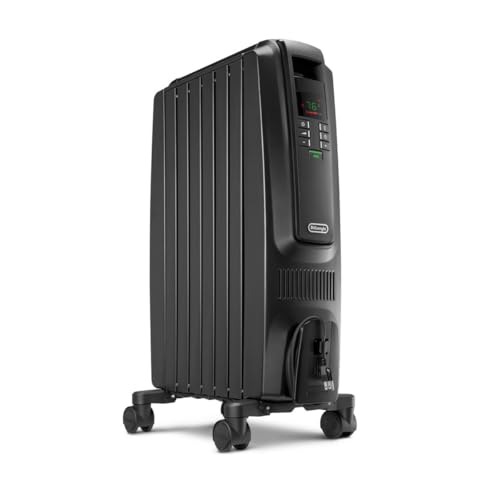
De'Longhi Dragon Digital Oil-Filled Radiator (TRD40615EBK)
The oil-filled radiator with a programmable timer, which is the version that matters overnight: it can bring a bedroom up before you wake and shut itself off, unattended, without you leaving it running all night.
Rated power
1,500 W
Covers (computed)
150 sq ft
Draw (computed)
12.5 A at 120 V
Cost per hour
27.5¢
Coverage at 10 W/sq ft, average insulation, 8 ft ceiling = 5,118 BTU/h. Cost at 18.34¢/kWh; an eight-hour night at full output is $2.20. Exceeds the 12 A continuous limit of a 15 A circuit — check what else shares the breaker.
What works
A programmable timer is the honest answer to “can I leave it on overnight” — you don't have to
Silent, like every oil-filled unit: no fan, no moving air
Digital control means you set a temperature, not a knob position
What does not
Costs more than the mechanical TRD40615T for identical heat output
Same slow warm-up as any oil-filled radiator
Heavy and bulky for its coverage — 26 inches of steel you will not be carrying upstairs
Published specification
Rated power
1,500 W at 120 V
Controls
Digital, with a 24-hour programmable timer
ECO function
Regulates power and temperature rather than running at full output
Dimensions
16" x 10" x 26"
Fluid
Permanently sealed diathermic oil
Safety
Child lock, thermal cut-off
Maker's coverage claim
None published — sold as a full-room heater
Heat type
Oil-filled
Maker’s coverage claim
None published — the coverage figure above is ours
Safety listing
No listing mark published in the listing text; verify the UL or ETL mark on the rating plate.
Who it is for
A bedroom where the heater needs to run on a schedule rather than all night, and where noise would wake you.
What it is not for
A room you need warm in five minutes, or a tight space where a hot 26-inch radiator cannot keep 3 feet of clearance.
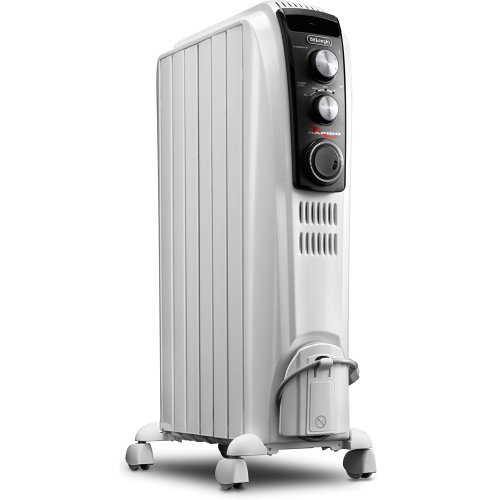
No fan, so no noise and no moving dust — and the sealed oil keeps radiating after the element cuts out, which is why an oil-filled unit feels steadier than a ceramic one at the same wattage.
Rated power
1,500 W
Covers (computed)
150 sq ft
Draw (computed)
12.5 A at 120 V
Cost per hour
27.5¢
Coverage at 10 W/sq ft, average insulation, 8 ft ceiling = 5,118 BTU/h. Cost at 18.34¢/kWh; an eight-hour night at full output is $2.20. Exceeds the 12 A continuous limit of a 15 A circuit — check what else shares the breaker.
What works
Genuinely silent: there is no fan to hear at 3 a.m.
The oil holds heat, so the room temperature swings less between thermostat cycles
Nothing blows air, so nothing stirs up dust in a bedroom
What does not
Slow. It takes 20–30 minutes to feel like it is doing anything
Heavy — the wheels are not a courtesy, they are a requirement
The surface gets genuinely hot; this is a radiator, not a cool-touch case
Published specification
Rated power
1,500 W at 120 V
Controls
Mechanical, with a programmable 24-hour timer
Fluid
Permanently sealed diathermic oil — never needs refilling
Maker's claim
Up to 75% more radiant surface area
Mobility
Front and rear handles, snap-on wheels
Heat type
Oil-filled
Maker’s coverage claim
None published — the coverage figure above is ours
Safety listing
No listing mark published in the listing text; verify the UL or ETL mark on the rating plate.
Who it is for
A bedroom, a nursery at a safe distance, or anywhere the fan noise of a ceramic heater is the actual problem you are trying to solve.
What it is not for
Fast heat, and not a room you only occupy for twenty minutes. It also should never be tucked beside a bed or curtain — hot surface, 3-foot rule.
3 · A published ETL mark on an oil-filled radiator
Amazon Basics Oil-Filled Radiator, 7 Fins, 1500 W
The rare budget radiator that names its safety certificate in the listing rather than leaving you to hunt for the rating plate.
Rated power
1,500 W
Covers (computed)
150 sq ft
Draw (computed)
12.5 A at 120 V
Cost per hour
27.5¢
Coverage at 10 W/sq ft, average insulation, 8 ft ceiling = 5,118 BTU/h. Cost at 18.34¢/kWh; an eight-hour night at full output is $2.20. Exceeds the 12 A continuous limit of a 15 A circuit — check what else shares the breaker.
What works
Publishes an ETL certificate in the listing itself — on this site that is the single most useful thing a budget listing can do
Silent in the way every oil-filled radiator is silent, because there is no fan
A remote on a radiator is more useful than it sounds: these are heavy and you do not want to walk to them
What does not
The wattage of the three heat settings is not published, so only the 1,500 W figure can be costed
Seven fins is a modest radiator — thermal mass is the whole point of the type, and there are bigger ones
No timer and no digital temperature readout: the thermostat is a dial
Published specification
Rated power
1,500 W at 120 V
Fins
7 oil-filled fins
Heat settings
Three
Thermostat
Adjustable
Remote
Included
Safety
Tip-over and overheat protection; ETL safety certificate
Heat type
Oil-filled
Maker’s coverage claim
None published — the coverage figure above is ours
Safety listing
ETL certified — stated explicitly in the listing, which is more than most of this category manages.
Who it is for
A bedroom, nursery or study where silence is the requirement and you want a published safety certificate without paying a premium brand price.
What it is not for
Fast heat, or a large open-plan room. A radiator this size warms a small-to-average room slowly and steadily; that is the design, not a fault.
Oil-filled warmth without the oil-filled price — a mechanical two-knob radiator that does the one thing the type is good at and publishes nothing it does not have.
Rated power
1,500 W / 600 W low
Covers (computed)
150 sq ft
Draw (computed)
12.5 A at 120 V
Cost per hour
27.5¢
Coverage at 10 W/sq ft, average insulation, 8 ft ceiling = 5,118 BTU/h. Cost at 18.34¢/kWh; an eight-hour night at full output is $2.20. Exceeds the 12 A continuous limit of a 15 A circuit — check what else shares the breaker.
What works
Genuinely silent: there is no fan in an oil-filled radiator, so there is nothing to hear
The cheapest route into the quietest heater type, by a wide margin
Two mechanical knobs means no menu, no display and nothing to go wrong electronically
What does not
The listing names no model number, and Pelonis sells this same PHO15A2AGW under at least two Amazon listings with identical titles at different prices — check both before buying
No published listing mark, no timer, no remote, no child lock and no digital thermostat — the thermostat is an unmarked knob
Oil-filled radiators are slow: they warm a room over half an hour, not in two minutes
Published specification
Rated power
600 W / 900 W / 1,500 W at 120 V (all three published by Pelonis)
Controls
Two knobs — mechanical thermostat and power level
Noise
No fan — the type's defining property
Portability
Four heavy-duty caster wheels and a front carry handle
Safety
Tip-over safety switch, overheat protection, power indicator light
Warranty
1 year
Heat type
Oil-filled
Maker’s coverage claim
None published — the coverage figure above is ours
Safety listing
No listing mark is published in the listing text; check the rating plate for UL or ETL.
Who it is for
A bedroom or study where silence matters more than speed, and where the budget will not stretch to a De'Longhi.
What it is not for
Anyone who needs heat quickly, anyone who wants to set an actual temperature rather than a knob position, or a room with a child who can reach the controls — there is no child lock.
Silence is the reason to buy this type, so it is the first criterion. An oil-filled radiator has no fan. That is the entire proposition, and any pick that compromises it is not doing the job.
Published wattages beat published adjectives. A maker who prints 600 W / 900 W / 1,500 W lets you compute what the low setting costs. A maker who prints “3 modes” does not, and we say which is which on every pick.
A named safety listing outranks a nice cabinet. ETL or UL in the published text is worth more here than an extra two fins, because an oil-filled radiator is the heater people most often leave running in a bedroom.
Controls are judged on whether they let the heater stop. A 24-hour timer or a real thermostat is what turns a 27.5-cents-an-hour appliance into a cheaper one; fin count does not.
No thermal-mass claims accepted without arithmetic. See the section below — the residual heat in the oil is real, and it is much smaller than the marketing implies.
And what we did not do: we have not tested these units, owned them, measured them or run them in a room. Everything above is compiled from published manufacturer specifications and live retail listings, with the electrical load, room coverage and running cost computed by us from the published wattage. The full method.
What we’d skip, and why
Every roundup on this site names something to skip. It costs us nothing to publish and it is the fastest way to tell whether a buying guide was written for you or for its commission.
Any oil-filled radiator sold on “more fins means more heat”
Fins change how fast a radiator sheds its heat into the room and how evenly it does it. They do not change how much heat there is. That is set by the element, and the element is capped at 1,500 W the same as every other plug-in heater in the United States. A seven-fin and an eleven-fin radiator running at 1,500 W put exactly 5,118 BTU per hour into your room, because 1,500 W is 5,118 BTU/h and there is nowhere else for the energy to go. Buy more fins for gentler, more even surface temperatures. Do not buy them expecting a warmer room.
An oil-filled radiator for a room you want warm in ten minutes
The thermal mass that makes this type pleasant is the same thermal mass that makes it slow. You are heating perhaps six or seven kilograms of oil and steel before the room sees much of the benefit. If your actual complaint is “this room is freezing when I walk in after work”, a fan-forced or infrared unit will feel dramatically better and an oil-filled radiator will feel broken. Nothing is wrong with it; you have bought the wrong type.
What we could not tell you
Two of the four picks — the Pelonis and the Amazon Basics — publish a number of heat settings but not the wattage of each. We have not filled those in. A 1,500 W radiator's low settings are commonly 600 W and 900 W, and it would be easy to write that down and produce a tidier table, but we would be guessing at a number readers would then use to compute a bill. Where a maker has not published it, the specification row says so.
We have also not tested any of these units, here or anywhere else on this site. There is no lab, no measurement and no “in our testing”. Everything above is published specification, the arithmetic we ran on it, and our reading of what that arithmetic means for a buyer.
One brand needs a page of its own, because its listings are genuinely hard to tell apart: Pelonis oil-filled radiators compared resolves the near-identical listings to two real model numbers, and flags the one that appears twice at different prices.
Questions people actually ask
Are oil-filled radiators cheaper to run than other space heaters?+
No. At the same wattage they cost exactly the same, because every electric resistance heater turns essentially all of its electricity into heat. A 1,500 W oil-filled radiator and a 1,500 W fan heater both cost about 27.5 cents an hour at the U.S. average rate. Where a radiator can genuinely save money is if its thermostat and timer make it run for fewer hours.
Do oil-filled radiators need refilling?+
No. The diathermic oil is sealed in at the factory and is never consumed — it is a heat-transfer medium, not a fuel. A radiator that appears to need oil has a leak and should be replaced, not topped up.
Are oil-filled radiators safe to leave on overnight?+
They are the type best suited to it — no fan, no exposed glowing element, and a surface that is warm rather than hot. That said, the U.S. Fire Administration's advice is to switch any portable heater off when you go to bed, and we do not contradict it. If you are going to run one overnight anyway, a model with a 24-hour timer and a thermostat is the one to do it with. See running a space heater overnight.
How long does an oil-filled radiator take to heat a room?+
Considerably longer than a fan heater — you are warming several kilograms of oil and steel before the room benefits. Budget half an hour or so for a small room to feel different. If that is unacceptable, this is the wrong type and an infrared or fan-forced unit is the right one.
Does more fins mean more heat?+
No. Fin count changes how quickly and evenly the radiator sheds heat, not how much heat exists. That is set by the element, which is capped at 1,500 W on any U.S. plug-in heater. Two radiators at 1,500 W deliver the same 5,118 BTU per hour regardless of fin count.
A remote is worth what it can change. Ranked by how much control it actually hands you.
Written by Scooter M., an enthusiast — not a tester and not a certified anything. Every figure on this page is either published by the manufacturer, taken from a live retail listing, or computed from the published wattage using the formulas we publish. Found an error? Tell us and we will correct it, visibly and with a date on it.