They are all 100% efficient. The unit that costs you least is the one that runs least, and that is a control question, not an element question.
By Scooter M. · Published August 31, 2026 · Last reviewed August 31, 2026
How this page is funded: we earn a commission if you buy through the links here, at no extra cost to you. Picks are chosen before links are attached, which is why every roundup names something to skip. Full disclosure.
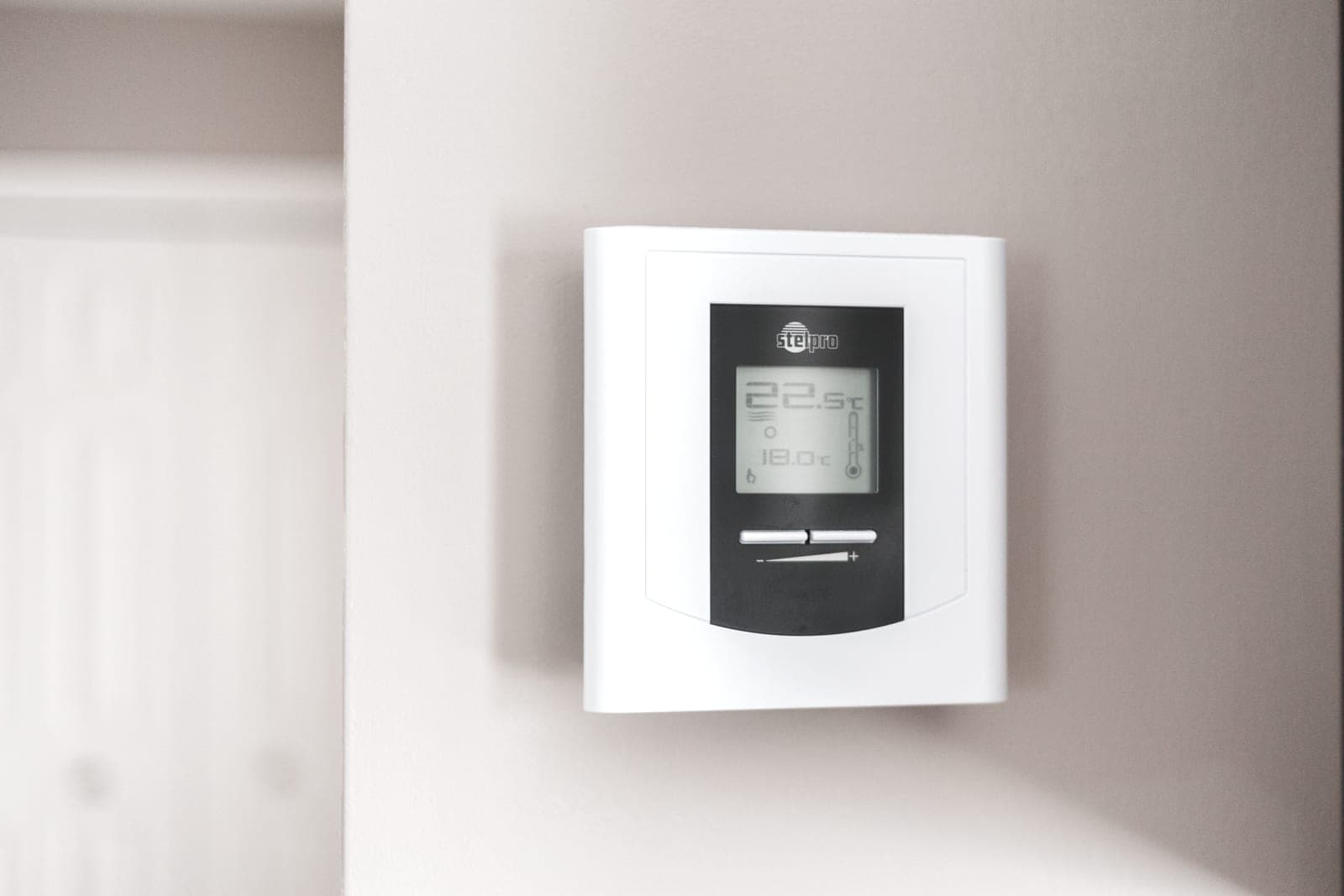
Every resistive electric heater converts essentially 100% of its electricity into heat, so no model is more efficient than another. What lowers the bill is a thermostat accurate enough not to overshoot, a low wattage setting when the room allows it, and a timer that stops the heater running when nobody is there.
Why the efficiency question has no answer
There is no flue, no combustion and no waste stream. Every joule of electricity a heater draws ends up as heat in the room it is standing in — including the joules that ran the fan, the display and the thermostat, because those also end up as heat. This is close to a physical certainty rather than a manufacturer claim, and it applies identically to a $40 ceramic tower and a $700 designer unit.
So a roundup titled “most energy-efficient space heaters” is, taken literally, a roundup of every space heater. The useful version of the question is different: which heater will end up consuming the fewest kilowatt-hours in my room? That has a real answer, and it is decided by three things.
The three levers that actually exist
1. Thermostat accuracy. A heater that holds 68°F costs less than one that overshoots to 73°F, because every degree of overshoot is energy you paid for and then opened a window to lose. A digital thermostat set in 1°F increments is a genuine, measurable saving over an unmarked dial — and it is the single most reliable way to spend money once and save it every night.
2. Wattage choice. Power scales linearly with cost. 750 W costs exactly half of 1,500 W per hour, with no efficiency penalty at part load. In a room that needs 1,000 W, running a 1,500 W unit on high is not faster in any way that matters; it just overshoots sooner.
Wattage
8 h/day
750 W
$33.01
1,000 W
$44.02
1,500 W
$66.02
Computed at 18.34¢/kWh — the U.S. residential average for June 2026 (EIA, Electric Power Monthly, Table 5.6.A, released August 26, 2026). Your rate is on your own bill; substitute it and the arithmetic still holds. Monthly figures are 30-day months at full output; a thermostat that cycles will reduce them.
3. Runtime. The cheapest kilowatt-hour is the one you do not use. A timer that shuts the heater off two hours after bedtime removes six hours of running from every night, which is a larger effect than any control precision.
Because that second criterion does most of the work, it has a page of its own: best space heaters with a thermostat ranks four units on how specific their published temperature control actually is, and explains the difference between a thermostat that holds a number and a dial that merely clicks out somewhere. If the budget is the binding constraint instead, best budget space heaters shows what you do and do not give up at the bottom of the market.
The picks
Quick picks
Ranked for fit, not for hype. Coverage and current draw are computed from each unit’s published wattage. Tap a row for the full write-up, or go straight to the listing.
#
Product
Best for
Covers
Draw
Price
1
Lasko 754201The 900 W low setting is the whole point: it is the rare listing that publishes both settings, so you can compute what the cheap mode actually costs instead of guessing.
Dreo Solaris 718The rare heater whose published coverage claim survives the arithmetic: 1,500 W is a genuine 300 sq ft at 10 W/sq ft, and Dreo publishes that number rather than implying more.
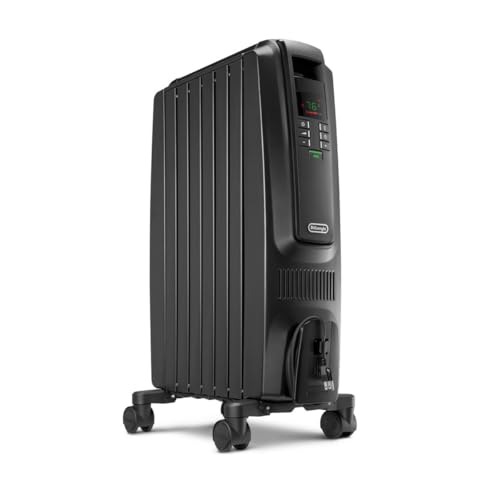
De'Longhi Dragon DigitalThe oil-filled radiator with a programmable timer, which is the version that matters overnight: it can bring a bedroom up before you wake and shut itself off, unattended, without you leaving it running all night.
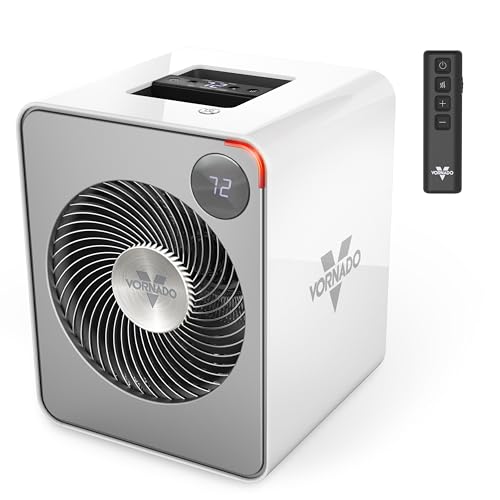
Vornado VMHi500The current top of Vornado's metal line: auto-climate control, two LED displays and a 1-12 hour timer in a cool-touch metal box, backed by five years.
The 900 W low setting is the whole point: it is the rare listing that publishes both settings, so you can compute what the cheap mode actually costs instead of guessing.
Rated power
1,500 W / 900 W low
Covers (computed)
150 sq ft
Draw (computed)
12.5 A at 120 V
Cost per hour
27.5¢
Coverage at 10 W/sq ft, average insulation, 8 ft ceiling = 5,118 BTU/h. Cost at 18.34¢/kWh; an eight-hour night at full output is $2.20. Exceeds the 12 A continuous limit of a 15 A circuit — check what else shares the breaker.
What works
Both wattages are published, which is what makes an honest cost comparison possible
9 inches tall: it fits under a desk without being in the way
Manual top-mounted controls — nothing to relearn, nothing to lose the remote for
What does not
A dial thermostat with no numbers on it: you cannot set 68°F, only “about there”
No child lock, so the dial is reachable by anyone who can reach the unit
Fan noise is the price of a small ceramic unit moving 1,500 W of heat
ETL listed, per Lasko's published specification — one of the few in this roundup that names a mark rather than leaving it to the rating plate.
Who it is for
A desk, a small office, a dorm room — somewhere you want heat on a person rather than in a room.
What it is not for
A nursery, and not unattended use. It publishes a tip-over switch and overheat protection, but no child lock — and the USFA's advice to switch a heater off when you leave the room applies to every unit on this site, listed or not.
The rare heater whose published coverage claim survives the arithmetic: 1,500 W is a genuine 300 sq ft at 10 W/sq ft, and Dreo publishes that number rather than implying more.
Rated power
1,500 W
Covers (computed)
150 sq ft
Draw (computed)
12.5 A at 120 V
Cost per hour
27.5¢
Coverage at 10 W/sq ft, average insulation, 8 ft ceiling = 5,118 BTU/h. Cost at 18.34¢/kWh; an eight-hour night at full output is $2.20. Exceeds the 12 A continuous limit of a 15 A circuit — check what else shares the breaker.
What works
A digital thermostat with numbers on it — you can set 68°F rather than guess at a dial
The published 300 sq ft claim matches the standard sizing rule instead of exceeding it
8 lb and 8 inches square: it moves room to room without a project
What does not
1,500 W is 1,500 W — nothing here heats faster than any other 1,500 W heater
Dreo does not publish a noise figure in decibels on the product page
Tall and narrow, which is a tipping profile: the tip-over cutoff matters more here
A living room, bedroom or den at or under 300 sq ft with average insulation and an 8-foot ceiling, where you want to set a temperature and stop thinking about it.
What it is not for
A garage, an uninsulated basement, or anything over about 300 sq ft. It is not under-powered — 1,500 W is the plug-in ceiling — the room is simply too big for one outlet.
De'Longhi Dragon Digital Oil-Filled Radiator (TRD40615EBK)
The oil-filled radiator with a programmable timer, which is the version that matters overnight: it can bring a bedroom up before you wake and shut itself off, unattended, without you leaving it running all night.
Rated power
1,500 W
Covers (computed)
150 sq ft
Draw (computed)
12.5 A at 120 V
Cost per hour
27.5¢
Coverage at 10 W/sq ft, average insulation, 8 ft ceiling = 5,118 BTU/h. Cost at 18.34¢/kWh; an eight-hour night at full output is $2.20. Exceeds the 12 A continuous limit of a 15 A circuit — check what else shares the breaker.
What works
A programmable timer is the honest answer to “can I leave it on overnight” — you don't have to
Silent, like every oil-filled unit: no fan, no moving air
Digital control means you set a temperature, not a knob position
What does not
Costs more than the mechanical TRD40615T for identical heat output
Same slow warm-up as any oil-filled radiator
Heavy and bulky for its coverage — 26 inches of steel you will not be carrying upstairs
Published specification
Rated power
1,500 W at 120 V
Controls
Digital, with a 24-hour programmable timer
ECO function
Regulates power and temperature rather than running at full output
Dimensions
16" x 10" x 26"
Fluid
Permanently sealed diathermic oil
Safety
Child lock, thermal cut-off
Maker's coverage claim
None published — sold as a full-room heater
Heat type
Oil-filled
Maker’s coverage claim
None published — the coverage figure above is ours
Safety listing
No listing mark published in the listing text; verify the UL or ETL mark on the rating plate.
Who it is for
A bedroom where the heater needs to run on a schedule rather than all night, and where noise would wake you.
What it is not for
A room you need warm in five minutes, or a tight space where a hot 26-inch radiator cannot keep 3 feet of clearance.
The current top of Vornado's metal line: auto-climate control, two LED displays and a 1-12 hour timer in a cool-touch metal box, backed by five years.
Rated power
1,500 W
Covers (computed)
150 sq ft
Draw (computed)
12.5 A at 120 V
Cost per hour
27.5¢
Coverage at 10 W/sq ft, average insulation, 8 ft ceiling = 5,118 BTU/h. Cost at 18.34¢/kWh; an eight-hour night at full output is $2.20. Exceeds the 12 A continuous limit of a 15 A circuit — check what else shares the breaker.
What works
Auto-Climate Control adjusts output to hold a temperature rather than running flat out — the cycling behavior that genuinely lowers consumption
A 1–12 hour timer means it can stop on its own, which is the only reliable way an overnight heater saves money
Five years on a heater at this price is a costed commitment, not a marketing line
What does not
Vornado publishes no wattage and no coverage figure, so every sizing and cost number here is ours, computed from the retail-listed 1,500 W
No child lock is published — the same gap the rest of Vornado's range has, and it is disqualifying for a nursery
It is a fan heater in a metal box: moving air is the mechanism and you will hear it
Published specification
Rated power
1,500 W at 120 V (retail listings; Vornado publishes settings, not watts)
Heat settings
2, plus fan-only
Thermostat
Auto-Climate Control, digital
Timer
1–12 hours
Display
Two LED displays, for reading it from across the room
Housing
Cool-touch, powder-coated gloss metal cabinet with cord storage
Safety
Tip-over protection and a 2-stage auto shutoff
Warranty
5-year satisfaction guarantee
Heat type
Fan-forced
Maker’s coverage claim
None published — the coverage figure above is ours
Safety listing
Vornado publishes tip-over protection and a 2-stage auto shutoff but does not name a listing mark; check the rating plate.
Who it is for
A living room or bedroom where the heater is permanent and visible, and where a real thermostat, a timer and a cool metal shell are worth paying for over a plastic tower.
What it is not for
A nursery, because no child lock is published; and not silence, which means an oil-filled radiator instead.
Every roundup on this site names something to skip. It costs us nothing to publish and it is the fastest way to tell whether a buying guide was written for you or for its commission.
Any heater advertising energy savings of a specific percentage
“Saves up to 50% on your heating bill” is the most common claim in this category and it is not a property of the heater. The same goes for an efficiency badge: ENERGY STAR certifies no portable space heaters at all, so a logo on one of these listings is not a certification. A 1,500 W heater consumes 1.5 kWh per hour of running, the same as every other 1,500 W heater — there is no element, coating, coil or chip that changes that. A saving can only come from heating a smaller space, for less time, to a lower temperature. When a listing attributes savings to the product rather than to the behavior, it is telling you it will say anything, which should affect how you read its safety claims too.
A “1,500 W equivalent” heater rated below 1,500 W
Equivalence claims in this category almost always mean the unit feels comparable because it is radiant and points at you. That can be genuinely true for personal comfort and it is a reasonable thing to sell — but it is not equivalent output, and it will not hold a room at a setpoint the way the wattage it is being compared to would. Read the rated wattage, size the room from that number, and treat the equivalence as marketing.
How these were picked
A thermostat with numbers on it. Overshoot is the largest avoidable cost, and you cannot avoid what you cannot set.
A published low setting. Half the watts is half the cost, exactly, with no efficiency penalty.
A timer, because the cheapest hour is the one the heater does not run.
Heat retention where it exists, since an oil-filled unit's mass genuinely reduces cycling frequency.
No credit for efficiency claims, which are physically meaningless in this category.
And what we did not do: we have not tested these units, owned them, measured them or run them in a room. Everything above is compiled from published manufacturer specifications and live retail listings, with the electrical load, room coverage and running cost computed by us from the published wattage. The full method.
Questions people actually ask
Which space heater uses the least electricity?+
The one with the lowest wattage setting you can live with, and the best thermostat. A 750 W heater uses half the electricity of a 1,500 W one. No element type is more efficient than another — they are all essentially 100%.
Do infrared heaters save money?+
They can, but not through efficiency. Radiant heat makes a person feel warm without raising the whole room's air temperature, so you may run the heater less or at a lower setting. Per kilowatt-hour consumed, the cost is identical.
Is it cheaper to run a space heater on low all day or high for an hour?+
Compare kilowatt-hours. 750 W for eight hours is 6 kWh; 1,500 W for one hour is 1.5 kWh. The short burst is cheaper. Whether it keeps the room comfortable is a separate question.
Do energy-saving space heaters exist?+
Not in the sense the phrase implies. Every electric resistance heater converts electricity to heat at the same rate. Features that genuinely reduce consumption are accurate thermostats, low wattage settings, timers and eco modes that cycle rather than run continuously.
150 W warms a person; 600 W holds about 60 sq ft. The picks, the amps, and what each wattage honestly covers.
Written by Scooter M., an enthusiast — not a tester and not a certified anything. Every figure on this page is either published by the manufacturer, taken from a live retail listing, or computed from the published wattage using the formulas we publish. Found an error? Tell us and we will correct it, visibly and with a date on it.