There is no ENERGY STAR category for portable electric heaters. That is not an oversight — it is a direct consequence of how these things work, and it tells you what to look for instead.
By Scooter M. · Published September 7, 2026 · Last reviewed September 7, 2026
How this page is funded: we earn a commission if you buy through the links here, at no extra cost to you. Picks are chosen before links are attached, which is why every roundup names something to skip. Full disclosure.
No. ENERGY STAR certifies no portable electric space heaters — the program has no such category. Its heating list covers air-source heat pumps, boilers, ductless heating and cooling, furnaces, geothermal heat pumps and smart thermostats. Any listing advertising an “ENERGY STAR space heater” is misusing the label.
What ENERGY STAR actually certifies
We read ENERGY STAR's own product pages for this rather than working from memory. Here is every heating-related category on the program's list, quoted as the program writes them:
ENERGY STAR heating category
Portable electric heater?
Air-Source Heat Pumps
No
Boilers
No
Commercial Boilers
No
Ductless Heating & Cooling
No
Furnaces
No
Geothermal Heat Pumps
No
Light Commercial Heating & Cooling
No
Smart Thermostats
No
Read from energystar.gov/products and energystar.gov/products/products-list. No entry for space heaters, portable heaters or room heaters appears on either page.
Note what those categories have in common: every one is a system — something installed, ducted, plumbed or wired in — or a control for one. There is no portable plug-in appliance in the heating list at all.
Why there is no category (our reasoning, not theirs)
ENERGY STAR does not publish a statement explaining the absence, so what follows is our inference and we are labeling it as ours. But it is not a difficult one, and it is the same fact this entire site is built on.
A certification program exists to separate better products from worse ones on a measurable axis. That requires a spread — some products meaningfully outperforming others. For portable electric heaters, on efficiency, that spread does not exist.
Every electric resistance heater converts essentially 100% of its input electricity into heat. There is no flue, no combustion and nowhere else for the energy to go — including the power that spins the fan and lights the display, which also ends up as heat in your room. A $40 ceramic tower and a $600 designer unit at the same wattage produce the same warmth and cost the same per hour to run. The full argument.
So a hypothetical “ENERGY STAR certified space heater” would be a label certifying that a product hit an efficiency figure every competing product also hits, by physics, without trying. There would be nothing to award.
So what is that listing you are looking at?
If a retail listing shows an ENERGY STAR logo next to a portable heater, one of four things is happening. It is worth knowing which, because only one of them is benign.
1.The seller has used the mark without certification. The most common case, and the one to walk away from. A logo dropped into a marketing image costs nothing to add and is unverifiable from the listing itself.
2.The product is not a resistance heater. Some listings sold under “heater” are heat pumps or mini-split units, and those genuinely can be certified. If so, it is a different appliance class with a different price and an installation requirement.
3.The seller means “energy efficient” generically. Loose marketing language rather than a claim about the program. Harmless in intent, useless as information — and it tells you the listing's other claims deserve the same skepticism.
4.A bundled or adjacent product carries the mark. Occasionally a smart thermostat or a fan in the same listing family is certified, and the mark migrates across the page to a product that is not.
What to check instead
Ruling out an efficiency label does not leave you with nothing to compare. It moves the comparison to the things that genuinely change what a heater consumes — none of which is the element, and all of which are on the box.
1.A thermostat you can set to a number. Overshoot is the single largest avoidable cost in resistance heating. A digital thermostat in 1°F increments holds 68°F; an unmarked dial gets found by trial and error, and most people end up setting it high and opening a window.
2.A published low setting. 750 W costs exactly half of 1,500 W per hour, linearly, with no efficiency penalty at part load. In a room that needs 1,000 W, running at 1,500 W just overshoots sooner. Which wattage your room needs.
3.A timer. The cheapest kilowatt-hour is the one you never use. A timer that removes six hours from every night removes most of a nightly bill, and it is also the honest answer to running a heater overnight.
4.An eco or auto mode that cycles rather than running flat out — the only mechanism by which any electric heater genuinely reduces consumption.
And the largest lever of all is not on the heater at all: turn the whole-house thermostat down while the heater runs. A space heater only saves money if it lets you heat less of the house. Running one on top of an unchanged furnace setting is pure addition. The arithmetic against central heat.
What those levers are actually worth
Here is the whole efficiency conversation for a portable heater, in one table. The saving comes from the wattage and the hours — not from anything a certification could measure.
Wattage
4 h/day
8 h/day
750 W
$16.51
$33.01
1,000 W
$22.01
$44.02
1,500 W
$33.01
$66.02
Computed at 18.34¢/kWh — the U.S. residential average for June 2026 (EIA, Electric Power Monthly, Table 5.6.A, released August 26, 2026). Your rate is on your own bill; substitute it and the arithmetic still holds. Monthly figures are 30-day months at full output; a thermostat that cycles will reduce them.
Compare the 750 W row against the 1,500 W row: that is a genuine halving, available on any heater with a published low setting, and no label was involved. Compare the 4-hour column against the 8-hour column for the same effect from a timer.
The certification that does matter
There is a mark worth looking for on a space heater. It is not about efficiency — it is about safety.
UL and ETL are both marks of Nationally Recognized Testing Laboratories under the OSHA NRTL program, and for a portable room heater both mean the unit was tested to the same published standard, UL 1278. Neither is superior to the other. That listing tells you a sample of the model was tested for construction, temperature limits, electrical spacing and abnormal-operation behavior, and that the factory is subject to follow-up inspection.
It is also, like the ENERGY STAR logo, trivially faked in a marketplace image — so check the rating plate on the unit itself for the mark and a file number rather than trusting a picture. How to verify a listing yourself.
Picks chosen on the levers that exist
Quick picks
Ranked for fit, not for hype. Coverage and current draw are computed from each unit’s published wattage. Tap a row for the full write-up, or go straight to the listing.
#
Product
Best for
Covers
Draw
Price
1
Dreo Solaris 718The rare heater whose published coverage claim survives the arithmetic: 1,500 W is a genuine 300 sq ft at 10 W/sq ft, and Dreo publishes that number rather than implying more.
Lasko 5586A long-running 1,500 W tower with a digital thermostat, an 8-hour timer and a remote — the cheap end of the category without the missing-safety-feature problem the cheap end usually has.
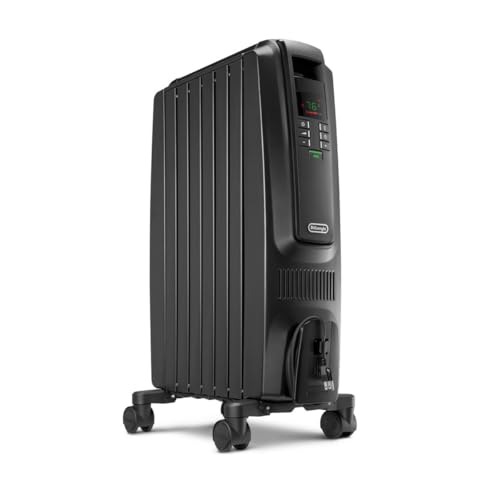
De'Longhi Dragon DigitalThe oil-filled radiator with a programmable timer, which is the version that matters overnight: it can bring a bedroom up before you wake and shut itself off, unattended, without you leaving it running all night.
Pasapair HP2501-15AWThe rare mica panel that publishes all three of its wattages and a thermostat you can set to the degree — which is what makes the cheap settings costable instead of guessable.
The rare heater whose published coverage claim survives the arithmetic: 1,500 W is a genuine 300 sq ft at 10 W/sq ft, and Dreo publishes that number rather than implying more.
Rated power
1,500 W
Covers (computed)
150 sq ft
Draw (computed)
12.5 A at 120 V
Cost per hour
27.5¢
Coverage at 10 W/sq ft, average insulation, 8 ft ceiling = 5,118 BTU/h. Cost at 18.34¢/kWh; an eight-hour night at full output is $2.20. Exceeds the 12 A continuous limit of a 15 A circuit — check what else shares the breaker.
What works
A digital thermostat with numbers on it — you can set 68°F rather than guess at a dial
The published 300 sq ft claim matches the standard sizing rule instead of exceeding it
8 lb and 8 inches square: it moves room to room without a project
What does not
1,500 W is 1,500 W — nothing here heats faster than any other 1,500 W heater
Dreo does not publish a noise figure in decibels on the product page
Tall and narrow, which is a tipping profile: the tip-over cutoff matters more here
A living room, bedroom or den at or under 300 sq ft with average insulation and an 8-foot ceiling, where you want to set a temperature and stop thinking about it.
What it is not for
A garage, an uninsulated basement, or anything over about 300 sq ft. It is not under-powered — 1,500 W is the plug-in ceiling — the room is simply too big for one outlet.
Lasko 5586 Oscillating Digital Ceramic Tower Heater (29 in)
A long-running 1,500 W tower with a digital thermostat, an 8-hour timer and a remote — the cheap end of the category without the missing-safety-feature problem the cheap end usually has.
Rated power
1,500 W
Covers (computed)
150 sq ft
Draw (computed)
12.5 A at 120 V
Cost per hour
27.5¢
Coverage at 10 W/sq ft, average insulation, 8 ft ceiling = 5,118 BTU/h. Cost at 18.34¢/kWh; an eight-hour night at full output is $2.20. Exceeds the 12 A continuous limit of a 15 A circuit — check what else shares the breaker.
What works
Digital thermostat and a timer at the price most units charge for a two-position knob
Oscillation moves the air rather than roasting whatever is directly in front of it
A model that has been on sale long enough for its failure modes to be well known
What does not
“For large rooms” is a marketing phrase, not a number — Lasko publishes no coverage figure
No child lock, which matters if the reason you are shopping is a nursery
Plastic housing and a light chassis: it will tip if a dog leans on it
Published specification
Rated power
1,500 W at 120 V
Maker's coverage claim
None published — listed as “for large rooms”
Controls
Digital thermostat, remote, 8-hour auto-off timer
Height
29"
Safety
Cool-touch housing, overheat protection
Heat type
Ceramic (PTC)
Maker’s coverage claim
None published — the coverage figure above is ours
Safety listing
Lasko does not publish a listing mark on the Amazon listing text; check the unit's own rating plate for the UL or ETL mark before you use it.
Who it is for
Someone heating one main room who wants a thermostat and a timer and is not willing to pay a premium for a metal cabinet.
What it is not for
A room with a toddler or a curious pet. Without a child lock, the controls are one press away from full output at floor height.
De'Longhi Dragon Digital Oil-Filled Radiator (TRD40615EBK)
The oil-filled radiator with a programmable timer, which is the version that matters overnight: it can bring a bedroom up before you wake and shut itself off, unattended, without you leaving it running all night.
Rated power
1,500 W
Covers (computed)
150 sq ft
Draw (computed)
12.5 A at 120 V
Cost per hour
27.5¢
Coverage at 10 W/sq ft, average insulation, 8 ft ceiling = 5,118 BTU/h. Cost at 18.34¢/kWh; an eight-hour night at full output is $2.20. Exceeds the 12 A continuous limit of a 15 A circuit — check what else shares the breaker.
What works
A programmable timer is the honest answer to “can I leave it on overnight” — you don't have to
Silent, like every oil-filled unit: no fan, no moving air
Digital control means you set a temperature, not a knob position
What does not
Costs more than the mechanical TRD40615T for identical heat output
Same slow warm-up as any oil-filled radiator
Heavy and bulky for its coverage — 26 inches of steel you will not be carrying upstairs
Published specification
Rated power
1,500 W at 120 V
Controls
Digital, with a 24-hour programmable timer
ECO function
Regulates power and temperature rather than running at full output
Dimensions
16" x 10" x 26"
Fluid
Permanently sealed diathermic oil
Safety
Child lock, thermal cut-off
Maker's coverage claim
None published — sold as a full-room heater
Heat type
Oil-filled
Maker’s coverage claim
None published — the coverage figure above is ours
Safety listing
No listing mark published in the listing text; verify the UL or ETL mark on the rating plate.
Who it is for
A bedroom where the heater needs to run on a schedule rather than all night, and where noise would wake you.
What it is not for
A room you need warm in five minutes, or a tight space where a hot 26-inch radiator cannot keep 3 feet of clearance.
4 · A slim fanless panel, on the wall or on castors
Pasapair HP2501-15AW Mica Panel Heater
The rare mica panel that publishes all three of its wattages and a thermostat you can set to the degree — which is what makes the cheap settings costable instead of guessable.
Rated power
1,500 W / 600 W low
Covers (computed)
150 sq ft
Draw (computed)
12.5 A at 120 V
Cost per hour
27.5¢
Coverage at 10 W/sq ft, average insulation, 8 ft ceiling = 5,118 BTU/h. Cost at 18.34¢/kWh; an eight-hour night at full output is $2.20. Exceeds the 12 A continuous limit of a 15 A circuit — check what else shares the breaker.
What works
All three wattages are published — 600 W, 900 W and 1,500 W — so the economical settings cost 11.0¢ and 16.5¢ an hour rather than an unknown amount
A thermostat set to the degree from 41 to 97°F, plus an anti-frost mode preset at 41°F for a room you are only keeping above freezing
Fanless by construction: mica panels radiate and convect, so there is no blower to hear and nothing blown off the floor
The wall-mount kit and the castors are both in the box, so the floor-space decision is not an extra purchase
What does not
The brand publishes nothing outside this listing. We could find no manufacturer site or spec sheet for Pasapair, so every figure here has exactly one source — unlike the De'Longhi it replaces, whose maker published its own page
The 250 sq ft coverage claim is 6 W per square foot. At the 10 W per square foot this site sizes by, 1,500 W covers about 150 sq ft, and in a drafty room about 120
No UL or ETL mark is published anywhere in the listing; the IP24 figure in the title is water ingress and is not a safety listing
The app needs 2.4 GHz Wi-Fi, the remote's batteries are not included, and the listing's own dimension fields are implausible for a 1,500 W panel — so we do not publish a size for it
Published specification
Rated power
600 W / 900 W / 1,500 W at 120 V — all three published on the listing
Element
Mica panels behind a perforated metal front panel; no fan
Thermostat
41–97°F set-point
Modes
Comfort, ECO, Anti-Frost (preset at 41°F) and Open Window Detection
Controls
Touch panel, remote (2 AAA, not included), Smart Life app and Alexa; 2.4 GHz Wi-Fi only
Timer
24/7 weekly scheduling through the app
Mounting
Wall-mount kit and 360° swivel castors both in the box; rear carry handle
Safety
Overheat protection and a tip-over switch
Maker's coverage claim
“rooms up to 250 sq. ft.” — our figure is 150 sq ft at 10 W per square foot
Warranty
12 months
Heat type
Micathermic
Maker’s coverage claim
250 sq ft
Safety listing
No UL or ETL mark is published in the listing. The title's IP24 claim is a water-ingress rating, not a safety listing — check the rating plate.
Who it is for
A small bedroom, study or hallway where floor space is tight and fan noise is the thing you are trying to avoid, and where being able to run 600 W rather than 1,500 W all evening matters.
What it is not for
A nursery or a home with toddlers at floor level — a mica panel is hot to the touch by design, and there is no child lock. Also not a large or drafty room: 1,500 W is 1,500 W whatever the listing claims.
The claim was checked at the source, not remembered. Both of ENERGY STAR's own product listings were read for this page and are cited below.
Where we reason rather than quote, we say so. ENERGY STAR does not publish an explanation for the absence; the explanation below is ours and is labeled as ours.
Picks are chosen on the three features that genuinely reduce consumption — thermostat precision, a published low setting and a timer — because efficiency itself does not vary.
And what we did not do: we have not tested these units, owned them, measured them or run them in a room. Everything above is compiled from published manufacturer specifications and live retail listings, with the electrical load, room coverage and running cost computed by us from the published wattage. The full method.
Questions people actually ask
Are there ENERGY STAR certified space heaters?+
No. ENERGY STAR has no product category for portable electric space heaters. Its heating list covers air-source heat pumps, boilers, ductless heating and cooling, furnaces, geothermal heat pumps and smart thermostats — all systems, not plug-in appliances.
Why is there no ENERGY STAR rating for space heaters?+
ENERGY STAR does not publish a reason, but the likely one is that there is nothing to rank. Every electric resistance heater converts essentially 100% of its electricity into heat, so there is no efficiency spread between products for a label to distinguish.
A listing says ENERGY STAR space heater — is it real?+
Almost certainly not. Check the model in ENERGY STAR's public product finder: certified products are all in that database. For a portable resistance heater it will not be there, because the category does not exist.
What certification should a space heater have?+
A safety listing — UL or ETL, tested to UL 1278 for movable electric room heaters. Both marks mean the same thing and neither is superior. Check the rating plate on the unit rather than a logo in a product photo.
What is the most energy efficient space heater?+
They are all equally efficient at converting electricity to heat. The one that consumes least is the one with an accurate thermostat, a low wattage setting you can use, and a timer — and it consumes least of all when you turn the main heating system down at the same time.
The monthly figure at 4, 8, 12 and 24 hours a day — including the 24/7 case, computed.
Written by Scooter M., an enthusiast — not a tester and not a certified anything. Every figure on this page is either published by the manufacturer, taken from a live retail listing, or computed from the published wattage using the formulas we publish. Found an error? Tell us and we will correct it, visibly and with a date on it.