The best space heater brands, ranked on what they publish
Brand loyalty in this category is mostly inherited. Here is a way to choose one that does not require trusting anybody — including us.
By Scooter M. · Published October 3, 2026 · Last reviewed October 3, 2026
How this page is funded: we earn a commission if you buy through the links here, at no extra cost to you. Picks are chosen before links are attached, which is why every roundup names something to skip. Full disclosure.
There is no single best space heater brand, but there is a way to rank them that does not rely on anyone's opinion. Of the 29 purchasable heaters we track across 15 brands, 11 publish a warranty, 8 name a safety listing mark and 7 publish a thermostat set-point in degrees. No brand publishes all three consistently.
Why “which brand” is a harder question than it looks
Every electric resistance heater is about 100% efficient, so at the same wattage every brand on this page delivers identical heat for identical money. That removes the thing you would most want to compare brands on. What is left is build, control and support — and we cannot measure build, because we do not test products and will not pretend otherwise.
So we counted something we can actually check. For each of the 28 heaters in our registry with a live listing, we recorded three facts that a manufacturer either states or does not: how long the warranty is, whether a safety listing mark is named, and whether the thermostat has a published range in degrees. None of those is a quality measurement. All three are commitments, and a maker who will not make them is telling you something.
What each brand publishes
Brand
Units tracked
Warranty published
Listing mark named
Set-point in degrees
Lasko
4
3 of 4 — 3 years
3 of 4 — ETL
0 of 4
Dr. Infrared Heater
4
2 of 4 — 1 year
2 of 4 — UL and cUL
3 of 4
De'Longhi
3
0 of 3
0 of 3
0 of 3
Dreo
3
0 of 3
1 of 3 — ETL
3 of 3 — 41–95°F
Vornado
2
2 of 2 — 5 years
0 of 2
0 of 2
Comfort Zone
2
2 of 2 — 1 year
0 of 2
0 of 2
Pelonis
2
1 of 2 — 1 year
1 of 2
1 of 2 — 41–95°F
Amazon Basics
2
0 of 2
1 of 2
0 of 2
Honeywell
1
1 of 1 — 3 years
0 of 1
0 of 1
Dyson
1
0 of 1
0 of 1
0 of 1
Heat Storm
1
0 of 1
0 of 1
0 of 1
BLACK+DECKER
1
0 of 1
0 of 1
0 of 1
Fahrenheat
1
0 of 1
0 of 1
0 of 1
Global Industrial
1
0 of 1
0 of 1
0 of 1
Sengoku
1
0 of 1
0 of 1
0 of 1
All brands
29
11 of 29
8 of 29
7 of 29
Counted across the 29 purchasable heaters in our registry as of 3 October 2026, not across each brand's full catalog. “Set-point” means a range in degrees, not the word “adjustable”.
Read down the columns and the trade-offs are immediate. Lasko is strong on two of the three — ETL on three of four units and a three-year warranty — and publishes a set-point on none of them, because Lasko sells dial thermostats with no numbers on the dial. Dreo is the mirror image: every Dreo unit publishes 41–95°F in 1°F steps, and not one publishes a warranty. Vornado has the longest warranty in the category at five years, names no listing mark on either unit, and publishes neither wattage nor coverage anywhere.
Exactly 2 of the 29 heaters publish all three facts — and both are Dr. Infrared units: the DR-966 and the DR-218. That is the single most useful thing on this page, and it comes with a wrinkle worth stating. Neither is a normal portable heater: the DR-966 is a hardwired 240 V unit heater that needs an electrician, and on the DR-218 all three figures come from retail listings rather than from iLiving's own page, which we flag on its product card. The best-documented heaters in this category are the ones sold to people who are going to be asked for a spec by a contractor.
What the three facts are actually worth
A warranty is the only durability figure anyone commits to. No maker publishes a service life for a portable heater, so any "these last 5–10 years" claim is unsourced — do not take one from us either. A five-year warranty on a $100 heater is a costed decision by someone who knows the return rate, and that makes it the closest thing to evidence in the category. What actually fails, and in what order.
A named listing mark is weaker than it sounds, and still worth having. UL and ETL test to the same standard, so neither is better than the other — the difference is the lab, not the bar. But note what the table does not say: an unnamed mark does not mean an unlisted heater. Most of these units almost certainly carry a mark on the rating plate. What the column measures is whether the maker will state it where you can read it before buying.
A set-point in degrees is the one that changes your bill. Hours are the only variable in running cost, and a thermostat you can set to 62°F removes hours in a way a dial marked “low–high” cannot, because you end up overshooting and opening a window. This is why Dreo's clean sweep of that column matters more than it looks: 41–95°F in 1°F increments is a genuinely better control surface than anything Lasko or Vornado ships. Why hours are the only lever.
The picks
Quick picks
Ranked for fit, not for hype. Coverage and current draw are computed from each unit’s published wattage. Tap a row for the full write-up, or go straight to the listing.
#
Product
Best for
Covers
Draw
Price
1
Lasko 755320A 23-inch digital tower with a thermostat, an 8-hour timer and a remote — and the only heater here whose published coverage figure lands exactly where our own sizing rule puts it.
The maker's coverage claim that matches the arithmetic
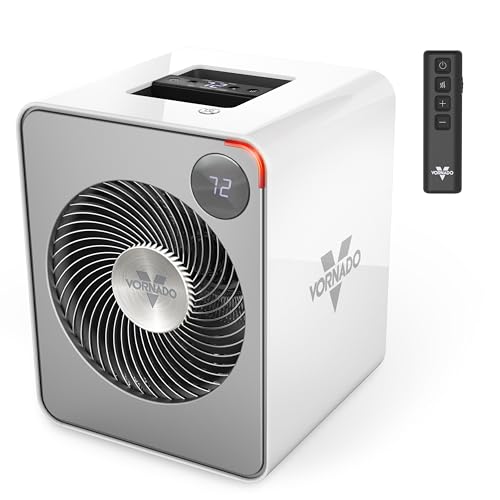
Vornado VMHi500The current top of Vornado's metal line: auto-climate control, two LED displays and a 1-12 hour timer in a cool-touch metal box, backed by five years.
Dreo Solaris 718The rare heater whose published coverage claim survives the arithmetic: 1,500 W is a genuine 300 sq ft at 10 W/sq ft, and Dreo publishes that number rather than implying more.
Honeywell HCE220BA shoebox-sized ceramic heater that publishes four preset temperatures and a 2/4/8-hour auto-off — specificity almost nothing else this size offers.
A thermostat with numbers on it, on a small heater
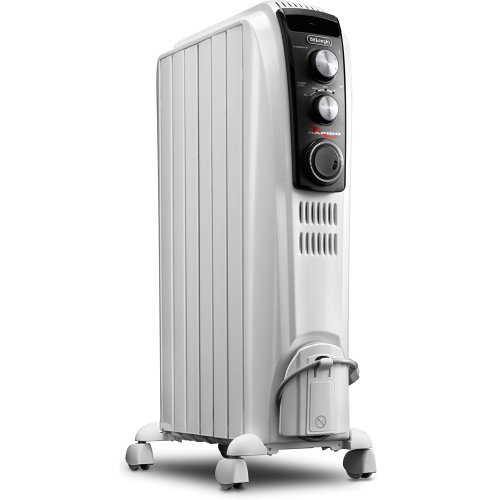
De'Longhi TRD40615TNo fan, so no noise and no moving dust — and the sealed oil keeps radiating after the element cuts out, which is why an oil-filled unit feels steadier than a ceramic one at the same wattage.
Top pick · The maker's coverage claim that matches the arithmetic
Lasko 755320 Oscillating Digital Ceramic Tower Heater (23 in)
A 23-inch digital tower with a thermostat, an 8-hour timer and a remote — and the only heater here whose published coverage figure lands exactly where our own sizing rule puts it.
Rated power
1,500 W / 900 W low
Covers (computed)
150 sq ft
Draw (computed)
12.5 A at 120 V
Cost per hour
27.5¢
Coverage at 10 W/sq ft, average insulation, 8 ft ceiling = 5,118 BTU/h. Cost at 18.34¢/kWh; an eight-hour night at full output is $2.20. Exceeds the 12 A continuous limit of a 15 A circuit — check what else shares the breaker.
What works
Lasko publishes 150 sq ft, and 1,500 W at 10 W per square foot is 150 sq ft — the claim and the arithmetic agree exactly, which almost never happens
A published 900 W low setting, so the economical mode has a computable cost
Digital thermostat, 8-hour timer and a remote at a price where a two-position knob is the norm
What does not
No child lock published, which rules it out of a nursery on this site's criteria
Tall, narrow and 7 lb — that is a tipping profile, and there is no published tip-over cutoff in Lasko's specification
Oscillation and a fan mean it is audible; the silent types are elsewhere in this roundup
Published specification
Rated power
900 W to 1,500 W (Lasko's published range)
Heat settings
Two
Thermostat
Adjustable, with a digital display
Oscillation
Yes
Timer
8 hours
Remote
Included, with onboard storage
Size
23" H x 7.25" D x 7.00" W, 7.29 lb
Safety
Cool-touch housing, automatic overheat protection
Warranty
3 years
Heat type
Ceramic (PTC)
Maker’s coverage claim
150 sq ft
Safety listing
ETL listed, stated on Lasko's own product page.
Who it is for
A home office, family room or bedroom at or under 150 sq ft where you want a real thermostat and a timer without paying for a metal cabinet.
What it is not for
A nursery, or a room where a curious pet or toddler can reach it. No child lock and no published tip-over switch is the wrong combination at floor height.
The current top of Vornado's metal line: auto-climate control, two LED displays and a 1-12 hour timer in a cool-touch metal box, backed by five years.
Rated power
1,500 W
Covers (computed)
150 sq ft
Draw (computed)
12.5 A at 120 V
Cost per hour
27.5¢
Coverage at 10 W/sq ft, average insulation, 8 ft ceiling = 5,118 BTU/h. Cost at 18.34¢/kWh; an eight-hour night at full output is $2.20. Exceeds the 12 A continuous limit of a 15 A circuit — check what else shares the breaker.
What works
Auto-Climate Control adjusts output to hold a temperature rather than running flat out — the cycling behavior that genuinely lowers consumption
A 1–12 hour timer means it can stop on its own, which is the only reliable way an overnight heater saves money
Five years on a heater at this price is a costed commitment, not a marketing line
What does not
Vornado publishes no wattage and no coverage figure, so every sizing and cost number here is ours, computed from the retail-listed 1,500 W
No child lock is published — the same gap the rest of Vornado's range has, and it is disqualifying for a nursery
It is a fan heater in a metal box: moving air is the mechanism and you will hear it
Published specification
Rated power
1,500 W at 120 V (retail listings; Vornado publishes settings, not watts)
Heat settings
2, plus fan-only
Thermostat
Auto-Climate Control, digital
Timer
1–12 hours
Display
Two LED displays, for reading it from across the room
Housing
Cool-touch, powder-coated gloss metal cabinet with cord storage
Safety
Tip-over protection and a 2-stage auto shutoff
Warranty
5-year satisfaction guarantee
Heat type
Fan-forced
Maker’s coverage claim
None published — the coverage figure above is ours
Safety listing
Vornado publishes tip-over protection and a 2-stage auto shutoff but does not name a listing mark; check the rating plate.
Who it is for
A living room or bedroom where the heater is permanent and visible, and where a real thermostat, a timer and a cool metal shell are worth paying for over a plastic tower.
What it is not for
A nursery, because no child lock is published; and not silence, which means an oil-filled radiator instead.
The rare heater whose published coverage claim survives the arithmetic: 1,500 W is a genuine 300 sq ft at 10 W/sq ft, and Dreo publishes that number rather than implying more.
Rated power
1,500 W
Covers (computed)
150 sq ft
Draw (computed)
12.5 A at 120 V
Cost per hour
27.5¢
Coverage at 10 W/sq ft, average insulation, 8 ft ceiling = 5,118 BTU/h. Cost at 18.34¢/kWh; an eight-hour night at full output is $2.20. Exceeds the 12 A continuous limit of a 15 A circuit — check what else shares the breaker.
What works
A digital thermostat with numbers on it — you can set 68°F rather than guess at a dial
The published 300 sq ft claim matches the standard sizing rule instead of exceeding it
8 lb and 8 inches square: it moves room to room without a project
What does not
1,500 W is 1,500 W — nothing here heats faster than any other 1,500 W heater
Dreo does not publish a noise figure in decibels on the product page
Tall and narrow, which is a tipping profile: the tip-over cutoff matters more here
A living room, bedroom or den at or under 300 sq ft with average insulation and an 8-foot ceiling, where you want to set a temperature and stop thinking about it.
What it is not for
A garage, an uninsulated basement, or anything over about 300 sq ft. It is not under-powered — 1,500 W is the plug-in ceiling — the room is simply too big for one outlet.
4 · A thermostat with numbers on it, on a small heater
Honeywell HCE220B UberHeat Plus Ceramic Heater
A shoebox-sized ceramic heater that publishes four preset temperatures and a 2/4/8-hour auto-off — specificity almost nothing else this size offers.
Rated power
1,500 W
Covers (computed)
150 sq ft
Draw (computed)
12.5 A at 120 V
Cost per hour
27.5¢
Coverage at 10 W/sq ft, average insulation, 8 ft ceiling = 5,118 BTU/h. Cost at 18.34¢/kWh; an eight-hour night at full output is $2.20. Exceeds the 12 A continuous limit of a 15 A circuit — check what else shares the breaker.
What works
Four preset temperatures rather than an unmarked dial — on a heater this small and this cheap, being able to ask for 70°F is unusual
Two independent overheat mechanisms are published — a high-temperature sensor and a thermal cut-off fuse — plus a tip-over switch
A 2/4/8-hour auto-off means it can stop by itself, which is what actually reduces the bill
What does not
No UL or ETL mark published by Honeywell, which is the one thing we would want stated at this size and price
Four presets is not the same as a full range: if you want 68°F you are choosing between 65 and 70
2.8 lb and shoebox-sized means it is a personal heater, not a room heater, whatever the 1,500 W suggests
Published specification
Rated power
1,500 W maximum at 120 V
Heat settings
2 (high and low)
Thermostat
Four preset comfort levels — 65°, 70°, 75° and 80°F
Auto-off timer
2, 4 or 8 hours
Safety
Tip-over switch; 2x overheat protection (high-temperature sensor plus a thermal cut-off fuse); cool-touch housing
Size
8.5" x 4.5" x 8.86", 2.8 lb
Warranty
3-year limited
Heat type
Ceramic (PTC)
Maker’s coverage claim
None published — the coverage figure above is ours
Safety listing
Honeywell does not publish a UL or ETL mark for this model; it does publish two independent overheat mechanisms. Check the rating plate.
Who it is for
A small office, a bedside table or a desk, where the heater needs to hold roughly a known temperature and switch itself off after a few hours.
What it is not for
A large or drafty room, and not a nursery — no child lock is published and the presets are reachable by anyone who can reach the unit.
No fan, so no noise and no moving dust — and the sealed oil keeps radiating after the element cuts out, which is why an oil-filled unit feels steadier than a ceramic one at the same wattage.
Rated power
1,500 W
Covers (computed)
150 sq ft
Draw (computed)
12.5 A at 120 V
Cost per hour
27.5¢
Coverage at 10 W/sq ft, average insulation, 8 ft ceiling = 5,118 BTU/h. Cost at 18.34¢/kWh; an eight-hour night at full output is $2.20. Exceeds the 12 A continuous limit of a 15 A circuit — check what else shares the breaker.
What works
Genuinely silent: there is no fan to hear at 3 a.m.
The oil holds heat, so the room temperature swings less between thermostat cycles
Nothing blows air, so nothing stirs up dust in a bedroom
What does not
Slow. It takes 20–30 minutes to feel like it is doing anything
Heavy — the wheels are not a courtesy, they are a requirement
The surface gets genuinely hot; this is a radiator, not a cool-touch case
Published specification
Rated power
1,500 W at 120 V
Controls
Mechanical, with a programmable 24-hour timer
Fluid
Permanently sealed diathermic oil — never needs refilling
Maker's claim
Up to 75% more radiant surface area
Mobility
Front and rear handles, snap-on wheels
Heat type
Oil-filled
Maker’s coverage claim
None published — the coverage figure above is ours
Safety listing
No listing mark published in the listing text; verify the UL or ETL mark on the rating plate.
Who it is for
A bedroom, a nursery at a safe distance, or anywhere the fan noise of a ceramic heater is the actual problem you are trying to solve.
What it is not for
Fast heat, and not a room you only occupy for twenty minutes. It also should never be tucked beside a bed or curtain — hot surface, 3-foot rule.
Judged on disclosure, not on feel. We have not tested these units, so brand quality here means what a maker is willing to put in writing and be held to — not an impression of sturdiness.
Three published facts, counted per product. A warranty with a stated length; a named safety listing mark (UL, ETL, cUL); and a thermostat set-point range in actual degrees rather than the word “adjustable”.
Counted across every purchasable heater in our registry, not across a brand's whole catalog — 28 units with a live listing, which is what we have individually verified.
An explicit absence counts as an absence. Where a maker's own page names no listing mark we record that, rather than assuming the mark exists because the product is obviously sold legally.
And what we did not do: we have not tested these units, owned them, measured them or run them in a room. Everything above is compiled from published manufacturer specifications and live retail listings, with the electrical load, room coverage and running cost computed by us from the published wattage. The full method.
What we’d skip, and why
Every roundup on this site names something to skip. It costs us nothing to publish and it is the fastest way to tell whether a buying guide was written for you or for its commission.
Any “best brand” list that ranks brands without naming a criterion
The category is full of brand rankings that amount to a popularity order. Ask what a ranking is measuring: if it is not test data and it is not disclosure, it is a vibe. We cannot offer test data — we have no lab and say so on every page — so we offer the other thing, which is countable and which you can re-check yourself on any product page in a couple of minutes.
Choosing a brand before choosing a shape
Brand is the last decision, not the first. A silent fanless radiator and a 1,500 W ceramic fan heater are different machines for different rooms, and every brand here is better at one than the other — De'Longhi has no real fan-heater answer and Vornado has no radiator. Work out whether you need silence, a child lock, a wall mount or 240 V first; by then the brand question has usually answered itself.
What this page cannot tell you
Disclosure is not reliability. A brand that publishes nothing may build excellent heaters, and a brand that publishes everything may build poor ones. We have no failure-rate data, no returns data and no test rig, and nothing on this page should be read as a durability prediction. What it is: a repeatable way to compare 15 brands on commitments they have already made in public, which beats choosing on name recognition.
The counts are of our registry, not of each catalog. Lasko sells far more than four heaters. We counted the 28 units we have individually verified and can cite, because extending the count to models we have not checked would be exactly the guessing this site exists to avoid. Where a brand has one unit tracked, one unit is a thin basis for a brand judgment and the table says so by showing the denominator.
Questions people actually ask
What is the best space heater brand?+
On published commitments, Lasko is the most consistent — ETL listed on three of the four units we track, with a three-year warranty. Vornado has the longest warranty at five years but names no listing mark. Dreo is the only brand that publishes a thermostat set-point in degrees on every unit. No brand is strong on all three.
Is Lasko or Vornado better?+
They are good at opposite things. Lasko publishes wattages, coverage and an ETL mark, and backs it three years. Vornado publishes neither wattage nor coverage nor a listing mark, and backs it five years with better safety hardware. We worked through the whole comparison in Lasko vs Vornado.
Which space heater brand lasts the longest?+
Nobody publishes a service life, so there is no sourced answer and we will not invent one. The longest warranty in the category is Vornado's five years, which is the only durability commitment anyone here has actually made. The fan is the part that usually fails first, so fanless designs remove the most common failure point.
Are expensive space heater brands worth it?+
Not for heat. At 1,500 W every heater here produces about 5,118 BTU/h and costs about 27.5 cents an hour to run, whatever it cost to buy. Money buys control precision, quietness, published safety features and build — not output. The full version of that argument.
Does it matter if a brand does not list a UL or ETL mark?+
It matters less than it appears. UL and ETL test to the same standard and most heaters sold in the US carry one on the rating plate. What an unnamed mark tells you is that the maker did not publish it where a buyer can check, which is a disclosure gap rather than proof of an unlisted product.
Four things worth doing, none of which is opening the cabinet — and the four signs it is finished.
Written by Scooter M., an enthusiast — not a tester and not a certified anything. Every figure on this page is either published by the manufacturer, taken from a live retail listing, or computed from the published wattage using the formulas we publish. Found an error? Tell us and we will correct it, visibly and with a date on it.